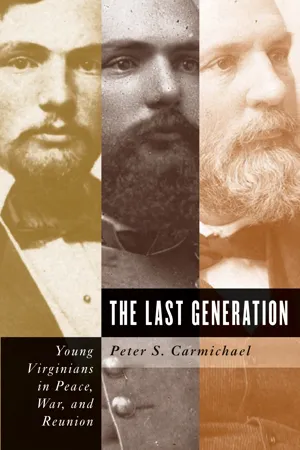
Challenging the popular conception of Southern youth on the eve of the Civil War as intellectually lazy, violent, and dissipated, Peter S. Carmichael looks closely at the lives of more than one hundred young white men from Virginia’s last generation to grow up with the institution of slavery. He finds them deeply engaged in the political, economic, and cultural forces of their time. Age, he concludes, created special concerns for young men who spent their formative years in the 1850s.
Before the Civil War, these young men thought long and hard about Virginia’s place as a progressive slave society. They vigorously lobbied for disunion despite opposition from their elders, then served as officers in the Army of Northern Virginia as frontline negotiators with the nonslaveholding rank and file. After the war, however, they quickly shed their Confederate radicalism to pursue the political goals of home rule and New South economic development and reconciliation. Not until the turn of the century, when these men were nearing the ends of their lives, did the mythmaking and storytelling begin, and members of the last generation recast themselves once more as unreconstructed Rebels.
By examining the lives of members of this generation on personal as well as generational and cultural levels, Carmichael sheds new light on the formation and reformation of Southern identity during the turbulent last half of the nineteenth century.
- 360 pages
- English
- ePUB (mobile friendly)
- Available on iOS & Android
eBook - ePub
About this book
Information
Notes
ABBREVIATIONS
AL | Albert and Shirley Small Special Collections Library, Alderman Library, University of Virginia, Charlottesville, Va. |
DU | Rare Book, Manuscript, and Special Collections Library, Duke University, Durham, N.C. |
EU | Special Collections, Emory University General Library, Atlanta, Ga. |
FSNMP | Fredericksburg and Spotsylvania National Military Park Library, Fredericksburg, Va. |
SHC | Southern Historical Collection, Wilson Library, University of North Carolina at Chapel Hill, Chapel Hill, N.C. |
VHS | Virginia Historical Society, Richmond, Va. |
VMI | Virginia Military Institute Archives, Preston Library, Virginia Military Institute, Lexington, Va. |
VT | Special Collections, Virginia Polytechnic Institute and State University, Blacksburg, Va. |
W&L | Special Collections, James Graham Leyburn Library, Washington and Lee University, Lexington, Va. |
PROLOGUE
1. William R. Aylett to Alice Roane (Brockenbrough) Aylett, July 20 and July 21, 1863, Aylett Family Papers, VHS.
2. “North and South at Gettysburg,” Army and Navy Journal, July 1887, 1001.
3. Ibid.
INTRODUCTION
1. Generations originate within specific historical experiences through which people who live at the same time and in the same place are able to forge social groups. Economic conditions, state and national politics, class relations, youth organizations, adult initiatives, and various networks of institutions present the reality in which young people try to make sense of their world and, in some cases, ultimately come together as a collective body. It is within a specific historical context that they can experience a mystic feeling of oneness within their own age group. Youth solidarity arises when young people believe that they share a common destiny, a driving, overriding purpose that infuses them with the capacity to believe they are at odds with the dominant opinion of their elders. Once they discover a common destiny and begin to act on it, young people typically emerge as a distinct political force in society with their own agenda and interests. In conceptualizing what a generation is, I have been aided by the work of Karl Mannheim, Marvin Rintala, and Alan B. Spitzer, who argue that between the ages of seventeen and twenty-five, a political outlook is basically formed and a group consciousness established. Generational consciousness must demonstrate a relationship between the historical-social process and the cohort’s formative years. I consider Southern men born between 1830 and 1843 to be part of the same generation because they became “political beings” during the 1850s. See the following works: Karl Mannheim, “The Problem of the Generations,” in Mannheim, Essays on the Sociology of Knowledge, ed. Paul Kecskemeti (New York: Oxford University Press, 1952), 300–303; Marvin Rintala, “Generations: Political Generations,” in International Encyclopedia of the Social Sciences, ed. David L. Sills (New York: Macmillan, 1973), 5:92–95; Alan B. Spitzer, “The Historical Problem of Generations,” American Historical Review 78 (December 1973): 1353–85. See also Norman B. Ryder, “The Cohort as a Concept in the Study of Social Change,” American Sociological Review 30 (August 1965): 843–61.
2. Mannheim, “The Problem of the Generations,” 308–9.
3. Although his study of Southern manhood focuses on the postwar period, Ted Ownby upholds a common perspective on manhood in the antebellum South. He writes: “And Southern men did not feel the same impulse toward upright behavior that drove middle-class men in the North. The lessons of economic morality — sobriety, thrift, and self-denial — that accompanied the development of a commercially minded Northern middle class in the nineteenth century were slow to gain acceptance in the rural South.” Although this statement does not accurately describe the experience of the last generation, Ownby deserves credit for recognizing that religion moderated male behavior. See his Subduing Satan: Religion, Recreation, and Manhood in the Rural South (Chapel Hill: University of North Carolina Press, 1990), 11. Southern historians who echo Ownby’s idea operate from a static view of what it meant to be a man in the Old South. Ideas about Southern manhood were not frozen over time. Many historians have not fully appreciated the evolution of Southern manliness because they have underestimated the softening influences of religion in the 1850s. As a result, they subscribe to the stereotype of Southern youth as lazy, irresponsible, anti-intellectual, and hotheaded. The authors cited below accept the image of the violent, hypersensitive, dissipated Southern youth at the expense of a more complex reading of male identity. Their explorations into Southern manhood, however, do not go so far as to support the caricature of Southern men that nineteenth-century Northerners invented. My criticisms do not undermine the core arguments of these scholars or take away from their important contributions. Orville Vernon Burton, In My Father’s House Are Many Mansions: Family and Community in Edgefield, South Carolina (Chapel Hill: University of North Carolina Press, 1985), 90–99, 114–15; Dickson D. Bruce Jr., Violence and Culture in the Antebellum South (Austin: University of Texas Press, 1979), 62–65; Bertram Wyatt-Brown, SouthernHonor: Ethics and Behavior in the Old South (New York: Oxford University Press, 1982), 149–74; Christine Leigh Heyrman, Southern Cross: The Beginnings of the Bible Belt (New York: Alfred A. Knopf, 1997), 211–12; Lisa C. Tolbert, Constructing Townscapes: Space and Society in Antebellum Tennessee (Chapel Hill: University of North Carolina Press, 1999), 120, 165, 170, 181, 184; John Hope Franklin, The Militant South, 1800–1861 (Cambridge, Mass.: Belknap Press of Harvard University Press, 1956); W. J. Cash, The Mind of the South (1941; reprint, New York: Vintage Books, 1991); Grady McWhiney and Perry D. Jamieson, Attack and Die: Civil War Military Tactics and the Southern Heritage (University, Ala.: University of Alabama Press, 1982), 170–72.
4. See the appendix for a statistical survey of the last generation.
5. Some of the finest scholarship on Virginia’s attitude toward secession has unfortunately overlooked the role of young people. See Daniel W. Crofts, Reluctant Confederates: Upper South Unionists in the Secession Crisis (Chapel Hill: University of North Carolina Press, 1989), 53–54, 277–83, 308–23; Henry T. Shanks, The Secession Movement in Virginia (Richmond: Garrett and Massie, 1934), 103–213; Charles B. Dew, Apostles of Disunion: Southern Secession Commissioners and the Causes of the Civil War (Charlottesville: University Press of Virginia, 2001).
6. William T. Sherman to Henry W. Halleck, September 17, 1863, Sherman’s Civil War: Selected Correspondence of William T. Sherman, 1860–1865, ed. Brooks D. Simpson and Jean V. Berlin (Chapel Hill: University of North Carolina Press, 1999), 545–46.
7. By 1830, the word “fogy” had become a disrespectful nickname for men advanced in age. According to David Hackett Fischer, the term gained popularity during the 1850s with the rise of the “Young America Movement.” See Fischer, Growing Old in America (New York: Oxford University Press, 1977), 90–92. For a more precise historical explanation of the word “fogy” and its evolution over time, see “fogy” in A Dictionary of American English on Historical Principles, ed. Sir William A. Craigie and James R. Hulbert (Chicago: University of Chicago Press, 1940), 2:1027; “fogy or fogey” in Random House Historical Dictionary of American Slang, ed. J. E. Lighter (New York: Random House, 1994), 1:796.
8. Although he looks exclusively at New England men, E. Anthony Rotundo has offered a valuable framework in which to understand the evolution of manliness in nineteenth-century America. This approach does not take into account regional differences, but Rotundo is sensitive to change over time; for this reason his work is useful. See his American Manhood: Transformations in Masculinity from the Revolution to the Modern Era (New York: Basic Books, 1993), 2–7.
9. On the place of universities in nineteenth-century American society, see Frederick Rudolph, The American College and University (New York: Alfred A. Knopf, 1965); Helen Lefkowitz Horowitz, Campus Life: Undergraduate Cultures from the End of the Eighteenth Century to the Present (New York: Alfred A. Knopf, 1987); Oscar Handlin and Mary F. Handlin, The American College and American Culture: Socialization as a Function of Higher Education (New York: McGraw-Hill, 1970); John S. Brubacher and Willis Rudy, Higher Education in Transition: A History of American Colleges and Universities, 1636–1976 (New York: Harper and Row, 1976). For the most complete history of the University of Virginia, see Philip Alexander Bruce, History of the University of Virginia, 1819–1919, 5 vols. (New York: Macmillan, 1920–21). Other secondary works include Ervin L. Jordan Jr., Charlottesville and the University of Virginia in the Civil War (Lynchburg, Va.: H. E. Howard, 1988); John S. Patton, Jefferson, Cabell and the University of Virginia (New York: Neale Publishing Co., 1906); Charles Coleman Wall Jr., “Students and Student Life at the University of Virginia, 1825–1861” (Ph.D. diss., University of Virginia, 1978). Secondary studies of Virginia’s other prominent universities abound. See George J. Stevenson, Increase in Excellence: A History of Emory and Henry College (New York: Appleton-Century-Crofts, 1963); Herbert C. Bradshaw, History of Hampden-Sydney College, 2 vols. (Durham, N.C.: Fisher-Harrison, 1976); John Luster Brinkley, On This Hill: A Narrative History of Hampden-Sydney College, 1774–1994 (Farmville, Va.: Hampden-Sydney, 1994); Richard Irby, History of Randolph-Macon College, Virginia: The Oldest Incorporated Methodist College in America (Richmond: Whittet and Shepperson, n.d.); James Edward Scanlon, Randolph-Macon College: A Southern History, 1825–1967 (Charlottesville: University Press of Virginia, 1983); Reuben E. Alley, History of the University of Richmond, 1830–1971 (Charlottesville: University Press of Virginia, 1977); W. Harrison Daniel, History of the University of Richmond (Richmond: Print Shop, 1991); Francis H. Smith, History of the Virginia Military Institute (Lynchburg: J. P. Bell, 1912); Jennings C. Wise, The Military History of the Virginia Military Institute from 1839 to 1865 (Lynchburg: J. P. Bell, 1915); Richard M. McMurry, Virginia Military Institute Alumni in the Civil War (Lynchburg: H. E. Howard, 1999); Ollinger Crenshaw, “General Lee’s College: Rise and Growth of Washington and Lee,” 2 vols. (typescript, Washington and Lee University, 1973), W&L; Susan H. Godson, Ludwell H. Johnson, Richard B. Sherman, Thad W. Tate, and Helen C. Walker, The College of William and Mary: A History, 2 vols. (Williamsburg: King and Queen Press, 1993).
10. My understanding of Victorian culture draws heavily from the following authors, who agree that radical innocence, moral discipline, and social refinement characterized the Victorian man. See Daniel Joseph Singal, The War Within: From Victorian to Modernist Thought in the South, 1919 to 1945 (Chapel Hill: University of North Carolina Press, 1982), 5, 6, 7; Anne C. Rose, Victorian America and the Civil W...
Table of contents
- Cover Page
- Title Page
- Copyright Page
- Dedication
- Contents
- Illustrations and Map
- Acknowledgments
- Prologue
- Introduction
- Progressives All
- United by a Problem
- Christian Gentlemen
- Defenders of Virginia, Union, and the South
- Eager Confederates
- Paternalistic Officers
- Christian Martyrs
- From Conservative Unionism to Old Fogydom
- Notes
- Bibliography
- Index
Trusted by 375,005 students
Access to over 1.5 million titles for a fair monthly price.
Study more efficiently using our study tools.
Frequently asked questions
Yes, you can cancel anytime from the Subscription tab in your account settings on the Perlego website. Your subscription will stay active until the end of your current billing period. Learn how to cancel your subscription
No, books cannot be downloaded as external files, such as PDFs, for use outside of Perlego. However, you can download books within the Perlego app for offline reading on mobile or tablet. Learn how to download books offline
Perlego offers two plans: Essential and Complete
- Essential is ideal for learners and professionals who enjoy exploring a wide range of subjects. Access the Essential Library with 800,000+ trusted titles and best-sellers across business, personal growth, and the humanities. Includes unlimited reading time and Standard Read Aloud voice.
- Complete: Perfect for advanced learners and researchers needing full, unrestricted access. Unlock 1.5M+ books across hundreds of subjects, including academic and specialized titles. The Complete Plan also includes advanced features like Premium Read Aloud and Research Assistant.
We are an online textbook subscription service, where you can get access to an entire online library for less than the price of a single book per month. With over 1.5 million books across 990+ topics, we’ve got you covered! Learn about our mission
Look out for the read-aloud symbol on your next book to see if you can listen to it. The read-aloud tool reads text aloud for you, highlighting the text as it is being read. You can pause it, speed it up and slow it down. Learn more about Read Aloud
Yes! You can use the Perlego app on both iOS and Android devices to read anytime, anywhere — even offline. Perfect for commutes or when you’re on the go.
Please note we cannot support devices running on iOS 13 and Android 7 or earlier. Learn more about using the app
Please note we cannot support devices running on iOS 13 and Android 7 or earlier. Learn more about using the app
Yes, you can access The Last Generation by Peter S. Carmichael in PDF and/or ePUB format, as well as other popular books in History & American Civil War History. We have over 1.5 million books available in our catalogue for you to explore.