As many as 20,000 women worked in Union and Confederate hospitals during America’s bloodiest war. Black and white, and from various social classes, these women served as nurses, administrators, matrons, seamstresses, cooks, laundresses, and custodial workers. Jane E. Schultz provides the first full history of these female relief workers, showing how the domestic and military arenas merged in Civil War America, blurring the line between homefront and battlefront.
Schultz uses government records, private manuscripts, and published sources by and about women hospital workers, some of whom are familiar — such as Dorothea Dix, Clara Barton, Louisa May Alcott, and Sojourner Truth — but most of whom are not well-known. Examining the lives and legacies of these women, Schultz considers who they were, how they became involved in wartime hospital work, how they adjusted to it, and how they challenged it. She demonstrates that class, race, and gender roles linked female workers with soldiers, both black and white, but became sites of conflict between the women and doctors and even among themselves.
Schultz also explores the women’s postwar lives — their professional and domestic choices, their pursuit of pensions, and their memorials to the war in published narratives. Surprisingly few parlayed their war experience into postwar medical work, and their extremely varied postwar experiences, Schultz argues, defy any simple narrative of pre-professionalism, triumphalism, or conciliation.
- 376 pages
- English
- ePUB (mobile friendly)
- Available on iOS & Android
eBook - ePub
About this book
Information
Part One
On Duty
Who wiped the death sweat from the cold, clammy brow, And sent home the message:—“’Tis well with him now”; Who watched in the tents whilst the fever fires burned, and the pain-tossing limbs in agony turned, And wet the parched tongue, calmed delirium’s strife Till the dying lips murmured, “My mother,” “My wife”?
—Clara Barton, “The Women Who Went to the Field,” 1892
—Clara Barton, “The Women Who Went to the Field,” 1892
Chapter One
Women at the Front
Custom inures the most sensitive person to that which is at first most repellent, and in the late war we saw the most delicate women, who could not at home endure the sight of blood, become so used to scenes of carnage, that they walked the hospitals and the margins of battle-fields, amid the poor remnants of torn humanity, with as perfect self-possession as if they were strolling in a flower garden.
— Mark Twain and Charles Dudley Warner,
The Gilded Age (1873)
— Mark Twain and Charles Dudley Warner,
The Gilded Age (1873)
A widely reproduced photograph of three women in dark dresses, white aprons, and beehivelike hats has been used by modern historians as evidence that young, uniformed nurses served in military hospitals during the Civil War.1 In fact, the women were volunteers in a food concession and were dressed in traditional Norman costumes to sell Normandy cakes at an 1864 Sanitary Commission fair in New York.2 The twentieth-century historian who first identified the photo expected nurses to wear white hats, even though no female relief worker of the Civil War ever wore professional headgear or a uniform.3
Historians misreading of the photograph exemplifies their misreading of the identity and status of female hospital workers in Civil War America. As early as 1866, assessments of women’s wartime contributions read like the lives of saints: the war generation held that the women who nursed soldiers were angelic and motivated by Christian sacrifice. After four years of unstinting labor, the story goes, they returned happily to their homes and domestic routines.4 What the editors of these early commemorative works did not spell out, however, was that the objects of their praise were exclusively white and middle class. Their depiction of sainted, self-sacrificing, and socially respectable women provided psychological penicillin for an ailing and still sectionalized nation. But it led modern historians away from discovering the demographic truth about more than twenty thousand women who served as domestic workers during the Civil War.
As a point of departure, this study does not restrict itself to a single group of relief workers but instead crosses the boundaries of race, region, and class to re-create the vast complexity of the medical world that women and men inhabited. Female hospital workers were as diverse as the population of the United States in 1860: they were adolescent slaves, Catholic sisters, elite slaveholders, free African Americans, abandoned wives, and farm women. Some were mothers and grandmothers, others childless or unmarried. Most served according to inclination, but a few served under chattel obligation. Northerners had been teachers or reformers before the war; mill operatives, seamstresses, or compositors.5 Among Southerners, we find plantation mistresses and escaped slaves, genteel widows looking for respectable employment, and yeoman women in need of a living wage.6 Under the idealized banners of patriotism and religious duty, women from fifteen to sixty-five offered their services. The zeal with which young men enlisted in the first year of the war was matched by women seeking hospital positions. Even though the number pursuing positions tapered off in both sections after 1862, civilian women were writing to the surgeons general as late as 1864 to find them hospital situations.
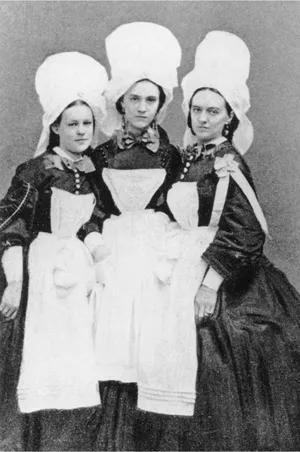
Three young women (possibly, from left to right, Katharine Prescott Wormeley, Eliza Woolsey, and Georgeanna Woolsey) pose in bakers outfits and toques advertising a concession at the U.S. Sanitary Commission’s metropolitan fund-raising fair in New York City in April 1864. Such fairs raised more than $4.4 million for the relief of Union soldiers during the war. (Courtesy of New-York Historical Society)
The evidence of willing Southern hands is particularly remarkable in light of the low morale in the Confederacy by the summer of 1864, when increasing numbers of Confederate women had begun urging their men to return home.7
Picnickers who drove eighteen miles to Manassas on a hot July day in 1861 to watch soldiers fight on Virginia soil little anticipated the horrific spectacle that war is. But they began to understand its seriousness when, looking out of their carriages, they saw bloodied, shoeless young men limping along the road to the capital. In lieu of Union or Confederate plans to provide for incapacitated soldiers—few in 1861 imagined how long the war might last—some of those citizens formed local aid societies for soldiers relief. Historians have estimated that ten thousand groups mobilized in the first year of the war alone.8 Societies made virtual factories of homes, schools, and churches by sending food, clothing, and medical supplies to the front.9 As early as April 1861 an alliance of well-to-do New Yorkers envisioned a national organization devoted to soldiers welfare. By June the U.S. Sanitary Commission (USSC) was trying to bring local aid societies organized by the Woman’s Central Relief Association under its wing. Though “manned” by women in the sense that material aid was the result of their labor, the administrators of the Union’s Sanitary Commission were primarily men.10 An early national example of centralized bureaucracy, the commission would distribute over $15 million in supplies, marshal a force of paid relief agents numbering in the hundreds, and work independently of the Union surgeon general’s appointment of civilian workers.11 Not as large but equally ambitious was the U.S. Christian Commission (USCC), established in November 1861 at a meeting of the Young Men’s Christian Association, for the purpose of promoting the soldier’s “spiritual good” along with his “social and physical comfort.”12 Motivated by an evangelical mission, the USCC distributed hundreds of thousands of Bibles and millions of pages of religious tracts in the hope of returning the errant soldier to the flock. By war’s end, it had collected over $3.5 million in aid and organized over 4,800 volunteers.13
The Confederate government did not centralize relief efforts until 1862. Where states rights had constituted an integral part of prewar politics, state relief organizations and individuals took the lead in caring for soldiers. The largesse of prominent Southern citizens, like Alabama’s Juliet Opie Hopkins, Arkansas Ella Newsom, North Carolina’s Catherine Gibbon, and Florida’s Mary Smith Reid, established state hospitals near the scene of fighting. Governors also relied on ladies aid societies to manufacture socks, shirts, and “hospital suits” for soldiers from their home states.14 Newspapers in Charleston and Richmond regularly reported their charitable contributions for hospitalized soldiers and for troops at the front.15 Judging from the early success of the South Carolina and Alabama hospitals in Charlottesville and Richmond, the state was a productive locus of organization and distribution.16 After 1862 the Confederate Congress authorized a more centralized relief system, but not on the public-private model of collaboration instituted in the North. The Women’s Relief Society of the Confederate States—begun by Nashville’s Felicia Grundy Porter in 1864—came closest to a Southern sanitary commission, but it received no aid from the flagging Confederate treasury. Historians have argued that the Confederate government’s takeover of citizen-sponsored relief early in the war effectively shut women out of the general hospitals.17 But by virtue of their proximity to battlefields, Southern women could scarcely avoid providing relief to the sick and wounded.
Women began volunteering for hospital work before the medical departments of either section had adequately assessed the magnitude of their task. Besieged by applicants as soon as Fort Sumter was fired on, the Union’s Acting Surgeon General R. C. Wood appointed fifty-nine-year-old Dorothea Dix to supervise the appointment of female nurses in May 1861 soon after Federal troops seized Alexandria and Newport News, and began blockading strategic Southern ports.18 Nationally recognized for humanitarian work in asylum and prison reform, Dix established the Office of Army Nurses and generated guidelines for the selection of nurses. By October 1863, after the enormous loss of life at Shiloh, Antietam, Fredericksburg, and Gettysburg, Surgeon General William Hammond authorized all U.S. surgeons to appoint female attendants, which circumvented Dix’s power. In reality, few surgeons or sanitary commissioners ever acknowledged Dix’s authority and her power was ineffectual from the war’s first year.19
The superintendent ultimately appointed over three thousand nurses. Her selection standards were stringent, and she turned away many able applicants.20 Dix stipulated that only women between thirty-five and fifty were eligible and that “matronly persons of experience, good conduct, or superior education and serious disposition will have preference.” She listed “neatness, order, sobriety, and industry” as prerequisites. Applicants were expected to produce two letters of reference testifying to their “morality, integrity, seriousness, and capacity for the care of the sick” and to “dress plain …while connected with the service, without ornaments of any sort.”21 Dix’s drab dress code and her preference for middle-aged matrons were meant to discourage thrill seekers from applying. Civilian and military officials feared what might happen to young women in hospitals filled with eager young men; wary of public opinion, Dix did what she could to head off potential romances. In one Washington-area hospital, for example, female workers were not even allowed to stroll the grounds without permission.22
Women whose applications had been rejected were persistent in finding ways to serve. New York’s Jane Woolsey reported that her sister Georgeanna and a cousin “earnestly wish[ed] to join the Nurse Corps, but [were] under the required age,” adding that she knew of women falsifying their ages to gain entry.23 Though Dix turned them down, the Woolseys social connections paid off: the Sanitary Commission put Georgeanna, cousin Eliza, and the wife of George Templeton Strong—all elite women—to work on its fleet of hospital ships while Generals George McClellan and Joseph Johnston amassed troops on the Peninsula in 1862.24 The less well-connected Fanny Titus-Hazen, of Vermont, whose petition was rejected by the Sanitary and Christian Commissions, packed her bags for Washington anyway. Armed with letters of reference, the twenty-three-year-old found leniency because, she reported, Dix “believe[d] [her] heart [was] in the work.”25 New Jersey’s Cornelia Hancock, also twenty-three, and twenty-eight-year-old Esther Hill Hawks of New Hampshire thought that Dix had turned them down because of their good looks. Trained at the New England Female Medical College in the 1850s, Hawks spent the summer of 1861 seeking medical employment in Washington. Finding none, she returned to Manchester in December and took over her husband’s medical practice. Ten months later she joined him on the Sea Islands, where he was serving the Union army as a plantation superintendent. There Hawks practiced among the predominantly black soldiers and residents of the islands, convinced that military officials, at best uninterested in people of color, looked the other way. Hancock traveled to Gettysburg just two days a...
Table of contents
- Cover Page
- Women at the Front
- Copyright Page
- Dedication
- Contents
- Illustrations and Figures
- Acknowledgments
- Introduction
- Part One On Duty
- Part Two The Legacy of War Work
- Appendix A Note on Historiography
- Notes
- Bibliography
- Index
Trusted by 375,005 students
Access to over 1.5 million titles for a fair monthly price.
Study more efficiently using our study tools.
Frequently asked questions
Yes, you can cancel anytime from the Subscription tab in your account settings on the Perlego website. Your subscription will stay active until the end of your current billing period. Learn how to cancel your subscription
No, books cannot be downloaded as external files, such as PDFs, for use outside of Perlego. However, you can download books within the Perlego app for offline reading on mobile or tablet. Learn how to download books offline
Perlego offers two plans: Essential and Complete
- Essential is ideal for learners and professionals who enjoy exploring a wide range of subjects. Access the Essential Library with 800,000+ trusted titles and best-sellers across business, personal growth, and the humanities. Includes unlimited reading time and Standard Read Aloud voice.
- Complete: Perfect for advanced learners and researchers needing full, unrestricted access. Unlock 1.5M+ books across hundreds of subjects, including academic and specialized titles. The Complete Plan also includes advanced features like Premium Read Aloud and Research Assistant.
We are an online textbook subscription service, where you can get access to an entire online library for less than the price of a single book per month. With over 1.5 million books across 990+ topics, we’ve got you covered! Learn about our mission
Look out for the read-aloud symbol on your next book to see if you can listen to it. The read-aloud tool reads text aloud for you, highlighting the text as it is being read. You can pause it, speed it up and slow it down. Learn more about Read Aloud
Yes! You can use the Perlego app on both iOS and Android devices to read anytime, anywhere — even offline. Perfect for commutes or when you’re on the go.
Please note we cannot support devices running on iOS 13 and Android 7 or earlier. Learn more about using the app
Please note we cannot support devices running on iOS 13 and Android 7 or earlier. Learn more about using the app
Yes, you can access Women at the Front by Jane E. Schultz in PDF and/or ePUB format, as well as other popular books in History & American Civil War History. We have over 1.5 million books available in our catalogue for you to explore.