In the decades after World War II, Protestant missionaries abroad were a topic of vigorous public debate. From religious periodicals and Sunday sermons to novels and anthropological monographs, public conversations about missionaries followed a powerful yet paradoxical line of reasoning, namely that people abroad needed greater autonomy from U.S. power and that Americans could best tell others how to use their freedom. In The Gospel of Freedom and Power, Sarah E. Ruble traces and analyzes these public discussions about what it meant for Americans abroad to be good world citizens, placing them firmly in the context of the United States' postwar global dominance.
Bringing together a wide range of sources, Ruble seeks to understand how discussions about a relatively small group of Americans working abroad became part of a much larger cultural conversation. She concludes that whether viewed as champions of nationalist revolutions or propagators of the gospel of capitalism, missionaries — along with their supporters, interpreters, and critics — ultimately both challenged and reinforced a rhetoric of exceptionalism that made Americans the judges of what was good for the rest of the world.
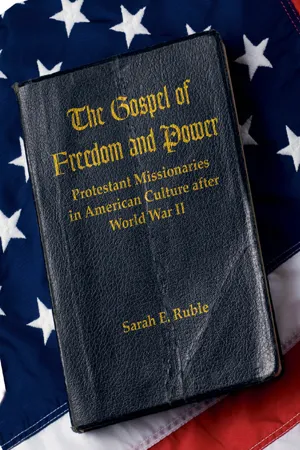
eBook - ePub
The Gospel of Freedom and Power
Protestant Missionaries in American Culture after World War II
- 232 pages
- English
- ePUB (mobile friendly)
- Available on iOS & Android
eBook - ePub
The Gospel of Freedom and Power
Protestant Missionaries in American Culture after World War II
About this book
Information
Topic
Theology & ReligionSubtopic
North American HistoryChapter One
Protestant Mainline
In 1984 a small war of words broke out in the United Methodist Church (UMC). Newscope, a weekly denominational newsletter, treated readers to accusations and counteraccusations of blasphemy, violence, and misrepresentation. The fight featured old combatants: members of Good News, a theologically conservative reform movement within the UMC, and the General Board of Global Ministries (GBGM), the official agency responsible for missions. For seventeen years, Good News had bewailed the board’s “liberal” mission policy, particularly its support for liberation theology, a theological movement Good News believed substituted Marxism for the Christian gospel. By 1984 the conservatives had lost patience with the board. In January, people associated with Good News announced that they had created the Mission Society for United Methodists, an alternative agency supported by United Methodists but not officially affiliated with the denomination.
The announcement brought out sharp disagreement regarding the missionary task. In October 1984 Newscope reported that, while Bishop Roy I. Sano, president of the GBGM’s World Division, called the board to “a regained appreciation of evangelism,” long a Good News demand, he remained committed to liberation theology. According to Newscope, the bishop claimed that “the Holy Spirit is at work in liberation movements,” and, therefore “attacks on liberation efforts are acts of blasphemy.”1 Three weeks later, Newscope reported Good News executive and new mission agency supporter James V. Heidinger’s reply. He claimed that the bishop had accused conservatives of “helping the world’s oppressors do their dirty business.” Moreover, the liberation movements the bishop lauded were “nearly all” violent, and thus the bishop was calling for a “baptizing of violent revolution.”2 Sano, predictably, rejected Heidinger’s characterization and the debate ended without resolution.
In some ways, the fight could be characterized as making a mountain out of a small missionary molehill. Like many so-called mainline denominations, the UMC had significantly scaled back its overseas missionaries after the 1960s.3 In 1953 mainliners constituted over half of the North American career missionary force. By 1985 only 11.5 percent of career missionaries came from the mainline.4 Some mainline denominations left missions altogether or retrenched so thoroughly that their overseas work all but disappeared.5 In the case of the UMC, declining numbers of missionary personnel played a part in the fight because Good News folk contended that a dearth of missionaries indicated a weak commitment to spreading the Christian message. The fight, however, was not merely about numbers.
Sano and Heidinger’s disagreement about the missionary task was also a disagreement about the effects of U.S. Cold War policy and Wilsonian logic on people abroad. They disagreed on what constituted freedom, how it related to the Christian gospel, and whether the United States basically retarded or advanced its spread. Their fight had a long history and was part of a larger postwar mainline story. After World War II, significant mainline institutions such as the Methodist Church and the Christian Century presented mainline Protestantism and its missionaries as part of a U.S. vanguard bringing freedom and peace to a weary world. As the postwar era gave way to the Cold War, however, many mainline leaders contended that their vision of freedom, not to mention the freedom people abroad wanted, did not necessarily align with what the United States seemed intent on spreading. In the 1960s particularly, mainline writers and denominational officials described the missionary task as counteracting the effects of American policy. Some people within the mainline, such as those affiliated with Good News, asserted that their denominations had moved beyond a healthy differentiation between the Kingdom of God and any particular nation and had joined the wrong side of the Cold War.
As the mainline’s assessment of the United States’ role in the world changed, so too did its public conversations about missionaries. More mundane factors such as denominational politics also altered how mainliners described what the world needed from their workers overseas. Yet one thing remained consistent. As mainline groups publicly debated the effects of America’s Wilsonian logic on the world, they also embodied it. Mainliners both took up the cause of freedom (variously defined) for people abroad and asserted, implicitly and otherwise, that they knew what that freedom should look like.
1945–1959: Protecting Mainline Influence Abroad
“A troopship carrying one of the most remarkable companies of passengers ever to sail the seas in modern times should be well on its way across the Pacific when these lines are read,” proclaimed a 1946 Christian Century editorial.6 The remarkable company consisted not of diplomats or politicians but of four hundred missionaries to Asia. A maritime strike in San Francisco had delayed the “epochal expedition.” When the strike ended, thousands of citizens joined the mayor at the opera house for a farewell celebration. Publisher Henry Luce traveled across the country to attend the festivities and gave an address in which he called the expedition “a living expression of faith in a world steeped in cynicism, of hope in a society floundering in despair, of love in a civilization sick of hatred.” The Century editor applauded Luce’s words: “He was right.”7 A longer article a few pages later was, if possible, even more laudatory. The author reported that the farewell featured a choir singing “Lead On, O King Eternal,” “The Son of God Goes Forth to War,” and the Hallelujah Chorus and that “the audience rose and sang as the ‘Four Hundred’ marched behind white-robed ushers carrying the flags of the church and of the United States down two aisles.”8 The article reported that the celebration chairman called the journey “the most significant event for American Protestant Christianity that has occurred in the twentieth century.”9 After years of war and dislocation, missionaries could return to Asia.
The articles’ ebullient tones and the opera house pageantry celebrated more than evangelists going to the Far East. The parade behind ecclesial and national flags and the address by a magazine mogul signaled that the missionaries were part of a national story. Americans, not only missionaries, remained players on the global stage. Before World War II, Americans had disagreed about how, or whether, the United States should participate in world problems. President Woodrow Wilson’s vision of an American-led world order had died when the United States refused to enter the League of Nations. Isolationist impulses had stymied President Franklin Roosevelt’s attempts to help the Allied powers before Pearl Harbor. But during World War II, Americans came to a new consensus: the United States should lead the world, not only through example but through participation. Five years before celebrating in San Francisco, Henry Luce, himself the child of missionaries to China, proclaimed the twentieth century the “American Century.” In an editorial in his own Life magazine, Luce opined that Americans had “to accept wholeheartedly our duty and our opportunity as the most powerful and vital nation in the world and in consequence to exert upon the world the full impact of our influence, for such purposes as we see fit and by such means as we see fit.”10 Public opinion polls consistently showed support for an active U.S. role in the postwar world and, in the immediate aftermath of the war, American power and responsibility became the new normal. A 16 August 1945 New York Times editorial declared that the United States “stands before the world today not only as the mightiest of all nations but also as the principal representative of democracy.”11 A year later, another editorial commended American activity after the war: “We have assumed world-wide responsibility for the future; we have offered to surrender control of our atomic explosive if other nations will meet us halfway; we are working as hard as we can for the kind of settlement that will produce a just and lasting peace.”12 As historian John Fousek has shown, postwar responsibility to the world was not yet couched in Cold War terms. The mission was not yet Communist containment but, in Fousek’s view, “to feed the starving and rebuild the world economy, to provide moral leadership in the name of American democratic values to a world that had clearly lost its bearings, and to ensure that the peace would be lasting.”13 According to Fousek, this sense of obligation was rooted in a long-standing American belief that its democratic values were really universal values. As the strongest nation standing after the war, the United States boasted the strength and the duty to shape the world.
Mainline Protestants echoed the call to responsibility. That assertion took multiple forms. Together, the Methodist magazine for families, heralded the Christian family as “the hope of the world.” Methodists proclaimed the white, middle-class nuclear family the foundation for civilization in the nuclear age—and their publications carried the heartwarming stories and Rockwellesque pictures to prove it.14 Other mainline outlets took a more academic view of the Protestant task. In a thirteen-article series titled, “Can Protestantism Win America?,” Christian Century editor C. C. Morrison outlined the strengths, weaknesses, and obligations of American Protestantism. He ended the series by emphasizing the peril of the postwar moment: “Both America and Protestantism are now caught in a vast world convulsion. Civilization is in a state of collapse. The old stabilities are dissolving before our eyes. A new world is being born.”15 He argued that only an ecumenical Protestantism (as opposed to a denominationally obsessed one) could meet the exigencies of the hour. His last sentences signaled his commitment to ecumenism and his appraisal of the church’s rightful role in the world: “Only such [an ecumenical church] can win America to the Christian faith. And only upon this faith can an enduring civilization be built, in America, and throughout the whole wide world.”16
Morrison’s assertion—much like the two flags leading the San Francisco missionary parade—yoked Christianity and the United States. More specifically, Morrison claimed a particular version of Christianity, ecumenical Protestantism or his version of mainline Protestantism, vital to the health of the United States. His assertion was not a postwar phenomenon. Throughout the early twentieth century, mainline Protestants assumed custodianship for the nation. Their leaders boasted access to politicians and policy makers, who themselves often belonged to mainline churches. Men (and they were almost all men) such as John Foster Dulles moved between leadership on mainline organizations like the Federal Council of Churches Commission to Study the Bases of a Just and Durable Peace and national leadership, in his case secretary of state under President Eisenhower. Former missionary to China John Leighton Stuart was named ambassador to China under President Truman. In the late 1940s, the mainline’s most prominent theologian, Reinhold Niebuhr, appeared on the cover of Time magazine and met regularly with State Department officials who appreciated his position that acting responsibly in an unjust world sometimes demanded the choice between lesser evils.17
References to missionaries in mainline literature in the late 1940s echoed the calls to world building under mainline American leadership. The Methodist World Outlook introduced readers to Dr. Barney Morgan and his wife Caroline McAfee Morgan, serving in the Dominican Republic, and noted approvingly that they had “taken the lead in the evangelical, social, and cultural life of the republic.”18 Their leadership was not self-serving but allowed them to be alert “to everyday needs of the people, material and spiritual.”19 Stories of missionary heroism during World War II suggested that missionaries had the personal mettle and the world concern necessary to remake the world. The Century ran Olive I. Hodges’s account of her time in a Japanese internment camp. Although the government had warned her to leave, she decided to stay: “I believed I was engaged in essential work and that my opportunities for doing that work had never been greater. That ‘essential work’ was teaching the fatherhood of God and hence the brotherhood of man.”20 Her experience in the camp had not embittered her. On her final day of imprisonment, former Japanese colleagues had visited, and their goodness “gives me courage to believe that even yet we can find a way for all the decent people of the world to live in peace and security.”21 Such an advance guard made a better future seem possible.
Unfolding events, however, cast a shadow over America’s bright optimism. Visions of a new world united in peace gave way to the reality of a bipolar world, with the United States and the Soviet Union both vying for dominance. Rhetoric of one world committed to peace and rebuilding gave way to dualities—the free world versus communism; democracy versus totalitarianism—and the language of cooperation was replaced by the policy of containment. First articulated by diplomat George Kennan, containment was premised on the conviction that the United States and the Soviet Union espoused incompatible values. According to historian William Inboden, Kennan argued that “because the USSR could not be appeased, nor defeated by anything less than a catastrophic global war . . . the United States instead should ‘contain’ the USSR by applying calculated pressure at strategic points, while waiting patiently for the Soviet system to collapse internally from the burden of its own internal contradictions and dysfunctions.”22 The policy, adopted by President Truman and followed by his successors, underwrote such varied activities as the Marshall Plan’s aid to rebuild Europe in the 1940s, the Korean War in the 1950s, and sanctions against Cuba in the 1960s. Political and military leaders also believed that containment demanded increased military spending. Only a military capable of winning a war against the Soviet Union, so the logic went, would not have to fight one.23
Yet for the United States the emerging Cold War was not simply a matter of building bombs and developing policy. It was an ideological and spiritual conflict. Its...
Table of contents
- Cover Page
- THE GOSPEL OF Freedom & Power
- Copyright Page
- Dedication
- Contents
- Acknowledgments
- Introduction
- Chapter One Protestant Mainline
- Chapter Two Evangelicals
- Chapter Three Anthropology
- Chapter Four Gender
- Conclusion
- Notes
- Bibliography
- Index
Trusted by 375,005 students
Access to over 1.5 million titles for a fair monthly price.
Study more efficiently using our study tools.
Frequently asked questions
Yes, you can cancel anytime from the Subscription tab in your account settings on the Perlego website. Your subscription will stay active until the end of your current billing period. Learn how to cancel your subscription
No, books cannot be downloaded as external files, such as PDFs, for use outside of Perlego. However, you can download books within the Perlego app for offline reading on mobile or tablet. Learn how to download books offline
Perlego offers two plans: Essential and Complete
- Essential is ideal for learners and professionals who enjoy exploring a wide range of subjects. Access the Essential Library with 800,000+ trusted titles and best-sellers across business, personal growth, and the humanities. Includes unlimited reading time and Standard Read Aloud voice.
- Complete: Perfect for advanced learners and researchers needing full, unrestricted access. Unlock 1.5M+ books across hundreds of subjects, including academic and specialized titles. The Complete Plan also includes advanced features like Premium Read Aloud and Research Assistant.
We are an online textbook subscription service, where you can get access to an entire online library for less than the price of a single book per month. With over 1.5 million books across 990+ topics, we’ve got you covered! Learn about our mission
Look out for the read-aloud symbol on your next book to see if you can listen to it. The read-aloud tool reads text aloud for you, highlighting the text as it is being read. You can pause it, speed it up and slow it down. Learn more about Read Aloud
Yes! You can use the Perlego app on both iOS and Android devices to read anytime, anywhere — even offline. Perfect for commutes or when you’re on the go.
Please note we cannot support devices running on iOS 13 and Android 7 or earlier. Learn more about using the app
Please note we cannot support devices running on iOS 13 and Android 7 or earlier. Learn more about using the app
Yes, you can access The Gospel of Freedom and Power by Sarah E. Ruble in PDF and/or ePUB format, as well as other popular books in Theology & Religion & North American History. We have over 1.5 million books available in our catalogue for you to explore.