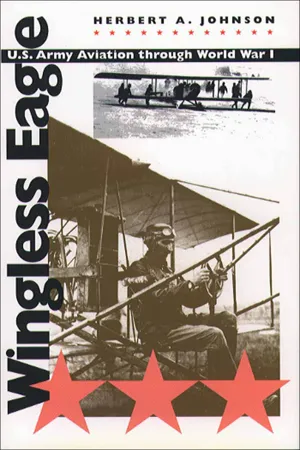
At the start of the twentieth century the United States led the world in advances in aviation, with the first successful engine-powered flights at Kitty Hawk, North Carolina, and Dayton, Ohio, beginning in 1903. Fifteen years later, however, American airmen flew European-designed aircraft because American planes were woefully inadequate for service on the Western Front. Why was the United States so poorly prepared to engage in aerial combat in World War I?
To answer this question, Herbert Johnson takes a hard look at the early years of U.S. military aviation, exploring the cultural, technical, political, and organizational factors that stunted its evolution. Among the recurring themes of Johnson’s narrative are the damaging effects of a chronic lack of governmental funding for military aeronautics and the disruptive influence of a civilian “aeronaut constituency” both on military discipline and on public and Congressional attitudes toward army aviation. In addition, the Wright brothers' patent litigation hindered the technical development of American aircraft and crippled the domestic aviation industry’s manufacturing capacity. Wartime experience helped correct some of these problems, but the persistence of others left the postwar Air Service with an uncertain and stormy future.
- 320 pages
- English
- ePUB (mobile friendly)
- Available on iOS & Android
eBook - ePub
About this book
1 Aeronautics in Embryo
The Aeronaut Constituency
One of the best ways to enter the complex history of early army aviation is to consider the Aero Club of America, a New York–based private club first established to advance competitive racing with free-flying hot air balloons. Organized under the auspices of the Automobile Club of America, the Aero Club not only occupied an influential place in aeronautical activities, but it also gained quasiofficial status as the international agency for the licensing of airplane pilots and for authorizing flying contests.1 Its wealthy membership provided both material and moral support to the Aeronautical Division of the Signal Corps after the division’s organization on August 1, 1907. The club also had excellent access to the communications media, and many of its members were political leaders in the states and the federal government. In addition, a significant portion of the club’s membership belonged to militia organizations or to volunteer-staffed military, naval, or flying groups. As the primary civilian proponent of aviation before 1910, the Aero Club of America may well be considered the midwife of military and naval aviation in the United States.
The Prehistory of the Aeronautical Division
Military aviation, like a newborn human infant, underwent a prenatal period. During the American Civil War, stationary reconnaissance balloons made a strong impression upon Union generals as a reliable source of tactical intelligence.2 Although the spherical balloons and their gas generators were cumbersome, and their civilian observers proved resistant to military discipline, the Balloon Corps amply demonstrated the value of aerial reconnaissance.3 After the surrender at Appomattox, army interest in lighter-than-air navigation waned, but its occasional use did lead to the development of improved balloons, and to doctrinal thought concerning their military applications. An abortive reconnaissance attempt to use a captive spherical observation balloon was made during the 1898 battle of San Juan Hill. Not only was there difficulty in controlling the balloon near a moving front line, but the presence of the observation balloon drew Spanish fire to the American headquarters location.4 Thereafter government economies, combined with this unfortunate experience in combat, resulted in limited expansion of army aeronautical activity. Despite these disappointments, the army continued its interest in the value of aerial flight as an adjunct to military operations.5
Between 1898 and 1903, the army’s Board of Fortifications and Ordinance provided financial support to the heavier-than-air experiments conducted by Professor Samuel P. Langley, the secretary of the Smithsonian Institution. Langley’s work was also supported by the Smithsonian Institution, but it was army disenchantment with the Langley experimental failures that had a negative impact upon military aeronautics. After achieving a modicum of success with gliders, Professor Langley moved forward to construct a large engine-powered machine, widely acclaimed as the aircraft that could carry man aloft in controlled, powered flight. Unfortunately its much publicized first flight from a house boat on the Potomac resulted in a dramatic crash immediately after takeoff. Down with it went Langley’s dreams and the U.S. Army’s financial encouragement for any heavier-than-air flight.6 Ironically, just a few days later, on December 17, 1903, the Wright brothers flew their powered aircraft over the dunes at Kitty Hawk, North Carolina. Because of Langley’s failure, the Army Board was totally disinterested in the Wrights’ invention until early in 1907.7
Langley’s failure had little impact on the Aero Club, since virtually all of its members were sport balloonists. Sport ballooning involved contest flying of free spherical balloons, the object being to increase the distance the balloon traveled or the speed it achieved. The Aero Club’s intrepid men, and a few women, inflated their balloons either with hydrogen gas or with hot air generators, and drifted with the wind across the skies of rural America. To encourage this competitive ballooning, and to maintain adequate records of their achievements, they organized the Aero Club of America in 1905. Ultimately the club would serve as a center for information on aeronautics, it would stimulate nationwide interest in sport ballooning, and it would become the national coordinator of flying competitions and exhibitions until the eve of the First World War. The Aero Club’s size and prestige rapidly established it as the international point of contact for foreign aviation agencies and clubs. As aviation moved out of the restricted sphere of sport ballooning, the Aero Club continued to play a significant role in popularizing aviation and at the same time encouraging the scientific study of aerodynamics, meteorology, and aeronautical engineering.8
Because of its size and membership, the Aero Club of America was the most prominent organization in what one may conveniently label the aeronaut constituency. This group consisted of those individuals and organizations that not only manifested an interest in manned flight but also were willing to apply continuous pressure upon Congress and governmental agencies for the advancement of aviation. When the Aeronautical Division was organized in 1907, and particularly after it received its first airplane in the autumn of 1909, the Aero Club of America was quick to join forces with army flyers in their campaign to advance military aviation.
The Aero Club of America
Modeled after the German Balloon Society organized in 1881 and the Aero Club of the United Kingdom founded in 1901, the Aero Club of America brought together a group of inventors, sportsmen, and others interested in ballooning and aeronautics in general. Eventually, it accepted the responsibility for certifying aviators.9
A group of Automobile Club of America members launched the Aero Club of America in 1905, focusing upon the conduct of sport ballooning and secondarily looking toward the promotion of aviation through contests and scientific study.10 Significantly, the first purpose set forth in the club’s 1910 charter of incorporation was that it was to be a social organization of persons who owned “aeronautical inventions for personal or private use.”11 This social aspect of the Aero Club of America should not be overlooked by emphasizing its early scientific activities and its public relations work for aeronautics. Members were those, both young and old, who could afford the luxury of balloon ownership or who were connected by family or friendship to those who were so affluent. Common bloodlines, parallel financial interests in mercantile and industrial affairs, and records of achievement in a broad range of human enterprises and activities united the Aero Club of America into a strong, coherent social organization. Men joined the Aero Club because it was fun. It was in keeping with their social status, and they enjoyed taking the risks of early sport ballooning in the company of close friends and like-minded acquaintances.
When the Aero Club spoke through its officers, it represented the views of a large and influential segment of America’s men of affairs, who were able to influence public opinion not only by what they said but by who they were. Even cursory study of the membership of the Aero Club of America and its affiliates suggests the pervasive influence of the club in American life. The first printed membership list for the Aero Club of America dating from 1907 is most helpful. It lists 240 active members and five honorary members. Among the honorary members were Lt. Frank Purdy Lahm of the U.S. Army, who won the 1906 James Gordon Bennett ballooning trophy in Paris. Active members included Capt. Charles deF. Chandler, a Signal Corps officer active in military balloon activities. Beyond these military members, the 1907 Aero Club membership ranged broadly over a number of occupations and among men of different ages. For the most part the active members were individuals already marked as men of accomplishment, although only thirty-three of them would be listed in Who’s Who in America for 1910–11.12
With some accuracy it has been commented that the Aero Club provided an association between young airplane fliers and old balloonists. From the club’s 1907 organization until 1910, this would be an accurate description of the membership. Balloonists Thomas S. Baldwin, Alberto Santos-Dumont, and Leo Stevens were members, as were Wilbur and Orville Wright, Glenn Curtiss, and Octave Chanute. However, age did not make a clear division between heavier-than-air enthusiasts and those who continued in the development of balloons and dirigibles. Yet Roy Knabenshue, a relatively young member of the Aero Club and one of the Wright Company’s test pilots, persisted in experiments with the dirigible well beyond 1910, when his colleagues had shifted their enthusiasm to the “flying machine.” Lieutenant Lahm was among the first army aircraft pilots and certainly not an old man even though his fame as a balloonist dated from 1906 and his interest in balloon navigation persisted into the First World War. Lahm’s participation in ballooning was encouraged by his balloonist father, Frank S. Lahm, who was also a member of the Aero Club.13
The thirty-three Aero Club members in Who’s Who in America show the catholicity of the group and its social and political importance. The material wealth of the membership is demonstrated by those who described themselves as “capitalists”—John Jacob Astor, Charles J. Glidden, Pierre Lorillard Jr., and Harry P. Whitney. One member, Thomas B. Clarke, listed himself as an art collector. Three appeared in Who’s Who as bankers—John E. Borne, Colgate Hoyt, and Jefferson Seligman. Sport ballooning was an expensive activity as well as a hazardous one, and the appearance of wealthy men on the Aero Club’s membership lists is not surprising. However, in the Horatio Alger world of early-twentieth-century America, the populace venerated men of great wealth. The club’s appeal for the rich “captains of industry” gave it both respectability and publicity.
No less distinguished on the 1907 membership list were the inventors, scientists, and even journalists and writers. They included Alexander Graham Bell, the Wright brothers, physicist Michael I. Pupin, meteorologist A. Lawrence Rotch, electrician Charles P. Steinmetz, and astronomer David P. Todd. Octave Chanute, William J. Hammer, and Peter Cooper Hewitt represented the engineering community. Journalism was the occupation of members George G. Bain and George O. Shields. Gutzon L. M. Borglum and A. S. Anderson were artists, and lawyer John J. Rooney was better known as a poet. The age was one of rapid scientific progress, particularly in applied science and mechanical invention. Precision and certainty of mathematical computations appealed to the popular mind, and the individuality and virtuosity of the inventor was praised by all groups in society. Writers and poets were treated with deference, and their works were perpetuated in multivolume editions of their literary output. Each of these members brought public esteem to the Aero Club and its activities.
Several members of the Aero Club of America are identifiable despite their failure to reach public notice through the 1910 edition of Who’s Who in America. Capt. Homer W. Hedges, the first president of the club, was also president of one of the largest advertising agencies in the United States. Robert J. Collier, who joined in September 1909 and served as president in 1911–12, was the publisher of Collier’s Weekly and a personal friend of the Wright brothers. Cortlandt F. Bishop, a charter member of the club and its president in 1906–7 and again in 1909, was in the real estate business, and George B. Chamberlain was a real estate lawyer. James C. McCoy, a copper-mining magnate, was intermittently president and vice president of the Aero Club in the years 1908–11.14
Other significant connections existed between the Aero Club and the centers of political and economic power in the United States. When Lieutenant Lahm won the Gordon Bennett Cup in 1906, his aide in piloting his balloon was Henry Blanchard Hersey, former major in President Roosevelt’s Spanish War regiment, the 1st U.S. Volunteer Cavalry.15 The “Rough Rider” officer joined the Aero Club in April 1907. As affiliated Aero Clubs were established throughout the United States, other men of prominence across the nation joined the program. Judge Elbert H. Gary, head of U.S. Steel, joined an affiliated Aero Club and was among those who backed the Wright brothers’ corporate organization in 1909. The Milwaukee Aero Club had Col. Gustave Pabst, the brewer, as a member. It was Pabst who gave that club a first-class balloon. The Aero Club of Seattle counted within its membership M. Robert Guggenheim of the American Smelting and Refining Company.

Cortlandt F. Bishop, president of the Aero Club of America, 1906–7 and 1909. It was during Bishop’s second term as president that the schism in the Aero Club took place. The group of socialites who were ballooning enthusiasts remained with the Aero Club, while active pilots and aircraft builders formed the Aeronautical Society of New York. (Aerial Age Weekly, December 11, 1916, 329)
Aero Club affiliates functioned as geographical outposts of aeronautical activity throughout the United States and abroad. By October 1909 affiliated clubs were meeting in St. Louis, North Adams (Massachusetts), and Seattle, along with regional or statewide clubs in New England, Ohio, California, and Indiana. New groups were forming in Mississippi and in the Northwest. There was even a short-lived affiliated club in Argentina.16
Through the affiliated aero clubs in the United States and its monthly magazine, the Aer...
Table of contents
- Cover Page
- Wingless Eagle
- Copyright Page
- Dedication
- Contents
- Preface
- Introduction
- 1 Aeronautics in Embryo
- 2 Army Aviation in the Media Fishbowl
- 3 European Military Aviation and the Hay Committee Hearings
- 4 Tactical Thinking, Army Politics, and Congressional Confusion
- 5 Patents, Production, and Progress
- 6 The Goodier Court-Martial
- 7 World War I in the Air
- 8 Dark Clouds and a Silver Lining
- Epilogue and Prologue
- Appendix
- Notes
- Bibliography
- Index
Trusted by 375,005 students
Access to over 1.5 million titles for a fair monthly price.
Study more efficiently using our study tools.
Information
Year
2003Topic
HistoryPrint ISBN
9781469614786
9780807826270
Subtopic
Military & Maritime HistoryeBook ISBN
9780807860236
Index
HistoryFrequently asked questions
Yes, you can cancel anytime from the Subscription tab in your account settings on the Perlego website. Your subscription will stay active until the end of your current billing period. Learn how to cancel your subscription
No, books cannot be downloaded as external files, such as PDFs, for use outside of Perlego. However, you can download books within the Perlego app for offline reading on mobile or tablet. Learn how to download books offline
Perlego offers two plans: Essential and Complete
- Essential is ideal for learners and professionals who enjoy exploring a wide range of subjects. Access the Essential Library with 800,000+ trusted titles and best-sellers across business, personal growth, and the humanities. Includes unlimited reading time and Standard Read Aloud voice.
- Complete: Perfect for advanced learners and researchers needing full, unrestricted access. Unlock 1.5M+ books across hundreds of subjects, including academic and specialized titles. The Complete Plan also includes advanced features like Premium Read Aloud and Research Assistant.
We are an online textbook subscription service, where you can get access to an entire online library for less than the price of a single book per month. With over 1.5 million books across 990+ topics, we’ve got you covered! Learn about our mission
Look out for the read-aloud symbol on your next book to see if you can listen to it. The read-aloud tool reads text aloud for you, highlighting the text as it is being read. You can pause it, speed it up and slow it down. Learn more about Read Aloud
Yes! You can use the Perlego app on both iOS and Android devices to read anytime, anywhere — even offline. Perfect for commutes or when you’re on the go.
Please note we cannot support devices running on iOS 13 and Android 7 or earlier. Learn more about using the app
Please note we cannot support devices running on iOS 13 and Android 7 or earlier. Learn more about using the app
Yes, you can access Wingless Eagle by Herbert A. Johnson in PDF and/or ePUB format, as well as other popular books in History & Military & Maritime History. We have over 1.5 million books available in our catalogue for you to explore.