Timothy Lomperis persuasively argues the ironic point that the lessons of American involvement in Vietnam are not to be found in any analysis of the war by itself. Rather, he proposes a comparison of the Vietnam experience with seven other cases of Western intervention in communist insurgencies during the Cold War era: China, Indochina, Greece, the Philippines, Malaya, Cambodia, and Laos.
Lomperis maintains that popular insurgencies are manifestations of crises in political legitimacy, which occur as a result of the societal stresses caused by modernization. Therefore, he argues, any intervention in a 'people’s war' will succeed or fail depending on how it affects this crisis. The unifying theme in the cases Lomperis discusses is the power of land reform and electoral democracy to cement political legitimacy and therefore deflect revolutionary movements. Applying this theory to the ongoing Sendero Luminoso insurgency in Peru, Lomperis makes a qualified prediction of that conflict’s outcome. He concludes that a global trend toward democratization has produced a new era of 'people’s rule.'
eBook - ePub
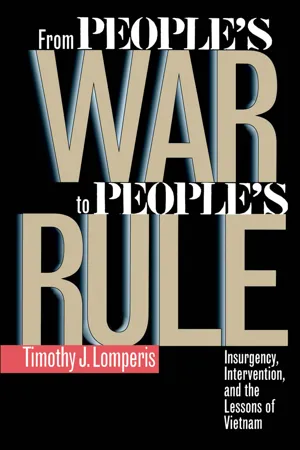
From People’s War to People’s Rule
Insurgency, Intervention, and the Lessons of Vietnam
- 456 pages
- English
- ePUB (mobile friendly)
- Available on iOS & Android
eBook - ePub
From People’s War to People’s Rule
Insurgency, Intervention, and the Lessons of Vietnam
About this book
Information
PART I
Theory and Context
INTRODUCTION
FROM GHOST TO LESSON
On the morning of April 30, 1975, three North Vietnamese tanks slammed through the gates of Saigon’s Presidential Palace. The exultant troopers hoisted Hanoi’s flag atop the courtyard flagpole. Hours earlier, in the predawn darkness, “Huey” helicopters plucked the final line of Americans from the rooftop of the U.S. Embassy in Operation Frequent Wind. Viewing newsclips of these jarring last images of the Vietnam War, President Gerald Ford remarked to an aide, “It’s over. Let’s put it behind us.”1
Whatever else Americans have done with Vietnam, they have certainly not put it behind them. It is the living ghost that haunts them whenever the prospect looms for an American intervention in a “remote” Third World conflict. As killings, headlines, and pressures on the United States mount, the inexorable invocation follows: El Salvador, Nicaragua, Honduras, Peru, Afghanistan, Angola, or the Philippines is “another Vietnam.” So, America, beware! Indeed, in 1984 former defense secretary Casper Weinberger, in outlining six tests for the commitment of U.S. military force, specifically invoked the lessons of Vietnam to reassure the nation that it would not be “dragged into a quagmire in Central America.”2
The meaning of this dreaded invocation, nevertheless, remains problematic. As just one example, in taking up the issue in the fall of 1983 as to whether to grant President Ronald Reagan a resolution permitting the continued presence of U.S. Marines in Lebanon, senator after senator invoked the memory of Vietnam to justify opposite votes. Senator Charles Percy (R, Ill.) said he favored such an explicit resolution because he didn’t want to “stumble into another Vietnam.” Senator Joseph Biden (D, Del.), on the other hand, said he opposed the resolution because he didn’t want the current generation “to suffer another Vietnam like my generation did.” Further, the fractious congressional disputes over funding for the contra rebels in Nicaragua throughout the Reagan presidency were a postwar replay of the Great Vietnam War Debate.
George Bush ascended to the presidency in 1989 vowing, in his inaugural address, to slay the dragon of Vietnam. Though the Persian Gulf War of 1991 was not about Vietnam, it intruded itself everywhere. In the eleventh-hour congressional debate to grant President Bush the authorization to use force against Saddam Hussein, Vietnam was the favorite monster metaphor of the nay-sayers. Indeed, Saddam Hussein himself frequently conjured up apparitions of Vietnam, most graphically of its Stygian river of body bags, to scare away the Americans. When the Americans and their coalition partners entered the mouth of the Gulf anyway and blitzed the Iraqis out of Kuwait with their AirLand battle strategy and Sword Excalibur of technological wizardry, George Bush’s exultations were more about Vietnam than Iraq: “By God, we’ve kicked the Vietnam syndrome once and for all,”3 and “The specter of Vietnam has been buried forever in the desert sands of the Arabian Peninsula.”4 And yet, as American forces pushed north into Iraq to the Euphrates River, Bush ordered a halt. To him, at the banks of these ancient waters, lay a Rubicon River leading to Baghdad—and another Saigon. Plainly, for Americans, pronouncements that the Vietnam War is “over” and “buried forever” do not mean much.
But Vietnam is a better ghost than a lesson. Though haunting as a memory and a metaphor, a ghost is not held down by any definition or bounded by an earthly context. Thus unfettered, it can be summoned for any lesson a conjurer wants. Ronald Reagan remembered Vietnam as a “noble crusade” and summoned it as a lesson to support his efforts to roll back communism in Central America. Antiwar activist Daniel Ellsberg, on the other hand, continues to relive Vietnam as a heinous “crime” and brandishes it as a weapon to slay America’s “interventionist impulse.”5
As a more serviceable lesson, the Vietnam War needs both a definition and a context. This book seeks to do both by providing a definitional perspective from which the war can be viewed, and then building on this perspective a context of similar cases from which the war’s lessons can be derived. It involves several steps: the formulation of a pair of research questions that drive the investigation, the articulation of a paradigmatic presupposition about the Vietnam War that spells out a context for comparing it to similar cases, and, finally, the delineation of a conceptual framework for the actual task of comparing Vietnam to these other cases both to test and to temper whatever lessons may emerge from an examination of the single case of Vietnam. Pinned to the ground in this way, the ghost of Vietnam can become a lesson.
The definitional assumption that marks the perspective of this book is that the war in Vietnam reflected a society in the throes of a revolutionary insurgency struggling to form and consolidate an independent and modernizing state. The United States intervened in this struggle to support the incumbent regime in its bid to defeat the insurgents, who, in turn, received ideological and material help from the outside as well. The Vietnam War, then, was both an internal and an international war, one of both insurgency and intervention. Thus the “lessons of Vietnam” lie in answering two fundamental questions. First, what are the ingredients of a successful insurgency (and, conversely, of a successful counterinsurgency)? Second, what is the optimal level of a Western intervention, if any, in thwarting such a revolutionary insurgency? The first is an empirical question, the second a policy one flowing from it. These two agenda-setting questions form the boundaries of this book’s perspective on the Vietnam War—and on insurgency and intervention.
As for these boundaries, the phenomenon bounded by these two questions is an insurgency. Answering these questions, then, depends on a theoretical presupposition about a revolutionary insurgency itself. It is my presupposition, then, that insurgencies, as part of a larger process of modernization, are best understood as crises in national political legitimacy and that the struggle between the two sides (the incumbents and the insurgents) is over competitive claims to, and definitions of, this legitimacy. Raising the concept of legitimacy inevitably brings up its companion concepts of power and authority. Indeed, William Connolly has referred to these three together as a “cluster concept.” By this he means that power, authority, and legitimacy are discrete phenomena that nevertheless cannot be fully or practically separated from each other. That is, their individual definitions involve aspects of their cluster companions so that operational indicators or pieces of evidence for one concept can never be free of this definitional contamination.6
Accepting this ineluctable contamination, for this book, power is rule; authority, the right to rule; and legitimacy, the justification upon which authority is based and rule rendered “rightful.” Thus, in Eqbal Ahmad’s words, legitimacy is “that crucial and ubiquitous factor in politics which invests power with authority.”7 In a revolutionary insurgency, the incumbents and insurgents unquestionably struggle for power and for the authority to make their rule fully sovereign over their people. It is the peculiar property of an insurgency, however, that the struggle is protracted. Thus both sides are obligated to justify themselves and their cause to the society being subjected to the hardship of this conflict. In other words, their claims must be legitimated, or justified, for both power and authority to be realized and the struggle won. Thus insurgencies are won—or lost—by the relative amounts of legitimacy the two competing sides achieve and by the impact of foreign interventions on these amounts.
One can certainly argue that the Vietnam War (and insurgencies more generally) was centrally something else, but I do not. Different voices have claimed, for example, that the war was primarily a manifestation of the East-West struggle; that it was no more than a police or military problem that got a little out of hand; that the war hinged more on leadership and organization than anything else; or even that at root the war was a struggle over economic issues. Why I am not persuaded by these alternative presuppositions is explained in Chapter 2. If the war, more fundamentally, were any of these “something elses,” then, of course, the lessons would be different. Thus understanding this paradigmatic presupposition of the Vietnam War as a crisis of political legitimacy is an absolute prerequisite to following the entire line of reasoning in this book.
As a society caught up in an insurgent struggle between incumbents and insurgents for the mantle of rule, and whose struggle had attracted substantial foreign intervention, Vietnam was not alone. In fact, in the post-World War II period there were six other cases in which societies were caught up in an insurgency similar to that in Vietnam (a Marxist people’s war) that also attracted substantial Western intervention in support of the incumbent regimes. Thus this book first probes the Vietnam War for its results and compares them with the results of these other cases through the use of the conceptual framework explained in Chapter 3. Despite the uniqueness of all historical events, such a framework provides a common context for, in the words of the historian Edward H. Carr, discerning “what is general in the unique.”8
What is interesting about this particular set of cases is that in three of them (Greece, the Philippines, and Malaya) the interventions were successful in beating back the insurgent challenges, and in five (counting Vietnam twice—once against the French and once against the Americans—as well as China, Cambodia, and Laos) they were not. More than just the lessons of Vietnam, then, this book is about the intersection of insurgency and intervention and eight cases in search of a theory about the conditions under which they intersect and what may be learned from the consequences.
The book divides into four parts. Part I sets out the theory and context. Chapter 1 provides a general overview. Chapter 2 examines the historical development of legitimacy and the international context of the Vietnam conflict. Chapter 3 develops the conceptual framework employed in this study. Next, the two chapters in Part II evaluate the central case of Vietnam within this conceptual framework. Then, each of the five chapters in Part III is devoted to a similar analysis of each of the other cases (though Cambodia and Laos are combined into one chapter). Finally, Part IV sets out the general lessons that emerge from this analysis and discusses their contemporary implications for American foreign policy.
I make three major points. First, by itself, the Vietnam War has no lessons. As a ghost, Vietnam has been treated by policymakers as a crucial case for any decision to intervene in the Third World. Constrained, however, by an analytic definition and a comparative context, the Vietnam War stands as a deviant case, an outlier from the very set of cases used as the comparative prism from which its lessons should be drawn.
Second, lessons do emerge when the Vietnam War is passed through the analytic prism of companion cases. Looking at these insurgencies as struggles for national political legitimacy, claiming this legitimacy depends on which side makes good on key reforms that justify political rule for a more inclusive and equitably based polity. Empirically, two emerge as pivotal: land reform and, even more important, free, fair, and competitive elections—the true Achilles’ heel of a revolutionary strategy of Marxist people’s war and the chief lesson of this study. This is what is general in the unique histories of the eight insurgencies.
The latter’s salience is owing to the fact that both people’s war by revolutionary insurgency and nation-building by evolutionary democracy are common searches for an Aristotelian middle ground for a political community. Communists call this mobilization; democrats, participation. The difference is that the mobilization of people’s war is exclusive in its drive for a monopolistic seizure of power, whereas the full participation called for by modernizing democrats requires compromise and power sharing. If incumbents can steel themselves to the risks of including insurgents in their polity and, specifically, their electoral rolls, elections leave people’s war as a strategy either preempted, co-opted, or out in the cold.
Finally, this book concludes with a pronouncement of its own. Following Theda Skocpol’s contention that the international environment is one of the major conditioning factors to the success or failure of revolutions,9 it should be pointed out that the eight cases of this study occurred during an international period of decolonization which favored the success of revolutionary insurgencies. This period, from the end of World War II to the fall of Saigon, I term the Era of People’s War. Since then, the international environment has shifted from a drive to seize power to a focus on governance and on managing power once it has been seized. Thus the agenda has switched from people’s war to people’s rule. The twentieth century’s long detour of seduction by Vladimir Lenin’s siren revolutionary call has faded, and Woodrow Wilson’s steadier voice of democracy, self-determination, and national legitimacy can be heard once more.
CHAPTER 1
ON THE BUSINESS OF LESSONS
On the business of drawing lessons from historical events such as the Vietnam War, two principles are important. First, historical lessons are properly drawn only by comparing one component of an event to a similar component in another event, not by applying an entire event wholesale.1 In other words, lessons come not from the outcomes of events themselves but from the components (factors or variables) that made them. With respect to the Vietnam War, this means that its lessons do not derive from the general outcome of victory or defeat but from the war’s constitutive components. The blitzkrieg, for example, was not the cause of the German defeat in World War II, nor was people’s war the strategy by which the Vietnamese communists came to power in 1975. Second, general lessons can rarely stand on a single case. In politics, lessons like Munich come around even less frequently than Halley’s Comet. Thus a candidate lesson from a single historical case can be confirmed only by passing it through an array of comparable but competing cases—a figurative comparative prism—to see if it still holds.2
Accordingly, this chapter first presents the historical context out of which revolutionary insurgencies like the Vietnam War emerged. From this context, it explains the two phenomenon-setting criteria from which the eight core cases were chosen—the presence of Western intervention and the use of a Marxist people’s war strategy by the insurgents—and defends this latter criterion against other strategies. It then discusses the two major research questions that are drawn from these criteria: what are the ingredients of a successful insurgency and what is the optimal level of intervention, if any, in one, as well as why the nature of their impact on the societal crisis of political legitimacy is central to answering both questions. It concludes with an explanation of the theory used in this book, the driving assumptions about these insurgencies and interventions, and the set of six thematic questions and attendant propositions that bind the eight cases together.
As a legitimacy crisis, the Vietnam War took place in both a general and a specific historical context. The general context emerged from a broad historical march that led to a global crisis after World War II. This crisis provoked the eruption of numerous insurgencies in the Third World (including the eight discussed in this book). In this march, the Vietnam War and its companion cases were part of a larger historical process of at least two centuries in which traditional and “backward” societies, under the shock of Western colonialism, were groping for modern states of their own definition and creation. For most of these countries, the nineteenth century was a period of dramatic change. Politically, the colonial powers regularized and strengthened the institutional hold of their rule. At the same time, the globalization of international trade and the establishment of a Western economic sector in colonial societies brought both economic growth and social dislocation. By the 1930s, continued social ferment and the decline in economic growth produced in all these cases some political impasse, serious social and economic turmoil, or both. During World War II, Axis armies of occupation sheared off the incumbent regimes of conquered countries and replaced them with pliant governments of collabor...
Table of contents
- Cover Page
- FROM PEOPLE’S WAR TO PEOPLE’S RULE
- Copyright Page
- Dedication
- CONTENTS
- TABLES AND FIGURES
- PREFACE
- PART I Theory and Context
- PART II Vietnam, the Deviant Case
- PART III The Comparative Prism
- PART IV Lessons
- APPENDIX 1 THE LITERATURES OF THE FRAMEWORK
- APPENDIX 2 A TALE OF TWO STRATEGIES: AN ALTERNATIVE EXPLANATION
- APPENDIX 3 ASSUMPTIONS, THEMATIC QUESTIONS, AND PROPOSITIONS
- NOTES
- INDEX
Trusted by 375,005 students
Access to over 1.5 million titles for a fair monthly price.
Study more efficiently using our study tools.
Frequently asked questions
Yes, you can cancel anytime from the Subscription tab in your account settings on the Perlego website. Your subscription will stay active until the end of your current billing period. Learn how to cancel your subscription
No, books cannot be downloaded as external files, such as PDFs, for use outside of Perlego. However, you can download books within the Perlego app for offline reading on mobile or tablet. Learn how to download books offline
Perlego offers two plans: Essential and Complete
- Essential is ideal for learners and professionals who enjoy exploring a wide range of subjects. Access the Essential Library with 800,000+ trusted titles and best-sellers across business, personal growth, and the humanities. Includes unlimited reading time and Standard Read Aloud voice.
- Complete: Perfect for advanced learners and researchers needing full, unrestricted access. Unlock 1.5M+ books across hundreds of subjects, including academic and specialized titles. The Complete Plan also includes advanced features like Premium Read Aloud and Research Assistant.
We are an online textbook subscription service, where you can get access to an entire online library for less than the price of a single book per month. With over 1.5 million books across 990+ topics, we’ve got you covered! Learn about our mission
Look out for the read-aloud symbol on your next book to see if you can listen to it. The read-aloud tool reads text aloud for you, highlighting the text as it is being read. You can pause it, speed it up and slow it down. Learn more about Read Aloud
Yes! You can use the Perlego app on both iOS and Android devices to read anytime, anywhere — even offline. Perfect for commutes or when you’re on the go.
Please note we cannot support devices running on iOS 13 and Android 7 or earlier. Learn more about using the app
Please note we cannot support devices running on iOS 13 and Android 7 or earlier. Learn more about using the app
Yes, you can access From People’s War to People’s Rule by Timothy J. Lomperis in PDF and/or ePUB format, as well as other popular books in Politics & International Relations & Political History & Theory. We have over 1.5 million books available in our catalogue for you to explore.