No writer or public intellectual of our era has been as sensitive to the role of faith in the lives of ordinary Americans as Robert Coles. Though not religious in the conventional sense, Coles is unparalleled in his astute understanding and respect for the relationship between secular life and sacredness, which cuts across his large body of work. Drawing inspiration from figures like Dietrich Bonhoeffer, Dorothy Day, and Simone Weil, Coles's extensive writings explore the tug of war between faith and doubt. As Coles himself admits, the "back-and-forthness between faith and doubt is the story of my life." These thirty-one thought-provoking essays are drawn from Coles's weekly column in the Catholic publication America. In them, he turns his inquisitive lens on a range of subjects and issues, from writers and painters to his recent reading and film viewing, contemporary events and lingering controversies, recollections of past and present mentors, events of his own daily life, and ordinary encounters with students, patients, neighbors, and friends. Addressing moral questions openly and honestly with a rare combination of rectitude and authorial modesty, these essays position Coles as a preeminent, durable, and trusted voice in the continuing national conversation over religion, civic life, and moral purpose.
eBook - ePub
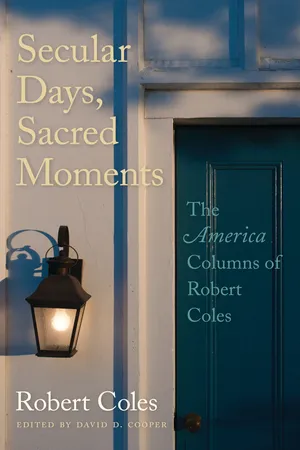
Secular Days, Sacred Moments
The America Columns of Robert Coles
- 128 pages
- English
- ePUB (mobile friendly)
- Available on iOS & Android
eBook - ePub
Secular Days, Sacred Moments
The America Columns of Robert Coles
About this book
Information
Topic
PhilosophySubtopic
Philosophy History & TheoryTable of contents
- Cover Page
- Title Page
- Copyright Page
- Contents
- Foreword
- November 23, 1996. We're Hoping for a Few Extra Moments of the Sacred during these Long Secular Days.
- January 4, 1997. “The Doctors, they be Strutters. They Need Teaching.”
- February 1, 1997. Merton and Milosz Find Common Ground in their Skepticism—The Distance they Put between Themselves and Faddish Trends.
- February 15, 1997. Like a Hebrew Prophet, Erikson was Insisting upon Psychological Investigation as a Moral Calling
- March 1, 1997. “The Third Reich was a Product of German History, but it was not the Only Possibility Open to the Country at that Time.”
- March 22, 1997. Surely Someone would Come by, See me Standing there Helplessly, Offer a Phone or a Lift.
- April 5, 1997. I was Witness to the Moral Energy a Painter or Photographer Can Stir in Children.
- May 3, 1997. There is Hope in those Sudden, Unexpected, Breakthrough Experiences that Bring us a Blessed Spell of Inwardness.
- May 31, 1997. This Double Standard Could all too Readily be Accommodated by the Slippery Imprecisions of Psychiatric Jargon.
- July 19, 1997. The Doctor who is Sick Now Turns his Students Into the Kind of Physician he Himself has been with Others.
- August 2, 1997. Through the Use of Fictional Strategies, the Writer Offers us a Clue about Oppression.
- September 13, 1997. What Appears to be Bizarre and Senseless is in Many Cases a Quite Reasonable Expression of Horror.
- November 8, 1997. “I'm Really Sorry. I Never should have Opened the Door without Looking…. I was Lost in Thought. I wasn't Thinking.”
- December 6, 1997. It was the Old Story of Teachers who have a lot to Learn from their Humble, Yet Knowing, Students.
- January 17, 1998. Dorothy Day Spoke of the Irony: “All that Philosophical Knowledge, and Such a Moral Failure; Such Blindness—and Worse—in a Life.”
- February 14, 1998. In Othello we Meet a Man of Great Dignity and Refinement who is Gradually Undone.
- February 28, 1998. Bonhoeffer's Position in Society, his Personal Safety, and, If Need be, His Very Life were not to be Defended at all Costs.
- March 21, 1998. Psychotherapy, in All its American Banality, is Redeemed through its Emphasis on the Personal as Part of the Communal.
- March 28, 1998. I Wondered if she Really Believed what she Seemed to Believe, Whether she wasn't Really Quite Frightened “Underneath.”
- April 25, 1998. I could Lecture on the Moral and Social Inquiry and Myself Behave Like a Moral and Social Outcast.
- July 4, 1998. Once More I Took Note of the Psychological Acuity, the Capacity to Figure out Others with a Certain Thoughtful Detachment.
- August 29, 1998. This Child knew that Misdeeds Deserve, Warrant an Expression of Regret.
- October 31, 1998. Our Insistent Yearnings Ought not to be the Stuff of Glib Psychiatric Pronouncements.
- November 21, 1998. These Youngsters Recognize that Smart or Powerful is not Necessarily the Same as Good.
- February 20, 1999. “I Wished he'd been as Understanding and Kindly at Home with His Family as he was in the World with All his Associates.”
- May 1, 1999. A Moral Leadership that is to Work must Mobilize a following in the Name of a Virtue; It must both Inspire and Coerce.
- July 31, 1999. Many of us who Took to Holden Caulfield, Embracing his Laid-Back Words, His Wisecracks, His Cool, Also Worried about him. Would he Make it?
- September 11, 1999. William Carlos Williams Treated Many Catholics who Said they would Pray for him. He was Skeptical about Such Promises.
- October 9, 1999. Private Hurts Trigger a Public Hurtfulness.
- December 4, 1999. Simone Weil Tried to Figure out Morally who we Humans are, what Obligations we Ought to feel and why, as we go about our Permitted time on this Planet.
- February 19, 2000. “Do you Really think the Pope Prayed for those Three Mass Murderers, Hitler, Stalin, Mussolini?” I asked Dorothy Day.
- Afterword
- Acknowledgments
- About the Author
Trusted by 375,005 students
Access to over 1.5 million titles for a fair monthly price.
Study more efficiently using our study tools.
Frequently asked questions
Yes, you can cancel anytime from the Subscription tab in your account settings on the Perlego website. Your subscription will stay active until the end of your current billing period. Learn how to cancel your subscription
No, books cannot be downloaded as external files, such as PDFs, for use outside of Perlego. However, you can download books within the Perlego app for offline reading on mobile or tablet. Learn how to download books offline
Perlego offers two plans: Essential and Complete
- Essential is ideal for learners and professionals who enjoy exploring a wide range of subjects. Access the Essential Library with 800,000+ trusted titles and best-sellers across business, personal growth, and the humanities. Includes unlimited reading time and Standard Read Aloud voice.
- Complete: Perfect for advanced learners and researchers needing full, unrestricted access. Unlock 1.5M+ books across hundreds of subjects, including academic and specialized titles. The Complete Plan also includes advanced features like Premium Read Aloud and Research Assistant.
We are an online textbook subscription service, where you can get access to an entire online library for less than the price of a single book per month. With over 1.5 million books across 990+ topics, we’ve got you covered! Learn about our mission
Look out for the read-aloud symbol on your next book to see if you can listen to it. The read-aloud tool reads text aloud for you, highlighting the text as it is being read. You can pause it, speed it up and slow it down. Learn more about Read Aloud
Yes! You can use the Perlego app on both iOS and Android devices to read anytime, anywhere — even offline. Perfect for commutes or when you’re on the go.
Please note we cannot support devices running on iOS 13 and Android 7 or earlier. Learn more about using the app
Please note we cannot support devices running on iOS 13 and Android 7 or earlier. Learn more about using the app
Yes, you can access Secular Days, Sacred Moments by Robert Coles,David D. Cooper, David D. Cooper in PDF and/or ePUB format, as well as other popular books in Philosophy & Philosophy History & Theory. We have over 1.5 million books available in our catalogue for you to explore.