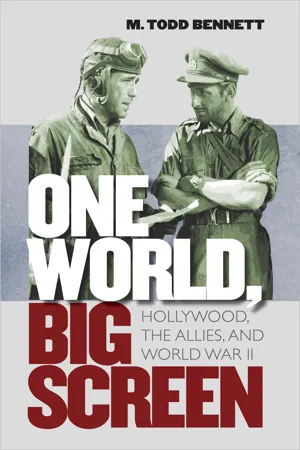
World War II coincided with cinema’s golden age. Movies now considered classics were created at a time when all sides in the war were coming to realize the great power of popular films to motivate the masses. Through multinational research, One World, Big Screen reveals how the Grand Alliance — Britain, China, the Soviet Union, and the United States — tapped Hollywood’s impressive power to shrink the distance and bridge the differences that separated them. The Allies, M. Todd Bennett shows, strategically manipulated cinema in an effort to promote the idea that the United Nations was a family of nations joined by blood and affection.
Bennett revisits Casablanca, Mrs. Miniver, Flying Tigers, and other familiar movies that, he argues, helped win the war and the peace by improving Allied solidarity and transforming the American worldview. Closely analyzing film, diplomatic correspondence, propagandists' logs, and movie studio records found in the United States, the United Kingdom, and the former Soviet Union, Bennett rethinks traditional scholarship on World War II diplomacy by examining the ways that Hollywood and the Allies worked together to prepare for and enact the war effort.
- 384 pages
- English
- ePUB (mobile friendly)
- Available on iOS & Android
eBook - ePub
About this book
Information
1 THE “MAGIC BULLET”
HOLLYWOOD, WASHINGTON, AND THE MOVIEGOING PUBLIC
In the 1940 Warner Bros. film Dr. Ehrlich’s Magic Bullet, actor Edward G. Robinson plays Dr. Paul Ehrlich, the real-life Nobel Prize–winning German physician who discovered a cure for syphilis. A founder of what became known as chemotherapy, the doctor’s remedy involved a pharmacological “magic bullet,” a chemical toxin that selectively targeted and killed disease-causing organisms. Neither he nor his biopic addressed propaganda’s effectiveness. But another “magic bullet” theory, so prominent as to be conventional social scientific wisdom at the time of the picture’s release, did. Also called the “hypodermic needle” model, it boldly asserted that propaganda exerted tremendous power over people by subcutaneously injecting data into the body politic that, like a chemical toxin, eradicated countervailing beliefs, implanted new ideas, and thereby manufactured thoughts and actions.
In short, there was widespread agreement that propaganda worked, that it could condition human behavior. No mass communication technology appeared to carry greater influence, for good or ill, than cinema. No other medium, not even radio, matched film’s sensory appeal, its audibility and visibility, in the pretelevision age. Movies were consumed in darkened theaters, immersive environments where viewers were said to be transfixed by what appeared before them on the big screen. Hollywood, maker of the planet’s most popular movies, only multiplied the effect. Hundreds of millions of people worldwide attended theaters each week, and observers documented, sometimes disapprovingly, the apparent ease with which Hollywood pictures made strong and lasting impressions on suggestible viewers. Hollywood served as a leading tastemaker, and it became clichéd to note the fans who mimicked the fashions, mannerisms, and mores modeled on-screen by their favorite larger-than-life stars.
Hollywood’s capabilities led policymakers to turn to film propaganda when the need arose to inspire Americans to join forces with the Allies against the Axis powers, an objective that turned moviemaking into a sort of defense industry worthy of official patronage. Enlisting the American motion picture industry, however, required negotiations among studio executives and U.S. government officials, who had divergent priorities. Commercial filmmakers initially failed to see how propaganda could be profitable; civil servants, diplomats especially, did not immediately appreciate how movies could be made to serve the public interest. And propaganda of any kind at first seemed downright dangerous to the republic. During the war years, however, those competing views were reconciled as Hollywood and Washington developed a corporatist framework for the projection of internationalism.
Practiced for centuries, propaganda acquired disreputable and even sinister connotations thanks in large part to World War I and the Third Reich. In hindsight, Americans felt manipulated by the Great War’s crude sloganeering. British operatives were held responsible for misleading the United States into joining that meaningless fight with unsubstantiated rumors of German atrocities in Belgium. Such tales left interwar isolationists opposed to propaganda on the grounds that it promoted belligerence.1 The historical reputation of the Committee on Public Information (CPI), the first U.S. propaganda agency, created in 1917 and led by newspaperman George Creel, plummeted along with that of Woodrow Wilson and his war. To disillusioned Americans, the CPI’s repeated assurances that the Great War would make the world safe for democracy rang hollow in the wake of the Great Depression, the rise of fascism, and the collapse of the Versailles peace. Moreover, early accounts charged the Creel Committee with hypocritically undermining liberty through jingoistic output that encouraged nativist vigilantism against radicals, immigrants, and members of ethnic groups. By 1939, these developments led journalist I. F. Stone to warn Americans against repeating the CPI’s “organized mass idiocy” if they were drawn into another overseas war.2
As soon as it became associated with totalitarianism, propaganda was thoroughly discredited in the Western democracies. Despite their differences, the USSR, Fascist Italy, and Nazi Germany were lumped together as totalitarian states by informed observers in part because all three used propaganda to unprecedented degrees and in similar ways. Germany’s Adolf Hitler and Reich Minister for Popular Enlightenment and Propaganda Joseph Goebbels leapt to mind as the most noxious and enthusiastic propagandists. But all totalitarians, regardless of ideology, were said to be adept at crushing the independent media, subordinating every aspect of public culture to the party-state, and then using propaganda to brainwash and control their minions. Nazis and Soviets alike ruled by virtue of their “complete control . . . of [the] press, schools, theater, broadcasting, and every other agency of propaganda,” wrote Christian Science Monitor foreign correspondent William Henry Chamberlin.3
Antifascists defined propaganda as positively un-American, outlining a nightmare scenario in which it helped spread the contagion of dictatorship to the United States. After a pro-Nazi rally attracted twenty-two thousand swastika-carrying followers to New York City’s Madison Square Garden in February 1939, the Committee for Cultural Freedom issued a manifesto alerting Americans to the fact that in Nazi Germany, “intellectual and creative independence is suppressed and punished as a form of treason. Art, science, and education have been forcibly turned into lackeys for a supreme state.” The committee, a group of noncommunist intellectuals organized by Marxist philosopher Sidney Hook, warned that the “tide of totalitarianism is rising throughout the world. It is washing away cultural and creative freedom along with all other expressions of independent human reason.” France’s fall to Germany in June 1940, the speed of which was partly attributed to the activities of Nazi fifth columnists, provocateurs among them, operating within the Third Republic, touched off a brown scare in the United States. Dictator Isms and Our Democracy, a tract that envisioned the chilling aftereffects of authoritarian takeovers of American cities, including the institution of official propaganda and censorship ministries, exemplified the widespread fear of expanding fascism reaching U.S. shores.4
Conservatives alleged that the country already had a dictator in its midst: President Franklin D. Roosevelt, who sought an unprecedented third term in 1940 after attempting to pack the Supreme Court in 1937. His administration’s opponents claimed that each federal agency included a publicity arm for the sole purpose of promoting the New Deal, the Democratic Party, and FDR himself, paving the way for a homegrown autocracy. The president’s extensive state-run apparatus rivaled those found in Hitler’s Germany, Joseph Stalin’s Russia, or Benito Mussolini’s Italy, or so argued the American Mercury’s managing editor, Gordon Carroll. Roosevelt, whom Carroll called the “Fuhrer,” supposedly “set out to show the world how a real propaganda machine, geared to soaring political ambition and the modern collectivist tempo, should regulate the lives and votes of [millions of] gullible persons.” The New Deal’s public relations network could well evolve into a propaganda ministry of the kind overseen by Goebbels, added New York Herald Tribune syndicated columnist and Committee for Cultural Freedom member Dorothy Thompson. John T. Flynn, chair of the New York City chapter of the isolationist America First Committee, similarly cautioned in 1940 that the administration’s informational activities made it “possible to do here what has been done in Germany and Italy.”5
Propaganda’s equation with dictatorship gave ammunition to civil libertarians, who deemed it undemocratic. Elitist, mass persuasion revealed what little confidence authorities had in the general public’s ability independently to reach wise conclusions or develop moral clarity. Promotional work distorted the facts, inflamed passions, and manipulated citizens, interfering with free, reasoned public discourse. Ideally, democracy depended on well-informed, objective discussion of issues in the public square, philosopher John Dewey declared in 1939, and propagandists, who had “developed an extraordinary facility” for spreading lies and arousing emotions, endangered that process.6
Liberals continued to register objections after U.S. entry into the war in December 1941, the point at which most other antipropagandists muted their opposition. When rumors spread in early 1942 that the Roosevelt administration was considering establishing a central war information office, the proposal struck some civil libertarians as an ominous drift toward authoritarianism. The Journal American predicted in March that Washington’s “bureaucratic propaganda centers of ‘enlightenment’” would rival Berlin’s if left unchecked. The next month, Chamberlin railed in Christian Century against the “powerful build-up for the creation in America of an organization comparable” to Goebbels’s propaganda ministry. Once founded, Chamberlin explained, such a ministry would “terrorize Americans into abandoning their normal faculties of criticism and common sense and closely imitate the method of government by unlimited propaganda which is so characteristic of the totalitarian state.” Moreover, the journalist reminded readers that the war was being fought in the name of freedom from fascist slavery, and he called attention to just how much the establishment of a U.S. propaganda ministry contradicted that mission: “It would be a ghastly irony if, in the name of a crusade against totalitarianism, an essentially totalitarian technique of propaganda and thought control should be set up in this country. We do not want a Gobbels [sic] in America, not even a Gobbels who might write an ode to the Statue of Liberty.”7
All opponents could agree on the need to treat propaganda as a controlled substance since it was so potent as to be injurious to public psychological health. Toxicity and disease recurred as descriptors of publicity’s disabling effect on rationality. Rockefeller Foundation official John Marshall, who channeled funding to scholarly studies of mass persuasion throughout the 1930s, spoke of propaganda as “pathology.” It turned “people into automatons,” robots “incapable of thought,” according to Donald Slesinger, the onetime dean of social sciences at the University of Chicago who directed the foundation-sponsored American Film Center. Representative Emanuel Celler spoke in favor of prophylactic legislation, similar to “our National Food and Drug Act,” designed to protect the public’s moral health by requiring the labeling of information. The New York Democrat got his wish in 1938, when Congress passed the Foreign Agents Registration Act, which criminalized foreign propaganda by subjecting its distributors to fines or prison sentences if they failed to register with the Department of Justice and/or follow U.S. regulations.8
Behavioral psychology informed the “magic bullet” theory. Critical of the intuitive, subjective, and hence unscientific nature of Freudian psychoanalysis, the field’s foundational orthodoxy, behaviorists prioritized what was observable and measurable: human behavior, taken to be the product not of internal consciousness but of external stimuli. If environment determined behavior, then it also stood to reason that human action could be manipulated by altering the causal conditions. Scientifically speaking, the concept of conditioning connected environment with behavior. Over the next several decades, experimental psychologists would subject conditioning to further analysis, only to discover that the learning process was in fact a good deal more complicated than had been anticipated. Still, the studies that established conditioning’s operability—the same texts that elevated behaviorism to its preeminent position in the psychological profession—had a direct and influential bearing on the emerging theory and practice of mass communications. To be sure, Propaganda and Promotional Activities (1935), an authoritative bibliography of pertinent research coedited by University of Chicago political scientist Harold D. Lasswell, referenced cutting-edge neobehaviorist literature that questioned linear conditioning. But it also cited the classic work of Ivan Pavlov, the Russian physiologist who conditioned canine reflexology, and of John B. Watson, named vice president of the J. Walter Thompson advertising agency after his seminal if notorious “Little Albert” experiment of 1920 established him as behaviorism’s founding father.9
Academic research and anecdotal evidence alike supported the conclusion that mass persuasion conditioned humans. Princeton University’s Office of Radio Research, underwritten by the Rockefeller Foundation, released a pioneering 1937 study showing that listeners were strongly influenced by on-air programming. Another foundation beneficiary, the Communications Group (a collection of scholars dedicated to understanding the mass media’s effects that included Lasswell, public opinion expert Hadley Cantril, and sociologist Robert S. Lynd) reported in 1940 that groupthink occurred “when millions of people, through the press, the radio, or the motion pictures, are all told the same thing, or approximately the same thing, at the same time.”10
Many more such examples could be cited. But the single event that most solidified the media’s reputation occurred on 30 October 1938, when the broadcast of Orson Welles’s radio play of the H. G. Wells novel War of the Worlds caused a mass panic among an estimated 1 million listeners who believed that the Earth was under attack by creatures from Mars. Frightened, some listeners jumped in their cars and fled cities on the Eastern Seaboard. Fearful New Yorkers rushed to police stations to receive evacuation orders. A Newark, New Jersey, hospital sedated several hysterical patients. The entire event drew the interest of Cantril, a Princeton psychologist who advised Roosevelt. Two years later, Cantril published a study based on listener interviews that found the whole bizarre episode to be a conclusive demonstration of the mass media’s ability, under certain conditions, to manipulate human behavior. If the incredible tale spun by War of the Worlds could move people, Cantril’s work implied, something more plausible could perform wonders.11
That power—the same power that unnerved some liberals—attracted other democrats when circumstances warranted. The change began with France’s fall. Nazism was on the march, and liberalism’s future seemed to hang in the balance. U.S. national security, moreover, was at much greater risk now that only one major European ally, Great Britain, stood between Hitler and America. Desperate times called for desperate measures, and the balance of opinion started to swing in favor of fighting fire with fire to save democracy in its darkest hour. To survive, the thinking went, republicanism needed to adapt and utilize modern mass communications to match its vocal fascist competitor word for word, decibel for decibel. Doing so meant engaging, both at home and abroad, in what was paradoxically called “democratic propaganda.” Defenders were quick to point out that democratic propaganda, unlike its dictatorial counterpart, appealed to reason and aspired to accuracy. In that regard, democratic propaganda was said to be consistent with liberalism insofar as its main objective was not to mislead but to inform the average citizen. John Q. Public needed to be educated about the serious challenge fascism posed to his way of life, and informational activities could do just that. Such an intellectual regimen would awaken Americans from their isolationist slumber and cause them to spring into antifascist action, producing a quick political response that transcended the numerous roadblocks that ordinarily stood in the way of efficient U.S. policymaking. The overall message of Lasswell, who coined the phrase “democratic propaganda,” was that Americans should stop worrying and learn to love mass persuasion as nothing more than a technique of modern governance that could serve a benevolent purpose.12
Propaganda’s propagandists glossed over its antidemocratic implications and muddied the waters in making their case. They defined the term so broadly (to encompass almost any kind of public argumentation) as to make it virtually indistinguishable from other kinds of human communication. Ohio State University education professor Edgar Dale likened persuasion to teaching, a simile that obfuscated the bright line between advocacy and pedagogy. Echoing Lasswell, Dale urged Americans to see propaganda as merely “a valuable means of promoting desirable institutions,” including “democracy itself.” Pollster George Gallup argued in The Pulse of Democracy (1940) that opinion surveys provided policymakers with the necessary “machinery” to hear, answer, and even alter what the people had to say about foreign and domestic affairs. Advertising pioneer Edward L. Bernays emerged as a forceful advocate. For almost two decades, Bernays, who had the added credential of being Sigmund Freud’s nephew, had favora...
Table of contents
- Cover Page
- ONE WORLD, BIG SCREEN
- Copyright Page
- CONTENTS
- ILLUSTRATIONS
- ACKNOWLEDGMENTS
- ABBREVIATIONS
- INTRODUCTION
- 1 THE “MAGIC BULLET”
- 2 “PRO-BRITISH-AMERICAN WAR PREACHERS”
- 3 ONE WORLD, BIG SCREEN
- 4 KISSING COUSINS
- 5 COURTING UNCLE JOE
- 6 NEGOTIATING THE COLOR DIVIDE
- CONCLUSION
- NOTES
- SELECTED BIBLIOGRAPHY
- INDEX
Trusted by 375,005 students
Access to over 1.5 million titles for a fair monthly price.
Study more efficiently using our study tools.
Frequently asked questions
Yes, you can cancel anytime from the Subscription tab in your account settings on the Perlego website. Your subscription will stay active until the end of your current billing period. Learn how to cancel your subscription
No, books cannot be downloaded as external files, such as PDFs, for use outside of Perlego. However, you can download books within the Perlego app for offline reading on mobile or tablet. Learn how to download books offline
We are an online textbook subscription service, where you can get access to an entire online library for less than the price of a single book per month. With over 1.5 million books across 990+ topics, we’ve got you covered! Learn about our mission
Look out for the read-aloud symbol on your next book to see if you can listen to it. The read-aloud tool reads text aloud for you, highlighting the text as it is being read. You can pause it, speed it up and slow it down. Learn more about Read Aloud
Yes! You can use the Perlego app on both iOS and Android devices to read anytime, anywhere — even offline. Perfect for commutes or when you’re on the go.
Please note we cannot support devices running on iOS 13 and Android 7 or earlier. Learn more about using the app
Please note we cannot support devices running on iOS 13 and Android 7 or earlier. Learn more about using the app
Yes, you can access One World, Big Screen by M. Todd Bennett in PDF and/or ePUB format, as well as other popular books in History & North American History. We have over 1.5 million books available in our catalogue for you to explore.