Around 1900, the southern states embarked on a series of political campaigns aimed at disfranchising large numbers of voters. By 1908, Alabama, Arkansas, Georgia, Louisiana, Mississippi, North Carolina, South Carolina, Tennessee, Texas, and Virginia had succeeded in depriving virtually all African Americans, and a large number of lower-class whites, of the voting rights they had possessed since Reconstruction — rights they would not regain for over half a century.
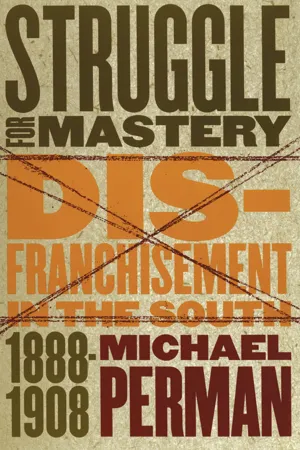
Struggle for Mastery is the most complete and systematic study to date of the history of disfranchisement in the South. After examining the origins and objectives of disfranchisement, Michael Perman traces the process as it unfolded state by state. Because he examines each state within its region-wide context, he is able to identify patterns and connections that have previously gone unnoticed. Broadening the context even further, Perman explores the federal government’s seeming acquiescence in this development, the relationship between disfranchisement and segregation, and the political system that emerged after the decimation of the South’s electorate. The result is an insightful and persuasive interpretation of this highly significant, yet generally misunderstood, episode in U.S. history.
- 416 pages
- English
- ePUB (mobile friendly)
- Available on iOS & Android
eBook - ePub
About this book
Information
Topic
HistoriaSubtopic
Historia de Norteamérica1 Devising Disfranchisement
“The Great Problem” in Its Final Phase
There is something deeper and more far-reaching in what is before us than the mere question of whether we can carry an election. I see underneath it the fundamental problem of what is to be the relation of these two unequal races.
—Alfred P. Thom, Virginia constitutional convention, 1 April 1901
—Alfred P. Thom, Virginia constitutional convention, 1 April 1901
In the mid-1870s, Republican control of the South was brought to an end. With the defeat and removal from office of the Republican-dominated governments, Reconstruction was over. The Democrats returned to power, and the South was redeemed. So decisive and dramatic was this Redemption, as historians have called it, that the change of administration, in which one party took the reins of government from its competitor, has been described as the overthrow of Reconstruction. Indeed, Redemption not only constituted a major political change but also marked the end of the Civil War era.
As definitive as this episode seems to have been, continuities remained. The attempt to reorganize and reconstruct the South may have failed, but fundamental changes had been introduced that would continue to resonate throughout society. For this reason, Eric Foner has characterized the experiment or revolution ushered in by Reconstruction as “unfinished.”1 Less noticed but also “unfinished” or incomplete was the counterrevolution undertaken by the opponents of Reconstruction. Despite the seeming finality of the overthrow and dispersion of the federally installed Republican governments, the Democrats’ counteroffensive stopped short of fulfillment. At first glance, they seemed to have accomplished everything they sought. The governments of all of the former Confederate states had changed hands decisively, and the Democrats had regained political control. But they soon realized that a change in government did not mean a change in regime.
Reconstruction had introduced not merely a new political party, the Republicans, but also a new electorate and a new electoral system. Universal male suffrage had enfranchised about a million African Americans, most of them recently released from bondage, and had mobilized thousands of whites who had been politically dormant during the Confederacy and earlier in the 1850s.2 These new voting rights were guaranteed by the federal government under the Fifteenth Amendment, as were civil rights under the Fourteenth Amendment. Furthermore, these rights had been confirmed at the state level by constitutional provision and by statute. With this constituency as its base, the Republican Party had been able during Reconstruction to vie with the region’s economic and political elite, which had reconstituted itself and reorganized in the Democratic Party.
Even though the Republicans no longer controlled any of the state governments in the South after 1877, their party was still part of the electoral system, as were the newly created and mobilized voters. Moreover, the Republican-controlled federal government that had failed to prevent the collapse of its Reconstruction initiative was not likely to permit the elimination of the party and the electorate it had brought into being in the South. Thus, Reconstruction was over and the Reconstruction governments had been overthrown, but its electoral system, its regime, remained. What was still lacking, then, was restoration of the status quo before Reconstruction. Redemption had overthrown governments; Restoration would attempt to remove all traces of the political and electoral system created during Reconstruction.3
Disfranchisement as Restoration
For fifteen to twenty years after Redemption, the victorious Democrats had to acknowledge the continuing existence of the electoral system established during Reconstruction and somehow work within it. But they never accepted it or accorded it legitimacy, just as they had never sanctioned the governments run by the Republicans during Reconstruction. Instead, they manipulated and subverted the system without actually eliminating it. The two post-Reconstruction decades constituted a distinct phase in the history of the late-nineteenth-century South. Viewed from the turn of the century, these twenty years, located between Reconstruction and disfranchisement or Restoration, comprise the second of three discrete periods in the region’s political history from the end of the Civil War until the first decade of the twentieth century.
Three Phases in the History of Black Suffrage in the Southern States since the Civil War | ||||
| Phase | Period | Length | Status of Suffrage | Modality |
| I | Reconstruction | 1867–early 1870s | Voter enfranchisement | Federal statute; federal constitutional amendment; state constitutions |
| II | Redemption | Mid-1870s–mid-1890s | Vote manipulation | State law (de jure); election fraud (de facto) |
| III | Restoration | 1890–1908 | Voter elimination | State constitutions (amendment or convention) |
This sequence or periodization was first formally proposed in three articles that appeared around 1900. In 1899, Walter C. Hamm published “The Three Phases of Colored Suffrage” in the North American Review. Two years later, the respected Columbia University historian William A. Dunning wrote “The Undoing of Reconstruction” for the Atlantic Monthly. And in 1902, Clarence H. Poe, a North Carolinian who edited the Progressive Farmer, published “Suffrage Restriction in the South: Its Causes and Consequences” in the North American Review.4 All three commentators concurred that the quarter century after the introduction of universal suffrage in the South under the Reconstruction Act of 1867, later nationalized by the Fifteenth Amendment, should, like Caesar’s Gaul, be divided into three parts. The first period, Reconstruction, was characterized by Poe as “the era of unrestricted suffrage”; it came to an end in the mid-1870s.5 The methods employed to overthrow the Reconstruction governments, all three observers agreed, were violence and fraud, as the Democrats, in Dunning’s words, vowed “to carry their point at all hazards.”6 In the second phase, the ascendant Democrats used a variety of means to limit black voting and keep the Republican Party at bay. Violence continued, but the Democrats primarily focused their efforts on the electoral system, employing various methods such as gerrymandering election districts, rigging the balloting system, controlling the supervision of elections, and, not least, engaging in outright fraud at the ballot box. Dunning contrasted this phase with the first since it relied on “legislation and fraud” as opposed to force alone.7 Moreover, it was successful because “the black vote slowly disappeared.”8
By the 1890s, the third and final phase commenced as the Democrats shifted strategy yet again. The task at this stage was, in Dunning’s view, “the termination of equal rights in law as well as in fact.”9 As Poe described the process, “the era of disfranchisement by state laws” had begun.10 By 1901, Dunning was announcing that “the undoing of Reconstruction is nearing completion.”11 Instead of manipulating and undermining the Reconstruction system of black voting, as they had done in the second phase, the Democrats proposed to “undo” it. In effect, they were bringing to fulfillment the elimination, the abolition, of black suffrage.
Despite some hesitancy about the accuracy of their speculations and minor discrepancies in the way each author depicted the three phases, these turn-of-the-century observers seemed convinced that the third phase was distinct from the second and that it provided not just an alternative approach but the solution to the racial problem at the root of the region’s political difficulties. An awareness that the suffrage question in the South was moving to a new stage, even a resolution, had been evident in the early 1890s, almost a decade earlier. This perception had arisen when Congress was debating whether to repeal the federal election laws of 1870–72, which were intended to enforce the Fifteenth Amendment. A number of Republican congressmen expressed this notion, but none as clearly as two Iowans, William P. Hepburn, who would achieve fame through the railroad regulation act of 1907 that bears his name, and Jonathan P. Dolliver.
Addressing the congressmen from Mississippi, a state that a few years earlier had called a constitutional convention to amend its suffrage requirements, Hepburn exclaimed angrily: “Tired of the murders that took place at first, when the first Mississippi plan was adopted [in 1875]; tired of the frauds that were substituted for the murders and the violence; fearful of the consequences of these continual annual frauds, [you] resorted to this wholesale method, and undoubtedly you congratulate yourselves upon your success.”12 The chronological sequence of methods employed by the Democrats—violence during Reconstruction, electoral fraud in the 1880s, and the “wholesale method” in 1890—had also been suggested by Dolliver a few days earlier. He had asserted that “before the year 1880, [the anti-Reconstruction ‘revolution’] had changed the weapons of violence for the cheaper but no less effective weapons of fraud, and these have [now] developed in States like Mississippi into legal machinery . . . which has in a gentlemanly way abolished the republican form of government altogether.”13 Not content with castigating the southern Democrats alone, Dolliver turned his guns on his fellow Republicans, charging them with twenty years of “cowardice turned first into indifference, then into aversion and at last into treachery.”14 It seemed that northern Republicans’ weakness and irresponsibility, like the southerners’ campaign against the electoral innovations of Reconstruction, proceeded through three stages. Once the third stage was reached with the adoption of the “wholesale method,” the Article 4 guarantee of “a republican form of government,” not to mention “free citizenship” itself, was subverted. Consequently, Dolliver believed his own party was complicit in an outcome tantamount to treason.15
In the South, the Democrats’ opposition to black suffrage increased in intensity as they embarked upon the third phase. By comparison with the preceding phase of electoral manipulation and fraud, the decision to disfranchise required a change aimed at achieving a solution since disfranchisement was intended to settle a problem that had smoldered for a quarter of a century. The chairman of the Democratic Party in North Carolina and the architect of its disfranchisement campaign, Furnifold Simmons, publicly acknowledged in 1899 that “we have temporized with the race question in politics long enough.”16 Finality was also evident in the pronouncement of the party’s newspaper organ in North Carolina, the Raleigh News and Observer, that passage of the amendment would “settle this irritating race question and remove this ever recurring and festering sore on the body politic.” Even more emphatically, the paper insisted that “settled and SETTLED FOREVER it MUST be.”17 In Alabama, Frank S. White, a Birmingham lawyer who was permanent chair of the Democratic state convention of 1900, told the cheering delegates that now “the great question of the Elective Franchise must be settled. The white line was formed in 1874 and swept the white men of Alabama into power. The white line has been re-formed in 1900 to keep them in power forever.”18
The disfranchisers’ belief that this third phase was to be final and permanent was accompanied by a similarly decisive and radical view of the remedy they had chosen. “Elimination” was the term they invariably employed, suggesting that attempts merely to curb, limit, or restrict black voting were to be rejected in favor of measures that were sweeping and thorough. “Trifling with halfway qualifications of the suffrage will help us but for a few years at the most,” the Charleston News and Courier warned during South Carolina’s constitutional convention in 1895. Instead, strong measures were needed to “reduce the colored vote to insignificance in every county in the State.” A few months earlier, the paper had announced that “a frank declaration . . . that [South Carolina] does not desire or intend ever to include black and colored men among its ‘citizens’” was “the only honest and right plan for the final settlement of our peculiar social and political troubles.”19 In accepting the presidency of the Louisiana constitutional convention in February 1898, Ernest B. Kruttschnitt, who was also chairman of the state Democratic Party, used the same term to describe disfranchisement: “We know that this convention has been called together by the people of the state to eliminate from the electorate the mass of corrupt and illiterate voters who have during the last quarter of a century degraded our politics.”20 Clearly, these Democratic leaders saw their task in heroic terms. As instruments for ending a problem that had persisted for several decades, they resolved to achieve their objective not by temporizing and equivocating, as in the past, but by the more drastic antidote of removal.
This decisive remedy was described at the time as “disfranchisement.” Interestingly, the word “disenfranchisement,” which most dictionaries consider an equivalent, was apparently never uttered or written by those involved in this episode during the twenty or so years in which it took place. However the word was pronounced or spelled, its meaning was clear. It simply meant to deprive a person of the vote, an objective that could be achieved in several different ways. First, a voter could be prevented from casting a vote by physical or verbal intimidation or the placement of obstacles in the way of the voter’s reaching the polls or depositing a ballot. Even if the voter cast his ballot for a candidate as intended, he could still be disfranchised in a second way. After his vote was cast, election officials might destroy the ballot, thereby disfranchising the voter without his knowledge. A third device was to disfranchise a voter by tallying his vote for a different candidate from the one he actually voted for. These last two maneuvers enabled unscrupulous election officials to “count out” votes cast for the opposition. In effect, the votes were taken or, in the vernacular, “stolen.” Another way for officials to “count out” their rivals was by filling the ballot boxes of their own party’s candidates with phony ballots. “Ballot box stuffing,” as this ruse was called, did not disfranchise a voter directly. His ballot was not tampered with or taken away since it was not cast in the first place. Instead, it was given to a candidate the voter did not support. Once again, the voter was unaware that this had happened. No matter when these methods were used or how they were employed, the outcome was the same. The voter’s ability to cast an effective ballot was denied. The voter, in effect, was deprived of the vote, or disfranchised.21
This kind of disfranchisement was not, however, what the Democrats who initiated the campaigns at the turn of the century had in mind. They rejected this weaker version as insufficient because it did nothing more than deny a voter the ability to vote as he wished and have his vote counted as he intended. Since the voter already possessed the ballot, his vote would have to be manipulated and rendered ineffective every time an election was held. This was an uninviting and never-ending prospect. A more satisfactory course of action that contained even the promise of a solution was to deprive the voter of the right to vote. In that case, the deprivation or loss of the vote would occur not at the ballot box at every election but at the point of registration and probably only once. The shift in focus away from manipulating and denying the vote at elections and t...
Table of contents
- Cover Page
- Struggle for Mastery
- Copyright Page
- Contents
- Illustrations
- Maps
- Acknowledgments
- Introduction
- 1 Devising Disfranchisement
- 2 Supervising the South
- 3 Embarking on Disfranchisement
- 4 Harmonizing Rival Factions I
- 5 Harmonizing Rival Factions II
- 6 Conciliating the South
- 7 Defeating Fusion I
- 8 Defeating Fusion II
- 9 Reforming the Black Belt I
- 10 Reforming the Black Belt II
- 11 Exonerating the South
- 12 Reinforcing Disfranchisement
- 13 Forging a Reform Coalition
- 14 Finishing Disfranchisement
- Conclusion
- Notes
- Bibliography
- Index
Trusted by 375,005 students
Access to over 1.5 million titles for a fair monthly price.
Study more efficiently using our study tools.
Frequently asked questions
Yes, you can cancel anytime from the Subscription tab in your account settings on the Perlego website. Your subscription will stay active until the end of your current billing period. Learn how to cancel your subscription
No, books cannot be downloaded as external files, such as PDFs, for use outside of Perlego. However, you can download books within the Perlego app for offline reading on mobile or tablet. Learn how to download books offline
Perlego offers two plans: Essential and Complete
- Essential is ideal for learners and professionals who enjoy exploring a wide range of subjects. Access the Essential Library with 800,000+ trusted titles and best-sellers across business, personal growth, and the humanities. Includes unlimited reading time and Standard Read Aloud voice.
- Complete: Perfect for advanced learners and researchers needing full, unrestricted access. Unlock 1.5M+ books across hundreds of subjects, including academic and specialized titles. The Complete Plan also includes advanced features like Premium Read Aloud and Research Assistant.
We are an online textbook subscription service, where you can get access to an entire online library for less than the price of a single book per month. With over 1.5 million books across 990+ topics, we’ve got you covered! Learn about our mission
Look out for the read-aloud symbol on your next book to see if you can listen to it. The read-aloud tool reads text aloud for you, highlighting the text as it is being read. You can pause it, speed it up and slow it down. Learn more about Read Aloud
Yes! You can use the Perlego app on both iOS and Android devices to read anytime, anywhere — even offline. Perfect for commutes or when you’re on the go.
Please note we cannot support devices running on iOS 13 and Android 7 or earlier. Learn more about using the app
Please note we cannot support devices running on iOS 13 and Android 7 or earlier. Learn more about using the app
Yes, you can access Struggle for Mastery by Michael Perman in PDF and/or ePUB format, as well as other popular books in Historia & Historia de Norteamérica. We have over 1.5 million books available in our catalogue for you to explore.