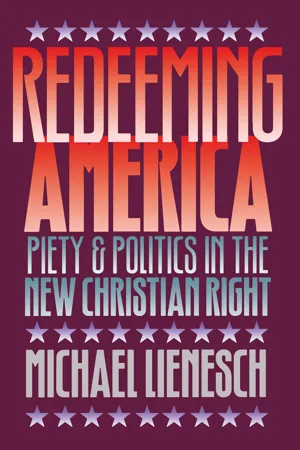
This balanced and comprehensive study of Christian conservative thinking focuses on the 1980s, when the New Christian Right appeared suddenly as an influential force on the American political scene, only to fade from the spotlight toward the end of the decade. In Redeeming America, Michael Lienesch identifies a cyclical redemptive pattern in the New Christian Right’s approach to politics, and he argues that the movement is certain to emerge again.
Lienesch explores in detail the writings of a wide range of Christian conservatives, including Jerry Falwell, Pat Robertson, Phyllis Schlafly, and Tim and Beverly LaHaye, in order to illuminate the beliefs and ideas on which the movement is based. Depicting the thinking of these writers as a set of concentric circles beginning with the self and moving outward to include the family, the economy, the polity, and the world, Lienesch finds shared themes as well as contradictions and tensions. He also uncovers a complex but persistent pattern of thought that inspires periodic attempts to redeem America, alternating with more inward-looking intervals of personal piety.
- 344 pages
- English
- ePUB (mobile friendly)
- Available on iOS & Android
eBook - ePub
About this book
Information
1. Self
At the center of Christian conservative thinking, shaping its sense of the self, lies the concept of conversion. With few exceptions, religious conservatives believe in conversion, the act of faith and forgiveness through which sinners are brought from sin into a state of everlasting salvation. And with few exceptions, they have experienced conversion themselves, having been born again in dramatic, life-changing moments of transformation. Thus conversion lies at the core of their characters, providing a psychodynamic center from which they proceed to construct their personalities. Moreover, it serves as a starting place for constructing a sense not only of autonomy and identity, but also of social order and political purpose. At least in this sense, Robert Zwier is right when he says that partisans of the Christian right practice “born-again politics.”1
Although almost all scholars agree that the conversion experience plays a crucial part in shaping the thinking of religious conservatives, few have said much about the concept of conversion itself. The problem is sizable, in part because there seems to be no single simple definition of the term. Even in its classic form, as practiced by early modern Protestants, conversion meant different things to different people. Elizabethan Puritans, led by the redoubtable theologian William Perkins, assumed a predictable ten-step pattern of conversion, what they called the ordo salutis or “way of salvation.”2 Their American counterparts, by contrast, while embracing the classic pattern in theory, seem to have experienced conversions that were much less predictable in practice.3 In fact, in The Puritan Conversion Narrative, her review of hundreds of early testimonies, Patricia Caldwell shows that early Americans experienced conversions of many kinds, most of them loosely structured, open-ended, and problematic.4 The same is true today. Americans, concludes Eric Gritsch in his Born Againism, a historical study of what he calls the “born-again movement,” are saved in a “confusing variety” of ways.5
Among religious conservatives autobiographies abound. Almost all of the most prominent personalities have written at least one, and several have written more than one. The books vary widely, showing different styles and levels of sophistication. All, however, seem to have the same purpose, serving as contemporary conversion testimonies. This chapter considers a selection of them, including the autobiographies of Jerry Falwell, Pat Robertson, James Robison, Anita Bryant, Jim and Tammy Bakker, and Pat Boone. While these writers are not assumed to be representative of all of those within the New Christian Right, they do include important national leaders of the movement (Falwell and Robertson), prominent local partisans (Robison and Bryant), and sometime activists and movement celebrities (the Bakkers and Boone). The group contains fundamentalists, evangelicals, and charismatics, representing the chief doctrinal divisions within the movement, and it includes both men and women.
While differing in the details of their descriptions, these writers, when taken together, describe a common concept of conversion. Roughly, it consists of three stages: (1) an early period of preparation, in which the authors become conscious not only of sin but also of their social anxiety and alienation, which seem to be for them contemporary preconditions of salvation; (2) the crucial period of salvation, during which they are redeemed by being born again, experiencing “justification,” discover new identities as more perfect people through a process of “sanctification,” and seek out new ways of living, or “vocation”; and (3) a final period of participation, in which the writers consider the conflicts between self and society that confront them as they seek to live as saints in a sinful world. Providing a pattern through which they can filter perceptions and formulate practices, this concept of conversion, while by no means causal, is instrumental in defining the personal and political identities of these writers, their characters as Christian conservatives. This chapter considers the concept.
Preparation
“I was a desperate sinner.” For Christians, the road to salvation has always started with a conscious sense of sin. From Paul to Augustine to Bunyan, the classic conversion stories have all begun with a catalogue of failings and misdeeds. Among the earliest American Protestants, the listing of misdoings became extensive enough to include more than two hundred varieties of sin. Nevertheless, in early testimonies, many of which come from the seventeenth century, the sins that seemed most prevalent were what might be called private sins, or sins against God, especially those that came from putting oneself before God. These sins included disbelief, worldliness, and pride. Most prominent of them, as Charles Lloyd Cohen most recently has shown, was pride. By contrast, in the conversion testimonies of today’s Christian conservatives, sin is described somewhat differently, as more public than private, an external force rather than an inner corruption or failing, the product of society instead of the soul. Adam and Eve may have suffered from pride, says Jerry Falwell, but Christians today have other sins to think of:
The modern list of sins grows longer with each night’s evening news: rape, incest, child molestation, corporate theft, political perjury, arson, kidnap, drug dealing and drug abuse, divorce and violence in our homes, robbery and murder on the streets, terrorism and all-out bloody warfare between races and nations.6
Searching for Sin
The autobiographies begin with sin. But the sin in these stories, while indisputable, seems somehow less significant than in earlier conversion narratives. At times it is hard to find at all. Falwell begins his 1987 autobiography, Strength for the Journey, with a visit to the Falwell family graveyard on the outskirts of Lynchburg, Virginia, where he goes in search of sin, “sin and its consequences in my life and in the lives of my extended family.” For the fundamentalist Falwell, sin is original and inherited, passed down from Adam at the beginning of the world. Apparently the Falwells passed along plenty of it. Reading over the gravestones, Falwell confesses that his family was not a “saintly bunch”: his ancestors, struggling farmers and tightfisted entrepreneurs, “were too busy building a new world to have much time to take seriously the questions of religion”; his grandfather was a “self-avowed atheist,” and his father was “an agnostic who hated preachers and refused to enter the doors of a church.” In each case, their lives consisted of struggles against sin, which Falwell sees as struggles against the devil. Satan, Falwell observes, was the “family enemy.”7
As Falwell searches the gravestones for insight into the meaning of sin, his father looms particularly large in his thinking. A bootlegger, gambler, and dance hall owner in Lynchburg during Prohibition, Carey Falwell was an ambitious and sometimes violent man who ran cockfights and dogfights, packed a .38 Remington revolver, and one night in 1931, in a family argument, shot and killed his own brother with a shotgun. To Jerry Falwell, the killing, although in self-defense, was a sin from which his father never recovered. From that time, as Falwell describes, his father, consumed by guilt, became increasingly addicted to alcohol, commonly drinking a dozen beers a day and downing a fifth or more of whiskey and several bottles of wine on top of them. To Falwell, his father was less a carrier than a casualty of sin and, very literally, a victim of the devil. “Little by little,” Falwell writes, “the Enemy had won.”8
Falwell considers himself as having inherited his father’s sins. He thinks of his own life as a continuing struggle with the devil. “I was my father’s son,” he writes. But in truth Falwell describes remarkably little sin in his own life. In fact, the worst of his misdeeds are no more than occasional pranks, timeless schoolboy antics like putting a mouse in the teacher’s desk drawer. Falwell seems eager to insert more sinfulness into his teen years, describing himself as a member of a Lynchburg “gang.” Yet he has to confess that gangs then were not what gangs are now, and that the worst misdeeds that he and his fellow gang members ever perpetrated were letting the air out of motorists’ tires, along with “a couple of fist-fights.” Overall, Falwell’s story is that of a talented and popular young man, who graduated as his high school class valedictorian (although, true to his reputation as a prankster, he was prevented from giving the valedictory address because he, along with several fellow football players, had pilfered lunch tickets from the school cafeteria). Throughout his life, Falwell admits, his sins have tended to be “small” and “safe.”9
Much the same can be said about many of the other autobiographies. Although the authors begin their testimonies with stories of the fall, none seem to have fallen very far. Indeed, all things considered, they appear to be a remarkably sinless lot. Jim Bakker notes that in seventh grade he spent some time cutting classes and “sneaking around smoking.”10 His wife, Tammy, at about the same age began experimenting with eye makeup, a violation of her church’s teachings.11 Texas evangelist James Robison confesses to “making out with girls.”12 Anita Bryant, writing in her Mine Eyes Have Seen the Glory about growing up in Velma-Alma, Oklahoma, claims to have been “always getting into mischief,” along with being “bull-headed” and “ornery.” Such sins notwithstanding, however, she states that she was really “rather well disciplined by my own choice.” In a benign variation on Augustine’s confessions, she tells of stealing watermelons from a neighbor’s patch, “never dreaming that Grandpa’s neighbor had told him to let us help ourselves.”13 Pat Boone, whose reputation as a squeaky-clean Hollywood performer seems to have been well earned, searches without success for any preconversion sin. “All my life I had been fairly religious,” he says in his autobiography, A New Song. “As a boy growing up in Nashville, I never missed Sunday school and church.”14
Fear and Feelings of Inferiority
In these conversion testimonies, an awareness of sin is present, but it seems less prominent than a more diffuse feeling of anxiety and fear. Robison provides an extreme case. Conceived through rape and born in a charity ward in a Houston hospital to a homeless single mother in her forties, Robison was placed in a foster home shortly after birth, only to be taken from it again by his mother at the age of five. He writes in his autobiography, Thank God, Vm Free, of his searing memories of the day his “other” mother came to claim him from the home of his foster parents, a Houston minister and his wife, Herbert and Katie Bell Hale:
My little cardboard suitcase was packed tight with everything I owned. She said, “You’re going with me.” It sounded so final, so absolute. . . .
The Hales protested. . . . Mrs. Hale lay across her bed, wailing convulsively. Even Pastor Hale was weeping. I was petrified.
I raced to my bed and scrambled underneath, the only safe place I could think of. Pastor Hale gently pulled me out by one foot while I desperately tried to cling to the slick hardwood floor. Why were they making me go? ... I thought my life had come to an end.
From this point Robison’s early years were spent being moved by his mother from town to town and room to room. He writes about how they “always seemed to live at a half address, 1701 ½ or 783 ½ Her room (or two at the most) was in the back or the basement or the attic of someone else’s place. The only treat she ever seemed to have was peanut butter and jelly.” Left alone for long periods, the confused and frightened boy retreated into feelings of inferiority and guilt. “At the time,” Robison writes, “I was so despondent, felt so worthless, that many nights I cried and cried. I figured I was a bad boy, and that must be why I never got any breaks. No dad. No friends. No sports to play. No loved ones who remembered me. Sometimes, when I was home, I banged my head against the wall until I knocked myself out. I just wanted to escape.”15
Similar, if less extreme, stories are told by the others. Jim Bakker, for example, describes the insecurity of his early life in his autobiography, Move That Mountain! “Fear had constantly pervaded my life,” he writes. “Not only was I afraid of God, even my own shadow alarmed me on occasion.” In fact, Bakker writes less of fear than of inferiority; as a child, he seems...
Table of contents
- Cover Page
- Redeeming America Piety
- Copyright Page
- Dedication
- Contents
- Acknowledgments
- Introduction
- 1. Self
- 2. Family
- 3. Economy
- 4. Polity
- 5. World
- Conclusion
- Notes
- Index
Trusted by 375,005 students
Access to over 1.5 million titles for a fair monthly price.
Study more efficiently using our study tools.
Frequently asked questions
Yes, you can cancel anytime from the Subscription tab in your account settings on the Perlego website. Your subscription will stay active until the end of your current billing period. Learn how to cancel your subscription
No, books cannot be downloaded as external files, such as PDFs, for use outside of Perlego. However, you can download books within the Perlego app for offline reading on mobile or tablet. Learn how to download books offline
Perlego offers two plans: Essential and Complete
- Essential is ideal for learners and professionals who enjoy exploring a wide range of subjects. Access the Essential Library with 800,000+ trusted titles and best-sellers across business, personal growth, and the humanities. Includes unlimited reading time and Standard Read Aloud voice.
- Complete: Perfect for advanced learners and researchers needing full, unrestricted access. Unlock 1.5M+ books across hundreds of subjects, including academic and specialized titles. The Complete Plan also includes advanced features like Premium Read Aloud and Research Assistant.
We are an online textbook subscription service, where you can get access to an entire online library for less than the price of a single book per month. With over 1.5 million books across 990+ topics, we’ve got you covered! Learn about our mission
Look out for the read-aloud symbol on your next book to see if you can listen to it. The read-aloud tool reads text aloud for you, highlighting the text as it is being read. You can pause it, speed it up and slow it down. Learn more about Read Aloud
Yes! You can use the Perlego app on both iOS and Android devices to read anytime, anywhere — even offline. Perfect for commutes or when you’re on the go.
Please note we cannot support devices running on iOS 13 and Android 7 or earlier. Learn more about using the app
Please note we cannot support devices running on iOS 13 and Android 7 or earlier. Learn more about using the app
Yes, you can access Redeeming America by Michael Lienesch in PDF and/or ePUB format, as well as other popular books in Politics & International Relations & Conservatism & Liberalism. We have over 1.5 million books available in our catalogue for you to explore.