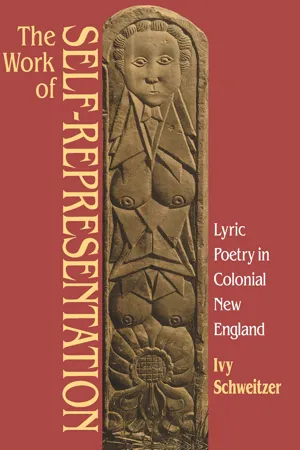
In The Work of Self–Representation Ivy Schweitzer examines early American poetry through the critical lens of gender. Her concern is not the inclusion of female writers into the canon; rather, she analyzes how the metaphors of “woman” and “feminine” function in Puritan religious and literary discourse to represent both the “otherness” of spiritual experience and the ways in which race and class function to keep the “other” in marginalized positions.
Schwetizer argues that gender was for seventeenth–century new England — and still is today — a basic and most politically charged metaphor for the differences that shape identity and determine cultural position. To glimpse the struggle between gender ideology and experience, Schweitzer provides close readings of the poetry of four New Englanders writing between the Great Migration and the first wave of the Great Awakening: John Fiske, Edward Taylor, Anne Bradstreet, and Roger Williams.
Schweitzer focuses exclusively on lyric poetry, she says, because a first–person speaker wrestling with the intricacies of individual consciousness provides fruitful ground for exploring the politics of voice and identity and especially problems of authority, intertextuality, and positionality. Fiske and Taylor define the orthodox tradition, and Bradstreet and Williams in different ways challenge it. Her treatment of the familiar poetry of Bradstreet and Taylor is solidly grounded in historical and literary scholarship yet suggestive of the new insights gained from a gender analysis, while discussions of Fiske and Williams bring their little–known lyric work to light.
Taken together, these poets' texts illustrate the cultural construction of a troubled masculinity and an idealized, effaced femininity implicit in the Puritan notion of redeemed subjectivity, and constitute a profoundly disturbing and resilient part of our Puritan legacy.
- 322 pages
- English
- ePUB (mobile friendly)
- Available on iOS & Android
eBook - ePub
About this book
Information
Chapter One: Introduction. Gendering the Universal: The Puritan Paradigm of Redeemed Subjectivity
The Puritan minister is pale and drawn in the wavering candlelight, his fine features sharpened by overwork and fatigue, and by a burning in the region of his heart that seems to consume him. A large Bible is open before him, and he writes feverishly, now clutching his quill compulsively, now casting beseeching eyes to heaven. All the while he hears, as if in a dream he cannot shake off, that woman, Hester Prynne, demanding of him in a tone that is both stern and tender, “And what hast thou to do with all these iron men, and their opinions? They have kept thy better part in bondage too long already!” (Hawthorne, Scarlet Letter, 142). Arthur Dimmesdale, Hawthorne’s young Puritan clergyman, replies disconsolately that he is “powerless” to “quit my post, though an unfaithful sentinel.” Returning to his room, he pours his remaining passion into composing the “election” sermon he will deliver the following day, shortly before his death. Presumably, after his death he enters heaven (which has before it a large wood-and-iron door to keep out all those not predestined to enter), leaving Hester alone to bear the letter of the iron men—and transform it.
Nathaniel Hawthorne’s portrait of the young minister captures and exaggerates the effect of the colonial Puritan patriarchy upon its “sons” and rising stars. As Hester’s minister, Dimmesdale is accountable for her soul; as her lover, he is accountable for her heart and the child they produce. Yet in the excruciating irony of the first scene, Dimmesdale, dramatically positioned up above the crowd though more cowardly and hypocritical than anyone, exhorts his “charge” to publicly reveal the name of her partner in sin—a confession he prays she will not make. “Wondrous strength and generosity of a woman’s heart! She will not speak!” he discovers with relief (53). Because of her silence, his passion, his paternity, and his sin go unrevealed. In this dramatic moment, what he believes and what he feels are completely at odds.
Students invariably find Hester a stronger, more “masculine” figure than her beleaguered lover, and they wonder what she could have possibly seen in a “wimp” like Dimmesdale. Hawthorne suggests that the blame falls upon grizzled old men like Dimmesdale’s senior colleague, the Reverend John Wilson, for whom kindness was, “in truth, rather a matter of shame than self-congratulation,” and who, therefore, had no “right” to “meddle with a question of human guilt, passion, and anguish” (50). In “The Custom-House,” the apparently autobiographical introduction to the tale, Hawthorne likewise accuses his “grave, bearded, sable-cloaked, and steeple-crowned … stern and black-browed” Puritan ancestors of being bitter persecutors, especially of women. Although these progenitors “had all the Puritanic traits, both good and evil,” they are remembered mainly for their cruelties, a quirk of history that impels Hawthorne as their representative to “take shame upon myself for their sakes” and remove the curse their sins have brought upon “the race” (11). In order to expiate these sins, Hawthorne loses his head—that is, his sinecure in the patriarchal world of the Custom House, his businesslike, purely mental, and masculine self-image—and becomes, through humiliation, the bearer of his society’s passionate and tenderer sentiments, the antithesis of his iron-visaged forebears—“a literary man” (36).
Even with a mother for its hero, The Scarlet Letter has been read as the archetypal American story of an individualist, a dissenter, a culturally masculine figure.1 As an important recent investigation into “manhood and the American Renaissance” contends, implicit in the “Introductory” and in The Scarlet Letter itself is Hawthorne’s exposure of conventional manliness “as unnatural and potentially persecuting, epitomized in his heartless Puritan ancestors” (Leverenz, Manhood, 36). We can question the historical verity of Hawthorne’s account of his Puritan precursors and the lurid tale he concocts to mitigate their doleful influence upon his own temperament. My concern, however, is not with “reality” but with representation, for out of representations “realities” are constructed. The characterization of the Puritanism of colonial New England as both pervasively masculine and cruel remains fixed in our national imagination. These were stern, mirthless men pursuing an otherworldly ideal that led them to excoriate all the softness and pleasures of the fallen world.2
A belief and practice dominated by men and doomed to failure without the mollifying feminine presence of the Virgin Mary, according to Walter J. Ong and others,3 colonial Puritanism has also been presented as an intellectual, as opposed to an emotional, phenomenon. Perry Miller’s monumental exposition of the New England mind, for all the banked-down fires of Augustinian mysticism he spies within, leaves the impression of coldly rational Ramist logicians who fanatically organized and abstracted their universe through the intricate scheme of technologia; only two women appear to have contributed to that compendious mind, and one of them negatively—the “poor,” misguided Mistress Hutchinson (Mind, 1:389).4 Since Miller’s ground-breaking work, a considerable amount of scholarship has concentrated on Puritan spirituality. Indeed, a recent trend reemphasizes the affective side of the Puritan experience. Charles Hambrick-Stowe, for example, studies the official ministerial and popular versions of devotional literature that emerged in New England, concluding that “Puritanism was as affective as it was rational. … Indeed, the particular forms of public worship and the characteristic private devotional exercises were what made a Puritan a Puritan” (viii). Nevertheless, the sword- and Bible-wielding Judge Hathornes still crowd out the dreamy, angel-voiced Arthur Dimmesdales.
A closer look at Hambrick-Stowe’s methodology will help to clarify the problematics. He begins his study with four “vignettes” of spirituality from “representative” Puritans: Captain Roger Clap, a militiaman; the Reverend Thomas Shepard, first pastor of the Cambridge Church; Samuel Sewall, a prominent Boston merchant; and Anne Bradstreet, a poet who was the daughter of one governor of the commonwealth and the wife of another. Confident that this group is “diverse,” Hambrick-Stowe offers examples from the private writings of each and finds that “all but Sewall, whom we left in the midst of anxiety and spiritual humiliation, experienced an ecstatic resolution and release of the tension that attended the onset of their devotions. Surprisingly,” he continues, “the words all spontaneously used to express outwardly the fire that burned within came from the poetry of the Song of Songs and the associated bridegroom imagery used by Jesus. The feeling of being ravished by Christ, the Great Lover of the mystical tradition, the Bridegroom, was clearly not unique to Edward Taylor, whose poetry seemed so un-Puritan to scholars only a few years ago.” Neglecting to pursue the implications of this conventional imagery, Hambrick-Stowe concludes that the experiences of this group “were characteristic of common practice,” which was indeed highly “affective” (20).
Hambrick-Stowe’s “surprise” at the uniformity of choice among these representative Puritans in their expressions of piety is itself surprising, since orthodox Puritan doctrine disseminated a specific discourse for religious experiences that laypeople and saints from all quarters embraced as their own. The definition of orthodoxy is, after all, drawing a line around experience and interpretation and declaring everything outside of that circle heresy. The metaphor of the soul’s betrothal in marriage to Christ was so pervasive, according to Edmund S. Morgan, because “marriage, which the Puritans regarded as the highest relationship between mortals, was generally accepted as the closest comparison to the believer’s union with God” (Puritan Family, 162). “It is a marriage-covenant that we make with God,” declared Peter Bulkeley, and he concluded, “therefore we must doe as the Spouse doth, resigne up our selves to be ruled and governed accordingly to his will” (Gospel Covenant, 50; quoted in Morgan, Puritan Family, 161). The Puritan clergy applied this basic metaphor to the whole gamut of spiritual relations. Like a lover, Christ wooed the soul, which resisted like a coy woman “full of whorish and adulterous lusts” (John Cotton, Practical Commentary upon John, 227; quoted in Morgan, Puritan Family, 163). Ministers served as the “friends” of the bridegroom who customarily helped arrange the match between the soul and Christ. Extending the metaphor to the entire Church community, John Cotton compared congregational worship to the sexual love of a married couple: “The publick Worship of God is the bed of loves: where, 1. Christ embraceth the souls of his people, and casteth into their hearts the immortal seed of his Word, and Spirit, Gal. 4.19. 2. The Church conceiveth and bringeth forth fruits to Christ” (A Brief Exposition … of Canticles, 209; quoted in Morgan, Puritan Family, 164). Cotton’s metaphor spiritualizes female physiology and applies it to the souls and hearts of the congregation, which become spiritual wombs impregnated by God’s inseminating Word and bearing the new birth of conversion.
Sermons and learned treatises were not the only places this discourse appeared. It was familiar and common among laypeople as well. No less eminent a personage than John Winthrop readily cast himself in a feminine role in describing his “intercourse” with Christ. Looking over letters that passed between himself and Mary Forth, his first wife,
and beinge thereby affected wth the remembrance of that entire & sweet love that had been sometymes betweene us, God brought me by that occasion in to suche a heavenly meditation of the love betweene Christ & me, as ravished my heart wth unspeakable ioye; methought my soule had as familiar and sensible society wth him, as my wife could have wth the kindest husbande; I desired no other happinesse but to be embraced of him; I held nothinge so deere that I was not willinge to parte wth for him; I forgatt to looke after my supper, & some vaine things that my heart lingered after before; then came such a calme of comforte over my heart, as revived my spirits, sett my minde & conscience at sweet liberty & peace. (Life and Letters, 1:105)
Winthrop evidently took his late wife’s experiences with “the kindest husbande” as a model for his own desires toward Christ—desires to be embraced, to make sacrifices, to be the recipient of love. His recollection of “that entire & sweet love” between them, a love in which Winthrop as husband played the traditional role of guardian, teacher, and breadwinner, brings on his rapturous intimacy with God. In the present moment, however, he experiences himself, not in the custodial and dominant role of husband, but in the submissive and obedient role of wife. From his memory of his earthly marriage to his present meditation on God, a radical transformation in his self-conception has occurred. In moving between the supposedly analogous relationships of husband and wife, man and God, Winthrop moves from the dominant to the subordinate position, from masculine to feminine. Even what he forgets to do in his rapturous contemplation is feminized: “look after my supper, and some vaine things. …”
So familiar and necessary did this discourse become that Samuel Sewall, who in Hambrick-Stowe’s example avoided this metaphor because of his nagging doubts, at another time complained to his journal when an English minister failed to use it: “March 10, 1688/9 would have heard mr. Goldwire, but mr. Beaumont the Minister of Faream preached from Ps. 45, 15. Doct. Interest and Duty of Christians to rejoice in Christ made good profitable Sermons; but I think might have been more so, if had us’d the Metaphor of Bridegroom and Bride, which heard not of” (Hambrick-Stowe, 108). The pious New Englander knows his Bible well. Psalm 45 is styled “a love song” and strongly resembles the Song of Songs, the Puritans’ major scriptural source for the marriage metaphor. The psalm addresses a “King” and a virgin daughter who is to be his bride. Clearly, Sewall was accustomed to hearing this metaphor used to describe an obedient Christian’s joy in Christ. Indeed, as Hambrick-Stowe discovers, colonial Puritans in their devotional literature turned frequently to the marriage metaphor to express their deepest spiritual longings. The clergy encouraged this, employing the metaphor as a crucial part of orthodox discourse—a discourse intended, as Sacvan Bercovitch has shown in The Puritan Origins of the American Self, to create a homogeneity of belief and behavior, if not the illusion of it.5 The notion of a cultural consensus painstakingly built by the leaders of New England was promulgated by early literary historians of the period, but it has been challenged by recent scholarship, which finds a healthy diversity of opinion among the early settlers. The following examination of the Puritan discourse of spiritual marriage contributes to that trend by considering the implications of gender positioning within the discourse, and suggesting how the discourse constructs a rhetoric of the “American self” that, by definition, contains the seeds of its own subversion.
Though often touted as the origin of American individualism, New England Puritanism succeeded precisely to the extent that it quelled the subjectivism implicit in its own doctrines. In their first three decades, the conservative clergy of New England evolved and instituted a form of Puritanism that checked the individualizing tendencies of Reformation thought with what Bercovitch calls “powerful counter-subjectivist” moves. The individual had gained a new prominence through Martin Luther’s two central principles: sola fides, “which removes the center of authority from ecclesiastical institutions and relocates it in the elect soul” (Bercovitch, Puritan Origins, 10), and sola scriptura, whereby “the Bible was made universally available and declared to be sole authority, [and] every man became his own exegete” (28). In order to bolster the bulwarks against the anarchy its doctrines threatened to unleash, the Puritan orthodoxy promulgated a radical interpretation of the imitatio Christi and invented and disseminated exemplum fidei. Ideally, the elect soul had little to do with the person and body it inhabited. The saint strove beyond a mere imitation of Christ for a “Christie identity” that reconstituted his fallen self as a saved soul; he became an exemplar of faith and was knitted into the church of the redeemed. Likewise, a saint’s reading of scripture was to be not personal or idiosyncratic but “Christological”: “Like Christ, the Bible could be rightly perceived only by one who had transformed himself in His image. … Interpreter and text confirmed one another in their mutual imitatio” (28). Not only did these countermoves encourage “a schizophrenic single-mindedness” and express “a sweeping rejection of individuality,” but they demonstrate the Puritans’ massive attempt to enforce a “regimentation of selfhood” (28).
Every culture provides its members with “organizing fictions” or “ideologies” that define their relations to other people and the world around them, and that teach them the discourses and the social codes upon which cultural meanings and a sense of self are based. This social and historical construction of selfhood is called subjectivity, the ongoing ideological process of recruiting individuals and transforming them into subjects who are shaped by, and maintain the set of values held by, the group or class in power.6 Puritanism, and the particular brand of non-separating Congregationalism practiced by the colonial Puritans, was a religious ideology that, as Darrett B. Rutman so perceptively points out, used language, rituals, and peer pressure to form and maintain the identities of its adherents (114–20). To paraphrase British cultural studies theorist John Fiske, the individual is produced by nature, the subject is constructed by culture, and, according to Puritan divines, the saint is regenerated by grace (258).
Saints were born, like everyone else, as individuals and acquired what they might have called “fallen subjectivity” by being, for example, English and Anglican. To become saints, they had to repudiate, at least in words and actions, those former states so that God might begin to produce in them what I call a state of “redeemed subjectivity,” replacing the “old man in Adam” with the “new man in Christ.” The apostle Paul identified the various stages of this process in his much-cited letter to the Romans; emphasizing God as the active principle in the formation of the redeemed subject, he declared authoritatively: “For whom he did foreknow, he also did predestinate to be conformed to the image of his Son, that he might be the firstborn among many brethren. Moreover, whom he did predestinate, them he also called: and whom he called, them he also justified: and whom he justified, them he also glorified” (8:29–30). Theologians expounded upon Paul’s statement as a paradigm for the experience of grace, ministers never tired of explicating the stages of salvation for their audiences, and saints anxiously measured their own personal experiences against this timeless and fixed model. As Morgan comments, “It is impossible to say whether the pattern of Puritan spiritual experience was produced by the prescriptions of men like Perkins and Hildersam [prominent English Puritan theologians], or whether the prescription was itself based on experience” (Visible Saints, 71). In either case, Puritan conversion experiences replicate Paul’s paradigm. Even poets of widely defined Protestant persuasions took it as a major structural and thematic influence (Lewalski, 13–14), though it was the Calvinists who honed it to a fine spiritual art.
The process of turning oneself from self to God regiments selfhood by attempting to obliterate the diversity of fallen selves and replace it with one single, absolute Self. It is a harrowing process, for it involves nothing less than a loathing, a denunciation, and finally an effacement of human and worldly selfhood. Such self-effacement requires a violence vividly communicated in Bercovitch’s seemingly endless citations from Puritan texts. From St. Augustine, who would root out “self-love in contempt of God” by sowing in its place “love of God in contempt of one’s self,” to John Calvin, who demands that we “rid our selves of all selfe-trust,” to Thomas Hooker, who urges “Not what Selfe will, but what the Lord will,” Puritan divines regaled their audiences with the horrors of Self. Richard Baxter declared: “Man’s fall was his turning from God to himself; and his regeneration consisteth in the turning of him from himself to God. … The very names of Self and Own, should sound in the watchful Christian’s ears as very terrible, wakening words, that are next to the names of sin and satan” (Puritan Origins 17–18).
Orthodox New England Puritans made crucial innovations in the content of, and especially in the use to which they put, the paradigm of conversion. Why they needed such a handy form of social control is part of a complex historical account, which I can only touch upon here. In the course of institutionalizing Puritanism’s concept of the “true revolution of the saints,” between 1633 and 1635 New En...
Table of contents
- Cover Page
- The Work of Self-Representation
- Copyright Page
- Dedication
- Contents
- Acknowledgments
- Chapter One: Introduction. Gendering the Universal: The Puritan Paradigm of Redeemed Subjectivity
- Chapter Two: The Paradox of “Practical Conformity”: John Fiske’s “Elegy” on John Cotton
- Chapter Three: The Puritan Cult of the Spouse: Edward Taylor’s Dialectic of Difference
- Chapter Four: Anne Bradstreet: “In the place God had set her”
- Chapter Five: Roger Williams’s Key: A Gynesis of Race
- Epilogue
- Notes
- Works Cited
- Index
Trusted by 375,005 students
Access to over 1.5 million titles for a fair monthly price.
Study more efficiently using our study tools.
Frequently asked questions
Yes, you can cancel anytime from the Subscription tab in your account settings on the Perlego website. Your subscription will stay active until the end of your current billing period. Learn how to cancel your subscription
No, books cannot be downloaded as external files, such as PDFs, for use outside of Perlego. However, you can download books within the Perlego app for offline reading on mobile or tablet. Learn how to download books offline
Perlego offers two plans: Essential and Complete
- Essential is ideal for learners and professionals who enjoy exploring a wide range of subjects. Access the Essential Library with 800,000+ trusted titles and best-sellers across business, personal growth, and the humanities. Includes unlimited reading time and Standard Read Aloud voice.
- Complete: Perfect for advanced learners and researchers needing full, unrestricted access. Unlock 1.5M+ books across hundreds of subjects, including academic and specialized titles. The Complete Plan also includes advanced features like Premium Read Aloud and Research Assistant.
We are an online textbook subscription service, where you can get access to an entire online library for less than the price of a single book per month. With over 1.5 million books across 990+ topics, we’ve got you covered! Learn about our mission
Look out for the read-aloud symbol on your next book to see if you can listen to it. The read-aloud tool reads text aloud for you, highlighting the text as it is being read. You can pause it, speed it up and slow it down. Learn more about Read Aloud
Yes! You can use the Perlego app on both iOS and Android devices to read anytime, anywhere — even offline. Perfect for commutes or when you’re on the go.
Please note we cannot support devices running on iOS 13 and Android 7 or earlier. Learn more about using the app
Please note we cannot support devices running on iOS 13 and Android 7 or earlier. Learn more about using the app
Yes, you can access The Work of Self-Representation by Ivy Schweitzer in PDF and/or ePUB format, as well as other popular books in Literature & Literary Criticism in Poetry. We have over 1.5 million books available in our catalogue for you to explore.