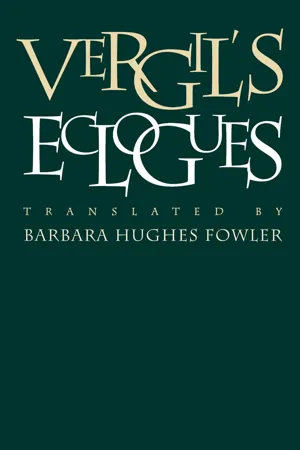
Best remembered for his unfinished epic, the Aeneid, the poet Vergil was celebrated in his time both for the perfection of his art and for the centrality of his ideas to Roman culture. The Eclogues, his earliest confirmed work, were composed in part out of political considerations: when the Roman authorities threatened to seize his family’s land, Vergil’s appeal in the form of Eclogue IX won a stay. Eclogue I appears to be a thank-you for that favor. Barbara Hughes Fowler provides scholars and students with a new American verse translation of Vergil’s Eclogues. An accomplished translator, Fowler renders the poet’s words into an English that is contemporary while remaining close to the spirit of the original. In an introduction to the text, she compares the treatment of the pastoral form by Vergil and Theocritus, illuminating the ways in which Vergil borrowed from and built upon the earlier poet’s work, and thereby moved the genre in a new direction.
- 65 pages
- English
- ePUB (mobile friendly)
- Available on iOS & Android
eBook - ePub
Vergil's Eclogues
About this book
Information
Notes
The line numbers in the notes refer to my translation rather than to the Latin text. My translation is almost but not quite line for line. Crossreferences to other notes cite the eclogue number and line number (I.6n meaning, for example, the note to the sixth line of Eclogue I).
ECLOGUE I
1 Tityrus. A slave who has at last bought his freedom and has been successful in his plea to Octavian to restore to him the land that had been allotted to Antony’s soldiers. See the Introduction. The name is Greek and is taken from Theocritus.
5 Amaryllis. A girl, probably a slave. The name is taken from Theocritus.
6 Meliboeus. A Roman citizen who has lost his lands to the confiscations and is forced to go into exile. The name is Greek but is not from Theocritus.
7 He’ll always be a god to me refers to the young Octavian. See the Introduction.
30 Galataea. In Theocritus an ocean nymph wooed by the Cyclops but here presumably another slave girl.
55 Hyblaean. Refers to the city Megara Hyblaea, slightly north of Syracuse in Sicily, which was known for its excellent honey.
63 Parthian. A native of Parthia, a country of Asia southeast of the Caspian Sea. The Parthians were a notoriously warlike people whose tactics included surrounding the enemy and pouring in upon them a shower of darts and then fleeing while shooting their arrows backward upon the enemy. Their empire extended over Asia from the Euphrates to the Indus, from the Indian Ocean possibly to the Oxus River. Antony campaigned unsuccessfully against the Parthians in 36 B.C.
63 Arar. A river of Germany.
64 Babylonian Tigris. One of the great rivers of Babylonia (modern Iraq). “Babylonian” does not appear in the Latin text. I added it for the sake of the meter.
67 Scythia. A region of western Asia north of the Black and Caspian Seas.
67 Oaxes. Possibly the river Oxus in central Asia, now the Amu-Dar’ya, which flows into the Aral Sea, “a remote and fabulous river of which V. can have had only the vaguest notion” (W. Clausen, A Commentary on Vergil, Eclogues [Oxford, 1994], 56 on 65).
ECLOGUE II
This eclogue is modeled after Theocritus’s Idyll XI, in which the grotesque Cyclops woos the lovely sea nymph Galataea. Here a simple shepherd laments his love for a slave boy who is being kept by their common master.
1 Corydon. A shepherd. In Theocritus, Idyll IV, the name belongs to a cowherd.
6 Alexis. A slave boy. Alexis is a traditional name for a catamite.
15 Amaryllis. See I.5n.
16 Menalcas. Evidently a boy with whom Corydon was once in love. The name is taken from Theocritus, Idyll VIII.
24 Amphion of Dirce. Amphion was a son of Zeus and Antiope, reared by shepherds and famous for his playing of the lyre. He was said to have built the walls of Thebes with his music: the stones moved into place as he played. Dirce was a fountain near Thebes, in central Greece.
25 Actaean Aracynthus. Actaean refers to Attica, in central Greece. Vergil seems to think that the mountain Aracynthus was located on the border between Attica and Boeotia to the north, but we know of no mountain of that name in that location. There was a Mount Aracynthus in Acarnania, in western Greece.
28 Daphnis. A name taken from Theocritus and used in Vergil for an idealized shepherd, beloved by Pan. In Theocritus he is a cowherd. In Idyll I, he is dying of an unnamed love; in Idyll VII, of love for a girl named Xenea.
32 Pan. A Greek god of shepherds and flocks, usually a son of Hermes. He originally belonged to Arcadia, of the Peloponnesus, in southern Greece. He invented the shepherd’s pipe. In art he is often portrayed as snub-nosed, horned, and with goat’s feet.
36 Amyntas. In Theocritus, Idyll VII, a real person but in Vergil a fictional shepherd.
38 Damoetas. Also a fictional person. In Theocritus, Idyll VI, he impersonates the Cyclops.
47 naiad. A nymph of fresh water: rivers, springs, lakes, and brooks.
63 Paris of Troy. The son of Priam and Hecuba, who stole Helen and thus caused the Trojan War. He was brought up as a shepherd on Mount Ida in Asia Minor.
63 Pallas Athene. The Greek goddess of wisdom and war. She is often referred to as guardian of the city, especially of Athens.
ECLOGUE III
In this eclogue, two shepherds, Menalcas and Damoetas, meet and agree to engage in a singing contest. After deciding what each shall wager, they invite Palaemon, who is passing by, to be their judge. The poem is modeled after Theocritus, Idylls IV and V.
1 Damoetas. The name is taken from Theocritus, Idyll VI. The character is imaginary.
1 Meliboeus. See I.6n.
2 Aegon. Damoetas’s master.
4 Neaera. A name long associated with easy virtue.
10 Micon. The name is taken from Theocritus, Idyll IV.
14 Menalcas. See II.16n.
16 Damon. A fictional character.
17 Lycisca. The name properly belongs to a mongrel bitch.
36 Alcimedon. A fictional artist.
39 Conon. A Samian astronomer and mathematician who lived and worked in Alexandria, Egypt.
45 Orpheus. A legendary musician of Thrace, in northern Greece, who accompanied the Argonauts. Given the lyre by Apollo and taught by the Muses, he charmed the wild beasts, trees, and rocks upon Olympus to follow him.
49 Palaemon. Another fictional character.
59 Jove. Jupiter, the king of the gods.
61 Phoebus. Apollo. See below, 103n.
66 Delia. A slave name.
75 Phyllis. A fictional girl.
75 Iollas. A non-Theocritean name. In Eclogue II he was the shepherd’s master.
83 Pollio. C. Asinius Pollio. He had supported Caesar and later Antony, and in 41 B.C. the latter appointed him legate of Cisalpine Gaul (northern Italy). It may have been then that he became acquainted with Vergil and urged him to try his hand at pastoral poetry. He was a patron of poets and himself a poet. See also the Introduction.
84 Pierides. The Muses, so named from their early home, Pieria, on the southeast coast of Macedonia, in northern Greece.
89 Bavius and Maevius, two real poets of whom we know nothing further.
103 Apollo. God of music and light.
ECLOGUE IV
This eclogue is not truly a pastoral. That is why Vergil suggests to the Sicilian Muses (1) that he sing a somew...
Table of contents
- Cover Page
- Vergil’s Eclogues
- Copyright Page
- Dedication
- Contents
- Acknowledgments
- Introduction
- Eclogue I
- Eclogue II
- Eclogue III
- Eclogue IV
- Eclogue V
- Eclogue VI
- Eclogue VII
- Eclogue VIII
- Eclogue IX
- Eclogue X
- Notes
Trusted by 375,005 students
Access to over 1.5 million titles for a fair monthly price.
Study more efficiently using our study tools.
Frequently asked questions
Yes, you can cancel anytime from the Subscription tab in your account settings on the Perlego website. Your subscription will stay active until the end of your current billing period. Learn how to cancel your subscription
No, books cannot be downloaded as external files, such as PDFs, for use outside of Perlego. However, you can download books within the Perlego app for offline reading on mobile or tablet. Learn how to download books offline
Perlego offers two plans: Essential and Complete
- Essential is ideal for learners and professionals who enjoy exploring a wide range of subjects. Access the Essential Library with 800,000+ trusted titles and best-sellers across business, personal growth, and the humanities. Includes unlimited reading time and Standard Read Aloud voice.
- Complete: Perfect for advanced learners and researchers needing full, unrestricted access. Unlock 1.5M+ books across hundreds of subjects, including academic and specialized titles. The Complete Plan also includes advanced features like Premium Read Aloud and Research Assistant.
We are an online textbook subscription service, where you can get access to an entire online library for less than the price of a single book per month. With over 1.5 million books across 990+ topics, we’ve got you covered! Learn about our mission
Look out for the read-aloud symbol on your next book to see if you can listen to it. The read-aloud tool reads text aloud for you, highlighting the text as it is being read. You can pause it, speed it up and slow it down. Learn more about Read Aloud
Yes! You can use the Perlego app on both iOS and Android devices to read anytime, anywhere — even offline. Perfect for commutes or when you’re on the go.
Please note we cannot support devices running on iOS 13 and Android 7 or earlier. Learn more about using the app
Please note we cannot support devices running on iOS 13 and Android 7 or earlier. Learn more about using the app
Yes, you can access Vergil's Eclogues by Barbara Hughes Fowler in PDF and/or ePUB format, as well as other popular books in Literature & Ancient & Classical Literary Criticism. We have over 1.5 million books available in our catalogue for you to explore.