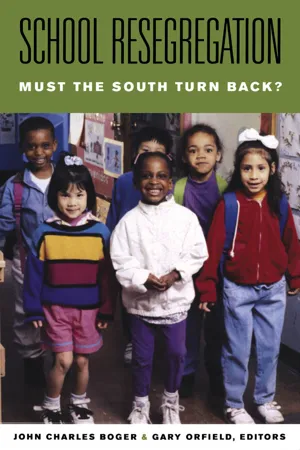
Confronting a reality that many policy makers would prefer to ignore, contributors to this volume offer the latest information on the trend toward the racial and socioeconomic resegregation of southern schools. In the region that has achieved more widespread public school integration than any other since 1970, resegregation, combined with resource inequities and the current “accountability movement,” is now bringing public education in the South to a critical crossroads.
In thirteen essays, leading thinkers in the field of race and public education present not only the latest data and statistics on the trend toward resegregation but also legal and policy analysis of why these trends are accelerating, how they are harmful, and what can be done to counter them. What’s at stake is the quality of education available to both white and nonwhite students, they argue. This volume will help educators, policy makers, and concerned citizens begin a much-needed dialogue about how America can best educate its increasingly multiethnic student population in the twenty-first century.
Contributors:
Karen E. Banks, Wake County Public School System, Raleigh, N.C.
John Charles Boger, University of North Carolina School of Law
Erwin Chemerinsky, Duke Law School
Charles T. Clotfelter, Duke University
Susan Leigh Flinspach, University of California, Santa Cruz
Erica Frankenberg, Harvard Graduate School of Education
Catherine E. Freeman, U.S. Department of Education
Jay P. Heubert, Teachers College, Columbia University
Jennifer Jellison Holme, University of California, Los Angeles
Michal Kurlaender, Harvard Graduate School of Education
Helen F. Ladd, Duke University
Luis M. Laosa, Kingston, N.J.
Jacinta S. Ma, U.S. Equal Employment Opportunity Commission
Roslyn Arlin Mickelson, University of North Carolina at Charlotte
Gary Orfield, Harvard Graduate School of Education
Gregory J. Palardy, University of Georgia
john a. powell, Ohio State University
Sean F. Reardon, Stanford University
Russell W. Rumberger, University of California, Santa Barbara
Benjamin Scafidi, Georgia State University
David L. Sjoquist, Georgia State University
Jacob L. Vigdor, Duke University
Amy Stuart Wells, Teachers College, Columbia University
John T. Yun, University of California, Santa Barbara
eBook - ePub
School Resegregation
Must the South Turn Back?
- 400 pages
- English
- ePUB (mobile friendly)
- Available on iOS & Android
eBook - ePub
School Resegregation
Must the South Turn Back?
About this book
Information
Topic
EducationSubtopic
Educational PolicyPART ONE
The History of the Federal Judicial Role
From Brown to Green to Color-Blind
CHAPTER ONE
ERWIN CHEMERINSKY
The Segregation and Resegregation
of American Public Education
The Courts’ Role
A half century of efforts to end school segregation have largely failed. Gary Orfield’s powerful recent study, Schools More Separate: Consequences of a Decade of Resegregation, carefully documents that during the 1990s, America’s public schools have become substantially more segregated. In the South, for example, he shows that from “1988 to 1998, most of the progress of the previous two decades in increasing integration in the region was lost. The South is still more integrated than it was before the civil rights revolution, but it is moving backward at an accelerating rate.”1 ”
The statistics presented in his study are stark. For example, the percentage of African American students attending majority white schools has steadily decreased since 1986. In 1954, at the time of Brown v. Board of Education, only 0.001 percent of African American students in the South attended majority white schools.2 In 1964, a decade after Brown, this number had increased to just 2.3 percent. From 1964 to 1988, however, significant progress occurred: the figure grew to 13.9 percent in 1967, 23.4 percent in 1968, 37.6 percent in 1976, 42.9 percent in 1986, and 43.5 percent in 1988. But since 1988, the percentage of African American students attending majority white schools has declined. By 1991, the percentage of African American students attending majority white schools in the South had decreased to 39.2 percent, and over the course of the 1990s this number dropped even more, reaching 36.6 percent in 1994, 34.7 percent in 1996, and 32.7 percent in 1998.3
Orfield’s study shows that the nationwide percentage of African American students attending majority African American schools and schools where more than 90 percent of the students are African American also has increased in the past fifteen years. In 1986, 62.9 percent of African American students attended schools that were 50–100 percent nonwhite; by 1998–99, this number had increased to 70.2 percent.4
Quite significantly, Orfield’s study shows that the same pattern of resegregation is true for Latino students.5 Desegregation efforts have historically focused on integrating African American and white students, but the burgeoning Latino population requires attention, too.6 The percentage of Latino students attending schools where the majority of students are of minority races or where students are almost exclusively of minority races increased steadily during the 1990s. Or-field notes that Latinos “have been more segregated than blacks now for a number of years, not only by race and ethnicity but also by poverty.”7
The simple and tragic reality is that American schools are separate and unequal. As Orfield documents, to a very large degree, education in the United States is racially segregated.8 By any measure, predominantly minority schools are not equal in their resources or their quality. Wealthy suburban school districts are almost exclusively white; poor inner-city schools are often attended exclusively by African American and Hispanic students. The year 2004 was the fiftieth anniversary of Brown v. Board of Education, and American schools marked that occasion with increasing racial segregation and gross inequality.
There are many causes for the failure of school desegregation. None of the recent presidents — Reagan, George H. W. Bush, and even Clinton — have done anything to advance desegregation. None have used the powerful resources of the federal government, including the dependence of every school district on federal funds, to further desegregation. “Benign neglect” would be a charitable way of describing recent presidents’ attitudes toward the problem of segregated and unequal education: the issue has been neglected, but nothing about this neglect has been benign. A serious social problem that affects millions of children has simply been ignored.
The federal government — and, for that matter, state and local governments — also have failed to act to solve the problem of housing segregation. In a country deeply committed to the ideal of the neighborhood school, residential segregation often produces school segregation. But decades have passed since the enactment of the most recent law to deal with housing discrimination,9, and efforts to enhance residential integration seem to have vanished.
There is no simple explanation for the alarming trend toward resegregation. In this chapter, I argue that the courts must share the blame: courts could have done much more to bring about desegregation, but the judiciary has instead created substantial obstacles to remedying the legacy of racial segregation in schools. I do not want to minimize the failure of political will, but every branch and level of government is responsible for the failure to desegregate American public education. I contend that Supreme Court decisions over the past thirty years have substantially contributed to the resegregation that Orfield and others document.
Desegregation will not occur without judicial action: desegregation lacks sufficient national and local political support for elected officials alone to remedy the problem. Specifically, African Americans and Latinos lack adequate political power to achieve desegregation through the political process. This relative political powerlessness was true when Brown was decided and remains true today. The courts are indispensable to effective desegregation, and over the past thirty years the courts, especially the Supreme Court, have failed. To be sure, as I discuss later in this chapter, individual court orders have brought about desegregation in many areas of the country. Courts could have done more, but even merely continuing rather than ending existing desegregation orders (as the Supreme Court has mandated) would have limited resegregation of southern schools.
This chapter focuses on two major sets of Supreme Court decisions that have contributed to resegregation. I will first examine the Supreme Court’s decisions of the 1970s, especially those decisions rejecting interdistrict solutions to segregation and funding inequities.10 Second, I will turn to the Supreme Court’s decisions of the 1990s ordering an end to desegregation efforts.11 These cases and subsequent lower court decisions have substantially contributed to resegregation of public schools. The third part of the chapter looks at why this judicial failure has occurred.
Some commentators, including Gerald Rosenberg, have argued that the failure to achieve desegregation reflects inherent limits on judicial power.12 I strongly disagree: the judiciary’s failure instead lies in its actions. Had the Supreme Court decided key cases differently, the nature of public education today would be very different. Although segregated schools have many causes, the overarching explanation for the Court’s rulings is simple: justices appointed by Republican presidents have undermined desegregation. Four justices appointed by President Richard Nixon are largely to blame for the decisions of the 1970s: the crucial cases were 5–4 decisions, with those four justices helping to make up the majority.13 Five justices appointed by Presidents Ronald Reagan and George H. W. Bush are responsible for the decisions of the 1990s that have contributed substantially to resegregation of schools.14 The resegregation of schools has resulted largely from the Court’s decisions, not from the inherent limits of the judicial process.
Today, there are voices — often strong voices — in minority communities that have turned against desegregation as the solution. The rejection of desegregation as a policy objective very much results from the lack of success — and possible success — given the current realities of desegregation described in this chapter. In cities with minority populations of 80–90 percent, meaningful desegregation just is not possible under current law. Understandably, many in these minority communities say that efforts at strengthening education should no longer focus on desegregation but should instead concentrate on improving schools for minority students. But history offers little reason for hope that dual school systems ever will be equal. As Thurgood Marshall expressed thirty years ago in a prophetic dissent in Milliken v. Bradley (1974), “we deal here with the right of all children, whatever their race, to an equal start in life and to an equal opportunity to reach their full potential as citizens. Those children who have been denied that right in the past deserve better than to see fences thrown up to deny them that right in the future. Our nation, I fear, will be ill served by the Court’s refusal to remedy separate and unequal education, for unless our children begin to learn together, there is little hope that our people will ever learn to live together.”15 ”
The Decisions of the 1970s: The Supreme
Court Contributes to the Resegregation
of American Public Education
The 1970s were a particularly critical time in the battle to desegregate American schools. From Plessy v. Ferguson in 1896 until Brown in 1954, government-mandated segregation existed in every southern state and in many northern states. As mentioned earlier, in 1954, when Brown was decided, only 0.001 percent of the South’s African American students attended majority white schools. After Brown, southern states used every imaginable technique to obstruct desegregation. Some school systems attempted to close public schools rather than desegregate.16 Some school boards adopted “freedom of choice” plans, which allowed students to choose the school where they would enroll and resulted in continued segregation.17 In some places, school systems outright disobeyed desegregation orders.18 The phrase “massive resistance” appropriately describes what occurred during the decade after Brown. By 1964, in Griffin v. County School Board, the Supreme Court had grown tired of the delay, lamenting that there had been far too little speed, and ordered that all vestiges of prior segregation be eliminated “quick[ly] and effective[ly].”19
The result of this massive resistance was that a decade after Brown, little desegregation had occurred. In the South, just 1.2 percent of African American schoolchildren were attending schools with whites.20 In South Carolina, Alabama, and Mississippi, not one African American child attended a public school with a white child in th...
Table of contents
- Table of Contents
- List of Tables & Table of Figures
- Title Page
- Copyright Page
- Acknowledgments
- Introduction. - GARY ORFIELD
- PART 1 The History of the Federal Judicial Role: From Brown to Green to Color-Blind
- PART 2 The Color of Southern Schooling: Contemporary Trends
- PART 3 The Adverse Impacts of Resegregation
- PART 4 The New Pressures from Standardized Testing
- Conclusion. - JOHN CHARLES BOGER
- Bibliography
- Contributors
- Notes
Trusted by 375,005 students
Access to over 1.5 million titles for a fair monthly price.
Study more efficiently using our study tools.
Frequently asked questions
Yes, you can cancel anytime from the Subscription tab in your account settings on the Perlego website. Your subscription will stay active until the end of your current billing period. Learn how to cancel your subscription
No, books cannot be downloaded as external files, such as PDFs, for use outside of Perlego. However, you can download books within the Perlego app for offline reading on mobile or tablet. Learn how to download books offline
Perlego offers two plans: Essential and Complete
- Essential is ideal for learners and professionals who enjoy exploring a wide range of subjects. Access the Essential Library with 800,000+ trusted titles and best-sellers across business, personal growth, and the humanities. Includes unlimited reading time and Standard Read Aloud voice.
- Complete: Perfect for advanced learners and researchers needing full, unrestricted access. Unlock 1.5M+ books across hundreds of subjects, including academic and specialized titles. The Complete Plan also includes advanced features like Premium Read Aloud and Research Assistant.
We are an online textbook subscription service, where you can get access to an entire online library for less than the price of a single book per month. With over 1.5 million books across 990+ topics, we’ve got you covered! Learn about our mission
Look out for the read-aloud symbol on your next book to see if you can listen to it. The read-aloud tool reads text aloud for you, highlighting the text as it is being read. You can pause it, speed it up and slow it down. Learn more about Read Aloud
Yes! You can use the Perlego app on both iOS and Android devices to read anytime, anywhere — even offline. Perfect for commutes or when you’re on the go.
Please note we cannot support devices running on iOS 13 and Android 7 or earlier. Learn more about using the app
Please note we cannot support devices running on iOS 13 and Android 7 or earlier. Learn more about using the app
Yes, you can access School Resegregation by John Charles Boger, Gary Orfield, John Charles Boger,Gary Orfield in PDF and/or ePUB format, as well as other popular books in Education & Educational Policy. We have over 1.5 million books available in our catalogue for you to explore.