From 1933 to 1945, the Reich Chamber of Culture exercised a profound influence over hundreds of thousands of German artists and entertainers. Alan Steinweis focuses on the fields of music, theater, and the visual arts in this first major study of Nazi cultural administration, examining a complex pattern of interaction among leading Nazi figures, German cultural functionaries, ordinary artists, and consumers of culture. Steinweis gives special attention to Nazi efforts to purge the arts of Jews and other so-called undesirables.
Steinweis describes the political, professional, and economic environment in which German artists were compelled to function and explains the structure of decision making, thus showing in whose interest cultural policies were formulated. He discusses such issues as insurance, minimum wage statutes, and certification guidelines, all of which were matters of high priority to the art professions before 1933 as well as after the Nazi seizure of power. By elucidating the economic and professional context of cultural life, Steinweis helps to explain the widespread acquiescence of German artists to artistic censorship and racial 'purification.' His work also sheds new light on the purge of Jews from German cultural life.
eBook - ePub
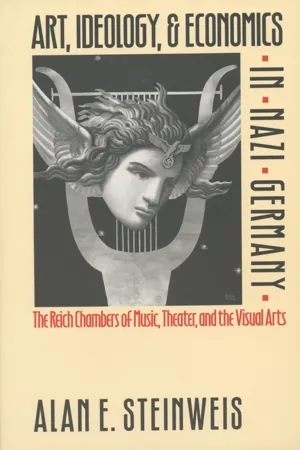
Art, Ideology, and Economics in Nazi Germany
The Reich Chambers of Music, Theater, and the Visual Arts
- 244 pages
- English
- ePUB (mobile friendly)
- Available on iOS & Android
eBook - ePub
Art, Ideology, and Economics in Nazi Germany
The Reich Chambers of Music, Theater, and the Visual Arts
About this book
Information
Topic
HistoireSubtopic
Histoire de l'AllemagneCHAPTER ONE: ART AND CULTURE IN THE WEIMAR REPUBLIC THE ECONOMIC, INSTITUTIONAL, AND POLITICAL CONTEXT
By 1933, Germany's long tradition as a land of kultur had left its mark on the occupational structure of the nation. In the Weimar Republic, the number of Germans officially designated as artists or entertainers exceeded the combined figures for those designated as doctors and lawyers. Despite ambiguous census categories, a fairly precise quantitative profile of the German artistic and cultural professions can be reconstructed. According to the 1933 occupational census,1 the German work force contained 14,750 visual artists (painters, sculptors, illustrators, graphic artists); 36,088 architects, probably about one-third of whom engaged in “creative” design as opposed to purely technical tasks;2 84,362 musicians, music teachers, and Kapellmeister; 9,499 singers and voice teachers; 5,129 dancers and dance teachers; 10,264 actors; 1,070 theater directors; and 8,301 variety performers (Artisten). Especially in German cities, artistic and cultural enterprises served as significant sources of employment. Based on 1925 census figures, the art and culture professions, excluding technical and support personnel, accounted for an average of about 1 percent of all employment in German cities, and for even higher percentages in cultural centers like Dresden (1.14 percent), Karlsruhe (1.14 percent), Munich (2.04 percent), and, of course, the great cultural metropolis of Berlin (1.29 percent). In 1925, the Reich capital was home to over 28,000 employed artists.3
To be sure, the art professions were highly diffuse entities, characterized by status and income disparities far more severe than those typical of the so-called academic professions, such as medicine, law, education, and engineering. The label “musician” could be applied to anyone from a journeyman cabaret accompanist to the concertmaster of a major symphony orchestra; “actor” could signify a struggling two-bit player or the star of a major stage in Berlin or Munich; “painter” could designate an artist with an impressive list of exhibitions or an anonymous commercial graphic artist or even a street artist of questionable ability who earned quick cash by hawking postcards or watercolors, as Adolf Hitler once had. Depending on employment status, German artists could be classified in any of the main occupational categories of German society, namely wage earners (Arbeiter), salaried employees (Angestellte), civil servants (Beamte), or members of the free professions (freie Berufe). Whereas about 79 percent of musicians and about 95 percent of stage actors were either wage earners or salaried employees, 80 percent of painters and sculptors were independent free professionals. Many Germans whose official occupation was listed as one of the art occupations could not sustain themselves exclusively from artistic income; even in good times, a high percentage required additional sources of income in order to survive.
Despite such heterogeneity, the German art professions did possess clearly identifiable contours in the Weimar Republic, largely because political and economic conditions had compelled artists to organize and, within limits, to professionalize. Artists had been profoundly affected by the unionization and professionalization trends of the Imperial and Weimar periods. In the nineteenth century, artists had begun to recognize the value of occupational associations as vehicles for influencing legislators, state regulators, and employers. Moreover, only in combination with occupational colleagues could most individual artists find, or afford, the specialized kinds of job counseling, legal representation, and social welfare programs required for a secure economic existence.4 The pressures of war, economic difficulties during the immediate postwar period, and the Weimar Republic’s legislative promotion of institutionalized collective bargaining all accelerated the process of interest group formation.
Economically speaking, the early years of the Weimar Republic did not bode well for the arts. The end of the German monarchies, the difficult transition to a new form of government, and the omnipresent inflation all resulted in diminished professional opportunities for artists. The plight of artists in the early 1920s was seen as symptomatic of a more general, widely recognized “crisis of intellectual workers.”5 In a book devoted to explaining the systemic nature of the crisis, George Schreiber, a professor at the university at Munster and a Center party Reichstag deputy, ascribed the hardships of artists to the decline of the German middle classes. Especially hard hit by the political instability and monetary inflation of the founding years of the republic, the German Bürgertum could no longer patronize the arts as it had in the days of the empire. Moreover, the Reich, the federal states, and individual communities could no longer maintain traditional levels of financial support for the arts. The costs inherent to new social welfare programs forced communities to cut back drastically on subsidies for theaters, orchestras, and museums. Higher property taxes discouraged new construction and therefore led to fewer opportunities for architects. Monetary instability resulted in a general decrease in publishing activity in the early 1920s, hurting both publishers and authors. Increased costs for freight transportation rendered art exhibitions more costly and therefore less frequent, depriving artists and sculptors of this outlet for selling their products.6
Some artists responded to the crisis by calling on their colleagues to overcome traditional divisions of function, income, and status in order to form a unified front of German artists, which could collectively pressure the government for favorable legislation and budgeting. In the early 1920s, activists organized regional pressure groups that cut across the traditional boundaries between the artistic occupations. But ideological fragmentation, tactical disagreements, and a lack of political skill and experience rapidly undermined such ambitious attempts at unity.7 Throughout the Weimar era, occupational heterogeneity and class/status divisions, exacerbated after 1929 by intense ideological conflict, continued to pose obstacles to unity among German artists. Nevertheless, chronic economic difficulties did result in collective action, as the unions (Gewerkschaften) and professional associations (Berufsverbände) inherited from the empire took on increasingly decisive roles within each sector of German artistic and cultural life.
The Weimar System of Professional Representation
The artistic unions and professional associations of the Weimar era constituted the raw materials from which the Reich Chamber of Culture gradually took form after the Nazi seizure of power. During the initial years of Nazi rule, the culture chambers assimilated organizational features and functions that had evolved in the economic and political context of pre-1933 Germany. From the Nazi point of view, the very existence of these organizations proved greatly convenient in the “coordination” of the cultural sphere. Influential elements in the Nazi government, particularly Joseph Goebbels, understood that the aspirations of German artists toward collective organization could be exploited to the regime’s advantage.
The case of Germany’s professional musicians perhaps best illustrates the organizational fragmentation of German artists in the Weimar era. A plethora of unions and associations represented musicians. The largest of these, the German Musicians’ Association (Deutscher Musiker-Verband, or DeMuV), had been founded in 1872. Affiliated since before World War I with the Allgemeiner Deutscher Gewerkschaftsbund, the umbrella organization of the Social Democratic-oriented trade unions, the DeMuV operated “for the protection of the interests of practical musicians.” Although the DeMuV contained a few “serious” (ernste) musicians, who possessed formal training and geared themselves to classical performance, the majority of the union’s members were “entertainment musicians” (Unterhaltungsmusiker). The DeMuV offered its members pension and funeral funds, an employment agency, and legal counseling on professional matters. The DeMuV also published the Deutsche Musiker-Zeitung, which, in addition to the all-important want ads, featured articles on economic developments in the music profession and on government economic and labor policies affecting musicians.8 In 1928 the DeMuV claimed about 40,000 members, organized into 180 locals. Attrition in the ranks of professional musicians, induced by the depression, reduced DeMuV membership to only 15,617 by the end of 1931.9
From the DeMuV’s inception, its paramount task had been to lobby for modification of the national commercial code (Gewerbeordnung), which had left the music labor market largely unregulated. Through alteration of the code, the DeMuV intended to insulate professional musicians from the considerable competition generated by amateurs and military musicians, as well as by so-called double earners (Doppelverdiener), state-employed musicians who padded their regular incomes with earnings from periodic gigs and concertizing. Although the Weimar version of the code represented an improvement over its imperial predecessor, the twin problems caustically referred to as Dilettanterei and Doppelverdienertum remained the focus of the DeMuV’s lobbying. In the early 1930s, with unemployment among professional musicians running especially high, the DeMuV intensified efforts to de-liberalize the music market for the benefit of professional musicians.10
The majority of formally trained musicians and music teachers rejected the DeMuV’s connections with labor unionism, choosing to organize separately in the Reich Association of German Music Artists and Music Teachers (Reichsverband deutscher Tonkünstler und Musiklehrer, or Tonkünstlerverband). Founded in 1922, by 1928 the Tonkünstlerverband comprised about ten thousand members in two hundred local branches. Criteria for membership were far more restrictive and elitist than those of the DeMuV. Limited to musicians who could offer “proof of sufficient specialized or academic training,” the Tonkunstlerverband meant to provide “professional representation for German musicians whose main criterion was emphasis on quality.”11 The Tonkunstlerverband offered its members a great variety of services, including job placement, professional counseling, social welfare support, and health insurance.
Musicians employed either by state-run orchestras or by music academies formed a kind of aristocracy within the German music world. As civil servants, they enjoyed enviable pay scales, benefit packages, and job security. Their privileged position, however, came under attack during the inflation of the early 1920s, when state and local governments adopted extraordinary austerity measures. Faced with the threat of layoffs and massive reductions in public support for orchestras, in 1923 orchestral musicians founded the Reich Association of German Orchestras and Orchestra Musicians (Reichsverband deutscher Orchester und Orchestermusiker, or RDOO). As an affiliate of the politically neutral Deutscher Beamtenbund, the RDOO pledged to rise above party conflict and to promote the “maintenance and extension of the position of German orchestra musicians as civil servants.”12 But the organization achieved only limited success in recruiting members. By 1930 the RDOO had attracted only 609 members, whereas a “civil servants’ section” of the DeMuV claimed a membership of 2,000 in the same year.13
Several smaller organizations represented musicians whose special needs could not be met by the major groupings. Musicians who performed primarily as guest artists could turn to the German Association of Concertizing Artists (Verband der konzertierenden Kunstler Deutschlands, or VdkKD) for representation.14 Music directors and conductors formed the Association of German Orchestra and Choir Directors (Verband deutscher Orchester- und Chorleiter), whose membership in 1928 totaled 272.15 Meanwhile, the German Choirmaster Association (Deutscher Chormeisterverband) united about five hundred choirmasters who could “present proof of their specialized and artistic calling.”16 The Society of German Composers (Genossenschaft deutscher Tonsetzer) represented about eight hundred composers, whose paramount concern was reform of German copyright laws.17 In the Weimar Republic, protection of musical copyrights had grown more complicated with the emergence of “mechanical music”—music reproduced on phonograph records or broadcast on the radio.18 Moreover, Germany remained one of the few countries that had not yet adopted a copyright period of fifty years after the death of the composer. Efforts during the Weimar era to extend the period of copyright protection brought into focus an inherent financial conflict between composers, or “creative” (schaffende) musicians, and performers, in this context referred to as “reproductive” (nachschaffende) musicians.19
In contrast to the pluralistic situation in the music world, two organizations dominated occupational representation in the German theater. The German Theater Association (Deutscher Bühnen-Verein) served as an employers’ association, representing theater managements and intendants, while the Society of German Theater Employees (Genossenschaft deutscher Bühnenangehörigen, or Bühnengenossenschaft), worked to “secure and elevate the spiritual and material interests of German theater employees.” In May 1919 the two organizations had signed a collective agreement that committed the Bühnen-Verein to employ only Bühnengenossenschaft members while forbidding Bühnengenossenschaft members to work at theaters not connected with the Bühnen-Verein. This arrangement remained in effect throughout the life of the Weimar Republic.20
The Bühnen-Verein comprised over six hundred personal and institutional members in 1932. Although the primary function of the Bühnen-Verein throughout the Weimar Republic remained the negotiation of collective agreements with the Bühnengenossenschaft and other interest groups, the group also administered funeral and welfare funds for intendants who were not civil servants and who therefore did not receive such benefits.21 The Bühnengenossenschaft was affiliated with the Allgemeiner freier Angestelltenbund, the umbrella organization of socialist-oriented white-collar unions; it comprised 15,300 members at the end of 1928 but only 6,100 three years later, a decrease that reflects the desperate situation of the German theater in the depression.22 Separate professional branches encompassed actors, directors, stage designers, and various other categories of skilled personnel, although performers clearly dominated the organization. The Bühnengenossenschaft offered medical services to disabled members, supplied legal counseling, ran an old age home in Weimar, and administered a voluntary pension fund.23
Four cooperative bodies carried out joint Bühnen-Verein-Bühnengenossenschaft regulation of professional matters. A joint committee on compensation (Tarifausschuss) served as the forum for negotiations on collective agreements. A system of arbitration courts (Bühnenschiedsgerichte) handled disputes between theater employers and employees. A limited-liability company, the Bühnennachweis, provided job placement services. Finally, a joint committee oversaw matters of theater education. The committee advised governments on theater academy curricula and on the certification of private theater instructors. Similar joint committees passed judgment on the credentials of job candidates who did not possess diplomas from approved theater academies.24
The visual arts remained the most loosely organized sector of German artistic life. An occupation dominated by self-employed, often part-time practitioners did not lend itself to the unionization or professionalization processes employed by music and the theater. Consequently, visual artists often identified more with ideologically oriented organizations than with occupational interest groups. Among the occupational associations, the Reich Association of Visual Artists of Germany (Reichsverband bildender Künstler Deutschlands, or RVbK) stood at the forefront. Founded in 1921, and ten thousand members strong by 1933, the RVbK promoted the “economic and social interests...
Table of contents
- Cover Page
- Title Page
- Copyright Page
- Dedication
- Contents
- Acknowledgments
- Abbreviations
- Introduction
- Chapter 1 Art And Culture In The Weimar Republic The Economic, Institutional, And Political Context
- Chapter 2 Nazi Coordination Of The Arts And The Creation Of The Reich Chamber Of Culture, 1933
- Chapter 3 Evolution Of The Chamber System
- Chapter 4 The Varieties Of Patronage, 1933-1939
- Chapter 5 Germanizing The Arts
- Chapter 6 Mobilizing Artists For War
- Conclusion
- Notes
- Bibliography
- Index
Trusted by 375,005 students
Access to over 1.5 million titles for a fair monthly price.
Study more efficiently using our study tools.
Frequently asked questions
Yes, you can cancel anytime from the Subscription tab in your account settings on the Perlego website. Your subscription will stay active until the end of your current billing period. Learn how to cancel your subscription
No, books cannot be downloaded as external files, such as PDFs, for use outside of Perlego. However, you can download books within the Perlego app for offline reading on mobile or tablet. Learn how to download books offline
Perlego offers two plans: Essential and Complete
- Essential is ideal for learners and professionals who enjoy exploring a wide range of subjects. Access the Essential Library with 800,000+ trusted titles and best-sellers across business, personal growth, and the humanities. Includes unlimited reading time and Standard Read Aloud voice.
- Complete: Perfect for advanced learners and researchers needing full, unrestricted access. Unlock 1.5M+ books across hundreds of subjects, including academic and specialized titles. The Complete Plan also includes advanced features like Premium Read Aloud and Research Assistant.
We are an online textbook subscription service, where you can get access to an entire online library for less than the price of a single book per month. With over 1.5 million books across 990+ topics, we’ve got you covered! Learn about our mission
Look out for the read-aloud symbol on your next book to see if you can listen to it. The read-aloud tool reads text aloud for you, highlighting the text as it is being read. You can pause it, speed it up and slow it down. Learn more about Read Aloud
Yes! You can use the Perlego app on both iOS and Android devices to read anytime, anywhere — even offline. Perfect for commutes or when you’re on the go.
Please note we cannot support devices running on iOS 13 and Android 7 or earlier. Learn more about using the app
Please note we cannot support devices running on iOS 13 and Android 7 or earlier. Learn more about using the app
Yes, you can access Art, Ideology, and Economics in Nazi Germany by Alan E. Steinweis in PDF and/or ePUB format, as well as other popular books in Histoire & Histoire de l'Allemagne. We have over 1.5 million books available in our catalogue for you to explore.