- 224 pages
- English
- ePUB (mobile friendly)
- Available on iOS & Android
eBook - ePub
About this book
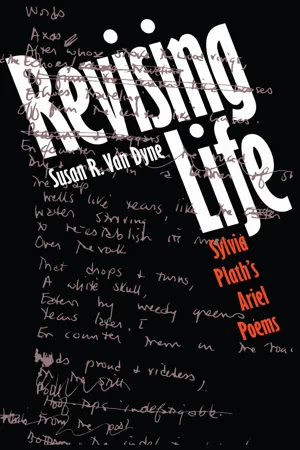
'Provides a compelling argument for Plath’s revision of the painful parts of her life — the failed marriage, her anxiety for success, and her ambivalence towards her mother. . . . The reader will feel the tension in the poetry and the life.'CHOICE '[Examines] Plath’s twin goals of becoming a famous poet and a perfect mother. . . . This book’s main points are clearly and forcefully argued: that both poems and babies require 'struggle, pain, endless labor, and . . . fears of monstrous offspring' and that, in the end, Plath ran out of the resources necessary to produce both. Often maligned as a self-indulgent confessional poet, Plath is here retrieved as a passionate theorist.' — Library Journal Susan Van Dyne’s reading of twenty-five of Sylvia Plath’s Ariel poems considers three contexts: Plath’s journal entries from 1957 to 1959 (especially as they reveal her conflicts over what it meant to be a middle-class wife and mother and an aspiring writer in 1950s America); the interpretive strategies of feminist theory; and Plath’s multiple revisions of the poems.
1 Rage: What a trash to annihilate
Engendering Rage: The Scene of Betrayal
Plath’s Ariel poems of rage react against an act of silencing that is startlingly prefigured in the journals of 1957–59. The period marks her return to America as a married woman; her first experience of work as a professional, first teaching at Smith College, then writing in Boston; and her resumption of psychotherapy. The period ends at the writers’ colony at Yaddo, with her first pregnancy and the decision to return with Hughes to make their literary careers in England. Her efforts to define herself as wife and professional poet necessarily included significant revisions of earlier identities. She revisited the scene of her undergraduate success at Smith, hoping to prove herself as a teacher; returned to proximity with her mother, whose approval was always important but apparently never sufficient; and reentered therapy, trying to cure her depression and debilitating writing blocks. The pattern in the journals from these years I want to highlight, however, is the one inscribed in an indelible moment from the spring of 1958. The roles she assigned to Ted in her script for their marriage become superimposed and sedimented in ways that she began to suspect enforced her dependency and threatened to silence her creativity.
I went alone into the coffee shop which was almost deserted. A few girls. And the back of the head of Bill Van Voris … the girl he was sitting with in the booth opposite him could see me. She had very fine black eyes, black hair, and a pale white skin, and was being very serious. … He was talking in his way: silly, pretentious, oh yes, fatuous. She stammered prettily. … I could see Al Fisher, sitting in the same seat, and me opposite, that official sexual rapport. Al Fisher and his dynasties of students: students made mistresses. Students made wives…
As I came striding out of the cold shadow of the library, my bare arms chilled, I had one of those intuitive visions. I knew what I would see. … Ted was coming up the road from Paradise Pond, where girls take their boys to neck on weekends. He was walking with a broad, intense smile, eyes into the uplifted doe-eyes of a strange girl with brownish hair, a large lipsticked grin, and bare thick legs in khaki Bermuda shorts. I saw this in several sharp flashes, like blows. … His stance next to Van Voris clicked into place. (J 231–33, May 19, 1958)
Plath’s unspoken rage at male betrayal in this scene, observed on her last day of teaching classes at Smith College and reported in the journals several days later, is equaled only by her disgust at the female gullibility that makes it possible. What Plath learned from the performances she witnessed here provides a key to the poems she would write at the breakup of her marriage four years later. In the layered recognitions of these scenes Plath sees herself uncomfortably inscribed in a repeated scenario of male authority and female collusion. The roles she observed define and depend on each other: the male actor requires a female audience, the teacher a student, the seducer a flirt. Their dynamics also threaten and rehearse the rupture of another pairing Plath considers here, husband and wife.1
Initially, Plath poses as satiric, omniscient onlooker at her married colleague’s flirtation. Sitting behind him, she appreciatively measures the girl’s youthful prettiness against his wife’s “dough color” skin and “stretched mouth: grim gripped lips,” as if she identified with the male gaze. Yet this male impersonation rapidly dissolves as she sees herself reflected in the mirror of the girl’s eagerness to please, her need to have her faltering self-confidence shored up as she, in turn, flatters male pretensions. Leaving the coffee shop to assume the role of teacher herself, Plath’s unsettling flashback links her instead to the “dynasties of students” through whom male teachers reproduce their sexual and professional power. She cynically reinterprets her undergraduate identity as prize-winning protegée, once thought special, as serial.2 Although she rereads her past through this gendered allegory, she believes she is now safely outside the script; its repetition is merely a bad joke on others: “my amusing insight, my ringside seat at Van Voris and Seductive Smith Girl: or William S. is bad agayne” (J 232). But she has not seen all. The final segment of this journal entry anticipates the characteristic inversions that mark Plath’s later poems of rage. The flashes of insight that come like blows threaten death: the death of her smug illusions about her perfect marriage and the death of her identity as uniquely beloved wife.
Compared with her ironic detachment from the first performance, her illicit pleasure in her ringside seat, Plath’s distance from the second scene of sexual betrayal is a pained, helpless exclusion. Her doubled vision that recognizes how the adoring gaze of the female student and her own serve as enlarging mirrors for the male ego is now triangulated, as the new sight forces her to identify with the deceived wife. The vision has a totalizing effect as images of the three men are superimposed, reducing all three to smiling villains, Plath’s persistent trope for Hughes in the Ariel poems. A cruelly depersonalizing metonymy stands in for the girl’s sexual availability: a large lipsticked grin, bare thick legs. This time she confronts the male gaze of gratified desire and lacks access to the second female subject in the scene, now substituted for herself: “I could not tell the color of the girl’s eyes, but Ted could, and his smile, though open and engaging as the girl’s was, took on an ugliness in context” (J 233).
Although a journal entry, this narrative is self-consciously structured to intensify the reader’s retrospective awareness of significant patterns and to require our participation in Plath’s emotional reversals. The striking conflation of hypermasculinity, fatuous male vanity, and treacherous sexual villainy is reproduced, almost compulsively, in Plath’s poetic revenge plots of the summer and fall of 1962. Plath also chooses a similar narrative strategy, a divided or double identification as smug, satiric observer and speechless victim to organize virtually all of the poems in the cycle discussed in this chapter. In Plath’s private writings, Ted as teacher and sexual betrayer, fused in the image by the pond, is associated for her with the masculine authority, accomplishment, and approval she doubted she could equal and with the erotic attachment she dreaded might deceive her.
Stoking the Fire: Myths of Masculinity
Plath expected her return to America, with husband triumphantly in hand, to confirm her personal and professional identity: “I told myself, coming over [to England as a graduate student], I must find myself: my man and my career before coming home. … And here I am: Mrs. Hughes. And wife of a published poet” (J 153). But Mrs. Hughes, wife of the poet, confidently proclaimed in England, was an identity more difficult to justify in America than she anticipated. The first major strain in Plath’s marriage came during 1958–59, when the couple gave up teaching jobs to become full-time writers, and can be traced in part to how she understood masculinity and work. She may have prized Ted for his un-Americanness, his persona as a rugged, wild man of the Yorkshire moors in touch with nature and the occult, but she consciously measured him against standards for male adulthood that were distinctive of her culture rather than his. The frequency with which Plath itemizes in her journals the things they can do without—“a steady job that earns money, cars, good schools, TV, iceboxes and dishwashers and security First” (J 273)—indicates the tension she felt between social measures of American male success and her investment in a myth of Hughes as romantic genius. Plath had crafted Ted’s image in hyperbolic terms from the outset of their affair in 1956. Her very first letters to Aurelia counter the news that he lacks a degree or a job with the representation of Hughes as primal poet: “I met the strongest man in the world, ex-Cambridge, brilliant poet whose work I loved before I met him, a large, hulking, healthy Adam … with a voice like the thunder of God—a singer, story-teller, lion and world-wanderer, a vagabond who will never stop” (LH 233).
The American model of masculinity she defended him against is derived from several notions that became the subjects for self-conscious cultural scrutiny and contestation in the 1950s among the middle class: “maturity,” the corporation man, and suburban family life. The way each of these served to define masculinity and yet were also attacked as seriously undermining it can help us understand the self-contradictory persona she constructed for Hughes. Plath’s journals indicate her conflicting allegiances to humanistic psychologies, which stressed self-actualization and would justify her and Hughes’s nonconformity, and to conventional measures of adulthood and achievement.3 Among the expectations that Plath regarded with mixed disdain and doubt, the criteria for male maturity often involved “settling down,” especially to a steady job and raising a family, and “working” at marriage. A man who resisted or delayed becoming sole breadwinner and parent was accused of “evading responsibility.”4 Before he was thirty, an American male needed a steady salary and a family to spend it on to avoid charges of latent homosexuality or infantile attachment to his mother.5 As Plath worried about postponing children until she and Ted had established themselves as writers and as she hoarded their always unpredictable, sometimes marginal income from selling poems or winning prizes, it is not surprising that she often represented herself and Hughes as late bloomers in the maturity race.6
Yet if accusations of sexual deviance were ways of policing the cultural imperatives for men to marry early and earn enough to consume conspicuously, other social critics believed the career path of the organization man was itself the largest threat to masculinity. Plath reported reading David Reisman’s bestseller The Lonely Crowd and seems to have shared his conviction that the conformity demanded by the middle-class workplace was inherently emasculating.7 Her disdain for the safe marriage she rejects is tinged with sexual disgust: “Get a nice little, safe little, sweet little loving little imitation man who’ll give you babies and bread and a secure roof and a green lawn and money money money every month. Compromise. A smart girl can’t have everything she wants” (J 268). The popular culture was also capable of a misogynist logic that made women, in the guise of both parasitic wives and overprotective mothers, responsible for unmanning husbands and sons. The suburbs were responsible for breeding exaggerated gender role separation as the commuting husband left the full-time housewife to raise an increasing number of children largely alone. The centrality of the mother’s influence, first sanctioned by baby books and women’s magazines, was then decried as a pernicious matriarchy. Look magazine ran a special series on American men in 1958, including “The American Male: Why Do Women Dominate Him?”8 The appearance of Playboy magazine in 1953, with Marilyn Monroe as its first centerfold, can be seen not as confirming the dominant paradigm for masculinity but as a self-conscious rebellion against it. In its antagonism to marriage, “conformity, togetherness, anonymity, and slow death,” Playboy detached virility from social responsibility, bachelorhood from homosexuality, and erected a counterimage of the American male free from the dominance of women who was served instead by interchangeable playmates.9
The coexistence in 1950s ideology of these contradictions—the definition of adult masculinity with the steady breadwinner and the counter-identification of escape from marriage with ebullient heterosexuality—also pointed toward corresponding fears of female dependence and female dominance. Plath’s particular dilemma in confronting these crosscurrents was to construct a myth of Hughes as manly poet powerful enough to subdue the cultural suspicion of the writer as effeminate and to quiet her own anxiety that as a husband he was improvident. A partial list of what she identifies as “main questions” needing resolution in 1958 reveals several embedded conflicts that pitted Plath against her culture and, perhaps inadvertently, herself against Hughes:
What to do for money & where to live: practical …
Ideas of maleness: conservation of power (sex & writing) …
Why do I freeze in fear my mind & writing: say, look: no head,
what can you expect of a girl with no head? …
Images of Society: the Writer and Poet is excusable only if he
is Successful. Makes Money. (J 273)
Ideas of maleness: conservation of power (sex & writing) …
Why do I freeze in fear my mind & writing: say, look: no head,
what can you expect of a girl with no head? …
Images of Society: the Writer and Poet is excusable only if he
is Successful. Makes Money. (J 273)
Undeniably Plath sought to define herself as well as Hughes as a successful writer and money-maker. Still the list makes clear that to endow the unlucrative vocation of poetry with “maleness” would also increase her risk as dependent wife and cast doubt on her own aspirations as a writer of the wrong gender.
What entrapped and enraged Plath was her belated recognition that in attempting to revise the cultural scripts for American success in order to validate her marriage and Ted’s vocation, she had assigned to herself a subordinate role as woman and poet. The particular tangle of self-blame for not accomplishing the appropriate feminine developmental tasks in her marriage and her seething yet censored resentment at her role as apprentice poet in the partnership are commonplace in the journals: “Get over instinct to be dowdy lip-biting little girl. Get bathrobe and slippers and nightgown & work on femininity. … Must try poems. DO NOT SHOW ANY TO TED. I sometimes feel a paralysis come over me: his opinion is so important to me” (J 295).10
“He is a genius. I his wife.”
How did Plath, who identified herself at seventeen as a girl who wanted to be God, come to such an impasse? How did she and Ted come to be “strangers in our study, lovers in bed”? Why did the mask of ultrafemininity come to disguise the rage of the thwarted poet? What silenced and estranged Plath in her study was more than the cultural construction of American marriages in the 1950s or her attempted remasculinization of poetry as a profession. If the outward signs of the poet’s life did not correspond to criteria for male maturity, the books in Plath’s study told another story. The authors she wrote about and later taught at Smith were predominantly, although not exclusively, male; this male dominance of the literary canon was reconfirmed by her graduate study at Cambridge and was affectionately though somewhat ambivalently reproduced in the gift books she received as a serious writer from her mother and then from Hughes. It would be a mistake, however, to imagine that Plath was without female models. As peers and predecessors, women writers provoked Plath’s sharpest critical response. What does emerge, however, is an underlying model of literary history that becomes more gendered as Plath matures and in which the male modernists she initially claimed as her masters become increasingly identified with Hughes.
Plath’s fondest fiction about her relationship with Hughes was that it was a mutually beneficial collaboration. In their early passion, Hughes evoked poems from her with orgasmic ease: “All gathers in incredible joy. I cannot stop writing poems! They come better and better” (LH 235). This flood of productivity is refined by loving discipline: he “is my best critic as I am his” (LH 243). But even in her initial euphoria, there was a note of competition: “We drink sherry in the garden and read poems; we quote on and on: he says a line of Thomas or Shakespeare and says: ‘Finish!’ We romp through words” (LH 235). Almost immediately this garden of poetic delights was replaced by a series of cramped apartments in which Ted tutors and tests her: “He literally knows Shakespeare by heart and is shocked that I have read only 13 plays. … He is educating me daily, setting me exercises of concentration and observation” (LH 267). While I agree with Margaret Dickie’s substantial evidence that in their poetry both were “voracious borrowers” and that Hughes’s themes and images show he followed Plath’s example as often as he led her in new directions, it is significant that Plath thought herself in Hughes’s debt.11 If she willingly assigned him the role of tutor (“Whatever Ted does I would like to submit myself to it. It would require a long discipleship” [J 283]), she also railed against his demands (“He is didactic, fanatic” [J 246]).12
Plath intended to act as Hughes’s sponsor in America, introducing him to a market she herself had already broken into. But when his prizes and publication began to outpace her own, she needed to justify his priorit...
Table of contents
- Cover Page
- Revising Life Sylvia Plarh’s Ariel Poems
- Copyright Page
- Contents
- Acknowledgments
- Abbreviations
- Introduction. Revising Woman
- 1 Rage: What a trash to annihilate
- 2 The Body: O bright beast I
- 3 Motherhood: The blood blooms
- Notes
- Selected Bibliography
- Index
- Permissions
Trusted by 375,005 students
Access to over 1.5 million titles for a fair monthly price.
Study more efficiently using our study tools.
Frequently asked questions
Yes, you can cancel anytime from the Subscription tab in your account settings on the Perlego website. Your subscription will stay active until the end of your current billing period. Learn how to cancel your subscription
No, books cannot be downloaded as external files, such as PDFs, for use outside of Perlego. However, you can download books within the Perlego app for offline reading on mobile or tablet. Learn how to download books offline
Perlego offers two plans: Essential and Complete
- Essential is ideal for learners and professionals who enjoy exploring a wide range of subjects. Access the Essential Library with 800,000+ trusted titles and best-sellers across business, personal growth, and the humanities. Includes unlimited reading time and Standard Read Aloud voice.
- Complete: Perfect for advanced learners and researchers needing full, unrestricted access. Unlock 1.5M+ books across hundreds of subjects, including academic and specialized titles. The Complete Plan also includes advanced features like Premium Read Aloud and Research Assistant.
We are an online textbook subscription service, where you can get access to an entire online library for less than the price of a single book per month. With over 1.5 million books across 990+ topics, we’ve got you covered! Learn about our mission
Look out for the read-aloud symbol on your next book to see if you can listen to it. The read-aloud tool reads text aloud for you, highlighting the text as it is being read. You can pause it, speed it up and slow it down. Learn more about Read Aloud
Yes! You can use the Perlego app on both iOS and Android devices to read anytime, anywhere — even offline. Perfect for commutes or when you’re on the go.
Please note we cannot support devices running on iOS 13 and Android 7 or earlier. Learn more about using the app
Please note we cannot support devices running on iOS 13 and Android 7 or earlier. Learn more about using the app
Yes, you can access Revising Life by Susan R. Van Dyne in PDF and/or ePUB format, as well as other popular books in Literatur & Literaturkritik in der Dichtkunst. We have over 1.5 million books available in our catalogue for you to explore.