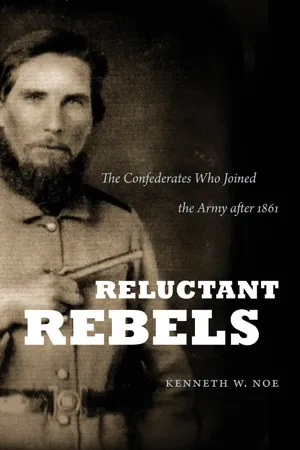
After the feverish mobilization of secession had faded, why did Southern men join the Confederate army? Kenneth Noe examines the motives and subsequent performance of “later enlisters.” He offers a nuanced view of men who have often been cast as less patriotic and less committed to the cause, rekindling the debate over who these later enlistees were, why they joined, and why they stayed and fought.
Noe refutes the claim that later enlisters were more likely to desert or perform poorly in battle and reassesses the argument that they were less ideologically savvy than their counterparts who enlisted early in the conflict. He argues that kinship and neighborhood, not conscription, compelled these men to fight: they were determined to protect their families and property and were fueled by resentment over emancipation and pillaging and destruction by Union forces. But their age often combined with their duties to wear them down more quickly than younger men, making them less effective soldiers for a Confederate nation that desperately needed every able-bodied man it could muster.
Reluctant Rebels places the stories of individual soldiers in the larger context of the Confederate war effort and follows them from the initial optimism of enlistment through the weariness of battle and defeat.
- 336 pages
- English
- ePUB (mobile friendly)
- Available on iOS & Android
eBook - ePub
About this book
Trusted by 375,005 students
Access to over 1.5 million titles for a fair monthly price.
Study more efficiently using our study tools.
Information
PART I “WHEN OUR RIGHTS WERE THREATENED”
1
DUTY, HONOR, COUNTRY
“PATRIOTISM IS A FINE WORD FOR HISTORIANS”
Only seventeen when the Civil War began, Harden P. Cochrane spent the first year of the war safely at home in Tuscaloosa, Alabama, a student at the local university. In March 1862, however, he and several other members of the University Cadet Corps marched away from their campus to help train new recruits at Camp Winn. His assignment was to help drill Company E of the new 28th Alabama Infantry. Just after the Battle of Shiloh, and only a few days before the regiment left its camp of instruction for the new front at Corinth, Cochrane witnessed a significant moment in the short life of the new regiment. On the night of April 11, the new soldiers of the 28th Alabama gathered outside the hotel at Shelby Springs to serenade their regimental colonel. The men were in high spirits, convinced that their army had won a victory at Pittsburgh Landing. When they demanded a speech, however, the colonel abruptly refused to say anything, handing the duty instead to the regimental adjutant. His oratory fell flat, and the mood soured even more when the commander of a nearby regiment rose to warn the men that contrary to the initial reports they had heard, the Confederates actually had been “slightly whipped” at Shiloh.1

Colors of the 28th Alabama Infantry, painted by the noted artist Nicola Marschall and later captured at Orchard Knob in November 1863. Photograph courtesy Alabama Department of Archives and History, Montgomery, Catalogue No. 86.3945.1.
Such an acknowledgment of defeat, however qualified, rankled the recruits. They now raucously demanded that Company E’s Capt. H. A. M. Henderson speak to them. Despite being ill, the former Methodist minister stood and gave the men the stem-winding oratory they clearly wanted and perhaps needed on the eve of their deployment to the front. He began by announcing that he “had a different opinion from that of some who had expressed theirs before.” He had not despaired of victory, he assured his men, for “he did not believe we could be whipped. . . . he did not believe there was a man in the whole regiment so debased as would not fight, and, if needs be, die for his country.” When the Southern states had seceded, he went on, all had agreed that the Confederacy “would be exterminated before it would submit, and that he would rather see our rivulets crimson with blood and every spot in our fair South from Shiloh to the Gulf of Mexico a soldier’s sepulchre.” But that would not happen, he added. Indeed, echoing William Shakespeare’s Henry V on St. Crispin’s Day, Henderson promised that “when we had gained our independence each man who had participated in the obtaining of it would be respected and loved by their wives, children, friends, and neighbors, be respected by all that knew them and on the other hand those who were killed would live in the mind of those who knew them and their names would be handed down by tradition to posterity.” Overcome with emotion, Henderson’s company broke into song, promising, “Oh, Alabama, we will fight for thee.”2
Harden Cochrane ultimately did not follow the 28th Alabama into Gen. Braxton Bragg’s army, but he did not return to school either. Soon after the night of speeches and song he enlisted as a private in the newly formed 2nd Alabama Cavalry. Writing home from that regiment’s camp that fall, however, he still remembered Henderson’s words and similar expositions, as he assured his reader that “we are whipping the enemy and driving them from our sunny South and before long I think the trumpet of Peace, Freedom, and Independence will be sounded and we will return to our happy homes in peace.”3
MEN SUCH AS Captain Henderson and Private Cochrane were not alone among later enlisters in using words such as “country,” “freedom,” “submission,” and “independence” to explain their decision to join Confederate ranks. Others couched their decision to enlist with words and phrases that reflected at least a simple patriotism if not a more developed political ideology. John Dooley, the twenty-year-old son of one of Richmond’s wealthiest and most influential Irish families, was one. When the war began, his father became a company commander in the 1st Virginia. For reasons that remain unclear, the devoutly Catholic son remained in Washington of all places until the following year, continuing his studies at Georgetown College. The months in Lincoln’s capital proved difficult, for at one point he lashed out against the city’s politicians and the North in general for unleashing “this diabolical alternative upon our native land.” In the spring, as Union forces approached his hometown of Richmond, Dooley finally went south and enlisted as a private in his father’s regiment.4
Dooley was not the only soldier who averred that he enlisted at least in part to defend his “native land.” Sixty-one (19.1 percent) of the 320 laterenlisting soldiers in the sample at least in part explained their initial decision to fight for the Confederacy in ideological language. Thirty-eight of them, 11.8 percent of the total, specifically mentioned their “country” at least once. Gary Gallagher has maintained that such statements, except when they explicitly refer to a state, comprise evidence of nationalism, “collective loyalties transcending state and locality.” On Gallagher’s scale, even one mention counts as evidence of nationalist sentiments.5 Not all scholars would agree, of course. Indeed, for many decades historians have debated Confederate nationalism. One school of thought regards it as either limited to a few elites or else denies its existence entirely. Paul Escott’s pathbreaking work acknowledged that while Jefferson Davis became over the course of the war a nationalist who put the needs of the entire Confederacy ahead of states and localities, he was ultimately an exception to a general rule. Indeed his inability to stir up Confederate national unity became the root cause of the nascent country’s defeat. Committed to states’ rights and distrustful of Davis’s centralizing policies, politicians at the local and state levels constantly threw up roadblocks to filling and feeding the ranks beyond their own constituents. Masters too resisted and held back their slaves from vital war work, while the Southern yeomanry increasingly resented and resisted the proverbial “rich man’s war, poor man’s fight” policies of conscription and impressment. Confederate nationalism, in the end, stunted and withered on the vine, unable to overcome localism, racial divisions, and class tensions.
Echoing Escott, other scholars reaffirmed and indeed extended the primacy of self-interest, extreme localism, and class while stressing the concurrent absence of nonelite nationalism.6 Although their definition of “nationalism” differs somewhat, the four authors of Why the South Lost the Civil War likewise maintained that the new Confederacy as a whole lacked “a feeling of oneness, that almost mystical sense of nationhood. . . . The Confederate nation was created on paper, not in the hearts and minds of its would-be citizens.” Too attached to their American past and allegedly guilt ridden over establishing a nation to protect slavery, Southerners never developed that emotional feeling of being Confederates instead of Macon Countians, Alabamians, or Americans. The book’s authors famously pointed in particular to Paraguay, which between 1864 and 1870 fielded a proportionally larger army and eventually lost over half of its total population during a bitter war with three powerful neighbors. The Confederates’ devotion to their country and resulting war effort seemed “feeble in comparison.”7
Other historians, however, interpreted the evidence differently. Over a half-century ago, David Potter stimulated such revisionist thoughts when he warned his fellow historians that blanket dismissals of the existence of Confederate nationalism could be dangerously presentist, rooted in a modern reluctance to give much credit to a nationalism rooted in slavery.8 Potter’s observations about what Gallagher later termed an “aroma of moral disapprobation” ultimately prodded several scholars to reexamine the question. They concluded that by 1860 many white Southerners indeed believed themselves to be a separate people who required a nation of their own. Emory Thomas, for example, forcefully maintained that Confederates after 1861 followed increasingly revolutionary economic, military, and political trajectories that together produced a true sense of nationhood among most white Confederates by the summer of 1863, although in the end it could not withstand the battlefield reverses that followed.9 Drew Gilpin Faust meanwhile offered a significant new consideration of the subject that depicted white Confederates as consciously and successfully acting to construct the unique national culture they knew they required, a “commentary upon itself,” that would both present the new nation’s best face to the world and “build a consensus at home, to secure a foundation of popular support for a new nation.” Steeped in the imagery of the French Revolution and especially the American War of Independence—which Confederates widely appropriated as their own protohistory—the main tenets of Confederate nationalism according to Faust were Christianity, republican virtue, slavery, and racial solidarity. The Confederate nation belonged to white Southerners, God’s new chosen people, who were to fulfill His divine will through a pure republican government that had jettisoned the corrupting excesses of mid-nineteenth-century Jacksonian democracy.10 George Rable’s examination of the Confederate government reached similar conclusions about nationalism’s relationship to Christian thought and classical republicanism while stressing the latter. Anne Sarah Rubin’s recent work, reminiscent in many ways of Faust’s in its emphasis on popular culture, Revolutionary motifs, chosen peoples, and proslavery ideology, offers the boldest assertion yet that Confederate nationalism not only was real but was felt deeply, widely, and quickly by a majority of whites. Indeed, it was durable enough to survive the actual collapse of the government in 1865.11
Not surprisingly, many historians of Civil War soldiers also have weighed in on the question of nationalism and its relationship to enlistment and subsequent military service. Those who stress social and cultural factors admit that patriotism played a role but minimize its importance. Stephen Berry, for example, suggests that public pronouncements of cause and country actually masked deeper, more private issues. In contrast, many of those who point to ideological motives highlight nationalistic expressions. Reid Mitchell viewed patriotism as a spur to enlistment and especially a sustaining motivator,12 while James McPherson especially stressed soldiers’ love of country, noting that two-thirds of the men in his sample at some point indicated patriotic reasons for service, with men from slaveholding families twice as likely to express patriotic sentiments as nonslaveholding Johnny Rebs. Confederate nationalism was a reality, with “roots several decades back in the antebellum ideology of Southern distinctiveness. Thus it seemed natural for many Confederate soldiers to express a patriotic allegiance to ‘my country.”’13
Gary Gallagher, Peter Carmichael, and Aaron Sheehan-Dean likewise emphasize strong nationalist sentiments among Confederate soldiers. Carmichael finds nationalism especially among young, college-educated officers from the slaveholding class, while Sheehan-Dean describes a Confederate nationalism that developed among all ranks beginning in 1862. Gallagher adds that service across the South and with men from other states tended to increase nationalism among men in uniform as the war progressed. For most white Confederate civilians and men stationed beyond the Old Dominion, Robert E. Lee’s Army of Northern Virginia became the symbol and hope of an independent Confederacy.14
The evidence compiled for this study, however, suggests that, in contrast, relatively few later-enlisting Confederates ever became nationalists to any degree. Only ten examples among youth—17 percent of all those identified as age twenty or younger—occur in the sample, and they are generally limited to the simplest expressions of patriotism and “country,” the sorts of brief, rhetorical statements that Bell Wiley dismissed altogether as cant. For example, writing from Vicksburg in May 1862, seventeen-year-old planter’s son Pvt. Willie Sivley of the 3rd Mississippi tried to persuade his sister that a cousin should join him in his company, for “he can’t do more for his country any where else than here, he will be fighting for his country and home too.”15 Likewise, a young Texan, Sgt. Thomas Smith, a former resident of Illinois, wrote in his diary on July 4, 1862, that “the Confederate States of America will ere soon show to the nations of the world that they are an independent nation.” Smith later copied into his diary a poem which began: “Better to die on the Battle Plain/To die for our native land.”16
As the war progressed, love of country continued to serve as a sustaining motivator for this handful of youthful soldiers. During the summer of 1863, North Carolina Capt. J. F. Coghill lamented the death of a friend “in the cause of his beloved country.”17 Sgt. Abraham Jones of the 5th North Carolina Cavalry, recently captured and exchanged, wrote his parents in August 1863 that “we held a meeting day before yesterday & passed resolutions condemning the course of the Raleigh Standard, progress, & other disloyal papers & citizens in the state. . . . I hope it will have some effect on the cowardly men at home, who don’t know war is & who had rather see their country’s rights trampled in the dust than take up arms.” Three weeks later he confided that he would prefer to go into winter quarters back in North Carolina, but added that he was “perfectly willing to remain here, if we are of more service to the country than we would be there.”18
The call of duty to country had less appeal still to older men. Twenty-eight sampled later-enlisting Confederates over the age of twenty, 15.2 percent of that cohort, referred to their country at some point in their letters. A select few stood out in their fervor. Sgt. John Price Thurman, a West Tennessee farmer who enlisted in Nathan Bedford Forrest’s 3rd Tennessee Cavalry early in 1862 at the age of thirty-one, stressed nationalism from the beginning. On the way to join his company after enlistment, he wrote his wife from Memphis that “it becomes the duty of every Patriot to make any sacrifice that our country demands.” After he arrived in camp, he sent home another missive in which he maintained that serving his nation was “an endorsement of my principals as a free man.”19 A month later, after the Battle of Shiloh, Thurman’s patriotism still burned brightly. Admitting his homesickness, he added that “I feel at the same time that I have a high duty to perform here and if needs be must sacrefice eny other consideration and for my God my country my wife & my children all to give even my life as a ransom to . . . our country from disgrace and insults as a people.” And two years later the veteran trooper praised the kinfolk who “have stood by our country in her woes, toils & hardeships, fighting on & ever will yet win for her a glorious independence.”20
Like Thurman, Pvt. William Ross Stilwell of the 53rd Georgia wrote eloquently and frequently of his patriotism. A twenty-three-year-old harness maker before the war, Stilwell rushed with his unit to the Virginia front just before the Seven Days Battles. “I don’t know when I may be killed,” he wrote his wife after his baptism of fire, “it may be in a few days and it may never be, but I expect to try to die like a brave man fighting for the right of his country.” A week later, he again affirmed that “my duty to my country demands my service and I must obey.”21 Stilwell’s regiment went on to fight at Antietam and took heavy casualties there. Among them was “old man Guest” who “was ...
Table of contents
- Cover Page
- RELUCTANT REBELS
- Copyright Page
- Dedication
- Contents
- ILLUSTRATIONS
- ACKNOWLEDGMENTS
- INTRODUCTION WHAT THEY DID NOT FIGHT FOR
- PART I “WHEN OUR RIGHTS WERE THREATENED”
- PART II “FIGHTING FOR THE PROPERTY WE GAINED BY HONEST TOIL”
- PART III “WE ARE A BAND OF BROTHERS AND NATIVE TO THE SOIL”
- APPENDIX
- NOTES
- WORKS CITED
- INDEX
Frequently asked questions
Yes, you can cancel anytime from the Subscription tab in your account settings on the Perlego website. Your subscription will stay active until the end of your current billing period. Learn how to cancel your subscription
No, books cannot be downloaded as external files, such as PDFs, for use outside of Perlego. However, you can download books within the Perlego app for offline reading on mobile or tablet. Learn how to download books offline
We are an online textbook subscription service, where you can get access to an entire online library for less than the price of a single book per month. With over 1.5 million books across 990+ topics, we’ve got you covered! Learn about our mission
Look out for the read-aloud symbol on your next book to see if you can listen to it. The read-aloud tool reads text aloud for you, highlighting the text as it is being read. You can pause it, speed it up and slow it down. Learn more about Read Aloud
Yes! You can use the Perlego app on both iOS and Android devices to read anytime, anywhere — even offline. Perfect for commutes or when you’re on the go.
Please note we cannot support devices running on iOS 13 and Android 7 or earlier. Learn more about using the app
Please note we cannot support devices running on iOS 13 and Android 7 or earlier. Learn more about using the app
Yes, you can access Reluctant Rebels by Kenneth W. Noe in PDF and/or ePUB format, as well as other popular books in History & American Civil War History. We have over 1.5 million books available in our catalogue for you to explore.