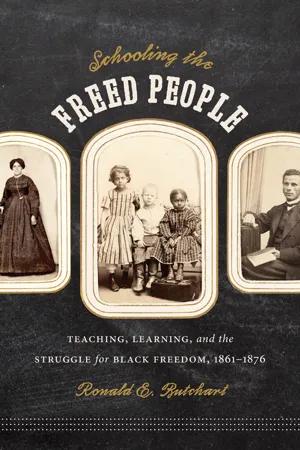
eBook - ePub
Schooling the Freed People
Teaching, Learning, and the Struggle for Black Freedom, 1861-1876
- 336 pages
- English
- ePUB (mobile friendly)
- Available on iOS & Android
eBook - ePub
Schooling the Freed People
Teaching, Learning, and the Struggle for Black Freedom, 1861-1876
About this book
Conventional wisdom holds that freedmen’s education was largely the work of privileged, single white northern women motivated by evangelical beliefs and abolitionism. Backed by pathbreaking research, Ronald E. Butchart’s Schooling the Freed People shatters this notion. The most comprehensive quantitative study of the origins of black education in freedom ever undertaken, this definitive book on freedmen’s teachers in the South is an outstanding contribution to social history and our understanding of African American education.
Information
Chapter One
At the Dawn of Freedom
The long, long years of law against slaves learning to read,
has created in them a deep determination to master all the
difficulties that lie in the way of gaining knowledge now that a way is opened.
has created in them a deep determination to master all the
difficulties that lie in the way of gaining knowledge now that a way is opened.
National Freedmen’s Relief Association, 1863
I never saw people more anxious nor Schollars
labor harder to learn.
labor harder to learn.
Robert Lindsey, former slave owner and Confederate veteran,
1869
1869
Their steady eagerness to learn is just something amazing. To be deprived of a lesson is a severe punishment. “I got no reading to-day,” or no writing, or no sums, is cause for bitter tears. This race is going to rise. It is biding its time.
Laura Towne, 1877
At the very dawn of freedom, well before the nation moved grudgingly toward formal emancipation, southern black slaves began to forge their own destiny. From the first days of freedom, through the displacements of war, and into Reconstruction, they pursued many strategies calculated to assure their self-emancipation. During the war, they fled plantations to reach Union lines. They reconstituted families, built their own churches, negotiated contracts. And they demanded access to literacy. They raised teachers from the literate among themselves, welcomed teachers from afar, even urged former slave owners to teach them, and filled schoolhouses to overflowing. Out of their great poverty they raised funds to buy land for their schools, supplied the labor to build the schools, supported teachers as best they could, and maintained such an effective network of schools across the South after the Civil War that W. E. B. Du Bois could argue that the postwar system of southern public education arose from the foundation laid by the freed people.1
Slavery’s great failure lay in its inability to crush the black longing to read and write. The dream of literacy would not die despite two and a half centuries of bondage and enforced illiteracy. Many of the slave states made it a crime to teach slaves to read and write. Where black literacy was not banned by law, it was effectively banned by custom. Many slaveholders meted out fearsome punishment to slaves who were caught with reading or writing materials. Literacy opened the possibility of encountering ideas opposed to human bondage and carried the potential of written communication between black conspirators. More important ideologically, keeping the masses of African Americans illiterate contributed to the myth of racial inferiority, a conveniently circular logic: blacks were intellectually incapable of mastering the skills of literacy; illiterate blacks were proof of black intellectual incapacity. Though some slaves succeeded in stealing their literacy and an occasional slaveholder taught a favored slave to read and write, it is likely that by the time of the American Civil War, not more than one in ten southern blacks were literate. Yet the black desire for literacy burned bright to the very end of slavery.2
African Americans acted on the possibilities of freedom with an overwhelming surge toward the schoolhouse door. As W. E. B. Du Bois observed, African Americans responded to their flight from slavery differently than any other largely illiterate people freed from bondage. Most former serfs and slaves have assumed that ignorance was their natural lot, or they have embraced their folk wisdom as superior to formal learning. “American Negroes never acted thus,” Du Bois wrote. “The very feeling of inferiority which slavery forced upon them fathered an intense desire to rise out of their condition by means of education.”3 Seventy years earlier, as the freed people’s response to emancipation was first manifesting itself, John W. Alvord, superintendent of freedmen’s education within the Freedmen’s Bureau, made the same observation. “This is a wonderful state of things,” he wrote in his January 1866 report. “We have just emerged from a terrific war; peace is not yet declared. There is scarcely the beginning of reorganized society at the south; and yet here is a people long imbruted by slavery, and the most despised of any on earth, whose chains are no sooner broken than they spring to their feet and start up an exceeding great army, clothing themselves with intelligence. What other people on earth have ever shown, while in their ignorance, such a passion for education?”4
The education of the freed people was, first and foremost, an education by African Americans, the work of the freed people themselves and of black Americans from the northern states. The freed people welcomed the help of northern white teachers and northern aid organizations, though they resented the paternalism and arrogance of the white efforts. In the end, however, the black community gave much more toward their own educational emancipation than did the far wealthier and far more numerous people that surrounded them. Indeed, the efforts of whites in black schools from the dawn of freedom and into Reconstruction were often equivocal and contradictory to the best interests of a truly free people. But to understand that story, it is necessary first to explore the unprecedented response of African Americans to freedom and the freedom to learn.
The freed people’s demand for literacy overawed all efforts to accommodate it. In the first decade of freedom, teachers often taught in classrooms numbering one hundred students or more. Harriet Buss, teaching alone on an isolated island plantation in South Carolina in 1863, had 118 students in her school.5 Fannie J. Scott taught over 200 students with her sister in Vicksburg in 1864 and delighted in her students’ great “zeal to learn.”6 A graduate of Mount Holyoke established the first black school in Sumter, South Carolina, in the summer of 1865, and immediately attracted over one hundred students. She gave that school to two other teachers and ventured further into the interior, establishing a second school in Dover Depot that quickly had one hundred students.7 In 1866, Trinity School in Augusta, Georgia, “one of the smallest schools in the city,” had over 160 students on its rolls and over one hundred in daily attendance studying under a single teacher.8 In 1869, a black teacher working on the coast of Georgia reported that she had to close her school to new students when enrollment “increased to 125 and they kept coming.”9 In 1872, Sallie B. Gove had 130 students a day, “all crowded together in a small house that has neither door nor window.” Two months later she had gained an assistant, but her school had increased to over 200.10 As more teachers were recruited, classroom crowding eased, though students continued to number fifty or more per class in the cities before the 1870s.11
Nor did the black demand for schools fade after its initial flowering in the springtime of emancipation. Despite predictions that black schooling was a passing fancy of a childlike people, despite the precipitous decline in northern support by the end of the 1860s, and despite rising violence against black education in the course of Reconstruction, the freed people were determined to educate their children, even as poverty drove the adults back to fields and shops. More than a decade after emancipation, Elizabeth Hyde Botume reported that her students at Beaufort, South Carolina, continued to protest having to take recess and were reluctant to “put up their work when the bell rings for the closing of the school.”12 Caroline Alfred, who taught in the black Claflin School in Columbus, Georgia, beginning in 1867 and observed the Deep South’s descent into terrorist violence in the 1870s, could still report in 1875 that “the interest in the school among the colored people seems greater than I have ever known it.”13 “It rained one day last week,” Laura Towne wrote in her diary in 1877, “but through the pelting showers came nearly every blessed child. Some of them walk six miles and back, besides doing their task of cotton-picking. Their steady eagerness to learn is just something amazing.”14 In the course of a single decade, black school attendance quintupled from less than 2 percent of all African Americans on the eve of the American Civil War, virtually all in the northern states, to nearly 10 percent by 1870, held down not by lack of desire but by lack of teachers and funds. In the following decade, it tripled again, to nearly one-third of black children of school age.15 The initial burst of black schooling was not confined to elementary literacy; a mere decade after emancipation, the southern freed people and their supporters had established well over one hundred secondary and postsecondary schools, most of which continued to serve black students far into the twentieth century.16
The first teachers to respond to this fierce will to know were themselves African Americans. Months before northern missionary societies and freedmen’s aid groups organized their work, black teachers who for years had shared the forbidden codes of literacy in the shadow of slavery threw off their veil of secrecy. In Washington and Baltimore, where free black children and an occasional favored enslaved child had quietly attended private black schools before the war, black teachers opened their schools to all black children. Around Norfolk and Alexandria, Virginia, and on the Sea Islands of South Carolina, where Union forces gained their first toeholds in the Confederacy, other black teachers opened the first “free” schools.17
By the end of 1861, at least forty southern black teachers had expanded their schools or established new schools to accommodate the swelling masses of eager students. Six months later, those forty southern black teachers constituted nearly half of all teachers working in the freed people’s schools. Fifty more were teaching by the summer of 1863, including nearly a dozen northern black teachers. By the time the war ended two years later, over 280 African Americans, most of them literate southern blacks, were answering the urgent call of their people. African Americans constituted one-eighth of the nation in 1860; literate African Americans could not have accounted for one-fiftieth of the nation.18 Yet here in 1865, at the dawn of freedom, well over one-quarter of the freed people’s first tutors were their own people. Some of those early black instructors taught briefly, until more capable teachers could be found, but most taught much longer than their northern white counterparts.19
The freed people did not wait for experienced teachers to begin the literacy work. So eager were they for schools that black settlements organized themselves into learning communities or created schools and pressed their literate members into sharing their knowledge. Slaves fleeing into Kansas in the first confusion of the war immediately started a school in Lawrence with one hundred students. Within days of the Union occupation of New Orleans, black schools sprang up and literate free blacks were urged into service as teachers. The black community pressured commanding general Nathaniel Banks to organize the black schools of New Orleans into a public system. When the federal government suspended the schools in November 1865, black New Orleans immediately opened private schools across the city staffed with black teachers.20 In 1864, an agent of the National Freedmen’s Relief Association went into the rural parishes of Louisiana to establish schools but reported that “the colored people themselves were ahead of us,” with flourishing schools in operation supported by a tuition system that exempted orphans and students with fathers in the military.21 When Mary S. Osborne, a northern white teacher, went to Church Creek, Maryland, in 1865 to establish a school, she found that the people had already organized one “immediately on their emancipation, and for nearly a year those who had been able by any means to gain a knowledge of letters have been imparting it to others.”22
In Georgia the freed people, “assisted by a few white friends,” created the Georgia Education Association in January 1866, a sophisticated organization with county-level affiliates, each with its own officers. The task of county affiliates was to create schools, “provide the schoolhouses, employ and pay the teachers,” with expenses to be borne by “the scholars and their parents.”23 Even earlier, the freed people of Marietta, Georgia, had created the Marietta Freedmen’s Association, possibly the model for the later statewide organization.24 One year after the war ended, thirty of the thirty-five black schools in Missouri were “sustained almost entirely by the struggles of the colored people.” Thirty-three black teachers taught in those thirty schools.25 The spontaneous movement of southern African Americans to launch their own schools and support their own teachers prompted one Freedmen’s Bureau agent to contrast their work with southern whites. In Wilmington, North Carolina, he wrote, “the Freedmen have started a school of their own, and employ at their own expense a colored teacher. A similar movement is commencing among the Freedmen in several other places, evincing a thirst for knowledge and a desire for improvement that finds no parallel among that numerous and degraded class, the ‘poor whites.’ ”26
The military witnessed equivalent educational enterprise among black troops and black civilian laborers. Those black adult learners bought spellers and primers, cajoled literate white soldiers to tutor them or chaplains to set up classes for them, and subscribed funds to pay teachers for their services. One black regiment raised $700 in four months for its own education and donated another $60 to maintain a school for the black children of a nearby town.27 Black laborers working in one white regiment prevailed upon the regimental chaplain to open a school for them in their few leisure hours.28 The 7th U.S. Colored Infantry established a literacy education program for the black noncommissioned officers. Those men in turn and on their own initiative created classes for their privates, teaching the soldiers what they had learned in their own lessons.29
Southern African Americans emerged from bondage penniless, often with little more than the clothing on their backs. Their stupendous poverty was rendered more grinding in the years immediately following the Civil War. Their embittered former owners attempted to do without their labor or routinely defrauded African Americans when they did hire them. Extraordinary crop failures due to floods, droughts, and insects in the later 1860s made matters worse for whites and blacks. Yet in spite of their poverty, the freed people found ways to purchase land for school purposes, lumber for the schoolhouse, and schoolbooks for themselves and their children. Their unpaid labor built the schoolhouses. They paid tuition to teachers and often boarded the teachers as well. They supplied fuel for heat in cold weather. In Georgia, for example, by late 1866 the freed people were fully supporting fifty-six of the state’s one hundred black schools and half their 113 teachers. The black Georgia Education Association asserted, “This result has been accomplished by pati...
Table of contents
- Cover Page
- Schooling the FREED PEOPLE
- Copyright Page
- Contents
- Illustrations and Tables
- Preface
- Acknowledgments
- Chapter One: At the Dawn of Freedom
- Chapter Two: To Serve My Own PeopleBlack Teachers in the Southern Black Schools
- Chapter Three: It Will Result in a Better Understanding of Their DutiesSouthern White Teachers and the Limits of Emancipation
- Chapter Four: A Desire to Labor in the Missionary CauseNorthern White Teachers and the Ambiguities of Emancipation
- Chapter Five: You Will, of Course, Wish to Know All about Our SchoolLearning and Teaching in the Freed People's Schools
- Chapter Six: Race, Reconstruction, and RedemptionThe Fate of Emancipation and Education, 1861–1876
- Appendix A: Teachers in the Freed People’s Schools, 1861–1876
- Appendix B: Estimating the Number of Black and Southern White Teachers, 1869—1876
- Notes
- Bibliography
- Index
Trusted by 375,005 students
Access to over 1.5 million titles for a fair monthly price.
Study more efficiently using our study tools.
Frequently asked questions
Yes, you can cancel anytime from the Subscription tab in your account settings on the Perlego website. Your subscription will stay active until the end of your current billing period. Learn how to cancel your subscription
No, books cannot be downloaded as external files, such as PDFs, for use outside of Perlego. However, you can download books within the Perlego app for offline reading on mobile or tablet. Learn how to download books offline
Perlego offers two plans: Essential and Complete
- Essential is ideal for learners and professionals who enjoy exploring a wide range of subjects. Access the Essential Library with 800,000+ trusted titles and best-sellers across business, personal growth, and the humanities. Includes unlimited reading time and Standard Read Aloud voice.
- Complete: Perfect for advanced learners and researchers needing full, unrestricted access. Unlock 1.5M+ books across hundreds of subjects, including academic and specialized titles. The Complete Plan also includes advanced features like Premium Read Aloud and Research Assistant.
We are an online textbook subscription service, where you can get access to an entire online library for less than the price of a single book per month. With over 1.5 million books across 990+ topics, we’ve got you covered! Learn about our mission
Look out for the read-aloud symbol on your next book to see if you can listen to it. The read-aloud tool reads text aloud for you, highlighting the text as it is being read. You can pause it, speed it up and slow it down. Learn more about Read Aloud
Yes! You can use the Perlego app on both iOS and Android devices to read anytime, anywhere — even offline. Perfect for commutes or when you’re on the go.
Please note we cannot support devices running on iOS 13 and Android 7 or earlier. Learn more about using the app
Please note we cannot support devices running on iOS 13 and Android 7 or earlier. Learn more about using the app
Yes, you can access Schooling the Freed People by Ronald E. Butchart in PDF and/or ePUB format, as well as other popular books in Social Sciences & History of Education. We have over 1.5 million books available in our catalogue for you to explore.