As the main artery of international commerce, merchant shipping was the world’s first globalized industry, often serving as a vanguard for issues touching on labor recruiting, the employment relationship, and regulatory enforcement that crossed national borders. In Sweatshops at Sea, historian Leon Fink examines the evolution of laws and labor relations governing ordinary seamen over the past two centuries.
The merchant marine offers an ideal setting for examining the changing regulatory regimes applied to workers by the United States, Great Britain, and, ultimately, an organized world community. Fink explores both how political and economic ends are reflected in maritime labor regulations and how agents of reform — including governments, trade unions, and global standard-setting authorities — grappled with the problems of applying land-based, national principles and regulations of labor discipline and management to the sea-going labor force. With the rise of powerful nation-states in a global marketplace in the nineteenth century, recruitment and regulation of a mercantile labor force emerged as a high priority and as a vexing problem for Western powers. The history of exploitation, reform, and the evolving international governance of sea labor offers a compelling precedent in an age of more universal globalization of production and services.
eBook - ePub
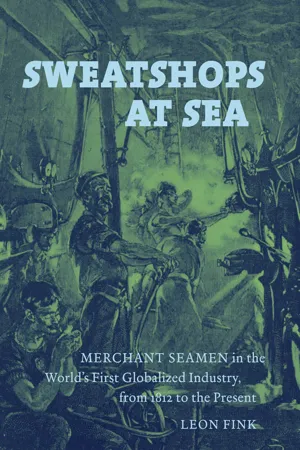
Sweatshops at Sea
Merchant Seamen in the World's First Globalized Industry, from 1812 to the Present
- 288 pages
- English
- ePUB (mobile friendly)
- Available on iOS & Android
eBook - ePub
Sweatshops at Sea
Merchant Seamen in the World's First Globalized Industry, from 1812 to the Present
About this book
Information
1 The Nation's Property
NINETEENTH-CENTURY SAILORS AND THE POLITICAL ECONOMY OF THE ATLANTIC WORLD
In The Wealth of Nations (1776), Adam Smith famously anticipated a world in which a relatively unfettered marketplace would maximize production, trade, and wealth for all those who could participate in its self-regulating mechanism. Yet, even as he identified the welfare of “nations” with the expansion of “wealth”—both of which, he believed, required restraint from governmental interference—Smith allowed himself some wiggle room when it came to shipping and sea power. It was no accident, he suggested, that the “first civilized” nations were those, around the coast of the tame Mediterranean Sea, that had first succeeded in “the infant navigation of the world.”1 Maintaining access to that navigable world and, if possible, dominance in world trade, it followed, was a crucial mark of national power. In a much-debated section of his classic text, Smith allowed that the bedrock principle of free trade might be abridged “when some particular sort of industry is necessary for the defence of the country. The defence of Great Britain, for example, depends very much upon the number of its sailors and shipping. The act of navigation, therefore, very properly endeavors to give the sailors and shipping of Great Britain the monopoly of the trade of their own country.”2 Thus it was that he offered a qualified defense of the notoriously restrictive Navigation Acts. Originally conceived amid rising Dutch-English tensions of the mid-seventeenth century, the assemblage of acts stipulated that a British-flagged ship be British-owned and British-built, that the master and at least three-quarters of the crew be British subjects, and (in order to protect the imperial “triangular trade”) that traffic between colonial ports be limited to British carriers. Smith did not directly contradict his general premise that free trade promised the greatest economic returns or his specific claim that the Navigation Acts distorted trade and dampened economic growth.3 Rather, his “exception” depended on an allowance that, “as defence . . . is of much more importance than opulence, the act of navigation is, perhaps, the wisest of all the commercial regulations of England.”4
The Smithian exception regarding national shipping and naval interests rested on long legs that convinced even an outwardly powerful and confident England to carefully nurture and regulate its maritime trades at least through the mid-nineteenth century. Both in symbol and fact, abolition of the British Navigation Acts in 1849 represented a key disjuncture (one is tempted to say “watershed”) of economic policy, even as it invited a new era of re-regulation in British shipping. For, even absent an older mercantilist emphasis on a favorable national balance of trade, there remained (for latter-day policy makers, just as for Smith) the residual strategic considerations that the merchant marine, or commercial sea labor, constituted a “nursery” for the navy and national defense as well as a key economic lifeline that could not be allowed to be ceded to potentially hostile powers. Thus it was that labor issues resonated throughout the nineteenth century at the center of transatlantic political debates about trade and shipping. Recruitment, disciplining, and ultimately the welfare of seamen were seen to bear on both national strength and reputation. As the American Niles Register asserted in 1829, seamen constituted the “property of the nation.”5 Even after midcentury, this assumption carried equally abiding force within the liberal, free-trade-oriented policies of a world-dominant United Kingdom as it did within the more rigidly protectionist policies of Britain's biggest contemporary trade rival, the United States.6
Impressment and the War of 1812
The logic of mercantilism—a bundle of assumptions emphasizing the national accumulation of wealth, positive balance of trade, and control of shipping lanes—exhausted itself in what qualifies as one of the last armed conflicts of the premodern era. The War of 1812 is properly seen as a battle between a defensive, maritime-based empire on the British side (fending off both Spain and France in the extended French Revolutionary and Napoleonic Wars, 1793–1815) and the boisterous sovereignty of the United States. Not coincidentally, however, it was also a war explicitly fought over a labor issue—impressment. The theme of “Free Trade and Sailors’ Rights” (as the Americans saw it) versus the duty of military service for native-born subjects (as the British preferred) defined the stakes of national power and identity in a world that Adam Smith might still have recognized as his own. Not surprisingly, the new symbols of national identity that emerged for Americans from the war—“The Star-Spangled Banner,” “Old Ironsides,” as well as the immemorial injunction “Don't give up the ship!”—all derived from the insistence on freeing American shipping, and ipso facto the nation's sailors, from British domination.7 Considerations of trade, nationalism, and citizenship all beckoned toward war in 1812, and each theme hinged in important respects on the status of merchant seamen.
That the condition and status of seamen should serve as a flashpoint of conflict between Great Britain and her former colony was no accident. As historians Jesse Lemisch and Gary Nash first documented, much of the American Revolutionary agitation derived from the conflicts and contentious labor forces of the late-eighteenth-century colonial ports.8 Waterfront rebels played key roles in the Knowles anti-impressment riot of 1747 and then again in resistance to the Townshend Duties of 1767 as well as the Boston Massacre of 1770 (where two of five victims were sailors and a third a ropemaker). In addition, captive sailors in Britain's Mill and Forton prisons kept both their own and home spirits alive with their proclamation of an in-house republic.9 Partly, the maritime presence in contemporary protests was a matter of sheer numbers. Though the figures are at best guesswork, Thomas Jefferson estimated in 1791 that 20,000 men were employed in the brand-new nation as merchant sailors or fishermen; by the era 1830–50, the seamen's number likely exceeded 100,000, or roughly half that employed by Great Britain in a period of population symmetry.10 In the Revolutionary Era (at least through 1813), these American crews included substantial numbers of both foreign-born (about 10 to 15 percent) and African American sailors (again, perhaps as many as 15 percent by 1812). The latter most famously included Olaudah Equiano, an Igbo slave and sailor before his London abolitionist agitation; Frederick Douglass, a slave caulker in Baltimore who, disguised as a merchant sailor, slipped north to his freedom; and “King Dick,” who judiciously ruled over 800 captured black privateers among a total of 5,000 seamen inside Britain's dismal Dartmoor Prison during the War of 1812.11
The emergent American Republic, moreover, found itself challenged on the seas in two fundamental respects. The first was the case of the “Barbary captives.” Caught by privateers (or privately commissioned corsairs) while entering Mediterranean waters off the North African coast, “enslaved” American merchantmen served as a major political embarrassment for the young Republic between 1785 and 1815. Counting themselves the “only victims” of American independence, more than 700 sailors languishing for as long as ten years in Algerine captivity haunted the popular imagination on two counts.12 Not only did their presence in the petty Barbary city-states of Algiers, Tunis, and Tripoli mock the capacity of the nation to defend and rescue its own citizens, it also highlighted the hypocrisy of the United States as a slave-holding power in its own right. In taking up the cause of abolition near the end of his life, Benjamin Franklin thus openly linked the captivity of Africans by Americans with that of Americans by North Africans: both, he suggested, represented a betrayal of man's natural right to freedom.13 In the popular culture, a more racist angle prevailed with plays and novels depicting virtuous, liberty-loving Americans as victimized by corrupt and bloodthirsty black Algerians. Lurid newspaper reports circulated of American prisoners with heads shaven and in rags led to work in chains by their barbarian captors.14 The Barbary issue would not go away, in fact, until the abatement of the British threat allowed for a concentration of U.S. military and diplomatic strategy on the North African coast.
The nub of maritime conflict throughout this period rested on the practice of British impressment. More than merely symbolic, the issue constituted an undeniable political crisis in the United States. To be sure, estimates vary as to the actual number of American citizen-sailors seized by British ships. Historians commonly cite the roughly 6,000 petitions from aggrieved U.S. seamen that President Madison himself pointed to in 1812. While contemporary newspaper and congressional testimony differed wildly in assessing the extent of the phenomenon, a recent scholarly assessment accepts the figure of “approximately 10,000 American sailors impressed between 1793 and 1812.”15 Most humiliatingly for an infant nation, the United States could only watch as the Royal Navy regularly stopped U.S. ships on the high seas, searched them for so-called British deserters, and claimed the right to “impress” any allegedly British-born subject, whether naturalized as an American citizen or not. As Secretary of State James Monroe insisted at the peace talks of 1814, “This degrading practice . . . must cease, our flag must protect the crew, or the United States cannot consider themselves an independent Nation.”16
For British officialdom, regular resort to impressment, a long-authorized albeit contentious practice, appeared throughout the Napoleonic Wars as a necessary emergency measure. Rooted in measures adopted by Oliver Cromwell to make war against the Dutch in the 1650s, impressment helped fashion what historians Peter Linebaugh and Marcus Rediker have labeled an “imperial hydrarchy” or “maritime state.”17 Perhaps at its most harsh in the 1690s, some three-fourths of those impressed reportedly died within two years, and the image of the “starving, often lame sailor in the seaport town became a permanent feature of European civilization.”18 As early as the seventeenth century, as Nicholas Rogers has demonstrated, Leveller protest in the English Civil War had likened impressment into the British navy as a form of “galley slavery” common to Turkey or Algiers. Repeatedly in the eighteenth century, sailor-reformers insisted that impressment violated Clause 39 of the Magna Carta, that there could be no arrest without a trial by jury. The Somerset case of 1772, which decided that no slave could be forcibly removed from Britain and sold into slavery again, raised the question of how seamen could similarly be forced to serve against their will. Such complaints, if not exactly answered, were trumped by a resort to the royal prerogative, as in Lord Walpole's 1740 rationale that “we must not only have ships but sailors.”19 Thus, despite persistent criticism, impressment continued to be regularly deployed in wartime, and those caught in its grip tended to escape only with help from social superiors. Though, in principle, every British-born or naturalized male subject was legally pressable, in practice the press gangs centered their attention on the most skilled, “able seamen” approaching land on inbound merchant ships.20 As need arose, however, the “floating population” or, more specifically, “men of seafaring habits between the ages of 18 and 55” not specifically exempted (such as fishermen and apprentices) in port towns were liable to forced service.21 Beginning in the 1770s, the Royal Navy began impressing all apprentices who were not carrying their indentures; by 1779, now facing the hostile forces of France, Spain, and Holland as well as the United States, press gangs proved ever less discriminate in their zeal.22 Indeed, at the height of British recruiting problems in 1812, an estimated 15 percent of the Royal Navy deckhands were “foreigners,” most of them simply seized off merchant ships in foreign ports.23
With the renewal of British-French hostilities in 1803—following a brief demobilization of sailors that had accompanied the Treaty of Amiens—Britain resumed the practice of stopping foreign vessels for inspection in order to impress any of the king's subjects aboard ship.24 Such encounters especially stoked tensions with the Americans both because their nation's higher wage rates induced recruitment of many British seamen and because of the difficulty of ascertaining the true citizenship of any Anglo-American sailor.25 Sailors in this era, as ever, it seems, were a young, mobile, and migrating lot: historian Paul A. Gilje, for example, relates the story of one John Blatchford, who signed on the Continental ship Hancock as a cabin boy in 1777 and returned to New Jersey six years later, having served under six flags and traveled halfway around the world.26 Moreover, throughout the long period of Anglo-American tensions, numerous sailors switched not only flags but allegiance and citizenship, whether according to immediate self-interest or political principle.27
Such messy demographic reality in the maritime trade, however, ran directly afoul of British war imperatives, post-1805. Particularly following the Essex decision (1805) and Orders in Council (1807), which aimed especially to curtail promiscuous U.S. trading with France and her colonies, British impressment policy merged with a geopolitical attempt to maintain commercial hegemony in the Atlantic world.28 In defense of the system's coercive features, British advocates repeatedly complained that the new nation offered all-too-easy employment and all-too-quick citizenship for deserting or refugee seamen. As protection against British impressment of legitimate American nationals, the U.S. government had begun issuing “certificates of citizenship” to American seamen in 1796. Bureaucratic controls, however, were lax. Unlike a latter day's concern for tight immigration restriction, “it is notoriously known,” wrote a British pamphleteer in 1807, “that the channels of perjury are, as they have been for years, still open for the obtaining of certificates of American citizenship. It is only necessary for one sailor to get another to swear for him, that he was born in such a place, and a certificate is granted… It has now arisen to that height, that men speaking most palpably the provincial dialects of England, Ireland, and Scotland, are to be seen thus protected. Is the British government tamely to acquiesce in this robbery of her seamen?”29
The issue was all the more strained because, under the principle of indefeasible nationality (formally maintained as late as 1870), expatriation away from British identity was not recognized: in short, “once a British subject, always a British subject.”30 The needs of the British fleet combined with its expansive legal claims, however, were exacted at the expense of U.S. sovereignty. Despite angry protests of the American government, post-1805, the cargoes of dozens of American merchant ships had been confiscated and virtually every vessel leaving the port of New York faced the indignity of an impressment search by British warships. War was nearly set off in 1807 in the Chesapeake affair. A patrolling British squadron, which had lost men to desertion, fired on the USS Chesapeake near Norfolk, Virginia, killing three sailors and mortally wounding another, then boarded the wrecked vessel and impressed a British-born deserter, two African American freemen, and a white native of Maryland. The incident unleas...
Table of contents
- Cover Page
- Sweatshops at Sea
- Copyright Page
- Dedication
- Contents
- Introduction
- PART I Mastered and Commanded
- PART II Strategies of Reform
- PART III A World Fit for Seafarers?
- Notes
- Works Cited
- Acknowledgments
- Index
Trusted by 375,005 students
Access to over 1.5 million titles for a fair monthly price.
Study more efficiently using our study tools.
Frequently asked questions
Yes, you can cancel anytime from the Subscription tab in your account settings on the Perlego website. Your subscription will stay active until the end of your current billing period. Learn how to cancel your subscription
No, books cannot be downloaded as external files, such as PDFs, for use outside of Perlego. However, you can download books within the Perlego app for offline reading on mobile or tablet. Learn how to download books offline
Perlego offers two plans: Essential and Complete
- Essential is ideal for learners and professionals who enjoy exploring a wide range of subjects. Access the Essential Library with 800,000+ trusted titles and best-sellers across business, personal growth, and the humanities. Includes unlimited reading time and Standard Read Aloud voice.
- Complete: Perfect for advanced learners and researchers needing full, unrestricted access. Unlock 1.5M+ books across hundreds of subjects, including academic and specialized titles. The Complete Plan also includes advanced features like Premium Read Aloud and Research Assistant.
We are an online textbook subscription service, where you can get access to an entire online library for less than the price of a single book per month. With over 1.5 million books across 990+ topics, we’ve got you covered! Learn about our mission
Look out for the read-aloud symbol on your next book to see if you can listen to it. The read-aloud tool reads text aloud for you, highlighting the text as it is being read. You can pause it, speed it up and slow it down. Learn more about Read Aloud
Yes! You can use the Perlego app on both iOS and Android devices to read anytime, anywhere — even offline. Perfect for commutes or when you’re on the go.
Please note we cannot support devices running on iOS 13 and Android 7 or earlier. Learn more about using the app
Please note we cannot support devices running on iOS 13 and Android 7 or earlier. Learn more about using the app
Yes, you can access Sweatshops at Sea by Leon Fink in PDF and/or ePUB format, as well as other popular books in History & North American History. We have over 1.5 million books available in our catalogue for you to explore.