Examining the social and intellectual collision of the American
reform tradition with immigrant Marxism during the Reconstruction
era, Timothy Messer-Kruse charts the rise and fall of the
International Workingman’s Association (IWA), the first
international socialist organization. He analyzes what attracted
American reformers — many of them veterans of antebellum crusades for abolition, women’s rights, and other radical causes — to the IWA, how their presence affected the course of the American Left, and why they were ultimately purged from the IWA by their orthodox Marxist comrades.
Messer-Kruse explores the ideology and activities of the
Yankee Internationalists, tracing the evolution of antebellum
American reformers' thinking on the question of wage labor and
illuminating the beginnings of a broad labor reform coalition in
the early years of Reconstruction. He shows how American
reformers' priority of racial and sexual equality clashed with
their Marxist partners' strategy of infiltrating trade unions.
Ultimately, he argues, Marxist demands for party discipline and
ideological unity proved incompatible with the Yankees' native
republicanism. With the expulsion of Yankee reformers from the
IWA in 1871, American Marxism was divorced from the American
reform tradition.
eBook - ePub
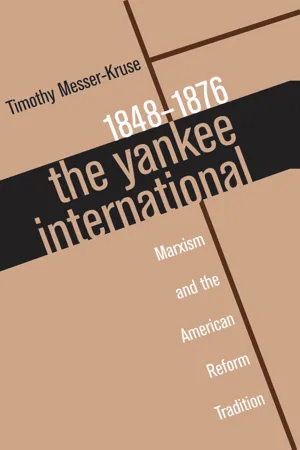
The Yankee International
Marxism and the American Reform Tradition, 1848-1876
- 336 pages
- English
- ePUB (mobile friendly)
- Available on iOS & Android
eBook - ePub
About this book
Information
Chapter One: The American Reform Tradition
The first international traveled to America in the steamer trunk of Cesare Orsini, a man whose name was well known on both sides of the Atlantic because of the exploits of his older brother Felice. Felice, a follower of Mazzini, was a veteran of revolutions along the entire length of the Italian peninsula and was eventually captured by the Austrians. He escaped from prison and made a daring attempt on the life of Napoleon III in 1858.1
Cesare Orsini set about recruiting Americans into the International soon after he arrived in 1866. He was immediately successful, as he later reported to Karl Marx, in lining up a number of prominent Americans. Among those he mentioned in his report, besides the few émigré socialists living in New York, was the Irish Fenian James Stephens and a number of American radicals of note, including Horace Greeley, Wendell Phillips, and Charles Sumner.2
Historians have tended to doubt that Horace Greeley and Charles Sumner were ever actually involved with the International, not because Orsini is a particularly untrustworthy source but because these American reformers have been portrayed as being so far afield ideologically from Marx, and from the labor movement in general, that no common ground was even conceivable to the scholars who have had to confront Orsini’s claim. Horace Greeley, while expressing sympathy for the workingman and endorsing the platform of George Henry Evans’s National Reformers, even for a time trumpeting the cause of Fourierist Associationism, could also proclaim the harmony of classes under capitalism and deplore “Jacobin ravings … against the Rich or the Banks.”3 Charles Sumner, the guiding light of Senate Radical Republicans and long considered a friend of labor by his Massachusetts constituents, has also been portrayed as remaining well within the boundaries of his party’s capitalist “free labor” ideology. Indeed, by the end of the war, the ideology of leading Republicans was rapidly falling out of step with a resurgent labor movement, and Sumner himself raised the ire of workers around the nation when he voted against a federal eight-hour bill in 1868. From what has been written of these two men, none would seem a likely representative of the socialist movement in America.4 Orsini’s success in gaining a sympathetic ear among several of the scions of abolitionism suggests that the attitude of many American reformers toward the labor movement, capitalism, and the working class in general was far more complex than has heretofore been recognized.
Upon closer examination, Orsini’s early recruitment of this trio of American reformers, though surprising, was not exceptional. In the years after the Civil War, many of the seasoned veterans of a plethora of antebellum reform movements publicly supported the aims, programs, and actions of the International. The breadth of support for the IWA is evident in the variety of reform journals that supported it. The longest running abolitionist journal, the National Anti-Slavery Standard, edited by A. M. Powell, opened its columns to the International and by the 1870s editorially endorsed it as well, as did its kindred reform sheet The Golden Age. Spiritualist newspapers such as The Banner of Light, The American Spiritualist, and Hull’s Crucible sympathetically reported on the International. So did the Bond of Peace, the organ of the Universal Peace Society, and freethought papers such as Boston’s Investigator. The Revolution, Susan B. Anthony’s monthly devoted to women’s rights gave it good notice, and the more strident (and more widely circulated) Woodhull & Claflin’s Weekly was the American IWA’s official organ in the English language.
Phillips, Sumner, and Greeley’s interest in the International was no fluke or misunderstanding. By the end of the Civil War, radicals who had devoted decades to a variety of antebellum reform movements were gaining a newfound concern for the “labor question.” In the 1860s and 1870s, many of the same faces that had been regularly arrayed on abolitionist, suffragist, pacifistic, and spiritualist daises of years before now occupied the same chairs under the auspices of the newly formed “labor reform” leagues and “eight-hour” associations. Of all the postwar labor reform organizations, none attracted the attention or recruited as many veteran American radicals as did the International Workingmen’s Association. By the early 1870s, the IWA had emerged as a vibrant continuation of the American reform tradition.
The appeal of the IWA to American radicals, who were the glue that held together its diverse constituency, and the ideas that ultimately proved intolerable to its immigrant Marxist partners are all found in the ideological foundations of the American radical tradition. A close examination of this tradition and its connections to the development of American radical movements is necessary to understand the deeper linkages between the diverse nineteenth-century reform movements whose programs on the surface appear so different and even contradictory.
American radicals by the middle of the nineteenth century were the products of two interconnected lines of ideological descent: the revolutionary legacy of the eighteenth century and the dissenting and evangelical religious traditions that had been present since the establishment of the earliest English colonies. In a sense, nineteenth-century radicals were the true inheritors of one major thrust of the American intellectual tradition.
The radical inheritance derived from the Revolutionary era is the more obvious and the more direct of the two ideological legacies. At the beginning of the movement for independence from Britain, a strong radical tendency was apparent within committees and other constituent bodies organized to carry forward the anti-imperial protest. Thomas Jefferson’s Declaration of Independence and Thomas Paine’s Common Sense were not merely protests against King George’s autocratic impositions or Parliament’s infringements of colonial rights; they were also clarion calls for the recognition of the Enlightenment ideas of natural rights, the social contract, the power of reason to remake the world, and their mutual corollary, the right of revolution.5
With the success of the American Revolution, such radical principles became the property of the artisanal and yeoman farmer classes, since they were no longer useful to those of higher station, who now mostly wished to govern and consolidate their control over a fledgling national economy. Many artisans and other workers combined their republicanism with ancient cultural traditions that stubbornly refused to accept that prices and wages were to be free from community regulation and that upheld a “moral economy” against the juggernaut of the market society. At its extreme, this tradition nourished the working-class intellectual movements that produced the first extended critiques of capitalism and fed others who kept alive Paine’s resistance to clericalism. By the 1840s, the tradition of artisan republicanism would reappear with renewed vigor in the movements for land reform, “individual sovereignty,” producer cooperatives, and the formation of a new “labor brotherhood.” By the 1870s, the declarations of the English-speaking branches of the International Workingmen’s Association rang with republican rhetoric and revolved around a twin commitment to the principles that all wealth is the product of labor and that justice demands that all workers have an equal voice in government.
The first Yankee radicals to join the International were men and women whose long and deep experience in American reform movements bridged the worlds of the artisan and the industrial worker. They were older veterans of a succession of interrelated reform movements stretching back to the land reform and workingmen’s parties of the 1830s.6 The oldest of these, men such as John Commerford and Gilbert Vale, could boast of having drawn their radicalism from the source, having once worked alongside the great republican freethinker Thomas Paine.7
However, the other, deeper root of American radicalism that connects to the International is religious in origin. Long before Thomas Paine took up his quill and assaulted both throne and pulpit, a sectarian movement within English and American Protestantism had established a firm base upon which to rationalize disobedience to earthly authority. So threatening were these ideas to the power of ecclesiastical and colonial elites, who preached long and hard that worldly governments were divinely sanctioned, that advocating them was, for much of the seventeenth century, a harshly punished offense.8
These simply iconoclastic ideas grew up from the ontological seed sown by the Reformation that God, who created the world, was sovereign over it. The idea of God as sovereign, so seemingly benign, contained within it a powerful challenge to earthly authority. When this idea was carried over from a strictly religious doctrine to the secular sphere of politics, as it was by dissenting English sects during the English religious wars of the seventeenth century, it led to the defense of the individual conscience against either king or covenant.9 For if, as it was claimed, God’s law was the supreme law of human society, and God, as part of his perfect plan, had placed within every heart an intuitive moral sense and in every will the power to follow his straight and narrow path, then the evil that existed in the world was of human rather than divine cause, and its eradication was possible, even necessary. For dissenters, the clearest expression of such evil was the institution of slavery, a form of human government that completely smothered the soul of the African and corrupted the government of the European. This doctrine, termed “the inner light” among the Quakers, who were the dissenting sect most influential to American radicalism, and God’s “Kingdom on Earth” by the evangelicals, who led a religious revolution across New England, Ohio, and western New York in the early nineteenth century, proved a powerful rationale for resistance to the upheavals and expropriations caused by the march of capitalism.10
By the 1820s, such ideas had spread across the “burned-over” district, that swath of passionate evangelism that cut across the North, and many Protestants were caught up in the revivals of itinerant ministers, most notably Charles Grandison Finney, who broke with the cold Calvinistic theology of predetermination and preached the doctrine of the kingdom of God, of the inner light, and of Christian free will, which called its adherents to benevolent action and self-improvement. The “Second Great Awakening,” as this outpouring of religious revivalism was called, emphasized the perfectibility of mankind on earth. Its theology led to the dangerous belief that the devout should not only work to reform society but also to bring it into complete harmony with natural and divine law. In this sense, reform became less a pragmatic philosophy than a form of millennialism.
The idea of the perfectibility of man and society was open-ended; radical adherents to this idea came to believe that wherever an evil was perceived there was some immediate human remedy for it. Out of the perfectionist doctrine came the idea of universal social reform, a sweeping commitment to all initiatives and ideas that promised to alleviate suffering or improve the morality of society.11 This conception of reform was all-encompassing in its scope; its goal was to probe every institution and challenge all found wanting. “What is abolition?” asked one midcentury abolitionist. Do you “think it is bounded by chattel slavery?” The answer to this rhetorical question offered a pure distillation of the widely held universal ideal of reform:
No sir—abolition, true abolition, runs the circle of the RIGHTS OF MAN. Overleaping all geographical boundaries, it plants its footsteps on the great universal platform of our common humanity; and its watchword is—“One Country, One Language, One Brotherhood.” Man was not made for institutions, but institutions for man. Down with all institutions, be they Church or State, whose existence depends on temporal or spiritual debasement of a single human being. This … is the creed that I learned in the abolition school.12
One of the distinguishing characteristics of antebellum reform movements in general was their comprehensiveness. Midcentury reformers dabbled in everything from abolitionism to women’s rights. No proposal for social improvement seemed to have escaped their attention, whether it involved mainstream reforms such as temperance or uncommon enthusiasms such as phrenology, Spiritualism, free love, Fourierism, or vegetarian diets. Abolitionism was the sun around which all these diverse planets of reform orbited. The pages of the Liberator were filled with discussions of the latest findings of pseudoscience and of reports of séances held to gain the advice of long-dead martyrs for the antislavery cause. The universalistic philosophy of reform even took institutional form: in 1840, a group of Boston radicals, chaired by Brownson Alcott, gathered and founded a new reform organization called the “Friends of Universal Reform.”13
Even more important than the scope of the radical vision that emerged out of perfectionist thinking was the intermingling of this universal concern with the idea of divine sovereignty. The theology of the sovereignty of God paralleled the Enlightenment notion of natural rights: both doctrines preached that some human liberties, especially those connected with the free expression of conscience, were inviolate by any human agency. By itself, the idea that laws made by men were subordinate to the laws of God was subversive, but when wedded to its logical corollary, that the righteous must not respect human law or human rule that blasphemes the will of the divine, it carried its radical potential into action. These beliefs, in the hands of antebellum radicals, justified civil disobedience and resistance to all manner of human institutions. Abolitionists called upon the righteous to abide by the biblical injunction to “come out from her, my people, that ye receive not of her plagues” and leave those churches that refused to condemn the sin of slavery. Many did, and “come-outer” sects proliferated in the 1840s and 1850s.14
William Lloyd Garrison and other radical abolitionists institutionalized these beliefs and even carried them close to a form of anarchism when they founded the New England Non-Resistance Society in September of 1838. The Non-Resistants condemned all forms of violence and coercion as sinful, and they specifically rejected their fealty to a government that harbored slavery. Garrison once dramatized this position by burning a copy of the U.S. Constitution. “The kingdoms of this world … are all to be supplanted, whether they are called despotic, monarchical, or republican,” Garrison wrote. “The kingdom of God is to be established in all the earth, and it shall never be destroyed, but it shall break in pieces and consume all others.”15 Such totalizing moral judgments and a willingness to challenge long-standing institutions—together the hallmark of the radical mind—were nurtured within the ranks of radical abolitionists. It was only natural, then, that they would later be unleashed against other evils. As the problems of industrial society mounted with the ongoing market revolution of the antebellum era, these radical concepts were easily extended to critique the evil of economic exploitation, an evil that the radical abolitionists only had begun to understand in the last years of their crusade.
By the end of the first third of the nineteenth century, the intellectual architecture of a native American radicalism was well established. Its pillars included religious precepts such as perfectionism and the moral imperative to “come-out” from, to reject, human institutions that oppressed or blocked the path to righteousness, as well as the more famous secular ideas of republicanism, natural rights, and freethought. By the end of the 1840s, American radicalism would strike out in new directions, a movement that has often been misinterpreted as a fragmentation of radical ranks. Indeed, on the surface the American reform tradition that was once primarily interested in abolition and communalism does appear to have emerged from that decade having frayed into a thick fringe of unrelated reform hobbies. But if one looks past the eclectic agendas of these reform strands to the people who championed them, the heavy overlap between them becomes immediately apparent. Radicals did not so much abandon their old reform allegiances for new ones; rather, they heaped more commitments upon their already overflowing perfectionist plates.
The year 1848 was a watershed one in the history of American radicalism. It marked the beginning of the most important intellectual and social movements that would culminate in the forming of the Yankee International twenty years later. The events of 1848 must have tapped the reserves of even the most eclectically ...
Table of contents
- Cover Page
- The Yankee International
- Copyright Page
- Dedication
- Contents
- Illustrations
- Acknowledgments
- Introduction
- Chapter One: The American Reform Tradition
- Chapter Two: Marx and the Republican Tradition of the First International
- Chapter Three: The New Democracy
- Chapter Four: The Rise of the Yankee International
- Chapter Five: Marxism, Civil Rights, and the Sources of Division in the American International
- Chapter Six: The Marxist Coup and the Splitting of the American International
- Chapter Seven: Race and Class in the Two Internationals
- Chapter Eight: The International, the Working Class, and the Trade Unions
- Epilogue: The Legacy of the Yankee International
- Notes
- Bibliography
- Index
Trusted by 375,005 students
Access to over 1.5 million titles for a fair monthly price.
Study more efficiently using our study tools.
Frequently asked questions
Yes, you can cancel anytime from the Subscription tab in your account settings on the Perlego website. Your subscription will stay active until the end of your current billing period. Learn how to cancel your subscription
No, books cannot be downloaded as external files, such as PDFs, for use outside of Perlego. However, you can download books within the Perlego app for offline reading on mobile or tablet. Learn how to download books offline
Perlego offers two plans: Essential and Complete
- Essential is ideal for learners and professionals who enjoy exploring a wide range of subjects. Access the Essential Library with 800,000+ trusted titles and best-sellers across business, personal growth, and the humanities. Includes unlimited reading time and Standard Read Aloud voice.
- Complete: Perfect for advanced learners and researchers needing full, unrestricted access. Unlock 1.5M+ books across hundreds of subjects, including academic and specialized titles. The Complete Plan also includes advanced features like Premium Read Aloud and Research Assistant.
We are an online textbook subscription service, where you can get access to an entire online library for less than the price of a single book per month. With over 1.5 million books across 990+ topics, we’ve got you covered! Learn about our mission
Look out for the read-aloud symbol on your next book to see if you can listen to it. The read-aloud tool reads text aloud for you, highlighting the text as it is being read. You can pause it, speed it up and slow it down. Learn more about Read Aloud
Yes! You can use the Perlego app on both iOS and Android devices to read anytime, anywhere — even offline. Perfect for commutes or when you’re on the go.
Please note we cannot support devices running on iOS 13 and Android 7 or earlier. Learn more about using the app
Please note we cannot support devices running on iOS 13 and Android 7 or earlier. Learn more about using the app
Yes, you can access The Yankee International by Timothy Messer-Kruse in PDF and/or ePUB format, as well as other popular books in History & North American History. We have over 1.5 million books available in our catalogue for you to explore.