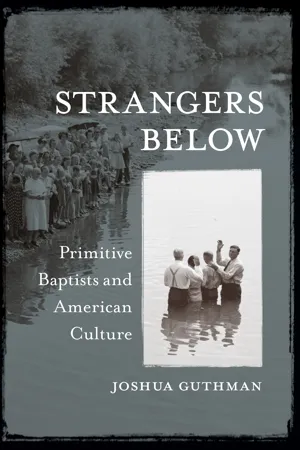
Before the Bible Belt fastened itself across the South, competing factions of evangelicals fought over their faith’s future, and a contrarian sect, self-named the Primitive Baptists, made its stand. Joshua Guthman here tells the story of how a band of antimissionary and antirevivalistic Baptists defended Calvinism, America’s oldest Protestant creed, from what they feared were the unbridled forces of evangelical greed and power. In their harrowing confessions of faith and in the quavering uncertainty of their singing, Guthman finds the emotional catalyst of the Primitives' early nineteenth-century movement: a searing experience of doubt that motivated believers rather than paralyzed them.
But Primitives' old orthodoxies proved startlingly flexible. After the Civil War, African American Primitives elevated a renewed Calvinism coursing with freedom’s energies. Tracing the faith into the twentieth century, Guthman demonstrates how a Primitive Baptist spirit, unmoored from its original theological underpinnings, seeped into the music of renowned southern artists such as Roscoe Holcomb and Ralph Stanley, whose “high lonesome sound” appealed to popular audiences searching for meaning in the drift of postwar American life. In an account that weaves together religious, emotional, and musical histories, Strangers Below demonstrates the unlikely but enduring influence of Primitive Baptists on American religious and cultural life.
- 232 pages
- English
- ePUB (mobile friendly)
- Available on iOS & Android
eBook - ePub
About this book
Information
Topic
Theology & ReligionSubtopic
North American History1: Who Are the Primitive Baptists?
Lemuel Burkitt preached while the rain fell. The hot August sky had cracked open, drenching the thousands gathered in the churchyard to hear Burkitt’s sermon and feel “the powerful effect,” the “uncommon effect,” that only Christ’s grace could bring. The effects that day were obvious. Men and women sobbed, collapsed to the ground as if dropped by a bullet, begged their fellows to pray for them, and cried out to God, “What must I do to be saved?” Others stood frozen in the hot rain, transfixed by Burkitt’s words, the holy company, and the legacy of two years of revival. For in North Carolina in 1803, God worked wonders. He sobered drunks and reformed liars, he made enemies into friends and friends into converts, he stamped out jealousy and led the wayward home. And in a rain-soaked churchyard, his spirit moved.1
For decades, Burkitt and his fellow Baptists had waited and worked for times like these. When, at last, the revival arrived and meetinghouses overflowed, they praised God for his mercy, testified to his power, and beseeched him for a future filled with such glad tidings. “After a long and tedious night,” wrote Burkitt in the midst of the revival, “the sable curtains are withdrawn, the day has dawned, and the sun of righteousness has risen with healing on his wings.” Burkitt’s Baptists in North Carolina and Virginia, like so many Protestants in the young nation, read the signs: the revivals burning across America at the century’s beginning were, they believed, marks of spiritual progress and harbingers, they hoped, of a Christian millennium. Wrote Burkitt: “O! that He would continue his work until the whole world is brought into subjection to the peaceable reign of Christ.”2
Within a generation, however, enthusiasm turned to skepticism. For many Baptists in the churches stoked by Burkitt’s preaching, the once-familiar flames of revival looked now like strange fire. Calm reflection, a gift of time’s passage, revealed different truths and exposed grievous errors. By the mid-1820s, skeptics viewed the 1802–3 revival and others like it with alarm. Obscured within the blessed multitude who joined the visible church during those heady days were those who were, as the skeptics explained, “deceived and [who] deceive[d] others.” The revivalists’ zeal, they wrote, had excited base passions of those gathered to hear the gospel. Led by such frantic guides, prospective converts lost their way: “human means” and religious “machinery” supplanted the Holy Spirit’s healing touch. In the revival’s cauldron, would-be Christians “imbibed the notion that the Holy Ghost is somehow so the creature of human feelings that he is led to regenerate persons by our getting their animal feelings excited; and therefore that in the same proportion as we can by any measure get the feelings of the people aroused, there will be a revival of religion.” For the latter-day doubters, the revivalistic excesses during the earliest years of the nineteenth century beckoned the wholesale religious treachery of their own day. What Lemuel Burkitt had described as progress, these later Baptist skeptics interpreted as the beginnings of decline. What Burkitt once assumed to be fidelity to God’s word was now seen as a step toward heresy.3
Baptist skeptics had dotted the ranks of the faithful for years, but they only crystallized into a movement by the late 1820s. During those years, they began referring to themselves as “Reformed” or “Old School” or “Primitive” Baptists, and as their various monikers indicate, they disavowed much of what passed for recent Baptist history. These Old School Baptists insisted on their own antiquity and chastised fellow Baptists for elevating the edicts of modern benevolent and missionary organizations above the authority of local churches and for adopting the “new measures” of the day, a term friend and foe alike used to describe the techniques of emotional excitement deployed by modern revivalists.4 While the Primitives railed against an array of Protestants, they engaged most often with their opponents within Baptist ranks. Primitives described these people in sweeping terms as “new school” or “missionary” Baptists, labels that did not correspond to a particular sect but rather evoked those believers’ association with what Primitives considered the objectionable traits of modern evangelicalism, namely, its innovations in doctrine and its devotion to organized benevolent causes, such as the emergent missions movement.5
In the wake of the schism, each group of Baptists produced preacher-historians who turned to the past for all the usual reasons: for comfort, for justification, for curiosity, for the preservation of memories that might serve as a guides to the present. Among the many functions of the accounts crafted by these preacher-historians was creation of a story of origins for each side in this intradenominational dispute. Believers could read these accounts and learn something of how their group came to be. These rather different missionary and Primitive chronicles appeared around midcentury—several decades after the schism—but each side’s writers drew from a shared Baptist past. That shared past was most carefully reconstructed in a third set of histories, written in the early 1800s by chroniclers poised on the cusp of two different eras in Baptist history. These early nineteenth-century chroniclers wrote during the series of revivals that were the most dramatic sign of Baptists’ changing fortunes. While these books reflected that era’s newfound confidence, the writers dwelled extensively on the lean times of the eighteenth century, when persecution and disorder reigned. This shared past of both persecution and incipient triumph offered missionary and Primitive chroniclers the raw materials for their own distinct tales of Baptists’ deep history and their more recent conflicts.
What is most remarkable about the early nineteenth-century Baptist histories is their optimism. Within the world conjured up by these works, there is a consistent movement from confusion to certainty, from chaos to order, from fragmentation to unity, from darkness to light. To be sure, the journey charted by the early Baptist historians never comes across as a leisurely tour though an uncomplicated landscape. Hardship, deprivation, persecution, and doubt litter the way, but these trials were mere prelude. Writing in the midst of the early nineteenth-century revivals, writers such as William Fristoe, Lemuel Burkitt, and Jesse Read interpreted their ancestors’ struggles as signs of providence. They brandished their ancestors’ scars, for the old wounds symbolically bound them to their Savior, who, too, had suffered before rising. The prior struggle only confirmed the present triumph.
The confidence that had seeped into the early nineteenth-century accounts soon flooded Baptist discourse. In histories of the sect written in midcentury, missionary Baptist writers displayed their faith in progress and their devotion to a God who matched their aspirations. These were romantic tales where a Baptist phalanx conquered adversity and subdued chaos. Baptists’ recent history—their growth in numbers, their benevolent efforts, their initiatives to formally educate the laity and the ministry, and especially their foreign and domestic missionary work—became the logical consequence of a divine plan to save the world. To these forward-looking missionary Baptists, their Primitive brethren, who opposed all that they held dear, were an obstinate people whose objections to progress could stem only from ignorance and a small-minded fear of the future.
Surveying the same historical landscape as their missionary brethren, Primitive Baptists spied deception and error where others had found glory and progress. Works by Primitive Baptist writers took a tragic and, in some cases, bitterly sarcastic turn. Primitive chroniclers often mocked the missionary Baptists’ optimism and what they saw as their insouciant certainty of salvation. When mockery would not suffice, Primitives accused missionary Baptists of betraying their faith for reasons of pride, envy, or greed. Old heroes also populated Primitives’ tales of the Baptist past, but these men persevered rather than triumphed. And in those lonely luminaries of days gone by, the Primitives discovered themselves: yet another generation of Baptists, stretching back even to the apostolic church, called to shepherd the true faith through a benighted land. What made such tales particularly tragic and instructive was that the worst deceivers now emerged from Baptist meetinghouses, not from the Catholic Church, the Anglican establishment, or other familiar bastions of treachery.
We recognize these plots. They are conventional, trite even, and, therefore, we may be tempted to dismiss them as cloudy narrative strategies that obscure our view of the past as it really was. But such conventions should not frustrate us. The poetics of these seemingly bland accounts have much to tell us. The church and denominational histories that nineteenth-century Baptists wrote were at once factual reports and symbolic narratives. Anyone who has perused these or similar texts—their pages blanketed with baptismal tallies, lists of preachers’ names, and bare summaries of church meetings—can confirm the former description. But even these seemingly tedious details find themselves part of a larger whole whose thematic qualities are revealing. Even the driest of these histories is a record of a people’s self-understanding: who they were, how they came to be, what they believed, where they were headed. If, then, we consider Baptists’ church, associational, and denominational histories as imaginative documents, if we read them not only for what their authors wrote but for the ways in which they wrote, then we can begin to understand the two very different group identities—one missionary, the other “primitive” or anti-missionary—at the center of the nineteenth-century Baptist schism. We will see how these identities came to be, how they were sustained in the histories each side crafted, and how their competing notions of self and other lived in such perfect symbiosis that it often seemed unimaginable that such different groups of believers had shared church pews only years earlier.
The Shared Past
In the colonial South, Baptists found themselves estranged from the rituals of plantation society and persecuted by colonial authorities. Outsiders noticed appearances first. In Virginia’s piedmont and tidewater, Baptists with “cut off” hair dressed plainly, refusing to don the powdered wigs or ruffled finery that filled the gentry’s armoires. Baptist churches were rudely constructed outposts or, just as often, members’ homes—a stark contrast to the more elaborate Anglican houses of worship that drew the allegiance of each parish’s most powerful families. Even more than appearances, Baptists’ rituals and beliefs set them apart from other colonial Christians. They insisted that their central rite be full-water immersion (no sprinkling allowed); that only adults were allowed to descend and then arise from this watery grave (no baptism for babies); and, finally, that all baptisms needed to be preceded by the convert’s experience of the saving grace of Jesus Christ (without such an encounter one remained outside the beloved community).6
Anglicans exacted a steep price from Baptist dissenters. Like all colonists in Virginia, Maryland, and the Carolinas, Baptists were required to attend and pay taxes to support the “established” Church of England. For noncompliance, Baptists faced fines, jailings, whippings, and beatings. Throughout the 1700s, Baptists’ numbers remained small, but their presence nevertheless betokened a radical rupture in the region’s gentry-dominated social life. By 1760, Baptists in colonial Virginia, at least, constituted what the historian Rhys Isaac memorably describes as an “evangelical counterculture,” revolting against both the Anglican religious establishment and the time-honored pastimes—hunting, drinking, horse racing, music making—of the planter society.7
Even as they fended off Anglicans and pleasure-seeking planters, eighteenth-century Baptists found their own ranks splintering. Consider North Carolina, where three different Baptist sects sparred over matters profound and petty. The General Baptists, many of them settlers from England, arrived first. They preached a generous doctrine of general atonement, which held that Christ’s death made salvation possible for everyone and not just for a limited number of predestined souls. Nor did these General Baptists require prospective members to publicly relate their conversion experience or submit to full-water immersion. A second Baptist sect called Regulars also traced its roots to England, but members espoused a “particular” rather than a “general” atonement. That is, in Calvinist fashion, they believed that Christ’s atonement on the cross did not make salvation available to all but instead saved only a predestined elect. The growth of Regular Baptist churches in North Carolina soon outpaced the halting progress made by the General Baptists, and by the 1760s Regular Baptist churches in New Jersey had dispatched preachers to the South on a successful campaign to reorganize many once-General churches along the Regulars’ Calvinist scheme. Meanwhile, a third clique of Baptists, the Separates, entered the fray. The notoriously spartan Separates scorned the Regular Baptists’ “superfluity of apparel.” They deemed the Regulars lax in doctrinal matters, too, objecting to what they considered the Regulars’ willingness to admit converts without requiring a relation of their conversion experience. For their part, the Regulars suspected the Separates of unreasonably hiding their true beliefs.8
For Baptists who had drifted into the rolling hills of Virginia and Carolina in the mid-1700s, it was not an auspicious start. Certainly, that is what the nineteenth-century descendants of these Baptist pioneers believed. Whether they were writing during the heady days of the Great Revival or during the fractious years following the denomination’s split, nineteenth-century Baptist chroniclers of all stripes recalled their ancestors’ struggles with a mix of horror, disappointment, and awe.
In Baptist histories and memoirs of those early years, tales of persecution abound. At times, the books read like catalogs of abuse. Verbal ridicule and threats of violence were standard fare. Interlopers shouted down Baptist preachers in midsermon. Dogs were cast into the river to interrupt baptisms. Such ridicule easily turned to violence. Colonial authorities ripped Baptist elders from the stand and carried them to prison for preaching without licenses. Elder John Tanner received a thigh full of buckshot for baptizing a woman whose husband disapproved of the upstart sect. Club-wielding mobs lay siege to churches, a miscreant brandished a gun at a preacher, and another mob rushed a meetinghouse, beating worshippers “so that the floor shone with sprinkled blood.” And so it went. The examples were legion, and Baptist chroniclers took them down with a bookkeeper’s efficiency.9
When nineteenth-century Baptists recounted this violent past, they poured their ancestors’ experiences into a familiar mold. The persecuted were to be admired because in their suffering they resembled Christ, and their injuries were to be carefully chronicled because the wounds formed a record—they were proof—that the current revivals were real and, in some sense, prophesied. Writing in 1808, William Fristoe, for instance, concluded that the early Baptists’ persecution was, in fact, responsible for their growth. Just as stories of Christ’s patient torment on the cross attracted converts, the early American Baptists’ trials must have earned them new followers, or so Fristoe surmised. Lemuel Burkitt and his coauthor Jesse Read also availed themselves of this enduring Christian model. Writing at roughly the same time as Fristoe, they praised the aforementioned Tanner for refusing to seek restitution, and they pointedly noted that instead of feeling angry or fearful when he was shot, Tanner “submitted to it patiently as persecution for Christ’s sake.” Primitive Baptists, too, patterned the Baptist past this way, declaring themselves startled, but happily so, that the endemic suffering of Baptists was “precisely the same in the modern eighteenth century as in the ancient first century.”10
While the nineteenth-century chroniclers easily apprehended and admired the Christlike suffering of their ancestors, they found the intradenominational chaos and strife that plagued these same people to be a more difficult interpretive challenge. When the first wave of antebellum Baptist chroniclers gazed backward, they either downplayed their denomination’s recent history of factionalism or admitted the disharmony only to the extent necessary to shoehorn it into a grand narrative of Christian progress. Such denial seems a corollary of the newfound unity born of the revivals. Even for the notoriously fractious Baptists, disagreement and division were nearly impossible to countenance during the years immediately surrounding the Great Revival. This shift in both story and mood marked a significant departure from what had traditionally been the conventional Baptist narrative, a narrative featuring bloodied and imprisoned preachers, struggling but holy churches, and ruthless oppressors. Baptists with particularly keen historical imaginations traced their denominational roots well past a familiar figure like Roger Williams, connecting themselves instead to a series of little-known sects—the Waldenses, the Petrobrusians, the Hussites—that, they claimed, also practiced believers’ baptism and were, therefore, Baptists in everything but name. But during the years of revival, this story of suffering and hiddenness lost some of its relevance. To make it comport with their present reality, the early nineteenth-century chroniclers downplayed it. These writers reduced the old narrative of persecution into an unfortunate, if necessary, prelude to their joyous present and smoothed the pitted surface of intra-Baptist conflict to reflect the harmony of their own era.
Perhaps our best sense of this narrative strategy comes from Burkitt and Read, the two preachers mentioned above who in 1803 cowrote a history of their particular Baptist association, the Kehukee—the same association that a little more than two decades later would spearhead the Primitive Baptist revolt. Though primarily a catalog of minutes, church enrollment figures, and doctrinal resolutions, Burkitt and Read’s book tells us much about how turn-of-the-century Baptists understood their past and envisioned their future. A collection of minutiae, the book also works to situate the Kehukee Association’s Baptists in the middle of a symbolic story about Christendom. The coauthors were themselves living testimony to the spirit of unity that pervaded the Kehukee and many other Baptist associations in the South beginning in the late 1700s. B...
Table of contents
- Cover Page
- Strangers Below
- Copyright Page
- Dedication
- Epigraph
- Contents
- Illustrations
- Introduction
- 1: Who Are the Primitive Baptists?
- 2: Doubts Still Assail Me
- 3: Filthy Lucre, Hired Nurses, and the Suckling Preacher
- 4: Rocking Daniel
- 5: The Lonesome Sound
- Epilogue
- Notes
- Bibliography
- Acknowledgments
- Index
Trusted by 375,005 students
Access to over 1.5 million titles for a fair monthly price.
Study more efficiently using our study tools.
Frequently asked questions
Yes, you can cancel anytime from the Subscription tab in your account settings on the Perlego website. Your subscription will stay active until the end of your current billing period. Learn how to cancel your subscription
No, books cannot be downloaded as external files, such as PDFs, for use outside of Perlego. However, you can download books within the Perlego app for offline reading on mobile or tablet. Learn how to download books offline
Perlego offers two plans: Essential and Complete
- Essential is ideal for learners and professionals who enjoy exploring a wide range of subjects. Access the Essential Library with 800,000+ trusted titles and best-sellers across business, personal growth, and the humanities. Includes unlimited reading time and Standard Read Aloud voice.
- Complete: Perfect for advanced learners and researchers needing full, unrestricted access. Unlock 1.5M+ books across hundreds of subjects, including academic and specialized titles. The Complete Plan also includes advanced features like Premium Read Aloud and Research Assistant.
We are an online textbook subscription service, where you can get access to an entire online library for less than the price of a single book per month. With over 1.5 million books across 990+ topics, we’ve got you covered! Learn about our mission
Look out for the read-aloud symbol on your next book to see if you can listen to it. The read-aloud tool reads text aloud for you, highlighting the text as it is being read. You can pause it, speed it up and slow it down. Learn more about Read Aloud
Yes! You can use the Perlego app on both iOS and Android devices to read anytime, anywhere — even offline. Perfect for commutes or when you’re on the go.
Please note we cannot support devices running on iOS 13 and Android 7 or earlier. Learn more about using the app
Please note we cannot support devices running on iOS 13 and Android 7 or earlier. Learn more about using the app
Yes, you can access Strangers Below by Joshua Guthman in PDF and/or ePUB format, as well as other popular books in Theology & Religion & North American History. We have over 1.5 million books available in our catalogue for you to explore.