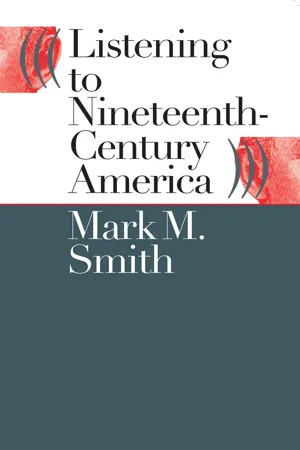
Arguing for the importance of the aural dimension of history, Mark M. Smith contends that to understand what it meant to be northern or southern, slave or free — to understand sectionalism and the attitudes toward modernity that led to the Civil War — we must consider how antebellum Americans comprehended the sounds and silences they heard.
Smith explores how northerners and southerners perceived the sounds associated with antebellum developments including the market revolution, industrialization, westward expansion, and abolitionism. In northern modernization, southern slaveholders heard the noise of the mob, the din of industrialism, and threats to what they considered their quiet, orderly way of life; in southern slavery, northern abolitionists and capitalists heard the screams of enslaved labor, the silence of oppression, and signals of premodernity that threatened their vision of the American future. Sectional consciousness was profoundly influenced by the sounds people attributed to their regions. And as sectionalism hardened into fierce antagonism, it propelled the nation toward its most earsplitting conflict, the Civil War.
- 384 pages
- English
- ePUB (mobile friendly)
- Available on iOS & Android
eBook - ePub
Listening to Nineteenth-Century America
About this book
Information
( ( ( PART I
Imagining Maestros
Constructing and Defending the Southern Soundscape
When antebellum southern slaveholder Alfred Huger wrote of his penchant for “the quiet and retirement of Plantation Life,” he referred to a specific set of ideal social and economic relations and forms of behavior embraced by southern slaveholding society. Whatever their ideological bent, nineteenth-century ruling classes heard as much as they saw. Atlantic elites measured their authority and took the pulse of the society over which they presided in part by listening. The Old South’s ruling class was not marginal to this tendency, and their heard worlds reveal much about how they understood themselves and the essence of their society.1
Men such as Huger spoke of plantation quietude, not of silence. Slaveholders were not foolish enough, even in their most marvelously romantic moments, to believe in an utterly silent slave South (as anyone who has had their ears stung by the roar of cicadas on a southern summer’s eve will testify).2 Their stubborn pragmatism told them that farms and plantations could never be silent. The rural South was punctuated by many, sometimes loud sounds, including braying and snuffling animals, baying hounds, blowing horns, and ringing plantation bells, to name but the most obvious soundmarks of a rural society.3 True, post-Revolution slaveholders presided over a mature slave society, and they liked to think their mastery absolute. But moments of fantasy aside, realist masters knew that their command was defined in no small part by challenges to their authority from within southern society. Thus they insisted not on silence—which they knew they could not have and, in fact, did not really want—but on quietude, tranquility, and sounds they deemed characteristic of their organic social order. Certain sounds were pleasant and distinctively rural and, as such, they were considered quiet in an abstract sense. Too much silence at particular moments rubbed nerves raw simply because silence was the unheard note that might precede insurrection. As well as constructing noise and sound, masters also constructed quietude and silence. Both were rooted in objective conditions, and slaveholders, like northern elites, communicated (and in the process defined) their core social values with aural images amplified through the skein of slavery’s social and economic relations and the physical environment that anchored them.
Some sounds, such as the hum of industriousness, the register of slave-based productivity, and the sounds considered preservative of social order, were encouraged. But for the most part, slaveholders imagined themselves custodians of a seamlessly tranquil society where calm reigned and harmony was heard. This projection of aural order hardly distinguished slaveholders from other classes concerned with mastery. One need only think of Victor Erice’s 1973 depiction of Franco’s Spain, El Espiritu de la Colmena, where all conversations were conducted in precious whispers, to appreciate how far ruling elites in conservative societies will go to maintain social order (as following chapters show, democratic capitalists could be equally unforgiving of persons who transgressed their preferred soundscape).
The slaveholders’ embrace of their constructed aural order was not so much an attempt to regain a putative quieter past but an effort to promote a particular vision of a social order in the face of an emerging northern bourgeois alternative. Training their ears northward, they increasingly heard boisterous industrialism, unfettered democracy, and wage labor capitalism. Slaveholders countered with a construction of sound stressing the rhythm of industriousness, not industrialism, and the sober tones of organic social and economic relations, not the noise of mobocracy or withering wage labor. They did not reject all modern innovations. Indeed they actively embraced sounds—such as the sound of time and a host of other quasi-bourgeois sentiments—that bolstered, disciplined, and improved their social order. Some, especially planters along the Mississippi River who had to hear steamboats, managed to pastoralize and thereby incorporate modern intrusions. Instead of hissing steam they heard boat “wheels beat a quick tattoo” and listened to “throbbing engines” that “forced the delusion of beholding a living thing.” Modern sounds were incorporated into the southern pastoral idiom through listening in certain ways: “The characteristics of the boats varied so one would know them in the dark unerringly by the sound of the steam-pipe or whistle, as you would recognize unseen the step and voice of friends from those of strangers.” Beyond such accommodation, slaveholders refused to countenance alien noises that threatened to disrupt their organic, hierarchic society. In slavery they heard the harmony of capital and labor; in northern capitalism, industrialism, urbanism, and democracy they heard only “revolutions and intolerable distress.”4
The master class sometimes embraced national sounds. For most southerners as for most Americans, in the years following the Revolution, July Fourth was probably the loudest day of the year about which northerners and southerners throughout the early national and antebellum years commented. Through print and travel, antebellum Americans invented an “imagined community” around an imagined soundscape on Independence Day, when they envisioned all Americans participating in a soundscape that was at once local and national. Juliana Conner, who relocated from Charleston to the rural repose of a North Carolina plantation in 1827, suggested as much. On Independence Day 1827 she commented on the “quiet and stillness of all around” and imagined “the moving throng and busy life which is, this day in all our cities.” She continued, “Not a fort in our sea port towns but is now reverberating with the echoes of her cannon and on every mast her flags are proudly unfurled—yet here not a sound is heard.” She was a little disappointed but understood why her day was silent: “I always feel a disposition to enjoy this birthday of our Independence as a holiday and would have been pleased to witness its celebration in some of the neighboring towns—but the het [sic] is so excessive that I suspect it would be more fatigue than pleasure—therefore will remain quietly at home.”5
A commitment to national sounds and a similarity in the way ruling classes used the heard world to regulate laboring bodies did not preclude a distinctively southern soundscape. Unlike northerners who equated southern quietude with indolence and economic backwardness, slave owners interpreted their plantation quietude as betokening honesty, pastoral contentedness, simplicity, studied efficiency, and above all, social order. Slaveholders wanted the quiet life, facilitated by their nonindustrial, comparatively quieter, rural society. The preservation of this organic society was, masters believed, contingent on keeping the plantation soundscape tranquil. In their efforts to protect their pastoral soundscape from external and internal enemies, slaveholders experienced profound and troubling tensions.6

( ( ( 1. Soniferous Gardens
The plantation was very quiet, with that stillness which broods over broad, clean acres that furnish no refuge for so much as a bird that sings.
—Kate Chopin, Bayou Folk, 1894
“WHERE’S YOUR TOWNS?” The question was so characteristic, and was uttered with such a meaning look and gesture, we could not refrain from turning aside to have a quiet laugh. And yet at least one half of the Northern people, used all their lives to the bustle of cities and towns, and the noisy clatter of mechanical trades, if similarly situated with our earnest New-York acquaintance, would propound just such a question as he did—never once reflecting that cotton, sugar, rice, wheat, corn, tobacco, and all other agricultural products, grow only in the country, and very quietly too at that.
—D. R. Hundley, Social Relations in Our Southern States, 1860
In part, constructions of a highly stylized and ideal antebellum southern soundscape took shape in postbellum nostalgia. Listening back, postbellum southerners heard the South of old. Writing in 1901, James Battle Avirett attempted to retemporalize his readers through an appeal to sound. “What noise is that we hear over in that direction?” he asked, reimagining his Old South plantation. “That’s the song of the boys on their light carts hauling the marl.” The “supper bell” and the work bell mingled to create a romantic tapestry of southern serenity. “What is that suspended high up in the air, just between those two houses? That is the old plantation bell which, in the hands of Uncle Jim, regulates the movements of the servants, calling them to and from labor and telling [sic] out the hours for the various duties.” Cue the sound of plantation industriousness: “The hum of the spinning wheel, the noise of the loom, with the stirring whiz of the weaver’s shuttle, all accompanied, many times, by the melody of plantation songs.” Such sounds, “heard from January to December,” were inextricable from the plantation soundscapes because, slaveholders fancied, slaves acted at the behest of a master/maestro who conducted his plantation like a well-governed orchestra.1
Postbellum southern women’s ears were similarly trained. Writing in the 1920s in the best tradition of the Lost Cause, Susan Bradford Eppes began to compile her memories on “a life-time spent among the negroes, both as slave and free.” Among the raft of reminiscent works by former plantation owners and mistresses, perhaps none captures both the imagined and actual soundscape of an Old South plantation as well as Eppes’s. For her, memories of plantation quietude rang loudly. “In the palmy days of the Old South,” she declared, “country life was the one thing to be most desired; only those who were forced by the trend of events lived in the cities.” Plantations, after all, were quieter. The big house was “the very sanctuary of domestic felicity and peace,” and the workforce was quietly obedient. With frightening aplomb Eppes described her antebellum Florida plantation in the following terms: “Many a time have we been good-naturedly laughed at by our Northern visitors for the many servants needed to carry on the work; but to us it seemed really needful and we loved to see them moving around so quietly and so cheerfully taking from us every menial task.” Herein lay the essence of the ideal plantation soundscape: a quiet world staffed by obedient, dutiful labor. Industrious workers added the satisfying timbre of sober productivity: “All winter the wagons were busy hauling wood, the axes of the wood cutters rang clear upon the air.” Plantation sounds were harmonious, not unlike ideal slave-master relations. “A summer’s day in Florida” was one where the “bees hummed drowsily as they hovered in and out of the honeysuckle vine.” Southern heat added to the serenity: “The canaries are preening their feathers and hopping lazily from perch to perch, but it is too hot to sing: on the door mat the yellow cat is sleeping and within the house all is quiet, for the post-prandial nap is an institution in the Summer Land.” Even those not privy to the afternoon shut-eye were deliciously tranquil: “From the distant laundry comes the subdued murmur of voices.” Eppes was not alone in her assessment of the heard southern past, for even former slaves remembered plantation life as quiet in several respects. Writing from antebellum Philadelphia, Charles Ball remembered of his South Carolina rice plantation at night, “all was quiet, and the stillness of undisturbed tranquility prevailed over our little community.”2
Antebellum southern elites appreciated the soundscape in ways similar to those of their postbellum brethren because they, too, heard their pasts and ideal South. Sound was tied to place and memory was the tether. William D. Valentine, for example, heard the history of his South through birds. “I hear the birds of Spring,” he wrote in 1852, “now reminding me of childhood and early friends. . . . Bugle notes of the past whisper in my soul.” So, too, with Georgia’s Robert Habersham, who was reminded of yore in 1832 by the sounds of the plantation: “How pleasant is the sound of rain[.] Its soft monotonous pattering on the roof,—and windows is soothing and puts one in a meditative humour. . . . To take a book upto the carriage house,—and hear the rain,—. . . was the delight of my boyhood days.”3
Although there was a good deal of wishful thinking embedded in these projections, and while they never served to obliterate slaveholders’ everyday anxieties, such idealizations nonetheless had their basis in reality. Because the antebellum South, even by 1860, was still a predominantly rural society, it retained sounds of ancient pedigree inherited from the colonial period and slave societies of old. Sometimes southerners constructed this soundscape in absentia while abroad. When in southern Europe they commented favorably on the soundscape of countryside and towns and, in the process, heard their home as well as their European pasts. James Johnston Pettigrew heard “the old plantation” while trekking through Spain in the 1850s, harvesting reassuring registers as he went. It was a place where “birds sung” and “a Southern breeze rippled gently.” He also marveled at the “quiet of the solitude” and hinted at comparisons between this chivalric, silent country where the “watchman cries the hour in your hearing” and his quiet North Carolina plantation home. One writer for the Southern Literary Messenger in 1857 commented on the “soothing tranquil[ity] and beauty” as he traveled through the Campagna surrounding Rome. Greeting him was “alluring solitude, unbroken by any objects that are not in perfect harmony with its sweet and mournful desolation.” This was a place unscathed by the ravages of modernity, a place where “silence has here its perpetual home, a deep and ancient silence that the song of the lark and the occasional report of a sportsman’s fowling-piece seem scarcely able to disturb.” Rome was even better, “the most delightful place of residence on earth.” Here the “repose of the city and its isolation from the great, throbbing, active world of Europe and America, render it especially attractive to the quiet, meditative person who has no great projects of ambition to work out, and an easy competency in his affairs.” True, a “liberal government, stimulating the energies of the people and giving freedom of thought and opinion would no doubt work an important change in the aspects of the city; it would make the Campagna wave with golden harvests, and cause the banks of the Tiber to resound with the hum of industry.” But was this really wanted? Here was a parable for the brewing sectional American conflict: “But the clash of engines would jar upon the eloquent silence, and the hand of improvement.” This mapping of the southern soundscape onto places foreign (and, indeed, the idealization of those places as models for the South) extended to Naples and in interesting ways. “No hum of industry, no shock of ponderous machinery comes upon the slumberous air.” In Naples “all is tranquility.” Therein lay the danger, as southern masters well knew. For while the Italian city had no stealthy, conniving slaves, it had its fair share of swindlers who threatened to wrest precious money from unwary travelers. “All is tranquility—but not peace, for the quiet of Neopolitan life is a treacherous quiet, which, gathering with the shades of evening, is characterized by the frequent play of the stiletto.”4
Southerners did not need comparisons with Europe to confirm the virtues of their soundscape. They knew the benefits and courted the tranquility of slave-based country life. North Carolina lawyer William D. Valentine suggested as much in 1838. “I love a country seat where I can study in quiet,” he wrote, à la the English aristocrat, concluding, “where I can enjoy the mellow, mild air of fine autumn days.” And if some southern counties did not fit the mold, then others would. Harriet Randolph hoped her family would find “many tranquil and useful days” and “a peaceful haven” after they moved to Florida from Virginia in 1829.5
Southern sounds were romantic. From New Smyrna, Florida, Connecticut native Stella Hull wrote ...
Table of contents
- Cover Page
- Title Page
- Copyright Page
- Dedication
- Contents
- Acknowledgments
- Introduction: Sounding Pasts
- Part I. Imagining Maestros: Constructing and Defending the Southern Soundscape
- Part II. Keynotes Old and New: Listening to Northern Soundscapes
- Part III. Aural Sectionalism: The Politics of Hearing and the Hearing of Politics
- Part IV. Noises Hideous, Silences Profound, Sounds Ironic: Listening to the Civil War and Reconstruction
- Notes
- Bibliography
- Index
Trusted by 375,005 students
Access to over 1.5 million titles for a fair monthly price.
Study more efficiently using our study tools.
Frequently asked questions
Yes, you can cancel anytime from the Subscription tab in your account settings on the Perlego website. Your subscription will stay active until the end of your current billing period. Learn how to cancel your subscription
No, books cannot be downloaded as external files, such as PDFs, for use outside of Perlego. However, you can download books within the Perlego app for offline reading on mobile or tablet. Learn how to download books offline
Perlego offers two plans: Essential and Complete
- Essential is ideal for learners and professionals who enjoy exploring a wide range of subjects. Access the Essential Library with 800,000+ trusted titles and best-sellers across business, personal growth, and the humanities. Includes unlimited reading time and Standard Read Aloud voice.
- Complete: Perfect for advanced learners and researchers needing full, unrestricted access. Unlock 1.5M+ books across hundreds of subjects, including academic and specialized titles. The Complete Plan also includes advanced features like Premium Read Aloud and Research Assistant.
We are an online textbook subscription service, where you can get access to an entire online library for less than the price of a single book per month. With over 1.5 million books across 990+ topics, we’ve got you covered! Learn about our mission
Look out for the read-aloud symbol on your next book to see if you can listen to it. The read-aloud tool reads text aloud for you, highlighting the text as it is being read. You can pause it, speed it up and slow it down. Learn more about Read Aloud
Yes! You can use the Perlego app on both iOS and Android devices to read anytime, anywhere — even offline. Perfect for commutes or when you’re on the go.
Please note we cannot support devices running on iOS 13 and Android 7 or earlier. Learn more about using the app
Please note we cannot support devices running on iOS 13 and Android 7 or earlier. Learn more about using the app
Yes, you can access Listening to Nineteenth-Century America by Mark M. Smith in PDF and/or ePUB format, as well as other popular books in History & North American History. We have over 1.5 million books available in our catalogue for you to explore.