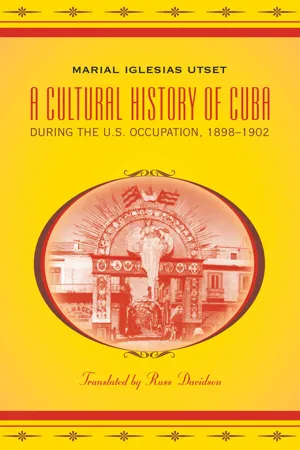
In this cultural history of Cuba during the United States' brief but influential occupation from 1898 to 1902 — a key transitional period following the Spanish-American War — Marial Iglesias Utset sheds light on the complex set of pressures that guided the formation and production of a burgeoning Cuban nationalism.
Drawing on archival and published sources, Iglesias illustrates the process by which Cubans maintained and created their own culturally relevant national symbols in the face of the U.S. occupation. Tracing Cuba’s efforts to modernize in conjunction with plans by U.S. officials to shape the process, Iglesias analyzes, among other things, the influence of the English language on Spanish usage; the imposition of North American holidays, such as Thanksgiving, in place of traditional Cuban celebrations; the transformation of Havana into a new metropolis; and the development of patriotic symbols, including the Cuban flag, songs, monuments, and ceremonies. Iglesias argues that the Cuban response to U.S. imperialism, though largely critical, indeed involved elements of reliance, accommodation, and welcome. Above all, Iglesias argues, Cubans engaged the Americans on multiple levels, and her work demonstrates how their ambiguous responses to the U.S. occupation shaped the cultural transformation that gave rise to a new Cuban nationalism.
eBook - ePub
A Cultural History of Cuba during the U.S. Occupation, 1898-1902
- 232 pages
- English
- ePUB (mobile friendly)
- Available on iOS & Android
eBook - ePub
A Cultural History of Cuba during the U.S. Occupation, 1898-1902
About this book
Information
INDEX
- Abakuá secret religious society, 138
- Abreu, Eulogio, 162 (n. 81)
- Abreu, Marta, 93–94
- Academy of Sciences, 18
- Acosta, Emilio, 52
- Advertisements: of consumer goods from United States, 25;
- endorsements of products in, by independence leaders, 120;
- in English language, 9, 56, 66, 69, 163 (n. 2);
- for flags, 108, 119–20;
- government regulations on, 155 (n. 39);
- for hotels and restaurants, 95–96;
- illustrations for, 15;
- for patriotic objects, 119–20
- Afro-Cuban culture: and Abakuá secret religious society, 138;
- and danzón, 4, 56–60, 62, 161 (n. 74);
- and drumming, 53, 59–60, 62, 138, 162 (nn. 79, 81);
- and Santería, 158 (n. 31), 159 (n. 45). See also Blacks
- Aguilera, Francisco Vicente, 117
- Alfonso XII (king of Spain), portrait of, 14
- Almanacs, 29–33, 42–43
- Alquízar, 89
- Alsina Neto, Arturo, 152 (n. 7)
- Álvarez Curbelo, Silvia, 34
- American Book Company, 72–73
- American Humane Association, 164–65 (n. 20)
- Americanization of Cuba: and changes in place names, 87–99, 169 (n. 24);
- and conflicts of identity, 10–13, 25–26, 83–86;
- and consumer goods, 2, 5, 24–25;
- and English language, 1–2, 6, 65–83, 163 (nn. 1–2), 164 (n. 6);
- and modernization generally, 2–3, 5–6, 8–9, 11, 12;
- nongovernmental or philanthropic organizations influencing, 164–65 (n. 20);
- overview of, 1–2, 5;
- and public hygiene, 22–25;
- and schools, 16, 69–86;
- and separation of church and state, 37–38, 42;
- and significance of everyday activities, 3–4, 9;
- and Statue of Liberty, 26, 27, 28;
- tension between Cuban nationalism and, 2–4, 8–9, 11, 77–78;
- and urban development, 2, 5, 18–22, 153 (n. 22);
- and U.S. celebrations, 33–36. See also United States; U.S. military occupation of Cuba
- American Monthly Review of Reviews, 70
- American Revolutionary War, 81
- Amerindian tradition, 116–17
- Anderson, Benedict, 7, 44, 128, 158–59 (n. 42)
- Animals, 22–23
- Appadurai, Arjun, 118
- Appleton, Ginn, and Company, 72
- Aragonés, Pedro, 81
- Archibald, James F. J., 161 (n. 74)
- Archives, Cuban, 17, 114
- Archivo General de la Isla, 17
- Arendt, H...
Table of contents
- Cover Page
- A Cultural History of Cuba during the U.S. Occupation, 1898–1902
- Copyright Page
- CONTENTS
- TRANSLATOR'S NOTE
- ACKNOWLEDGMENTS
- Introduction
- ONE Empty Pedestals and Barracks Converted into Schools
- TWO Policies Governing Celebrations
- THREE Attempts at Linguistic Colonization and the Struggle to Preserve Spanish
- FOUR The “Decolonization” of Names
- FIVE The Socialization of Symbols Representing the Idea of Country
- SIX Public Culture and Nationalism
- NOTES
- BIBLIOGRAPHY
- INDEX
Trusted by 375,005 students
Access to over 1.5 million titles for a fair monthly price.
Study more efficiently using our study tools.
Frequently asked questions
Yes, you can cancel anytime from the Subscription tab in your account settings on the Perlego website. Your subscription will stay active until the end of your current billing period. Learn how to cancel your subscription
No, books cannot be downloaded as external files, such as PDFs, for use outside of Perlego. However, you can download books within the Perlego app for offline reading on mobile or tablet. Learn how to download books offline
Perlego offers two plans: Essential and Complete
- Essential is ideal for learners and professionals who enjoy exploring a wide range of subjects. Access the Essential Library with 800,000+ trusted titles and best-sellers across business, personal growth, and the humanities. Includes unlimited reading time and Standard Read Aloud voice.
- Complete: Perfect for advanced learners and researchers needing full, unrestricted access. Unlock 1.5M+ books across hundreds of subjects, including academic and specialized titles. The Complete Plan also includes advanced features like Premium Read Aloud and Research Assistant.
We are an online textbook subscription service, where you can get access to an entire online library for less than the price of a single book per month. With over 1.5 million books across 990+ topics, we’ve got you covered! Learn about our mission
Look out for the read-aloud symbol on your next book to see if you can listen to it. The read-aloud tool reads text aloud for you, highlighting the text as it is being read. You can pause it, speed it up and slow it down. Learn more about Read Aloud
Yes! You can use the Perlego app on both iOS and Android devices to read anytime, anywhere — even offline. Perfect for commutes or when you’re on the go.
Please note we cannot support devices running on iOS 13 and Android 7 or earlier. Learn more about using the app
Please note we cannot support devices running on iOS 13 and Android 7 or earlier. Learn more about using the app
Yes, you can access A Cultural History of Cuba during the U.S. Occupation, 1898-1902 by Marial Iglesias Utset, Russ Davidson in PDF and/or ePUB format, as well as other popular books in History & Latin American & Caribbean History. We have over 1.5 million books available in our catalogue for you to explore.