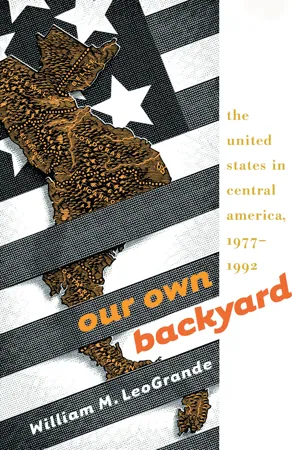
In this remarkable and engaging book, William LeoGrande offers the first comprehensive history of U.S. foreign policy toward Central America in the waning years of the Cold War. From the overthrow of the Somoza dynasty in Nicaragua and the outbreak of El Salvador’s civil war in the late 1970s to the final regional peace settlements negotiated a decade later, he chronicles the dramatic struggles — in Washington and Central America — that shaped the region’s destiny.
For good or ill, LeoGrande argues, Central America’s fate hinged on decisions that were subject to intense struggles among, and within, Congress, the CIA, the Pentagon, the State Department, and the White House — decisions over which Central Americans themselves had little influence. Like the domestic turmoil unleashed by Vietnam, he says, the struggle over Central America was so divisive that it damaged the fabric of democratic politics at home. It inflamed the tug-of-war between Congress and the executive branch over control of foreign policy and ultimately led to the Iran-contra affair, the nation’s most serious political crisis since Watergate.
- 792 pages
- English
- ePUB (mobile friendly)
- Available on iOS & Android
eBook - ePub
About this book
Information
Notes
Abbreviations Used in the Notes
GOVERNMENT DOCUMENTS
- Iran-Contra Chronology
- U.S. Congress, Report of the Congressional Committees Investigating the Iran-Contra Affair: Appendix C, Chronology of Events, H. Rept. 100–433, S. Rept. 100–216, 100th Cong., 1st sess. (Washington, D.C.: Government Printing Office, 1988).
- Iran-Contra Depositions
- U.S. Congress, Report of the Congressional Committees Investigating the Iran-Contra Affair: Appendix B, Depositions, Volumes 1–27, H. Rept. 100–433, S. Rept. 100–216, 100th Cong., 1st sess. (Washington, D.C.: Government Printing Office, 1988).
- Iran-Contra Documents
- U.S. Congress, Report of the Congressional Committees Investigating the Iran-Contra Affair: Appendix A, Source Documents, Volumes 1 and 2, H. Rept. 100–433, S. Rept. 100–216, 100th Cong., 1st sess. (Washington, D.C.: Government Printing Office, 1988).
- Iran-Contra Hearings
- U.S. Congress, Iran-Contra Investigation: Testimony, Volumes 100–1 to 100–13, Joint Hearings before the Senate Select Committee on Secret Military Assistance to Iran and the Nicaraguan Opposition, and the House Select Committee to Investigate Covert Arms Transactions with Iran, 100th Cong., 1st sess. (Washington, D.C.: Government Printing Office, 1987).
- Iran-Contra Report
- U.S. Congress, Report of the Congressional Committees Investigating the Iran-Contra Affair, H. Rept. 100–433, S. Rept. 100–216, 100th Cong., 1st sess., November 17, 1987 (Washington, D.C.: Government Printing Office, 1988).
- Iran-Contra Testimonial Chronology
- U.S. Congress, Report of the Congressional Committees Investigating the Iran-Contra Affair: Appendix D, Testimonial Chronology: Witness Accounts Supplemented by Documents, Volumes 1–5, S. Rept. 100–216, 100th Cong., 1st sess. (Washington, D.C.: Government Printing Office, 1988).
- Reagan Papers
- Public Papers of the Presidents of the United States: Ronald Reagan, 1981–1989 (Washington, D.C.: Government Printing Office, 1982–89).
ARCHIVES AND MEDIA
- CQ Weekly Report
- Congressional Quarterly Weekly Report
- CSM
- Christian Science Monitor
- LAT
- Los Angeles Times
- MH
- Miami Herald
- NSA
- National Security Archive
- NYT
- New York Times
- PROFS
- Professional Office System (NSC computerized message system)
- UPI
- United Press International
- WP
- Washington Post
- WSJ
- Wall Street Journal
CHAPTER ONE
1. “Inaugural Address, January 20, 1981,” Reagan Papers, 1981, pp. 1–4.
2. Reagan on August 18, 1980, quoted in Cannon, Reagan, p. 271. On opinion among both the mass public and the political elite, see Holsti and Rosenau, American Leadership in World Affairs, and Rielly, American Public Opinion.
3. Reagan coined the term “Evil Empire” in a March 8, 1983, speech to Evangelical ministers in Orlando, Florida. Cannon, President Reagan, p. 316.
4. Franck and Weisband, Foreign Policy by Congress; Crabb and Holt, Invitation to Struggle.
5. Public Law (PL) 93–189, Sec. 30, 87 Stat. 714.
6. See Johnson, Season of Inquiry.
7. See Schoultz, Human Rights.
8. Francis X. Clines, “Sun Smiles on the President, Blowing Kisses and Happy,” NYT, January 21, 1981; Pete Early and Thomas Morgan, “National Pride Unites Throng of Revelers at Inauguration,” WP, January 21, 1981.
9. Pete Early and Thomas Morgan, “National Pride Unites Throng of Revelers at Inauguration,” WP, January 21, 1981.
CHAPTER TWO
1. Reagan first used this comparison in “Remarks on Central America and El Salvador at the Annual Meeting of the National Association of Manufacturers, March 10, 1983,” Reagan Papers, 1983, book 1, pp. 372–77.
2. Bulmer-Thomas, Political Economy of Central America, pp. 1–10.
3. Berman, Under the Big Stick, pp. 43–46.
4. Ralph Lee Woodward Jr., Central America: A Nation Divided, pp. 136–48.
5. Quoted in Blachman, LeoGrande, and Sharpe, Confronting Revolution, pp. 329–50. For a detailed history of the Monroe Doctrine, see Perkins, History of the Monroe Doctrine.
6. The next two sections are adapted from LeoGrande, “Revolution in Nicaragua,” Foreign Affairs, Fall 1979.
7. Berman, Under the Big Stick, p. 169.
8. Macaulay, Sandino Affair; Selser, Sandino.
9. Quoted in LaFeber, Inevitable Revolutions, p. 67.
10. Smallwood, Writings of Will Rogers, p. 134.
11. The best history of the relationship between Somoza and the United States is Millet, Guardians of the Dynasty.
12. Pastor, Condemned to Repetition, pp. 3–4.
13. Millet, Guardians of the Dynasty, p. 252.
14. Booth, End and Beginning, pp. 67–82; Eric Morgenthaler, “Somoza Combines Politics, Business, Military to Rule Nicaragua as Undisputed Strongman,” WSJ, October 22, 1973.
15. Booth, End and Beginning, chaps. 6–7; Chamorro, Dreams of the Heart, pp. 99–103.
16. Millet, Guardians of the Dynasty, pp. 258–59. On the early history of the Sandinistas, see also Nolan, Ideology of the Sandinistas; and for a first-person account, Cabezas, Fire from the Mountain.
17. LeoGrande, “Cuba,” in Blachman, LeoGrande, and Sharpe, Confronting Revolution, pp. 229–55. Sandinista defector Roger Miranda says that the FSLN received no more than a few thousand dollars in aid from Cuba prior to late 1978. Miranda and Ratliff, Civil War in Nicaragua, p. 97.
18. Diederich, Somoza, p. 129.
19. “University of Notre Dame: Address at Commencement Exercises at the University, May 22, 1977,” Public Papers of the Presidents of the United States: Jimmy Carter 1977, book 1, pp. 954–62.
20. Carter, Keeping Faith, p. 145. Regarding the ability of the human rights issue to build a domestic consensus behind foreign policy, see the results of Carter’s pollster, Patrick Caddell, reported in Elizabeth Drew, “Reporter-at-Large: Human Rights,” New Yorker, July 18, 1977.
21. Lake, Somoza Falling, pp. 28, 76; Pastor, Condemned to Repetition, p. 50.
22. Schoultz, Human Rights, p. 257. According to Wade Matthews, the State Department’s director of Central American affairs in 1977–78, Carter officials saw Central America as “a great testing ground” for the human rights policy. Quoted in Morley, Washington, Somoza, and the Sandinistas, p. 96.
23. In March 1977, a publication of the U.S. Foreign Service reported, “During 1976, the government inflicted heavy blows on the local guerrilla organization and now faces no serious threat from that quarter.” Quoted in Diederich, Somoza, pp. 141–42.
24. For an excellent history of U.S. relations with Nicaragua during the Nixon and Ford administrations, see Morley, Washington, Somoza, and the Sandinistas.
25. Alan Riding, “U.S. Neutrality Heartens Nicaragua Rebels,” NYT, February 5, 1978.
26. Christian, Nicaragua, pp. 48–51. The text of the statement is in Leiken and Ruben, Central American Crisis Reader, pp. 172–73.
27. The differences among the three tendencies are explained in interviews with three Sandinista factional leaders, in “Sandinista Perspectives,” Latin American Perspectives, Winter 1979.
28. It was never established with certainty who killed Chamorro. Five men were arrested and tried for the crime, one of whom claimed that a Cuban-American businessman, Pedro Ramos, ordered the murd...
Table of contents
- Cover Page
- Our Own Backyard
- Copyright Page
- Dedication
- Contents
- Preface
- Abbreviations Used in the Text
- I Origins
- II El Salvador
- III Nicaragua
- IV Denouement
- Notes
- Bibliography
- Index
Trusted by 375,005 students
Access to over 1.5 million titles for a fair monthly price.
Study more efficiently using our study tools.
Frequently asked questions
Yes, you can cancel anytime from the Subscription tab in your account settings on the Perlego website. Your subscription will stay active until the end of your current billing period. Learn how to cancel your subscription
No, books cannot be downloaded as external files, such as PDFs, for use outside of Perlego. However, you can download books within the Perlego app for offline reading on mobile or tablet. Learn how to download books offline
We are an online textbook subscription service, where you can get access to an entire online library for less than the price of a single book per month. With over 1.5 million books across 990+ topics, we’ve got you covered! Learn about our mission
Look out for the read-aloud symbol on your next book to see if you can listen to it. The read-aloud tool reads text aloud for you, highlighting the text as it is being read. You can pause it, speed it up and slow it down. Learn more about Read Aloud
Yes! You can use the Perlego app on both iOS and Android devices to read anytime, anywhere — even offline. Perfect for commutes or when you’re on the go.
Please note we cannot support devices running on iOS 13 and Android 7 or earlier. Learn more about using the app
Please note we cannot support devices running on iOS 13 and Android 7 or earlier. Learn more about using the app
Yes, you can access Our Own Backyard by William M. LeoGrande in PDF and/or ePUB format, as well as other popular books in Politics & International Relations & Latin American & Caribbean History. We have over 1.5 million books available in our catalogue for you to explore.