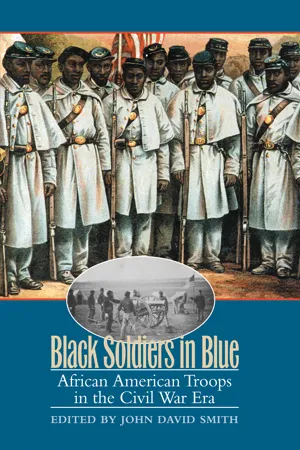
Inspired and informed by the latest research in African American, military, and social history, the fourteen original essays in this book tell the stories of the African American soldiers who fought for the Union cause.
An introductory essay surveys the history of the U.S. Colored Troops (USCT) from emancipation to the end of the Civil War. Seven essays focus on the role of the USCT in combat, chronicling the contributions of African Americans who fought at Port Hudson, Milliken’s Bend, Olustee, Fort Pillow, Petersburg, Saltville, and Nashville. Other essays explore the recruitment of black troops in the Mississippi Valley; the U.S. Colored Cavalry; the military leadership of Colonels Thomas Higginson, James Montgomery, and Robert Shaw; African American chaplain Henry McNeal Turner; the black troops who occupied postwar Charleston; and the experiences of USCT veterans in postwar North Carolina. Collectively, these essays probe the broad military, political, and social significance of black soldiers' armed service, enriching our understanding of the Civil War and African American life during and after the conflict.
The contributors are Anne J. Bailey, Arthur W. Bergeron Jr., John Cimprich, Lawrence Lee Hewitt, Richard Lowe, Thomas D. Mays, Michael T. Meier, Edwin S. Redkey, Richard Reid, William Glenn Robertson, John David Smith, Noah Andre Trudeau, Keith Wilson, and Robert J. Zalimas Jr.
- 464 pages
- English
- ePUB (mobile friendly)
- Available on iOS & Android
eBook - ePub
About this book
Information
Chapter 1: Let Us All Be Grateful That We Have Colored Troops That Will Fight
John David Smith
When President Abraham Lincoln’s September 22, 1862, preliminary Emancipation Proclamation went quietly into effect on Thursday, January 1, 1863, Secretary of the Navy Gideon Welles pronounced it “a broad step … a landmark in history”—an “extraordinary and radical measure—almost revolutionary in its character.” But few persons in the North or the South envisioned what historian James M. McPherson has termed the “revolution of freedom”—“the greatest social revolution in American history”—that ensued as the Civil War, with the preservation of the Union at stake, became a war of black liberation. On New Year’s Day, “all persons held as slaves within any state … then … in rebellion against the United States” became “thenceforward, and forever free.”1
In his final Emancipation Proclamation Lincoln issued on January 1, the president added a new paragraph authorizing that suitable emancipated slaves “will be received into the armed service of the United States to garrison forts, positions, stations, and other places, and to man vessels of all sorts in said service.” This passage signaled a major reversal in policy because since the start of the war the U.S. Army had turned away free black volunteers. Lincoln’s revised text, however, signified more than his changes in attitude and in policy during the last months of 1862. Soon after the war had commenced, he in fact had begun to move cautiously, carefully, but consistently toward emancipation and the enlistment of African American soldiers. The politics of emancipation and the politics of black enlistment always were closely entwined, and Lincoln’s final Emancipation Proclamation underscored the vital nexus in the president’s thinking between the two policies. So too, historian Joseph P. Reidy explains, were “military expediency” and “the North’s commitment to emancipation.” It is essential to remember, Reidy insists, “that … without a Union victory there would be no emancipation.” Lincoln’s decision to free and then employ blacks in the U.S. Army would rank among his boldest, most controversial, and most important measures.2
In August 1863, after black troops had first proven their mettle under fire, Lincoln explained to his critics that some of his commanders, including opponents of abolition and the Republican Party, “believe the emancipation policy, and the use of colored troops, constitute the heaviest blow yet dealt to the rebellion; and that, at least one of those important successes, could not have been achieved when it was, but for the aid of black soldiers.” “You say you will not fight to free negroes,” the president declared, adding wryly, “[s]ome of them are willing to fight for you.” Lincoln predicted that when the war finally ended, “there will be some black men who can remember that with silent tongue, and clenched teeth, and steady eye, and well-poised bayonet, they have helped mankind on to this great consummation; while, I fear, there will be some white ones, unable to forget that, with malignant heart, and deceitful speech, they have strove to hinder it.” In April 1864 the president recalled that he experimented with arming Northern free blacks and Southern ex-slaves with “a clear conviction of duty … to turn that element of strength to account; and I am responsible for it to the American people, to the Christian world, to history, and on my final account, to God.”3
A harbinger of radical racial change, the freeing and arming of the slaves elicited a mountain of comments from both supporters and opponents of emancipation. For example, General John White Geary, a brigade commander in the Union army, remarked that “[t]he President’s proclimation [sic] is the most important public document ever issued by an officer of our Government, and although I believe it, in itself, to be correct, I tremble for the consequences.” Responding to newspaper reports of Lincoln’s proclamation, another officer of antislavery convictions, Lieutenant John Quincy Adams Campbell of the 5th Iowa Infantry, proclaimed January 1, 1863, “the day of our nation’s second birth. God bless and help Abraham Lincoln—help him to ‘break every yoke and let the oppressed go free.’ The President has placed the Union pry under the corner stone of the Confederacy and the structure will fall.” In a pamphlet circulated widely in the North in 1863, George H. Boker proclaimed: “We are raising a black army. We are thus incurring a solemn obligation to abolish slavery wherever our flag flies…. When we do this, we shall have taken the last step in our difficult path, and shall have reached the goal, the natural, inevitable, fitting and triumphant end of the war, emancipation—the one essential condition to peace and Union.”4
Not surprisingly, abolitionists, African Americans, and others sympathetic to the slaves welcomed Lincoln’s final proclamation. But many expressed disappointment, disillusionment, and frustration because the president’s edict only “freed” slaves in territory still under Confederate control. According to historian Russell F. Weigley, “Lincoln freed only the slaves it was not in his power to free.” To be fair to the president, however, his proclamation in fact did free many slaves along the Mississippi River, in eastern North Carolina, on the Sea Islands along the Atlantic coast, and in pockets throughout the Confederacy. Nonetheless, Lincoln’s critics interpreted the restrained, legalistic wording of the Emancipation Proclamation as indicative of his overall lethargy in freeing and arming the slaves, and they complained that he followed the lead of others and rarely defined policy himself. “Indeed,” historian Michael Vorenberg notes correctly, “in all matters concerning slavery, Lincoln was more restrained than most of his Republican colleagues.” The president’s critics struggled making the transformation from what historian George M. Fredrickson has correctly termed “the celestial politics of moral reform to the earthly politics of President Lincoln.”5
On September 25, 1862, for example, the fiery abolitionist William Lloyd Garrison remarked that
[t]he President’s Proclamation is certainly matter for great rejoicing, as far as it goes for the liberation of those in bondage; but it leaves slavery, as a system or practice, still to exist in all the so-called loyal Slave States, under the old constitutional guaranties, even to slave-hunting in the Free States, in accordance with the wicked Fugitive Slave Law. It postpones emancipation in the Rebel States until the 1st of January next, except as the slaves of rebel masters may escape to the Federal lines. What was wanted, what is still needed, is a proclamation, distinctly announcing the total abolition of slavery.
The abolitionist Moncure Conway agreed, faulting Lincoln for not going far enough in his final proclamation, for failing to make the war a moral crusade against slavery. After meeting with the president on January 25, 1863, Conway came away “with a conviction that the practical success of the Emancipation Proclamation was by no means certain in the hands of the author.”6
Sergeant George E. Stephens of the all-black 54th Massachusetts Volunteers, the first black regiment recruited in the North, shared Conway’s skepticism of Lincoln’s commitment to black freedom. Though on New Year’s Eve, 1862, Stephens predicted that the Emancipation Proclamation would wash away “the sorrows, tears, and anguish of millions” and “necessitate a general arming of the freedmen,” Lincoln’s actions quickly soured him on the president. Like other critics, black and white, Stephens chided Lincoln for moving too slowly to emancipate the slaves, for doing so on military— not humanitarian—grounds, and for leaving the “peculiar institution” untouched in the loyal slave states. In letters to the Weekly Anglo-African, published in New York, Stephens denounced “the false and indefinite policy of the Administration” for allowing slavery to continue in the border states.
“The Emancipation proclamation,” he said, “should have been based as much on the righteousness of emancipation as on the great need of the measure, and then let the people see that the war for slavery and secession could be vigorously met only by war for the Union against slavery.” As late as September 1864, Stephens condemned the North’s emancipation policy as “the fulmination of one man, by virtue of his military authority, who proposes to free the slaves of that portion of territory over which he has no control, while those portions of slave territory under control of the Union armies is exempted, and slavery receives as much protection as it ever did. United States officers and soldiers are yet employed hunting fugitive slaves.” He damned Lincoln’s proclamation as “an abortion wrung from the Executive womb by necessity.”7
Whereas Stephens complained that Lincoln’s emancipation policies fell too short, others judged them as going too far. Though opposed to slavery because it contradicted “the spirit of modern progress and civilization,” Charles Francis Adams, Jr., of Massachusetts nonetheless believed that setting free the slaves would have disastrous results for the freedpeople. Emancipation, he predicted, would open the South’s cotton fields to free labor and modern technology and thereby destroy the slaves’ “value as agricultural machines.” “As to being made soldiers,” Adams insisted, “they are more harm than good.” At best they could perform fatigue duty. “It will be years before they can be made to stand before their old masters, unless … some leader of their own, some Toussaint rises, who is one of them and inspires them with confidence. Under our system and with such white officers as we give them, we might make a soldierly equal to the native Hindoo regiments in about five years.” Adams also was convinced that black recruitment would prove too costly and thus “the idea of arming the blacks as soldiers must be abandoned.”8
Ironically, by 1864 Adams was in command of the all-black 5th Massachusetts Cavalry. While he considered the African American competent enough to serve as an infantryman, Adams judged him unacceptable as a cavalryman. “He has not the mental vigor and energy,” Adams informed his father, the U.S. diplomat Charles Francis Adams; “he cannot stand up against adversity. A sick nigger … at once gives up and lies down to die, the personification of humanity reduced to a wet rag. He cannot fight for life like a white man…. In infantry, which acts in large masses, these things are of less consequence than in cavalry … where individual intelligence is everything, and single men … have only themselves and their own nerve, intelligence and quickness to rely on.” He continued: “Of the courage in action of these men, at any rate when acting in mass, there can no doubt exist; of their physical and mental and moral energy and stamina I entertain grave doubts. Retreat, defeat and exposure would tell on them more than on the whites.” Generally Adams found the black troops deficient, lacking “the pride, spirit and intellectual energy of the whites.” He had “little hope for them in their eternal contact with a race like ours.”9
Like Adams, many white Northern soldiers doubted the blacks’ abilities to fight and protested against freeing and arming the slaves. Some were ambivalent about Lincoln’s policies. Others expressed feelings of anger and betrayal. While willing to sacrifice their lives to suppress the rebellion, they had not joined the army to liberate blacks or to serve alongside them. The pioneer African American historian George Washington Williams, an army veteran, wrote in 1888 that the black soldier entered the war surrounded by prejudice and bad faith, “persistently denied public confidence.” At best, white troops “damned him with faint praise—with elevated eyebrows and elaborate pantomime. The good words of the conscientious few who felt … that he would fight were drowned by a babel of wrathful depreciation of him as a man and as a soldier.”10
On September 30, 1862, for example, Lieutenant George Washington Whitman of the 51st New York Volunteers, the poet’s brother, took note of the preliminary Emancipation Proclamation and remarked: “I dont know what effect it is going to have on the war, but one thing is certain, he [Lincoln] has got to lick the south before he can free the niggers … and unless he drives ahead and convinces the south … that we are bound to lick them, and it would be better for them to behave themselvs and keep their slaves, than to get licked and lose them, I dont think the proclamation will do much good.” Another soldier, Corporal George W. Squier of the 44th Indiana Volunteers, predicted that the Emancipation Proclamation would have a deleterious effect on Union troops. Although Squier considered the proclamation “in itself right and intende[d] for good,” he was confident that it would “add one hundred thousand men to the rebbels’ army and take nearly as many from our army.” Squier found Kentucky troops particularly unwilling “to peril their lives to, as they say, free the ‘Nigger,’ and many, very many from the free states are little better.”11
Major Henry Livermore Abbott of the 20th Massachusetts Volunteers strongly opposed emancipation and expressed sentiments common among officers in the Army of the Potomac. Soon after the Emancipation Proclamation went into effect, Livermore informed his aunt: “The president’s proclamation is of course received with universal disgust, particularly the part which enjoins officers to see that it is carried out. You may be sure that we shan’t see to any thing of the kind.” Another soldier, Corporal Thomas H. Mann of the 18th Massachusetts Volunteers, noted succinctly, “The President’s Proc[lamation] will have no effect except in conquered territory…. [and] will prolong the war.” Faced with the prospect of serving with black soldiers, Corporal Felix Brannigan of the 74th New Yo...
Table of contents
- Cover Page
- Title Page
- Copyright Page
- Dedication
- Contents
- Illustrations and Maps
- Acknowledgments
- Introduction
- Chapter 1: Let Us All Be Grateful That We Have Colored Troops That Will Fight
- Chapter 2: An Ironic Route to Glory: Louisiana’s Native Guards at Port Hudson
- Chapter 3: Battle on the Levee: The Fight at Milliken’s Bend
- Chapter 4: The Battle of Olustee
- Chapter 5: The Fort Pillow Massacre: Assessing the Evidence
- Chapter 6: From the Crater to New Market Heights: A Tale of Two Divisions
- Chapter 7: The Battle of Saltville
- Chapter 8: The USCT in the Confederate Heartland, 1864
- Chapter 9: Lorenzo Thomas and the Recruitment of Blacks in the Mississippi Valley, 1863–1865
- Chapter 10: Proven Themselves in Every Respect to Be Men: Black Cavalry in the Civil War
- Chapter 11: In the Shadow of John Brown: The Military Service of Colonels Thomas Higginson, James Montgomery, and Robert Shaw in the Department of the South
- Chapter 12: Henry McNeal Turner: Black Chaplain in the Union Army
- Chapter 13: A Disturbance in the City: Black and White Soldiers in Postwar Charleston
- Chapter 14: USCT Veterans in Post–Civil War North Carolina
- Contributors
- Index
Trusted by 375,005 students
Access to over 1.5 million titles for a fair monthly price.
Study more efficiently using our study tools.
Frequently asked questions
Yes, you can cancel anytime from the Subscription tab in your account settings on the Perlego website. Your subscription will stay active until the end of your current billing period. Learn how to cancel your subscription
No, books cannot be downloaded as external files, such as PDFs, for use outside of Perlego. However, you can download books within the Perlego app for offline reading on mobile or tablet. Learn how to download books offline
Perlego offers two plans: Essential and Complete
- Essential is ideal for learners and professionals who enjoy exploring a wide range of subjects. Access the Essential Library with 800,000+ trusted titles and best-sellers across business, personal growth, and the humanities. Includes unlimited reading time and Standard Read Aloud voice.
- Complete: Perfect for advanced learners and researchers needing full, unrestricted access. Unlock 1.5M+ books across hundreds of subjects, including academic and specialized titles. The Complete Plan also includes advanced features like Premium Read Aloud and Research Assistant.
We are an online textbook subscription service, where you can get access to an entire online library for less than the price of a single book per month. With over 1.5 million books across 990+ topics, we’ve got you covered! Learn about our mission
Look out for the read-aloud symbol on your next book to see if you can listen to it. The read-aloud tool reads text aloud for you, highlighting the text as it is being read. You can pause it, speed it up and slow it down. Learn more about Read Aloud
Yes! You can use the Perlego app on both iOS and Android devices to read anytime, anywhere — even offline. Perfect for commutes or when you’re on the go.
Please note we cannot support devices running on iOS 13 and Android 7 or earlier. Learn more about using the app
Please note we cannot support devices running on iOS 13 and Android 7 or earlier. Learn more about using the app
Yes, you can access Black Soldiers in Blue by John David Smith in PDF and/or ePUB format, as well as other popular books in History & American Civil War History. We have over 1.5 million books available in our catalogue for you to explore.