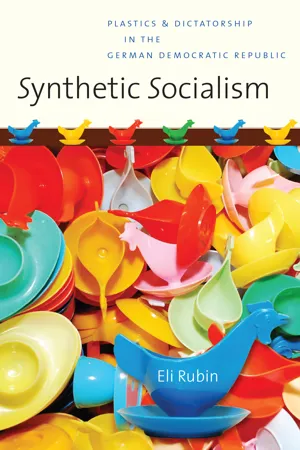
Eli Rubin takes an innovative approach to consumer culture to explore questions of political consensus and consent and the impact of ideology on everyday life in the former East Germany. Synthetic Socialism explores the history of East Germany through the production and use of a deceptively simple material: plastic. Rubin investigates the connections between the communist government, its Bauhaus-influenced designers, its retooled postwar chemical industry, and its general consumer population. He argues that East Germany was neither a totalitarian state nor a niche society but rather a society shaped by the confluence of unique economic and political circumstances interacting with the concerns of ordinary citizens.
To East Germans, Rubin says, plastic was a high-technology material, a symbol of socialism’s scientific and economic superiority over capitalism. Most of all, the state and its designers argued, plastic goods were of a particularly special quality, not to be thrown away like products of the wasteful West. Rubin demonstrates that this argument was accepted by the mainstream of East German society, for whom the modern, socialist dimension of a plastics-based everyday life had a deep resonance.
eBook - ePub
Synthetic Socialism
Plastics and Dictatorship in the German Democratic Republic
- 304 pages
- English
- ePUB (mobile friendly)
- Available on iOS & Android
eBook - ePub
About this book
Information
Table of contents
- Cover Page
- Synthetic Socialism
- Copyright Page
- Dedication
- Contents
- Illustrations
- Tables
- Acknowledgments
- Abbreviations and Acronyms
- Introduction
- 1. 1958, the Year of Consumption and Chemicals
- 2. Plastics and the Victory of Functionalist Design, 1945–1962
- 3. Plastics and the Socialist Apartment of the Future
- 4. Plastic Consumer Goods in the Everyday World of East Germany, 1958–1969
- 5. Centralization Plastics, Design, and Total Control, 1962–1972
- Conclusion
- Notes
- Bibliography
- Index
Trusted by 375,005 students
Access to over 1.5 million titles for a fair monthly price.
Study more efficiently using our study tools.
Frequently asked questions
Yes, you can cancel anytime from the Subscription tab in your account settings on the Perlego website. Your subscription will stay active until the end of your current billing period. Learn how to cancel your subscription
No, books cannot be downloaded as external files, such as PDFs, for use outside of Perlego. However, you can download books within the Perlego app for offline reading on mobile or tablet. Learn how to download books offline
Perlego offers two plans: Essential and Complete
- Essential is ideal for learners and professionals who enjoy exploring a wide range of subjects. Access the Essential Library with 800,000+ trusted titles and best-sellers across business, personal growth, and the humanities. Includes unlimited reading time and Standard Read Aloud voice.
- Complete: Perfect for advanced learners and researchers needing full, unrestricted access. Unlock 1.5M+ books across hundreds of subjects, including academic and specialized titles. The Complete Plan also includes advanced features like Premium Read Aloud and Research Assistant.
We are an online textbook subscription service, where you can get access to an entire online library for less than the price of a single book per month. With over 1.5 million books across 990+ topics, we’ve got you covered! Learn about our mission
Look out for the read-aloud symbol on your next book to see if you can listen to it. The read-aloud tool reads text aloud for you, highlighting the text as it is being read. You can pause it, speed it up and slow it down. Learn more about Read Aloud
Yes! You can use the Perlego app on both iOS and Android devices to read anytime, anywhere — even offline. Perfect for commutes or when you’re on the go.
Please note we cannot support devices running on iOS 13 and Android 7 or earlier. Learn more about using the app
Please note we cannot support devices running on iOS 13 and Android 7 or earlier. Learn more about using the app
Yes, you can access Synthetic Socialism by Eli Rubin in PDF and/or ePUB format, as well as other popular books in History & German History. We have over 1.5 million books available in our catalogue for you to explore.