On February 25, 1946, African Americans in Columbia, Tennessee, averted the lynching of James Stephenson, a nineteen-year-old, black Navy veteran accused of attacking a white radio repairman at a local department store. That night, after Stephenson was safely out of town, four of Columbia’s police officers were shot and wounded when they tried to enter the town’s black business district. The next morning, the Tennessee Highway Patrol invaded the district, wrecking establishments and beating men as they arrested them. By day’s end, more than one hundred African Americans had been jailed. Two days later, highway patrolmen killed two of the arrestees while they were awaiting release from jail.
Drawing on oral interviews and a rich array of written sources, Gail Williams O'Brien tells the dramatic story of the Columbia “race riot,” the national attention it drew, and its surprising legal aftermath. In the process, she illuminates the effects of World War II on race relations and the criminal justice system in the United States. O'Brien argues that the Columbia events are emblematic of a nationwide shift during the 1940s from mob violence against African Americans to increased confrontations between blacks and the police and courts. As such, they reveal the history behind such contemporary conflicts as the Rodney King and O. J. Simpson cases.
eBook - ePub
The Color of the Law
Race, Violence, and Justice in the Post-World War II South
- 352 pages
- English
- ePUB (mobile friendly)
- Available on iOS & Android
eBook - ePub
The Color of the Law
Race, Violence, and Justice in the Post-World War II South
About this book
Information
1 THE COLUMBIA STORY
CONFRONTATION
For Gladys Stephenson, getting the children's radio repaired was a trying experience. A 37-year-old domestic worker and mother of four, Stephenson lived in a black working-class neighborhood in the West End in Columbia, a small Middle Tennessee town located about forty-three miles south of Nashville. She had sent the radio in for repairs in early January 1946. Her eldest son James would soon be home from the Navy, and she may have wanted it in working condition for his return; certainly, the other children were clamoring for it. When Stephenson's 17-year-old son, John Robert, carried the radio to the repair shop at Caster-Knott, a department store situated on the southeast corner of the Columbia square, he was told by LaVal LaPointe, the service shop manager, that repairs would cost between $8 and $10.1
About a month later when John Stephenson returned to the store to pick up the radio, he learned that it had been sold to a farmer who worked for John Calhoun Fleming Sr. Fleming was the father of William “Billy” Fleming, a 28-year-old Army veteran who began apprenticing in radio repair under the GI Bill at Caster-Knott around December 1, 1945, just a few months after his discharge from service. Although the store had a policy that permitted the sale of an item brought in for repair and not picked up within thirty days, radios were scarce, the younger Fleming later admitted, and none other than Stephenson's had ever been sold. Upon learning of the sale of her children's radio, Gladys Stephenson made her first trip to Caster-Knott, where she conversed with LaPointe. Rather than the $8 to $10 originally estimated for repairing it, the shop manager now said charges would be $13.75, with batteries needed to make it play bringing the cost to $17.50. Stephenson informed LaPointe that she could not pay the latter amount but would pay the former. He promised to retrieve the radio.
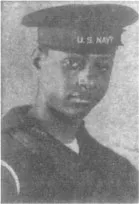
James Stephenson (Courtesy of NAACP)
A week or so later John Stephenson, accompanied by his 19-year-old brother James who was now home from service, returned to the store. According to LaPointe, he “went into considerable detail” to explain to James the work that had been done on the radio. The older Stephenson responded that he felt the charges were too high and that because he was “a radio man in the Navy,” he could make the necessary repairs. Stephenson then asked LaPointe to remove the new tubes and to charge him only for the labor involved. LaPointe refused, saying that this would require the removal of some additional parts and would “take all of the profit out of the repair job.” James at that point paid LaPointe the $13.75 and left the store without comment.2
When Gladys arrived home from work that afternoon and discovered that the radio still would not play and that it had no electric cord, she was quite upset. The next day, Friday, February 22nd, she informed her employer Evelyn Watkins Sowell, a Columbia widow, of her difficulties. Sowell called Caster-Knott and spoke with someone who said that Gladys should return to the store and an adjustment would be made. On Saturday, the 23rd, Gladys returned, only to be told that the manager was in Nashville and she would have to come back another time to see him.
On February 25, 1946, between 9:30 and 10:00A.M., Gladys Stephenson and her son James made a final, fateful trip to the radio repair shop at Caster-Knott. Exasperated, Gladys announced upon their arrival, “Here I am with the same radio.” LaPointe then commented that he had “had quite a bit of trouble with that radio,” and Gladys responded, “Yes, you have, because it has not given satisfaction.”3 Gladys Stephenson and LaVal LaPointe then engaged in what one store clerk termed “a loud argumentative conversation” in which Stephenson insisted that the radio had always played on electric current; LaPointe informed her that it would not do so now without additional parts, and she responded that she felt as if she had already paid for those parts. She also added that she did not wish him to do any further work on the radio beyond the reattachment of the electric cord.4 Throughout the discussion, James Stephenson and Billy Fleming remained silent.
As Stephenson and his mother descended from the third floor of Caster-Knott where the repair shop was located, an elderly white man entered the store with a broken radio. Although Gladys Stephenson insisted that she did not speak to this individual but to her son, she was obviously aggravated, and she burst out as they passed the man, “I will take my radio some place else and have it fixed, all they did here was tear it up.”5 Infuriated, Fleming told her to leave the store. When Gladys communicated this remark to her son, James handed her the radio and placed himself between her and the assistant repairman.
As mother and son exited, James Stephenson allegedly looked back through the window of the closed door “in what Fleming considered to be a threatening manner.” The young Army vet then raced through the door, hitting the former Navy man in the back of the head with his fist. Stephenson, a welterweight boxer in the Navy, immediately spun around and punched Fleming, who fell through a small window located between the sidewalk and the entry to the store (not the large plate glass window at the front of the store, as everyone later believed). Losing his balance, Stephen-son fell in after him, and both men came up fighting. “Once the fight got underway,” LaPointe recollected, “neither Fleming nor James Stephenson made an effort to retreat.”6
Apparently LaPointe tried to assist Fleming, but Gladys Stephenson grabbed him from behind. She claimed that the repair shop manager slapped her; LaPointe insisted he attempted to hold and quiet her. “When we stepped out the door, one of the men slapped me and the other man, Mr. Flemming [sic], hit my boy and we was fighting, we was fighting mad,” she later recalled. LaPointe himself admitted, “Things were a little confused, it happened so fast.”7
Wrenching herself free from LaPointe, Gladys grabbed a piece of glass from the broken window, and lunged at Billy Fleming's back, rendering a glancing blow to his shoulder.8 At that point, another white man wearing a khaki soldier's jacket, who was probably Elmer H. Rogers, a veteran and an employee at a nearby hosiery mill, raced across the street from the courthouse and threw Gladys to the ground, blacking her eye, tearing her coat, and hitting her on the arm.
As Fleming and Stephenson fell across an automobile parked in front of a store on the square, both LaPointe and Rogers assisted Fleming, and the Navy vet was “subdued without further blows.”9 Although a white man (possibly LaPointe) who was holding Stephenson's mother told Stephenson that he “had better go ahead and run and get out of there,” James stayed to assist Gladys.10 Both were held at the front of the store for three or four minutes until the police arrived. Bleeding profusely from a cut in his leg, Fleming was taken to the back of the store for first aid. Later, he was carried in an ambulance to the hospital where he spent the night. Though not seriously injured, he was treated for the cut and for shock.
As the police approached, LaPointe and Rogers “walked upon the sidewalk.” Ignoring them, police chief Walter Griffin demanded from James Stephenson his knife, a weapon the young man did not carry. As Griffin drew back his billy club to strike the former soldier, his mother screamed: “Don't you hit that boy, you ought to investigate before you start hitting.” The police chief lowered his arm, but the other officer, W. E. “Clyde” Frazier, a radio operator at the Columbia police station, struck Gladys two or three times as Griffin again asked if James Stephenson had a knife, and Gladys excitedly yelled “That boy don't carry a knife.”11
During the fight, a largely white crowd of fifty to sixty people had gathered. Many directed angry remarks toward James Stephenson. Both he and his mother were placed in a police car and taken to the Columbia jail. There they were held in adjacent cells for half an hour to an hour. Then they were taken to a small side room where they were asked if they were guilty of fighting on the street. Each said yes; each was fined $50, the maximum penalty in such cases. No further questions ensued.
Rather than being freed, however, the Stephensons were led back to their cells. They remained there until early in the afternoon when Police Chief Griffin removed them to the county jail. Unbeknownst to either Gladys or James, John Fleming Sr. had obtained a warrant for attempted murder against the pair for their alleged attack upon his son. At the county jail, Sheriff James J. Underwood Sr. “patted us down to see what we had,” James recalled, and he inquired of the young man if he were hurt. Only his thumb, he answered, and the sheriff then asked about the weapon he had used in his fight with Fleming. When Stephenson said his fist, Underwood noted that Fleming was “cut pretty bad.” It must have happened when he fell through the window, the Navy vet responded, and the sheriff said “Okay,” though he added, “The people up town are talking.” When Stephenson was asked later what the sheriff had meant, he said Underwood had told him people were talking “about a mob.”12
By early afternoon on the 25th, cars filled with white men from the Culleoka vicinity in eastern Maury County, the home of the Flemings, began arriving on the square in downtown Columbia. They were joined by phosphate and hosiery mill workers and by an assortment of others, including auto mechanics, filling station attendants, and taxicab drivers. Many, though not all, were in their late teens and early twenties. World War II veterans comprised the most volatile element in the crowd. Among those appearing on the square was Billy Fleming's father, John Sr. Inebriated, the elder Fleming urged the lynching of Stephenson, but he “fainted” and had to be taken away. He had breathed too many ether fumes when he visited his son in the hospital, he later claimed to the FBI!13
While the crowd milled, Hannah Peppers proceeded to the county jail where Sheriff Underwood permitted a visit with her daughter and grandson. As she crossed the town square, Peppers saw “some white people there, quite a few there.” They were “kind of bunched off in bunches,” and from one cluster of two or three men, Peppers heard the remark: “We are going to take them two ‘niggers,’ the Stephenson ‘niggers’ out of the jail and hang them.”14 For black Maury Countians, such threats held ominous overtones, for within the previous two decades, two lynchings had occurred in the community, one in the Culleoka vicinity itself.
Yet rather than mention this conversation to the sheriff, Peppers raced immediately after her jail visit to the first block of East Eighth Street, an area known among many blacks as the “Bottom” and among whites as “Mink Slide.” There she pleaded with James Morton, a third-generation funeral home owner, and with Julius Blair, East Eighth Street's 76-year-old patriarch and soda “fount” proprietor, to get her daughter and grandson out of jail. Quite familiar with such proceedings, both men promised their assistance.
Shortly thereafter, they made their way, along with Blair's eldest son Saul (often spelled Sol), and another local resident, John Dudley, to the office of Magistrate C. Hayes Denton. For the first time, they learned that the Stephensons had been charged with attempted murder, and they began to perceive the extent of white restiveness. Denton in fact urged them to leave mother and son in jail for their own safety. Well aware that Henry Choate had been removed from jail and lynched in 1927, and that Denton's automobile had been used in the 1933 abduction and subsequent lynching of Cordie Cheek, Blair responded resolutely: “Let us have them, Squire. . . . We are not going to have any more social lynchings in Maury County.”15
Concerned about potential trouble, James Morton telephoned the sheriff following this visit, and he endeavored to locate him at the courthouse. Underwood, who had already heard reports of disturbances throughout town as he left the court, had driven to the Bottom, where he was conversing with Julius and Saul Blair when Morton approached. Clearly, mob violence was on the sheriff's mind, for he had “commenced telling off a tale” as soon as he encountered the Blairs about how his father had prevented the lynching of a white man in Arkansas, and he promised there would be no trouble in Columbia.16
Next the conversation had shifted to politics. In October, Underwood had lost the Democratic primary to Billy Fleming's younger brother Flo by a mere thirteen votes, and the Blairs were trying to convince the sheriff to run himself or his son for the office on an independent ticket.17 Upon encountering the trio, Morton expressed his concern about the anger of whites toward James Stephenson, and he and the Blairs agreed to meet the sheriff at the jail at 5:00 so that mother and son could be released into their custody. Later as Underwood turned the pair over to the East Eighth Street proprietors, he urged: “Take care of them.”18 Gladys Stephenson was driven to her home “out on West End,” but James was taken to the Bottom “where we could see after him better than at home,” Julius explained.19
Just as word of Stephenson's alleged attack on Billy Fleming spread rapidly among whites in Maury County, rumors that rope had been purchased and that young Stephenson's life was in danger circulated among African Americans. Soon armed black Maury Countians were pouring into the Bottom. By early evening, when Sheriff Underwood and his first deputy Claude Goad traveled to East Eighth Street, the sheriff found “probably one hundred fifty negroes . . . forty to fifty or maybe more [with] guns in their hands, shotguns, rifles of different types and calibers.”20
In their trips to the Bottom, law officers encountered anger and frustration among many in the assemblage. When Columbia authorities entered the area, “a lot of negroes jumped on the police car,” and one on the rear bumper yelled, “Let's turn the car over.” “A colored boy, a ‘nigger,’” as one police officer termed him, declared that “he had fought for freedom overseas and he was going to fight for it here.” Another, in reference to Sheriff Underwood, told crowd members that “if they would get out of the way he would kill the son-of-a-bitch now.”21
In contrast, black leaders remained respectful toward the sheriff and the police but nevertheless firm in their commitment to keep whites out of the area. Saul Blair told the group as they jumped on the car, “You all are the craziest bunch I have ever seen. Get off the Law's car,” while Calvin Lockridge, a carpenter and Missionary Baptist minister, “gently” took the Sheriff by the arm and “kept nudging . . . [him] out of the crowd” when he heard the threat against his life. Either Saul Blair or James Morton also urged: “‘Keep quiet, lets hear what he has to say,’” as Underwood tried to speak to the crowd.22
Lockridge, however, had in his possession “an Army paratrooper's [semiautomatic machine] gun and several clips of ammunition,” while James Morton, restaurant-poolroom owner Meade Johnson, and possibly Julius Blair carried double-barreled shotguns. Morton told police officer George Reeves “he didn't want any white people in the area,” including “white taxis.” “Get rid of the white people on the square,” he maintained, “and the negroes would be all right.”23
Before leaving, Deputy Goad spoke privately with Saul Blair. “It is getting pretty hot uptown, get the boy out,” he suggested. When Blair relayed this information to “Pappa,” Julius made his decision. “Get him out,” he declared. “Go out the dirt road to East End Street, come in on the Bear Creek Pike, and come in to the Nashville Pike,” he instructed his 55-year-old son as he described a circuitous and hopefully safe route out of Columbia. Thomas William “Tommy” Neely, who was in Saul's barbershop “getting a shine,” agreed to drive. Robert Frierson and James “Popeye” Bellanfante volunteered to ...
Table of contents
- Cover Page
- THE COLOR OF THE LAW
- Copyright Page
- Dedication
- CONTENTS
- ILLUSTRATIONS
- ACKNOWLEDGMENTS
- INTRODUCTION
- 1 THE COLUMBIA STORY
- I RACIAL VIOLENCE
- II RACIAL JUSTICE
- CONCLUSION
- NOTES
- SOURCES CITED
- INDEX
Trusted by 375,005 students
Access to over 1.5 million titles for a fair monthly price.
Study more efficiently using our study tools.
Frequently asked questions
Yes, you can cancel anytime from the Subscription tab in your account settings on the Perlego website. Your subscription will stay active until the end of your current billing period. Learn how to cancel your subscription
No, books cannot be downloaded as external files, such as PDFs, for use outside of Perlego. However, you can download books within the Perlego app for offline reading on mobile or tablet. Learn how to download books offline
Perlego offers two plans: Essential and Complete
- Essential is ideal for learners and professionals who enjoy exploring a wide range of subjects. Access the Essential Library with 800,000+ trusted titles and best-sellers across business, personal growth, and the humanities. Includes unlimited reading time and Standard Read Aloud voice.
- Complete: Perfect for advanced learners and researchers needing full, unrestricted access. Unlock 1.5M+ books across hundreds of subjects, including academic and specialized titles. The Complete Plan also includes advanced features like Premium Read Aloud and Research Assistant.
We are an online textbook subscription service, where you can get access to an entire online library for less than the price of a single book per month. With over 1.5 million books across 990+ topics, we’ve got you covered! Learn about our mission
Look out for the read-aloud symbol on your next book to see if you can listen to it. The read-aloud tool reads text aloud for you, highlighting the text as it is being read. You can pause it, speed it up and slow it down. Learn more about Read Aloud
Yes! You can use the Perlego app on both iOS and Android devices to read anytime, anywhere — even offline. Perfect for commutes or when you’re on the go.
Please note we cannot support devices running on iOS 13 and Android 7 or earlier. Learn more about using the app
Please note we cannot support devices running on iOS 13 and Android 7 or earlier. Learn more about using the app
Yes, you can access The Color of the Law by Gail Williams O'Brien in PDF and/or ePUB format, as well as other popular books in Social Sciences & North American History. We have over 1.5 million books available in our catalogue for you to explore.