This outstanding collection of fifteen original essays represents innovative work by some of the most influential scholars in the field of women’s history. Covering a broad sweep of history from colonial to contemporary times and ranging over the fields of legal, social, political, and cultural history, this book, according to its editors, 'intrudes into regions of the American historical narrative from which women have been excluded or in which gender relations were not thought to play a part.' The book is dedicated to pioneering women’s historian Gerda Lerner, whose work inspired so many of the contributors, and it includes a bibliography of her works.
The contributors include:
Linda K. Kerber on women and the obligations of citizenship
Kathryn Kish Sklar on two political cultures in the Progressive Era
Linda Gordon on women, maternalism, and welfare in the twentieth century
Alice Kessler-Harris on the Social Security Amendments of 1939
Nancy F. Cott on marriage and the public order in the late nineteenth century
Nell Irvin Painter on 'soul murder' as a legacy of slavery
Judith Walzer Leavitt on Typhoid Mary and early twentieth-century public health
Estelle B. Freedman on women’s institutions and the career of Miriam Van Waters
William H. Chafe on how the personal translates into the political in the careers of Eleanor Roosevelt and Allard Lowenstein
Jane Sherron De Hart on women, politics, and power in the contemporary United States
Barbara Sicherman on reading Little Women
Joyce Antler on the Emma Lazarus Federation’s efforts to promulgate women’s history
Amy Swerdlow on Left-feminist peace politics in the cold war
Ruth Rosen on the origins of contemporary American feminism among daughters of the fifties
Darlene Clark Hine on the making of Black Women in America: An Historical Encyclopedia
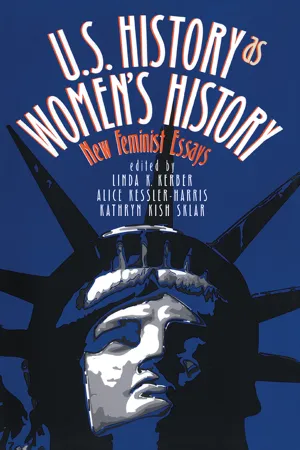
eBook - ePub
U.S. History As Women's History
New Feminist Essays
- 488 pages
- English
- ePUB (mobile friendly)
- Available on iOS & Android
eBook - ePub
U.S. History As Women's History
New Feminist Essays
About this book
Information
PART 1 State Formation
CHAPTER 1 : A CONSTITUTIONAL RIGHT TO BE TREATED LIKE AMERICAN LADIES : WOMEN AND THE OBLIGATIONS OF CITIZENSHIP : LINDA K. KERBER
The title of this essay comes from the words of Kathleen Teague, who represented the Eagle Forum, a conservative women’s organization, in testimony before the House of Representatives Armed Services Committee in March 1980. The Soviet Union had invaded Afghanistan the previous winter; seeking a measured response, President Jimmy Carter had proposed universal mandatory draft registration. Carter recognized that in the event of a draft, current rules required that women be assigned only to noncombat roles; nevertheless, with 150,000 women already serving in the all-volunteer army, he believed that “[t]here is no distinction possible, on the basis of ability or performance, that would allow me to exclude women from an obligation to register.” Teague argued against the administration’s proposal. She and her colleagues pointed out that the obligation of military service had always been marked by gender. Recognizing the reciprocal relationship between rights and obligations, Teague pointed out that the absence of an obligation to serve in the military was tantamount to the presence of a right; women, she said, had the right “to be treated like . . . ladies. ... [A right] which every American woman has enjoyed since our country was born.”1
Teague was not wrong to argue that American tradition and precedent have sustained the practice of defining the ingredients of citizenship differently on the basis of gender. Women have been citizens of the United States from the moment of its origins: they could be naturalized, they were subject to its laws, and they could claim the protection of its courts; as single adult women, they were vulnerable to taxation. But American women’s relationship to the state has from the beginning been understood to be different in substantial and important respects from the relationship of their male counterparts and contemporaries. Rights and obligations have generally been stated in generic terms incumbent on all citizens, male and female, but they have been experienced differently by men and by women. Struggle over women’s suffrage and, in recent years, over the interpretation of the meaning of the right to the “equal protection of the laws” guaranteed in the Fourteenth Amendment has publicized the extent to which the meaning of rights has been linked to gender. That there is a history of gendered obligation is less well understood.
I suspect that we have not thought much about gendered differences in citizenship because we employ egalitarian language; all citizens, after all, pledge allegiance to the flag, using a capacious rhetoric that ignores differences of gender, race, and ethnicity. Indeed, in recent years the suspicion has been voiced that public understanding of the meaning of citizenship has shifted sharply. It is possible that an older scheme that emphasized conduct—the exercise of rights and the fulfillment of duties—is fading, to be replaced by an emphasis on claims without reciprocal duties, what Mary Ann Glendon has called “rights talk.” Lizabeth Cohen and others have pointed out that the meaning itself is changing; in the late twentieth century, citizenship is increasingly treated as a commodity. Instead of being understood as a status that in turn authorizes civic participation, citizenship is increasingly likely to stand for a range of entitlements: to unemployment compensation, to welfare payments.2
What did Kathleen Teague mean when she asserted that American women have the “right” to be “treated like ladies”? The context suggests that she understood being a “lady” to involve being excused from civic obligation. Most contemporary theorists of citizenship, as well as members of Congress, acknowledged that the power to draft women was implicit in the sovereignty of the state. But many, like Teague though not so explicitly, also took the position that the failure of the state to exercise that power over the long course of the history of the republic had been tantamount to abandoning the claim. Although no one made the explicit analogy, the reasoning was not unlike the logic of the Supreme Court in Minor v. Happersett (1875), when the Court had agreed that given the absence of prohibitions against woman suffrage in the original constitutions of the federal government and the states, the original intent of the founding generation might well have encompassed the development of woman suffrage. But in 187 5 the Court also maintained that the failure to act on that potential over a long period of time had established a fact. If woman suffrage had not been generated within a century after the ratification of the Constitution, the burden was on suffragists to establish their claim. A century after Minor, Teague conveyed that if an obligation of military service had not been developed over the course of nearly two centuries since ratification, a reciprocal right to be free of that obligation had been constructed in its place. She concluded that those who wished to change that status quo carried the burden of persuading women that the change was to their advantage.
In John Locke’s classic formulations, claims of rights are generally related to reciprocal duties; the right to self-preservation is linked to the duty to preserve the safety of others.3 Theorists of the social contract generally connect a duty to obey the law with the power to claim rights under it. The right to invoke the protection of the state is, for example, often tied to the obligation to bear arms in its defense. The relationship of rights and duties is rarely, however, so neatly reciprocal. The obligation to pay taxes has not always brought with it the right to vote, the right to vote does not bring with it the obligation to vote, and until very recently the right to serve on juries did not bring with it the obligation to serve on juries.
In her transformation of an issue of obligation into a problem of rights, Teague was squarely in the American political tradition; constitutional and theoretical debates have generally been focused around claims for rights. American political theorists have had relatively little to say about obligation. This emphasis is congruent with English political theory, which has, ever since Magna Carta, stressed claims that subjects can make against the prerogatives of the Crown and in which articulation of obligation has been correspondingly weak.4 Much American thinking on the subject developed in the late eighteenth century, when the relation of the citizen to the state was theorized by revolutionaries who were asserting claims of rights against the state. Arguments were modeled on those expounded by Whigs during and after the English civil war, and also on those developed by Baptists, Quakers, and other groups in their struggle against compulsory church taxes in colonial Massachusetts and elsewhere. These political and religious rebels pushed the defense of rights in the direction of protecting freedom of thought and conscience and of resisting taxation without representation. The federal Constitution was remarkably silent on obligation. It was restricted to a succinctly outlined set of specified powers; the first ten amendments activated a set of limits on those powers, to be enforced by the act of claiming rights. The Civil War amendments continued in the same spirit; the Fourteenth Amendment, for example, describes citizenship in terms of its “privileges and immunities,” not its duties or obligations. The strategy continues to infuse American constitutional and legal thinking.
The term duty is often informally used interchangeably with obligation. But duty is a broad term, encompassing behavior understood to be required by systems of morals as well as systems of law. Avoiding the term obligation, with its implication of a binding and perhaps transcendent moral duty, American constitutional argument, like liberal political theory in general, has mainly rested on the confidence that individuals can be authentically bound only by rules that they themselves have chosen, and that authentic government is shaped by freely chosen agreements among the ruled. Consent theory makes all obligation in some way an obligation to oneself, “there being,” Thomas Hobbes wrote in Leviathan (pt. II, chap. 21), “no obligation on any man, which ariseth not from some act of his own.” Much American constitutional talk proceeds as though the Revolution had created a state of nature and as though the Constitution were a social contract; having consented to the political order, all obligation becomes individually elected obligation. The burdens of citizenship, in theory, rest on all citizens alike. Once the powers of government are properly framed, a binding obligation, impersonally imposed on all citizens, ensues.
Consent theory, however, brings with it a number of fictive elements. As Edmund S. Morgan has poignantly argued, “government requires make-believe.” It requires that an imagined community be called into being, personified “as though it were a single body ... superior to government, and able to alter or remove a government at will.”5 When the Continental Congress issued a decree “on the authority of the people,” and—especially—when the federal convention, exceeding its mandate to revise the Articles of Confederation, issued its Constitution in the name of “We the People,” it was, as Michael Warner observes, displaying a “delirious theatricality . . . acting out, through time, the eighteenth century’s narrative of legitimation: the social contract.” In that context “the People” functioned as “a legitimating signifier,” interpolating subjects into a political world; it was “cultural assumptions that allowed the printed constitution to embody the will of all.”6
Even if the authority of “the people” is conceded, men and women have been differently situated in relation to consent theory. Carole Pateman’s searching examination of the theory of social contract reveals that men are imagined as entering the social contract as free agents, but most women enter the social contract already bound by marriage and by antecedent obligations to their husbands.7 This was certainly true in early America. When revolutionaries challenged laws governing the relations between male subjects and the king, reconstituting men as individuals free of patriarchal constraint, they left intact the law of domestic relations, which systematically merged the civic identity of married women with that of their husbands. Even though coverture, which transferred a woman’s civic identity to her husband at marriage, giving him the use and direction of her property throughout the marriage, was theoretically incompatible with revolutionary ideology and with the liberal commercial society developing in the early republic, patriot men carefully sustained it. They even continued to refer to the body of law of coverture by its traditional name, “The law of baron et feme,” that is, not the reciprocal “husband and wife” or “man and woman” but “lord and woman.”8
To examine early American law of the household is an exercise in turning Pateman’s theorizing into practice. To put it another way, before the constitutions were constructed as new social contracts, there were marriage contracts and the complex system of subordination and authority that they were understood to embody. If ever there were a site to examine the simultaneity of the personal as the political, it is here. The legal treatises of the early republic describe households as hierarchical as if Locke had never written.
Tapping Reeve, for example, conducted perhaps the most respected legal training in his generation; among his students were his own brother-in-law Aaron Burr and John C. Calhoun; there were also future U.S. congressmen and senators, judges and Supreme Court justices. A full generation after the Revolution (forty years after the Declaration of Independence and twenty-nine years after the Constitutional Convention) Reeve published an authoritative treatise on the law of baron and feme. First published in 1816, it was reprinted with up-to-date annotations in 1846, a testament to its continued vitality.9
Reeve began with the forthright statement that “the husband, by marriage, acquires an absolute title to all the personal property of the wife”; in the second chapter he described the husband’s control of the wife’s real estate. By the third chapter Reeve was asking “what advantages the wife may gain, eventually, by marriage, in point of property” and answering directly, “She gains nothing.” Reeve did not stop there, however. Once these asymmetrical property relations were established, personal implications wound their way throughout the law. From the husband’s control of all property there logically resulted the wife’s inability to resist him; his coercive power over her was so great by blackmail that he was not thought to need to use force. Any legal offense that she did in his presence “if he joins in committing it, or also encourages, or in any way approves thereof, the law presumes, that whatever the wife does, is done by the husband’s coercion.” A wife could not make a contract, since it would not be reasonable to hold her to its terms, “as it might be effect of coercion.”10
To follow the law of domestic relations, as Reeve delicately spun out its implications, is to watch the playing out of a stacked deck. Husbands were responsible for crimes committed by their wives in their presence or with their approval—except in the case of treason, a crime so severe that responsibility for it overrode obligation to the husband—or in the event that a wife kept a brothel with the husband’s knowledge, since keeping a brothel “is an offense of which the wife is supposed to have the principal management.” Because a wife could not make contracts in her own name, a husband was bound “to fulfill the contract of his wife, when it is such an one as wives in her rank of life usually purchase.… If, however, she were to purchase a ship or yoke of oxen, no such presumption would arise, for wives do not usually purchase ships or oxen.”11
The law of domestic relations presupposed the husband’s right to sexual access to the wife’s body. For example, when Reeve explained why it was logical that wives could not enter into contracts, his reason was not only that wives did not control property that could guarantee their performance of the contract; wives could not enter into contracts involving their own labor. “[T]he right of the husband to the person of his wife,” Reeve observed, “... is a right guarded by the law with the utmost solicitude; if she could bind herself by her contracts, she would be liable to be arrested, taken in execution, and confined in a prison; and then the husband would be deprived of the company of his wife, which the law will not suffer.” However, if a husband were banished from the realm, then his wife “could contract, could sue and be sued in her own name; for in this case,... he was already deprived of the company of his wife, and her confinement in prison would not deprive him of his wife to any greater extent than was already the case.”12
Under coverture, a woman’s only freely chosen obligation was to her husband. Once she made that choice, he controlled her body and her property; there were relatively few constraints on what he could do with either, except for the near universal guarantee of the use of one-third of his property during her widowhood. A married woman had no means of acting upon a choice of her own that challenged her husband’s; there were too many ways in which he could, by “moderate correction” or by manipulating her property, coerce her into agreement with him. Instead of protecting her against coercion, the law acknowledged that it was embedded in the marriage relationship. The married woman could have no will of her own. The legal system acknowledged her dependency by the practice of holding private examinations of married women before permitting them to sign away their right to any dower property and by not holding married women responsible for crimes committed in the presence of and with the knowledge of their husbands. If married women were permitted to vote, it was understood that husbands could too easily pressure their choices.
American revolutionaries did not change the law of domestic relations at the same time that they radically changed other civic relations; they did not even debate the possibility. T...
Table of contents
- Cover Page
- Title Page
- Copyright Page
- Table of Contents
- Dedication
- Introduction
- Part 1. State Formation
- Part 2. Power
- Part 3. Knowledge
- Notes
- Bibliography of the Writings of Gerda Lerner, compiled by Thomas Dublin
- Contributor
- Index
Trusted by 375,005 students
Access to over 1.5 million titles for a fair monthly price.
Study more efficiently using our study tools.
Frequently asked questions
Yes, you can cancel anytime from the Subscription tab in your account settings on the Perlego website. Your subscription will stay active until the end of your current billing period. Learn how to cancel your subscription
No, books cannot be downloaded as external files, such as PDFs, for use outside of Perlego. However, you can download books within the Perlego app for offline reading on mobile or tablet. Learn how to download books offline
Perlego offers two plans: Essential and Complete
- Essential is ideal for learners and professionals who enjoy exploring a wide range of subjects. Access the Essential Library with 800,000+ trusted titles and best-sellers across business, personal growth, and the humanities. Includes unlimited reading time and Standard Read Aloud voice.
- Complete: Perfect for advanced learners and researchers needing full, unrestricted access. Unlock 1.5M+ books across hundreds of subjects, including academic and specialized titles. The Complete Plan also includes advanced features like Premium Read Aloud and Research Assistant.
We are an online textbook subscription service, where you can get access to an entire online library for less than the price of a single book per month. With over 1.5 million books across 990+ topics, we’ve got you covered! Learn about our mission
Look out for the read-aloud symbol on your next book to see if you can listen to it. The read-aloud tool reads text aloud for you, highlighting the text as it is being read. You can pause it, speed it up and slow it down. Learn more about Read Aloud
Yes! You can use the Perlego app on both iOS and Android devices to read anytime, anywhere — even offline. Perfect for commutes or when you’re on the go.
Please note we cannot support devices running on iOS 13 and Android 7 or earlier. Learn more about using the app
Please note we cannot support devices running on iOS 13 and Android 7 or earlier. Learn more about using the app
Yes, you can access U.S. History As Women's History by Linda K. Kerber, Alice Kessler-Harris, Kathryn Kish Sklar, Linda K. Kerber,Alice Kessler-Harris,Kathryn Kish Sklar in PDF and/or ePUB format, as well as other popular books in Social Sciences & North American History. We have over 1.5 million books available in our catalogue for you to explore.