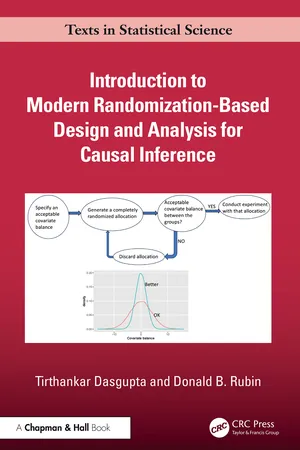
Introduction to Modern Randomization-Based Design and Analysis for Causal Inference
eBook - ePub

Introduction to Modern Randomization-Based Design and Analysis for Causal Inference

  1. 340 pages
  2. English
  3. ePUB (mobile friendly)
  4. Available on iOS & Android
eBook - ePub

Introduction to Modern Randomization-Based Design and Analysis for Causal Inference

About this book

Design of experiments is, in essence, a disciplined way to learn about cause and effect. Modern experiments can involve a few to millions of units and hundreds or thousands of covariates. These settings demand tools that are flexible, transparent, and faithful to the underlying design in order to reach reliable conclusions about which interventions work and which ones do not. This book provides a modern, accessible, and computationally supported introduction to experimental design grounded firmly in randomization and the formulation of ideas and methods in terms of potential outcomes. Instead of prescribing a model for each design, we begin with the treatment assignment mechanism and link it directly to the observed outcomes through the potential outcomes framework. This formulation illuminates how changing the design changes the analysis, and it naturally distinguishes finite-population inference from super-population modeling. The book also incorporates new developments at the interface of causal inference and experimental design, many stemming from the authors' recent collaborative research efforts.

  • Strengthens the link between design and analysis, enabling students to see immediately how the structure of an experiment shapes the exact tools used to analyze it.
  • Teaches foundational concepts without assuming linear-model assumptions.
  • Equips readers with the tools needed to analyze non-standard and complex experiments, whose randomization mechanisms fall outside the scope of traditional textbooks.
  • Support students with limited programming experience by providing algorithms and code throughout the book, enabling them to implement randomization-based methods easily and efficiently.

This book is a textbook for one/two semester course on introductory experimental design.

Information

Year
2026
Print ISBN
9780367500986
Edition
1
eBook ISBN
9781040729793

Table of contents

  1. Cover Page
  2. Half-Title Page
  3. Series Page
  4. Title Page
  5. Copyright Page
  6. Dedication Page
  7. Contents
  8. Preface
  9. Symbols
  10. About the Authors
  11. 1 Understanding Experimental Design: Fundamental Concepts
  12. 2 CRD with one factor, two levels
  13. 3 Better comparisons using blocking
  14. 4 Beyond blocking: acceptable versus unacceptable allocations
  15. 5 Randomized experiments with J(>2) treatment arms
  16. 6 The 22 factorial experiment
  17. 7 2K factorial designs
  18. 8 Design and analysis of factorial experiments with constraints
  19. 9 Model-based analysis of designed experiments and superpopulation inference
  20. 10 Including covariates in the design, model-based analysis and subsequent inference
  21. 11 Appendix
  22. Bibliography
  23. Index

Trusted by 375,005 students

Access to over 1.5 million titles for a fair monthly price.

Study more efficiently using our study tools.

Frequently asked questions

Yes, you can cancel anytime from the Subscription tab in your account settings on the Perlego website. Your subscription will stay active until the end of your current billing period. Learn how to cancel your subscription
No, books cannot be downloaded as external files, such as PDFs, for use outside of Perlego. However, you can download books within the Perlego app for offline reading on mobile or tablet. Learn how to download books offline
We are an online textbook subscription service, where you can get access to an entire online library for less than the price of a single book per month. With over 1.5 million books across 990+ topics, we’ve got you covered! Learn about our mission
Look out for the read-aloud symbol on your next book to see if you can listen to it. The read-aloud tool reads text aloud for you, highlighting the text as it is being read. You can pause it, speed it up and slow it down. Learn more about Read Aloud
Yes! You can use the Perlego app on both iOS and Android devices to read anytime, anywhere — even offline. Perfect for commutes or when you’re on the go.
Please note we cannot support devices running on iOS 13 and Android 7 or earlier. Learn more about using the app
Yes, you can access Introduction to Modern Randomization-Based Design and Analysis for Causal Inference by Tirthankar Dasgupta,Donald B. Rubin in PDF and/or ePUB format, as well as other popular books in Mathematics & Probability & Statistics. We have over 1.5 million books available in our catalogue for you to explore.