In the presidential campaign of 1948, Henry Wallace set out to challenge the conventional wisdom of his time, blaming the United States, instead of the Soviet Union, for the Cold War, denouncing the popular Marshall Plan, and calling for an end to segregation. In addition, he argued that domestic fascism — rather than international communism — posed the primary threat to the nation. He even welcomed Communists into his campaign, admiring their commitment to peace. Focusing on what Wallace himself later considered his campaign’s most important aspect, the troubled relationship between non-Communist progressives like himself and members of the American Communist Party, Thomas W. Devine demonstrates that such an alliance was not only untenable but, from the perspective of the American Communists, undesirable.
Rather than romanticizing the political culture of the Popular Front, Devine provides a detailed account of the Communists' self-destructive behavior throughout the campaign and chronicles the frustrating challenges that non-Communist progressives faced in trying to sustain a movement that critiqued American Cold War policies and championed civil rights for African Americans without becoming a sounding board for pro-Soviet propaganda.
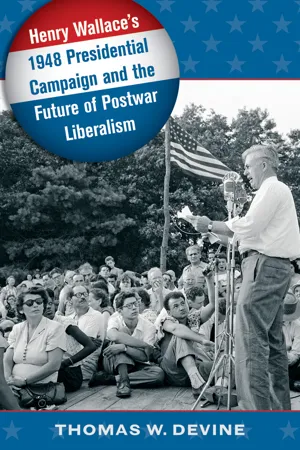
eBook - ePub
Henry Wallace's 1948 Presidential Campaign and the Future of Postwar Liberalism
- 424 pages
- English
- ePUB (mobile friendly)
- Available on iOS & Android
eBook - ePub
Henry Wallace's 1948 Presidential Campaign and the Future of Postwar Liberalism
About this book
Information
1
A FRENCHMAN NAMED DUCLOS
The Communists and the Origins of the Progressive Party
The origins of Henry A. Wallace’s Progressive Party occasioned heated debate among political partisans throughout the presidential campaign, and they remain a topic of some controversy. Beginning in 1948, critics of the Progressive Party contended that the Communists, on orders from Moscow, had conceived the idea, organized the party according to a “detailed time-table,” chosen Wallace as the candidate, and pressured him relentlessly until he accepted his predetermined role. In their view, the Wallace candidacy was an entirely synthetic, top-down venture that the Communists had created with the sole purpose of serving Soviet foreign policy. Accordingly, they portrayed non-Communist Progressives—including Wallace himself—as a motley collection of innocent dupes consciously or unconsciously doing the Kremlin’s bidding by dividing and discrediting American liberalism and thus paving the way for the victory of “reaction.”1
Not surprisingly, Wallace supporters told a different story. In Gideon’s Army, for some time considered the standard historical account of the Progressive Party, Curtis MacDougall dismissed such an account of the party’s origins as a fantastic conspiracy theory. According to MacDougall, the Communists decided to support the third party only after Wallace had committed to run for president and after independent liberals—like MacDougall himself—had laid the groundwork for his candidacy. The New Party, he maintained, was the inevitable outgrowth of liberals’ profound disillusionment with the Truman administration and the only vehicle available for “progressives” to combat the rightward drift of the nation’s politics. The Communists might have jumped on the Wallace bandwagon for their own reasons later on, but they had little to do with launching the party.2
A close look at the relationship between the evolution of the postwar American Communist Party (CPUSA) line and the origins of Wallace’s party offers little support for MacDougall’s conclusion. The Communists played a vital role in promoting sentiment for a third party, and, through their influence in Popular Front organizations, saw to it that “independent political action” became the preferred tactic for promoting the “progressive” cause. Their tireless efforts transformed inchoate dissatisfaction into the organized political force that became the Progressive Party. Yet accounts that portray the Communist Party (CP) as painstakingly following a complex blueprint to a preordained conclusion are equally distorting. Much as the American Communists would have liked to have had one, there is no evidence of a Moscow-directed master strategy. Rather, uncertainty, hesitation, internal tensions, and the pursuit of contradictory objectives characterized this period of the Party’s history. Major shifts in emphasis came in response to promptings from abroad, but the Party’s leaders had no guarantee that they were correctly interpreting these signals. Indeed, individual Communist leaders routinely exploited this uncertainty to advance their own ideological agendas, claiming that they had Moscow’s sanction. Moreover, for all the Communists’ public bravado about the scientific nature of Marxist-Leninism, their course of action during the immediate postwar years was decidedly ad hoc. Local circumstances and the interplay of personalities often proved determinative in setting day-to-day policy. Even in the development of longer-term strategy, ideological formulations occasionally provided after-the-fact justification for decisions made hastily and amid unfavorable, fluid circumstances. Finally, critics’ charges that the Communists’ backing of a third party constituted a nefarious plot to produce an electoral triumph for the most reactionary elements in the Republican Party do not stand up to scrutiny. Though the American Communists undoubtedly supported Wallace’s candidacy because they believed it served the interests of Soviet foreign policy, Party literature demonstrates that they genuinely feared “Republican reaction” as much as the anticommunist liberals who condemned the third party. This was no replay of 1932, when the German Communists had failed to oppose the rise of Hitler in the hopes that full-blown fascism would pave the way for a Communist revolution. Concern over splitting the “progressive forces” (and thereby isolating the Party) weighed so heavily on Communist leaders that as late as September 1947, they appeared to have abandoned the third party project. In short, the Communists’ role in the origins of the Progressive Party was both more extensive than MacDougall acknowledged and more complex than some of the Party’s critics have allowed.

Having dispensed with Browder’s “erroneous conclusions” about the likelihood of postwar cooperation, Duclos insisted that the American Communists must emphasize the centrality of the class struggle, and he encouraged his comrades to adopt a combative, confrontational line. Specifically, he backed the more militant position of Browder’s long-time rival, William Z. Foster. Duclos quoted favorably from Foster’s January 1944 letter to the CPUSA National Committee that rejected the premises of Browder’s Teheran thesis and predicted sharpening class divisions, economic crisis, and the resurgence of aggressive American imperialism after the war.3
That the French leader had quoted from an internal party document, however, raised some troubling questions concerning the article’s origins. So, too, did his public exposure of differences within the American party leadership. Duclos would not have had access to Foster’s letter or knowledge of intraparty disputes unless he had been in contact with the Soviet Communists. Finally, it seemed incongruous that an official of the French party would endorse such a confrontational line, given that it directly contradicted the accommodationist position the PCF itself was then taking within the French government. Taking all of this into account, Browder concluded that Duclos’s criticisms were a likely message from Moscow.4
The opening of Soviet archives has confirmed Browder’s suspicions and even called into question whether his Teheran thesis had ever won Moscow’s approval in the first place. Beyond adding a brief introduction and an assurance that the PCF had not engaged in any of the CPA’s ideological deviations, neither Duclos nor the French Communist Party had anything to do with the article’s preparation. It had been composed in the Kremlin and published in Russian in the January 1945 issue of the Bulletin of the Information Bureau of the CC VKP(b): Issues of Foreign Policy, a publication distributed only to members of the Communist Party Central Committee and to top Soviet government officials. It had then been translated and sent to Paris for inclusion in Les Cahiers du Communisme. Moreover, we now know that Georgi Dimitrov, general secretary of the recently dissolved Comintern, had informed Browder in a March 1944 cable that he was “somewhat disturbed by the new theoretical, political, and tactical positions you are developing.” Dimitrov had questioned even then whether Browder was “going too far” in assuming that the Big Three agreements reached in Teheran had allowed for the denial of the “theory and practice of class struggle” and of “the necessity for the working class to have its own independent political party.” At the time, Browder had not revealed the contents of Dimitrov’s cable to his comrades. Instead, he disregarded its implied criticism and reported to the CPA board that Moscow had endorsed his views.5
Confirmation of the wholly Soviet origins of the Duclos Letter has prompted a reexamination of its meaning and significance. Among other things, Soviet authorship resolves the peculiarity of Duclos endorsing a line that his own PCF had rejected, though it does raise the question of whether Moscow had also intended the article as an indirect reprimand to the French party, lest its newfound influence in domestic politics lead to a sense of independence.6 More important, the letter, written in late 1944 or early 1945, undermines the view that Moscow’s belligerent attitude toward the West emerged as an entirely defensive reaction to the dropping of the atomic bomb or to the announcements of the Truman Doctrine and the Marshall Plan. Even before the Yalta Conference, Soviet officials were reconsidering the terms of the Grand Alliance and preparing to take a more confrontational stance. Likewise, the Dimitrov cable to Browder suggests that Moscow had never shared the American leader’s conciliatory views. The Bulletin of the Information Bureau itself is a revealing source in that its articles from the first half of 1945—intended exclusively for internal consumption—express an open suspicion and hostility toward the Western Allies that did not appear at that time in the Soviet press or in the private exchanges between Soviet and Western diplomats.7
Given the Duclos Letter’s strident tone and sharp condemnation of Browder’s vision for socialist-capitalist cooperation in the postwar world, some historians have considered it a “diplomatic document”—“the first salvo in Stalin’s confrontation with the West.”8 At the time, some officials in the State Department shared this view and notified the White House of the letter’s potential significance. Indeed, Browder himself later referred to it as “the first public declaration of the Cold War.”9 Yet such a view proves too simplistic. New evidence from Soviet and Eastern European archives paints a more complicated picture of Stalin’s postwar strategy. That top Soviet officials were envisioning, and indeed preparing for, the possibility of confrontation with the West as early as January 1945—before Roosevelt’s death and well before any indication of a “get tough” policy from the United States—should put to rest claims that Stalin’s postwar policies were exclusively defensive reactions to American provocations.10 Nonetheless, Soviet officials were not looking to precipitate a conflict with the West, and in fact hoped to preserve the wartime alliance as long as possible because they believed it suited Moscow’s purposes. This is not to say that the Soviets were eager to embrace the kind of “friendly, peaceful competition” with the United States that Wallace and other progressives later claimed would have been possible if not for the Truman administration’s allegedly aggressive policies.11 Rather, it appears that Stalin hoped for continued collaboration with the West, but only if the British and the Americans were willing to accommodate his postwar goals and did not move toward forming an anti-Soviet bloc. As the historian Vladimir O. Pechatnov has maintained, until Winston Churchill’s “iron curtain” speech in March 1946—which Stalin interpreted as evidence of an emerging anti-Soviet Anglo-American bloc—“‘sharpening of the ideological struggle’ remained intertwined with ‘peaceful coexistence.’” Similarly, Jonathan Haslam notes that the Duclos Letter reasserted the line “demarcating peaceful coexistence between states and between societies.” While the former was acceptable to Moscow, the latter was not, “as it would amount to a denial of Marxism-Leninism in the international sphere.”12
Yet such subtleties were lost on the American Communists. The leadership read the Duclos Letter as a sharp “left turn” in the international Communist line and hastened to comport with what it believed were that line’s new requirements. In practical terms, this meant an end to the Communists’ accommodating Popular Front strategy—thereafter reviled as “Browderism”—and the expulsion from the Party of the “great leader” himself. Foster, Browder’s longtime rival, moved quickly to dissolve the Communist Political Association and reconstituted the Communist Party, setting down a more classically Leninist line that emphasized the irreconcilable differences between the “imperialist” and “socialist” camps and that favored ideological purity over political pragmatism. “Militant mass action” and “greatly sharpened attacks on monopoly capital” became the order of the day. Though cooperation with certain “progressive” forces remained permissible, the aggressive promotion of the programs of international communism took priority.13
The post-Duclos line immediately put strains on the Popular Front coalition that had thrived during the war. Although the CP did not seek to sever relations with sympathetic liberals, the preconditions for a continued alliance became far more stringent. Those reluctant to offer unquestioning support for Communist policies—and more precisely, for Soviet foreign policy—were no longer considered suitable associates. Within Popular Front organizations, the Communists expected their liberal colleagues to accept resolutions predetermined at CP “fraction” meetings without asking embarrassing questions or raising the issue of democratic procedure. Concealed Communists aggressively enforced the Party line while denouncing as “red-baiters” those who criticized their tactics or called attention to their presence. The Communists also cultivated a political atmosphere in which any opinions not in accordance with the Party position became suspect, and those who expressed them traitors to the progressive cause. When intellectual intimidation failed to silence heretical liberals, the latter found themselves publicly branded as “reactionaries,” “fascists,” and “warmongers.” Though many non-Communists intent on preserving progressive unity opted for self-censorship, such intransigence on the part of the CP drove away many of the Party’s most valued liberal supporters. Yet rather than run the risk of reverting to “Browderite revisionism,” the CPers bid their erstwhile allies good riddance, convinced they were strengthening the progressive forces by cutting their numbers.
Contrary to the later claims of Henry Wallace’s political enemies, however, the CP did not immediately commit itself to launching a third party in the aftermath of the Duclos Letter. Indeed, the leadership often appeared unsure exactly how to implement the new line. Tensions soon arose between Foster, a militant hard-liner who seemed willing to sacrifice political success for ideological purity, and the CP’s new general secretary, Eugene Dennis, a less dogmatic figure who shared Foster’s commitment to Marxist-Leninism but feared that “the old man’s” proclivity for “going it alone” would isolate the party and undermine its effectiveness. The tensions between Foster and Dennis were more than a personal rivalry. The struggle between ideological purists and political pragmatists would plague the CPUSA for most of its postwar history, with the former group generally gaining the upper hand, to the overall detriment of the Party’s fortunes. Foster and Dennis carefully concealed their differences, however, and most of the Party cadre, much less the rank and file, never learned of such behind-the-scenes disagreements. Still, both men agreed that an independent third party, no matter how desirable, was a long-term goal that the CP should not force on the “masses” prematurely. Two other manifestations of the abrupt change in the Communists’ political perspective did appear early on, however. First, the CP and those labor unions and Popular Front organizations in which it exercised strong influence grew stridently critical of the Truman administration’s foreign policy; and, second, the CPUSA began trumpeting the need for an “anti-monopoly coalition” to halt the march of “reactionary American imperialism.” Both tacks would contribute significantly to the disintegration of Popular Front liberalism in the postwar period.14
The war had barely ended when the American Communists unleashed a torrent of invective at the Truman administration. Party publications that in April had hailed the president as “a tireless worker for progress” were discovering “imperialist tendencies” in Truman as early as July 1945. By September, the Party chairman, Foster, was bitterly assailing the president as a “militant imperialist,” while the Daily Worker discovered that “the center of the reactionary forces in the world today rests in the United States.” Even the Soviet press had not yet resorted to such harsh denunciations. As most scholars now agree, the CPUSA overreacted to the Duclos Letter, due in large part to Foster’s reading of it as Moscow’s endorsement of his own extreme positions on American imperialism and the “war danger.” Throughout 1945–47, Foster’s views were well to the left of most Western European CP leaders, resembling more those of the ultramilitant Yugoslavian CP under ...
Table of contents
- Cover Page
- Henry Wallace’s 1948 Presidential Campaign and the Future of Postwar Liberalism
- Copyright Page
- Dedication
- CONTENTS
- PREFACE
- 1 A FRENCHMAN NAMED DUCLOS
- 2 I SHALL RUN AS AN INDEPENDENT CANDIDATE FOR PRESIDENT
- 3 ONE ROBIN DOESN’T BRING NO SPRING
- 4 WALL STREET IS IN THE SADDLE
- 5 LIKE A SILKEN THREAD RUNNING THROUGH THE WHOLE THING
- 6 THE WHOLE PLACE HAS GONE WALLACE WACKY
- 7 ROLLING DOWNHILL
- 8 TOO DAMNED LONG IN THE WOODS TO BE FOOLED BY WEASELS
- 9 THIRTY YEARS TOO SOON
- 10 TRUMAN DEFEATS WALLACE
- CONCLUSION
- NOTES
- BIBLIOGRAPHY
- ACKNOWLEDGMENTS
- INDEX
Trusted by 375,005 students
Access to over 1.5 million titles for a fair monthly price.
Study more efficiently using our study tools.
Frequently asked questions
Yes, you can cancel anytime from the Subscription tab in your account settings on the Perlego website. Your subscription will stay active until the end of your current billing period. Learn how to cancel your subscription
No, books cannot be downloaded as external files, such as PDFs, for use outside of Perlego. However, you can download books within the Perlego app for offline reading on mobile or tablet. Learn how to download books offline
Perlego offers two plans: Essential and Complete
- Essential is ideal for learners and professionals who enjoy exploring a wide range of subjects. Access the Essential Library with 800,000+ trusted titles and best-sellers across business, personal growth, and the humanities. Includes unlimited reading time and Standard Read Aloud voice.
- Complete: Perfect for advanced learners and researchers needing full, unrestricted access. Unlock 1.5M+ books across hundreds of subjects, including academic and specialized titles. The Complete Plan also includes advanced features like Premium Read Aloud and Research Assistant.
We are an online textbook subscription service, where you can get access to an entire online library for less than the price of a single book per month. With over 1.5 million books across 990+ topics, we’ve got you covered! Learn about our mission
Look out for the read-aloud symbol on your next book to see if you can listen to it. The read-aloud tool reads text aloud for you, highlighting the text as it is being read. You can pause it, speed it up and slow it down. Learn more about Read Aloud
Yes! You can use the Perlego app on both iOS and Android devices to read anytime, anywhere — even offline. Perfect for commutes or when you’re on the go.
Please note we cannot support devices running on iOS 13 and Android 7 or earlier. Learn more about using the app
Please note we cannot support devices running on iOS 13 and Android 7 or earlier. Learn more about using the app
Yes, you can access Henry Wallace's 1948 Presidential Campaign and the Future of Postwar Liberalism by Thomas W. Devine in PDF and/or ePUB format, as well as other popular books in History & North American History. We have over 1.5 million books available in our catalogue for you to explore.