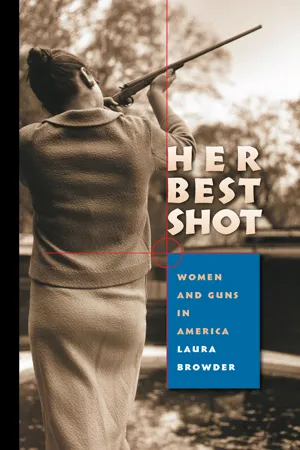
The gun-toting woman holds enormous symbolic significance in American culture. For over two centuries, women who pick up guns have disrupted the popular association of guns and masculinity, spurring debates about women’s capabilities for violence as well as their capacity for full citizenship. In Her Best Shot, Laura Browder examines the relationship between women and guns and the ways in which the figure of the armed woman has served as a lightning rod for cultural issues.
Utilizing autobiographies, advertising, journalism, novels, and political tracts, among other sources, Browder traces appearances of the armed woman across a chronological spectrum from the American Revolution to the present and an ideological spectrum ranging from the Black Panthers to right-wing militias. Among the colorful characters presented here are Deborah Sampson, who disguised herself as a man to fight in the American Revolution; Pauline Cushman, who posed as a Confederate to spy for Union forces during the Civil War; Wild West sure-shot Annie Oakley; African explorer Osa Johnson; 1930s gangsters Ma Barker and Bonnie Parker; and Patty Hearst, the hostage-turned-revolutionary-turned-victim. With her entertaining and provocative analysis, Browder demonstrates that armed women both challenge and reinforce the easy equation that links guns, manhood, and American identity.
- 304 pages
- English
- ePUB (mobile friendly)
- Available on iOS & Android
eBook - ePub
About this book
Information
1
Military Heroines
Narratives of Female Soldiers and Spies in the Civil War
The first Currier and Ives print of Molly Pitcher appeared in 1848, the same year that Elizabeth Cady Stanton and other feminists met at Seneca Falls for the first women’s rights convention. The “Declaration of Sentiments and Resolutions” passed by the delegates at the convention called for women’s enfranchisement as “this first right of a citizen.” Perhaps it was no accident that Molly Pitcher emerged as a celebrated figure when issues of individual rights were in ferment; by the time of the Civil War and immediately thereafter, the discussion linking citizenship to the bearing of arms in battle was particularly intense in the United States. During this period, the female soldier, both real and fictitious, became a focus for popular discussion about women’s rights and women’s obligations. In popular culture the figure of Molly Pitcher stood, sometimes awkwardly, alongside celebrity female Civil War soldiers such as Belle Boyd and Sarah Edmonds, as well as novelist E. D. E. N. Southworth’s fictional armed heroine Britomarte, the Man-Hater.
How did popular cultural representations of armed women become a way to talk about women’s emancipation, as well as women’s violence and sexuality? The warrior woman had been a popular literary figure in American narratives since the early nineteenth century, and she had featured in Anglo-American balladry dating back to the mid-seventeenth century. However, with the onset of the Civil War, these fictional representations took on greater weight, raising questions about women’s enfranchisement and its relationship to women’s putative nature. In this chapter I will discuss how representations of armed women involved in the Civil War revised popular notions of female patriotism, how actual women who took up arms represented themselves in their bids for celebrity, and why their autobiographies succeeded or failed with the public.
The feminists who demanded equal rights at Seneca Falls were doing so within the context of a long tradition linking military service to the idea of citizenship. Linda Kerber has traced this trajectory from the Spartan ideal of the warrior-citizen through the work of Machiavelli and has highlighted the importance that American revolutionaries of the eighteenth century attached to the political theories of eighteenth-century English writer James Burgh, who described the “possession of arms [as] the distinction between a freeman and a slave.” As Kerber writes, in the early American republic, the “connection between the republic and male patriots—who could enlist—was immediate. The connection between the republic and women—however patriotic they might feel themselves to be—was not.”1 Although not all male citizens would be called on to serve in battle, women were considered physically and mentally unsuitable for combat, and thus for the obligations and rights of full citizenship. Military service was at the heart of arguments for women’s disenfranchisement, for during times of war men’s valor and strength and their service to the nation was given especially great importance.
Both feminists and their opponents understood the literal nature of the body politic. When only white males were considered full citizens, commentators often noted that women’s bodies rendered them unsuitable for the vote. One popular satire of women’s emancipation suggested that if women were granted equal status to men, they might give birth in the pulpit, while discharging their duties as physicians, or “in a raging tempest of battle, and then what is to become of the woman legislator, the female captain of the ship, or the female general of the army. The idea is ludicrous beyond measure.”2 An abolitionist journal reported in 1853 that a Cincinnati woman who dressed like a man in order to vote was sentenced to twenty days in prison.3 While some advocates of bloomers recommended that women dress in male attire simply for reasons of comfort, the notion of a cross-dressing woman was obviously threatening to many—if a woman could appear to be a man, how could her inherent feminine weakness be detected? As a writer for the southern periodical De Bow’s Review wrote mockingly of women’s rights advocates, “At this rate, ladies, it is time to throw aside your kid gloves, and accustom yourselves to something even more manlike than your satin and muslin Bloomer equipments. Your fair hands must harden themselves to the management of Colt’s revolvers, of bombs, grenades, and whatnot?”4 This suggestion was clearly sarcastic—after all, southern courts had affirmed that, legally speaking, even self-defense in the home was an action to be taken only by the male head of household.5
The humorous discussions of women’s physical ability to handle tasks of public responsibility had serious implications, for feminists as well as antifeminists tied their ideas about women’s citizenship to military service. Women’s rights advocates used a number of strategies to question the ideal of the male citizen-soldier, ranging from pointing out that soldiers sometimes made less than ideal citizens, to championing women’s pacific nature and questioning the need for warfare, to finally, and most provocatively, pointing to historical examples of female soldiers.
First, feminists stressed there were many reasons for men to go to war, many of which had nothing to do with civic virtue. As H. H. Van Amringe pointed out at the 1850 Woman’s Rights Convention held in Worcester, Massachusetts, military service was undertaken by men for a number of reasons, including “a passion of ambition, a love of glory, a desire for carnage, and as a means of subsistence.”6 In other words, the traits of good soldiers did not necessarily make for the best citizens.
Other feminists went further in rejecting the model of the citizen-soldier by claiming that women’s enfranchisement would mean the end of all wars. Speaking in 1849, Lucretia Mott asserted that although many women throughout history had fought in wars, “more noble, moral daring is marking the female character at the present time, and better worthy of imitation. As these characteristics come to be appreciated in man too, his warlike acts, with all the miseries and horrors of the battlefield, will sink into their merited oblivion.”7 Thus, Mott looked to women’s enfranchisement to redefine the meaning of citizenship and to sever the connection between martial valor and full civic participation.
However, the ideal of the citizen-soldier remained well entrenched in American culture. Because of this, the female soldier was the most charged of symbols in a republican ideology that stressed male valor as the basis for citizenship. At the Syracuse Woman’s Rights Convention of 1852, a speaker noted that women had fought in every war, ably playing men’s roles at every rank and taking positions of leadership.8 Some feminists pointed all the way back to biblical times in order to invoke a long history of female soldiers as a justification for women’s rights. If women could engage in warfare, there was no reason, so this argument went, to deny them full civic rights. During a time of active public debates about women’s suitability for full citizenship, the Civil War provided an opportunity for feminists and antifeminists to rethink the nature of women’s patriotism. Specifically, it offered a chance for women to use the gun to redefine their role in society.
The image of the woman armed with a gun was particularly resonant during the Civil War, when mass production made firearms much more reliable and mass marketing made them much more widely available. As William Hosley notes of the Civil War era, “Never before or since has American society embraced guns with such a vengeance.”9 Contributing to an increase in national consciousness of the gun’s role in shaping America’s identity was its crucial function in subduing “savage” peoples and in making Manifest Destiny possible in the years leading up to the Civil War; the gun was also considered to be a “peacemaker” that could prevent wars through deterrence. Moreover, guns did not demand great strength to operate, and they enabled one to kill quickly, efficiently, and from a distance—no direct contact with the victim was required. Thus, the use of the gun in combat meant that women could less persuasively be debarred from wartime service on account of physical weakness. It offered the chance for women to write themselves into the history of war as soldiers, as well as for novelists to write women into war as violent actors. Although it may be tempting to view women soldiers of the Civil War as mere curiosities, their memoirs and the fiction written about them in fact speak to the central issues regarding women’s status as patriots and as citizens.
THE LITERARY TRADITION OF THE FEMALE SOLDIER
Although the public’s fascination with the female soldier intensified during the Civil War era, when issues related to patriotism and women’s rights were in the forefront of the nation’s consciousness, the armed woman had interested Americans since Revolutionary War times.10 Early depictions of the female soldier include seventeenth- and eighteenth-century “warrior woman” ballads featuring adventurous lovers in drag, Revolutionary-era fiction about female patriots and autobiographies of female soldiers, and early and mid-nineteenth-century narratives proposing that cross-dressing and taking up arms were the means of personal liberation. By the time of the Civil War, the female soldier even appeared in gothic guise in a series of popular dime novels. Although not all of these fictional female soldiers were concerned with the rhetorical construction of the female citizen, taken as a whole, they provided a rich context for armed Civil War–era women to draw on for their autobiographical self-presentations. As we shall see, the figure of the female soldier was often deployed for entertainment or titillation, but in times of national crisis it became a more charged, contested character. Moreover, the actual female soldiers who published autobiographies and embarked on stage tours often modeled their narratives on those of their fictional counterparts.
ORIGINS
The figure of the female soldier was well established internationally by the time it became popular in the American colonies. However, early representations focused on female soldiers as lovers, rather than as patriots. At the turn of the seventeenth century, ballads featuring female warriors first appeared in print in Britain, where they soon became popular and established a genre: 100 new female warrior ballads were printed between 1700 and the middle of the nineteenth century. As folklorist Dianne Dugaw notes, one of the earliest of these, Mary Ambree, was “the equivalent in her time of Ain’t She Sweet in the 1920s, Blowin’ in the Wind in the 1960s.”11 The British ballads soon made their way across the Atlantic, and by the eighteenth century broadside publishers in Boston, Providence, and Philadelphia were issuing American editions. One can gauge how well these songs were liked by the fact that an imprisoned American sailor’s journal of the Revolutionary War era included handwritten versions of two of them.12
The British ballads were not concerned with the legal foundations of women’s rights: the typical protagonist was motivated by romantic considerations to don sailor’s or soldier’s clothing and follow her lover into battle. The early bawdy ballads, featuring tough women whose imposture was detected only when they became pregnant, gave way to more sentimental ones. But the focus of the ballads remained on the construction of gender; politics and citizenship were not at issue.
THE REPUBLICAN CONTEXT
The charged debates of the Revolutionary era over the suitability of women for citizenship, given their inability to fight in battle, gave rise to representations of female soldiers that directly engaged these questions of rights and responsibilities. Within the American context, the figure of the female warrior was early identified not just with love and glory but also with patriotism and feminism.
The earliest American representation of the female soldier was fictional. In his 1799 novel, Ormond, Charles Brockden Brown included the character of Martinette de Beauvais, an American Revolutionary War veteran who follows her husband into battle. The sympathetically portrayed Martinette, a Frenchwoman, was a very different type than the female soldiers depicted in ballads. Perhaps Brown reckoned that a violent, feminist Frenchwoman would seem less threatening or unappealing to readers than an American woman of a similar personality. As she explains to the novel’s heroine, Constantia, “My soul was engrossed by two passions, a wild spirit of adventure, and a boundless devotion to [my husband]. I vowed to accompany him in every danger, to vie with him in military ardour; to combat and to die by his side.” Thus, Martinette’s military service is motivated by competition as well as love: her “boundless devotion” is not, in her mind, incompatible with her desire to “vie” with her husband on the battlefield. Soon it becomes clear that cross-dressing and military services are means for her to transform herself completely: “I delighted to assume the male dress, to acquire skill at the sword, and dexterity in every boisterous exercise. The timidity that commonly attends women, gradually vanished. I felt as if embued by a soul that was a stranger to the sexual distinction.”13 If her very soul can be altered by the process of fighting in warfare, what then is the basis for “sexual distinction”? Martinette not only succeeds in boisterous exercises but also rescues her husband “more than once ... from death by the seasonable destruction of his adversary” (202).
Martinette is a transitional figure in the history of the female warrior—she starts off as a lover but becomes a patriot—one who, moreover, delights in inflicting violence on her political enemies. It is not her love for her husband that keeps her on the battlefield; after his death from a wound, she travels to Paris, where she fights in the revolution. When Constantia asks her, “How can the heart of women be inured to the shedding of blood?” she replies with a passionate speech: “Have women, I beseech thee, no capacity to reason and infer? ... My hand never faultered when liberty demanded the victim. If thou wert with me at Paris, I could show you a fusil of two barrels, which is precious beyond any other relique, merely because it enabled me to kill thirteen officers at Jemappe” (206). Her devotion to the cause—and her ability to kill “when liberty demanded the victim”—is proof of women’s “capacity to reason and infer.” Finally, she disputes the idea that hers is an exceptional case. As she tells Constantia, who is shocked at the idea that Martinette might have fought in the ranks, “Hundreds of my sex have done the same. Some were impelled by the enthusiasm of love, and some by a mere passion for war; some by the contagion of example; and some, with whom I myself must be ranked, by a generous devotion to liberty” (207).
While Charles Brockden Brown had the fictional Martinette express herself freely about her enthusiasm for patriotic violence and for the freedom given her by cross-dressing, an actual woman combatant of the Revolutionary era, negotiating republican unease with the idea of the female soldier, found it necessary to write with a great deal more reserve. Deborah Sampson Gannett was an American woman who cross-dressed and fought in the American Revolution under the name Robert Shurtliff. After the war she made a living giving stage performances, under her married name, Gannett, in which, dressed in an infantry uniform, she first delivered a text based on her experiences and then carried out manual exercises with a musket. In her performances, transcribed for publication in 1802, and in a 1797 memoir, The Female Review, she portrayed herself as demure by nature, but compelled by such an overwhelming devotion to liberty that she surmounted her feminine modesty and took up arms.14
It is hard to imagine a more apologetic female warrior than Gannett. When in her stage performance she takes up her wartime experiences of cross-dressing and fighting, she claims that “I indeed recollect it as a foible, an error and presumption, into which, perhaps, I have too inadvertently and precipitately run; but which I now retrospect with anguish and amazement.” She continues, “And yet I must frankly confess, I recollect it with a kind of satisfaction, which no one can better conceive and enjoy than him, who, recollecting the good intentions of a bad deed, lives to see and to correct any indecorum of his life.” Indeed, Gannett anticipates a kind of revulsion on the part of her listeners about her wartime deeds: “They are a breach in the decorum of my sex, unquestionably; and, perhaps, too unfortunately ever irreconcilable with the rigid maxims of the moralist; and a sacrifice, which, while it may seem perfectly incompatible with the requirements of virtue—and which of course must ring discord in the ear, and disgust to the bottom of sensibility and refinement, I must be content to leave to time and the most scrutinizing enquiry to dis...
Table of contents
- Cover Page
- Her Best Shot
- Copyright Page
- Dedication
- Contents
- Illustrations
- Preface
- Acknowledgments
- Introduction: The News about Women and Guns
- 1 Military Heroines
- 2 Little Miss Sure Shot and Friends, or How Armed Women Tamed the West
- 3 Maid Marians and Bad Mothers
- 4 Radical Women of the 1960s And 1970s
- 5 Armed Women of the Far Right
- 6 Armed Feminism or Family Values?
- Conclusion
- Notes
- Bibliography
- Index
Trusted by 375,005 students
Access to over 1.5 million titles for a fair monthly price.
Study more efficiently using our study tools.
Frequently asked questions
Yes, you can cancel anytime from the Subscription tab in your account settings on the Perlego website. Your subscription will stay active until the end of your current billing period. Learn how to cancel your subscription
No, books cannot be downloaded as external files, such as PDFs, for use outside of Perlego. However, you can download books within the Perlego app for offline reading on mobile or tablet. Learn how to download books offline
Perlego offers two plans: Essential and Complete
- Essential is ideal for learners and professionals who enjoy exploring a wide range of subjects. Access the Essential Library with 800,000+ trusted titles and best-sellers across business, personal growth, and the humanities. Includes unlimited reading time and Standard Read Aloud voice.
- Complete: Perfect for advanced learners and researchers needing full, unrestricted access. Unlock 1.5M+ books across hundreds of subjects, including academic and specialized titles. The Complete Plan also includes advanced features like Premium Read Aloud and Research Assistant.
We are an online textbook subscription service, where you can get access to an entire online library for less than the price of a single book per month. With over 1.5 million books across 990+ topics, we’ve got you covered! Learn about our mission
Look out for the read-aloud symbol on your next book to see if you can listen to it. The read-aloud tool reads text aloud for you, highlighting the text as it is being read. You can pause it, speed it up and slow it down. Learn more about Read Aloud
Yes! You can use the Perlego app on both iOS and Android devices to read anytime, anywhere — even offline. Perfect for commutes or when you’re on the go.
Please note we cannot support devices running on iOS 13 and Android 7 or earlier. Learn more about using the app
Please note we cannot support devices running on iOS 13 and Android 7 or earlier. Learn more about using the app
Yes, you can access Her Best Shot by Laura Browder in PDF and/or ePUB format, as well as other popular books in Social Sciences & Social History. We have over 1.5 million books available in our catalogue for you to explore.