Dennis Merrill examines the origins and implementation of U.S. economic assistance programs in India from independence in 1947 to the height of John F. Kennedy’s “development decade” in 1963. As the Cold War spread to the Third World in the late 1940s and 1950s, American policymakers tried to use economic aid to draw neutral India into the Western camp. Citing the country as the “world’s largest democracy,” the Americans hoped to establish India as a showcase for American–sponsored development and a counterweight to the Communist model in the People’s Republic of China.
By the early 1960s, India has become one of the Third World’s leading recipients of American economic assistance. Yet, as Merrill demonstrates, India remained dedicated to a nonaligned status, and Prime Minister Jawaharlal Nehru’s frequent criticism of U.S. foreign policy tried the patience of Cold War strategists. Even in the area of economic policy, the two nations differed on a wide variety of developmental issues. Thus, argues Merrill, the Indian case offers a keen vantage point from which to explores modern American foreign policy and the complexities of the foreign aid process.
Bread and the Ballot is one of the first studies of U.S. attitudes toward Third World development in the decades following World War II to be based largely on recently declassified government documents. Merrill’s study draws on materials from the Harry S. Truman, Dwight D. Eisenhower, and John F. Kennedy presidential libraries, U.S. State Department records, and the papers of Chester Bowles, who served as ambassador to India under both Truman and Kennedy. In addition, Merrill’s extensive research in Britain and Indian public records gives this work a multinational perspective.
Originally published in 1990.
A UNC Press Enduring Edition — UNC Press Enduring Editions use the latest in digital technology to make available again books from our distinguished backlist that were previously out of print. These editions are published unaltered from the original, and are presented in affordable paperback formats, bringing readers both historical and cultural value.
eBook - ePub
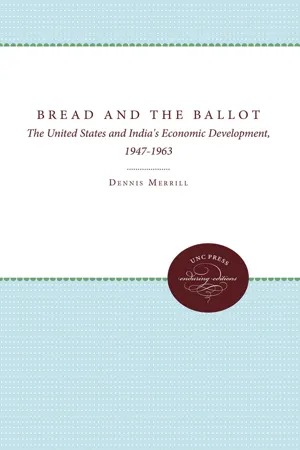
Bread and the Ballot
The United States and India's Economic Development, 1947-1963
- 304 pages
- English
- ePUB (mobile friendly)
- Available on iOS & Android
eBook - ePub
About this book
Information
Table of contents
- Cover Page
- Title Page
- Copyright Page
- Dedication
- Contents
- Illustrations
- Preface
- One Introduction: American Developmentalism and India
- Two A Missed Opportunity, 1947-1950
- Three War and Aid, 1950-1951
- Four A Matter of Priorities, 1951-1953
- Five A Changing Cold War, 1953-1956
- Six Take-Off, 1957-1961
- Seven JFK and India's Development Decade, 1961-1963
- Eight Conclusion
- Notes
- Selected Bibliography
- Index
Trusted by 375,005 students
Access to over 1.5 million titles for a fair monthly price.
Study more efficiently using our study tools.
Frequently asked questions
Yes, you can cancel anytime from the Subscription tab in your account settings on the Perlego website. Your subscription will stay active until the end of your current billing period. Learn how to cancel your subscription
No, books cannot be downloaded as external files, such as PDFs, for use outside of Perlego. However, you can download books within the Perlego app for offline reading on mobile or tablet. Learn how to download books offline
Perlego offers two plans: Essential and Complete
- Essential is ideal for learners and professionals who enjoy exploring a wide range of subjects. Access the Essential Library with 800,000+ trusted titles and best-sellers across business, personal growth, and the humanities. Includes unlimited reading time and Standard Read Aloud voice.
- Complete: Perfect for advanced learners and researchers needing full, unrestricted access. Unlock 1.5M+ books across hundreds of subjects, including academic and specialized titles. The Complete Plan also includes advanced features like Premium Read Aloud and Research Assistant.
We are an online textbook subscription service, where you can get access to an entire online library for less than the price of a single book per month. With over 1.5 million books across 990+ topics, we’ve got you covered! Learn about our mission
Look out for the read-aloud symbol on your next book to see if you can listen to it. The read-aloud tool reads text aloud for you, highlighting the text as it is being read. You can pause it, speed it up and slow it down. Learn more about Read Aloud
Yes! You can use the Perlego app on both iOS and Android devices to read anytime, anywhere — even offline. Perfect for commutes or when you’re on the go.
Please note we cannot support devices running on iOS 13 and Android 7 or earlier. Learn more about using the app
Please note we cannot support devices running on iOS 13 and Android 7 or earlier. Learn more about using the app
Yes, you can access Bread and the Ballot by Dennis Merrill in PDF and/or ePUB format, as well as other popular books in History & Indian & South Asian History. We have over 1.5 million books available in our catalogue for you to explore.