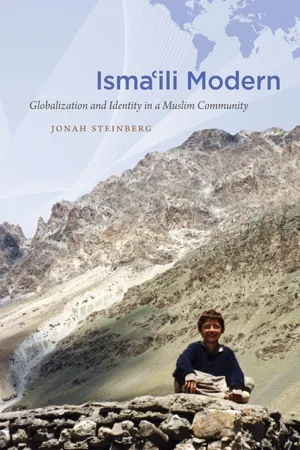
The Isma'ili Muslims, a major sect of Shi'i Islam, form a community that is intriguing in its deterritorialized social organization. Informed by the richness of Isma'ili history, theories of transnationalism and globalization, and firsthand ethnographic fieldwork in the Himalayan regions of Tajikistan and Pakistan as well as in Europe, Jonah Steinberg investigates Isma'ili Muslims and the development of their remarkable and expansive twenty-first-century global structures.
Led by a charismatic European-based hereditary Imam, Prince Karim Aga Khan IV, global Isma'ili organizations make available an astonishing array of services — social, economic, political, and religious — to some three to five million subjects stretching from Afghanistan to England, from Pakistan to Tanzania. Steinberg argues that this intricate and highly integrated network enables a new kind of shared identity and citizenship, one that goes well beyond the sense of community maintained by other diasporic populations. Of note in this process is the rapid assimilation in the postcolonial period of once-isolated societies into the intensively centralized Isma'ili structure. Also remarkable is the Isma'ilis' self-presentation, contrary to common characterizations of Islam in the mass media, as a Muslim society that is broadly sympathetic to capitalist systems, opposed to fundamentalism, and distinctly modern in orientation. Steinberg’s unique journey into remote mountain regions highlights today’s rapidly shifting meanings of citizenship, faith, and identity and reveals their global scale.
The role of leadership, succession, and schism in the history of Islam warrants careful (albeit brief) consideration here.1 It is only through an understanding of these processes that the story of Isma
ilism can be fully explained. At almost every historical moment, how the Isma
ili community defined and redefined itself revolved around questions of succession and rightful authority. This was always an issue in Shi
ism in general, since legitimate authority was the domain of the Ahl al-Bayt, the “people of the house” of the Prophet Muhammad, especially through the line of his nephew and son-in-law
Ali. The Shi
a opposed the Sunni notion of rule by consensus (ijma
) of the community, because they believed that leadership should only be in the hands of the qualified, especially since leadership involved elucidation of the underlying truth of the religion. The criteria among the Shi
a for the selection of qualified leaders were lineal; only the descendants of
Ali were seen to be qualified to lead Islamic society. The question, then, revolved around who was in fact the rightful heir in the line of
Ali.
Since the inception of the religion, and especially after the death of the Prophet, Islamic societies and polities have devoted a great deal of attention to these questions. After all, the Islamic leader, or caliph, was charged with prescribing both religious and worldly conduct. Leadership has remained more of a concern for Isma
ilism than for most other branches of Islam; Sunni populations no longer have a centralized caliph, nor do the Ithna
ashari Shi
a, who believe in the messianic return of the twelfth imam as Mahdi. Isma
ilis, however, retain a leader whom they believe to be a direct descendant of
Ali and thus uniquely qualified to explain and interpret the meaning of their religion.
In sum: after Muhammad's death, questions of succession caused a rift between those who favored
Ali as the leader of the Muslim community, and those who favored Abu Bakr, Muhammad's successor. Those loyal to
Ali and his cause would become known as the Shi
a, the “party” of
Ali; those who favored the caliphs beginning with Abu Bakr would later be referred to as Sunni. The Shi
a felt that
Ali had been wronged and cheated of his rights. Each group slowly developed its own distinctive religious orientation. The Shi
a too split into many sects, often over questions of succession. The Shi
i Isma
ilis were born in one such dispute: The major branch of Shi
a and the proto-Isma
ilis shared all the same imams through Ja
far al-Sadiq, the sixth imam by current Nizari Isma
ili reckoning (and the fifth in other reckonings). When Ja
far's son and heir-apparent, Isma
il, died before his father, a dispute arose over who was the rightful successor. Those who believed that it was Isma
il would become the Isma
iliyya (Daftary 1990: 1).
The various formations referred to as the “Isma
iliyya” have been commonly perceived as taking a somewhat radical and oppositional stance in the Islamic world; this reputation has been at the center of the attributes bestowed upon them by other groups. They have gone through cycles of great prominence and complete obscurity over the course of their history and have been divided by schism a number of times. Beginning in the tenth century, significantly, the Isma
ilis established a territorial state, the Fatimid Empire, which included much of North Africa and western Asia. The Fatimids built the city of Cairo (including the famous Al-Azhar mosque and university), which quickly became a cosmopolitan center; their territory incorporated Morocco and Mecca, Jerusalem and Sicily, and their religiopolitical network stretched from Africa to India (Daftary 1990: 2; Robinson 1996). These facts would become ethnographically important later for the influence they had on Isma
ilis’ views of themselves, but their actual relationship to contemporary Isma
ilism is difficult to discern. In fact, despite Isma
ili institutions’ insistence on their historical salience for modern Isma
ilism, their real shared continuity is rooted more in interpretation than historical fact.
As the Fatimid Empire began to fall apart, another major schism over succession to the Isma
ili imamate divided the sect into branches that became the Musta
lawiyya (or Musta
lian Isma
ilism, out of which emerged the Tayyibis and the Bohras of Yemen and India), and the Nizariyya, the branch that is our primary concern here, whose early post-Fatimid history was primarily in Iran, and out of which eventually came the line of the Aga Khans. The Nizariyya too had a “territorially scattered state” (Daftary 1990: 2) in Iran, with a center in the Elbrus Mountains above the Caspian Sea, and a vassal state in Syria with its own complex and significant history. It consisted of widely distributed fortresses that maintained intensive communication between them. While the Nizari state was not on the same scale as the Fatimid state, in the eyes of the key powers of the Islamic world, particularly the Seljuqs, it was a real threat and figures prominently in Islamic histories of the period; almost all the dynasties feared the rebellious Isma
ilis of the time. The Mongol invasions, however, especially the campaigns led specifically against the Nizaris by Hülegü, proved to be disastrous for the sect, and as the invaders swept across Iran on horseback, the Isma
ili community seemed to fade into obscurity; it became, for a time, little more than a conglomeration of scattered populations, with the central leadership presenting itself as a Sufi order. Only in the past century, with the explosion of global processes, has the Isma
ili community come back into the consciousness of the non-Isma
ili world. It should be noted that, while over the cours...
Table of contents
Cover Page
Ismaʿili Modern
Copyright Page
Dedication
Contents
Acknowledgments
INTRODUCTION Beyond Territoriality
CHAPTER ONE Antecedents and Precursors
CHAPTER TWO Fluid Cartographies
CHAPTER THREE Universalizing Ismaʿilism
CHAPTER FOUR Into the Fold
CHAPTER FIVE Living Globality
CONCLUSION Decoding Globality
Notes
Bibliography
Index
Trusted by 375,005 students
Access to over 1.5 million titles for a fair monthly price.
Study more efficiently using our study tools.
Frequently asked questions
Yes, you can cancel anytime from the Subscription tab in your account settings on the Perlego website. Your subscription will stay active until the end of your current billing period. Learn how to cancel your subscription
No, books cannot be downloaded as external files, such as PDFs, for use outside of Perlego. However, you can download books within the Perlego app for offline reading on mobile or tablet. Learn how to download books offline
Perlego offers two plans: Essential and Complete
Essential is ideal for learners and professionals who enjoy exploring a wide range of subjects. Access the Essential Library with 800,000+ trusted titles and best-sellers across business, personal growth, and the humanities. Includes unlimited reading time and Standard Read Aloud voice.
Complete: Perfect for advanced learners and researchers needing full, unrestricted access. Unlock 1.5M+ books across hundreds of subjects, including academic and specialized titles. The Complete Plan also includes advanced features like Premium Read Aloud and Research Assistant.
Both plans are available with monthly, semester, or annual billing cycles.
We are an online textbook subscription service, where you can get access to an entire online library for less than the price of a single book per month. With over 1.5 million books across 990+ topics, we’ve got you covered! Learn about our mission
Look out for the read-aloud symbol on your next book to see if you can listen to it. The read-aloud tool reads text aloud for you, highlighting the text as it is being read. You can pause it, speed it up and slow it down. Learn more about Read Aloud
Yes! You can use the Perlego app on both iOS and Android devices to read anytime, anywhere — even offline. Perfect for commutes or when you’re on the go. Please note we cannot support devices running on iOS 13 and Android 7 or earlier. Learn more about using the app
Yes, you can access Isma'ili Modern by Jonah Steinberg in PDF and/or ePUB format, as well as other popular books in Teologia e religione & Storia mediorientale. We have over 1.5 million books available in our catalogue for you to explore.