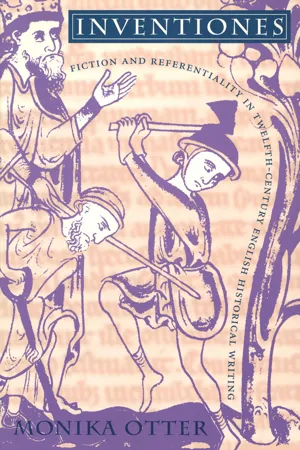
Combining literary theory and historiography, Monika Otter explores the relationship between history and fiction in the Latin literature of twelfth-century England. The beginnings of fiction have commonly been associated with vernacular romance, but Otter demonstrates that writers of Latin historical narratives also employed the self-referential techniques characteristic of fiction. Beginning with inventiones, a genre dealing with the discovery of saints' relics, Otter reveals how exploring the fundamental problems of writing history and the nature of truth itself leads monastic or clerical Latin writers to a budding awareness of fictionality. According to Otter, accounts of conquests, treasure hunts, descents into underground worlds, and efforts (usually unsuccessful) to retrieve subterranean objects serve as self-referential metaphors for the problems of accessing and retrieving the past; they are thus designed to shake the reader’s faith in historical representation and highlight the textuality of the historical account. Otter traces this self-conscious use of fictional elements within historical narrative through the works of William of Malmesbury, Geoffrey of Monmouth, Gerald of Wales, Walter Map, and William of Newburgh.
Originally published in 1996.
A UNC Press Enduring Edition — UNC Press Enduring Editions use the latest in digital technology to make available again books from our distinguished backlist that were previously out of print. These editions are published unaltered from the original, and are presented in affordable paperback formats, bringing readers both historical and cultural value.
Inventiones have long been recognized as a hagiographic genre, but they have rarely received the scholarly attention they deserve.1 Most historians who comment on them at all more or less subsume them under translationes, narratives about the transfer of relics to a different location or to a different shrine within the same church.2Inventiones are indeed closely related to these narratives, but their purpose and their “built-in” imagery is sufficiently different to warrant treating them as a separate category.
Inventio as a liturgical term refers to the discovery of a saint’s relics and to the feast commemorating that event. More important to my purpose here, inventiones are brief narratives about such findings of relics. The medieval English inventiones discussed here are almost all of monastic provenance, and they usually concern a particular monastery’s patron saint or another important relic the house owns. Most are connected to the story of the house’s foundation. The connection may be direct or oblique, but inventiones are told, by and large, to explain a monastery’s origin.3
The genre of inventio, as a written form and sometimes even as a staged event, flourishes under outside pressure. Monasteries write or commission inventiones when their interests are under attack. On the Continent, inventiones, along with related hagiographical narratives and other local monastic historiography, are most popular in the tenth, eleventh, and early twelfth centuries, the time of the great monastic reforms; perhaps the competition of different observances played a role, although, on the Continent as in England, economic interests and privileges are the major immediate objective.4 England, as has often been observed, lags behind the Continent in the production of such local historiography, and pre-Conquest inventiones are correspondingly rare.5 The great time of English inventiones is from the late eleventh to the late twelfth century. This new vogue was aided, if not caused, by a number of Continental hagiographers, such as Folcart and Goscelin of St. Bertin, who lent their services to several English houses.6 The need for such texts was greatly stimulated by the need to reassert rights and privileges, and generally to reestablish historical continuity, after the disruption caused by the Norman Conquest; but there was also a more general desire to fill in the historio- graphical gaps, to consolidate in writing what was previously oral or sparsely documented local tradition.7 Later in the twelfth century, it was chiefly quarrels over land, privileges, or status and sometimes conflicting traditions about the location of certain relics that prompted local historiography. A major shift in economics late in the century, which favored larger, administratively sophisticated landholders over smaller ones, was also an incentive for getting one’s books in order, both the documentation and the narrative;8 the result was composite works, narrative cartularies, that contain the house’s most important documents with more or less narrative tissue between them.9
In the early twelfth century, historians in England were catching up on work that had been neglected, rallying the historiographical forces after the disruption of the Conquest. The standard image conjured up by modern historians is of Anglo-Saxon monks frantically defending their native traditions, and above all their saints, against the skeptical and arrogant Norman abbots and bishops forced upon them against their will. In an important recent essay, Susan Ridyard cautions against overly simplistic views of ethnic tensions in post-Conquest England: the Norman newcomers were by no means universally contemptuous of Anglo-Saxon traditions, but on the contrary often helped promote them.10 A nice visual illustration of the collaboration and blending of the ethnic groups can be seen in one of the most important manuscripts of Goscelin’s works, an early twelfth-century manuscript from St. Augustine’s, Canterbury: it contains the lives of the abbey’s local saints written in a pre-Conquest English hand, a hand of the typical Norman-influenced style that was being developed next door at Christ Church Cathedral, and a hand that combines both types; the hands alternate, often in mid-narrative, and give an impression of peaceful collaboration in a common cause.11 It is also worth recalling that much English historiography at the time was written for Norman patrons. As Frank Barlow puts it, “the parvenu Normans were appropriating Old-English history.”12 But the much quoted instances of Norman hostility that Ridyard seeks to play down show, if nothing else, that there was a perception of such hostility; and, even if the spate of historiographic activity did not break down along ethnic lines, it is true that monasteries perceived the need to put their local traditions into writing for defensive reasons. Glastonbury commissioned William of Malmesbury—of mixed Norman and Anglo-Saxon descent—to write up its local traditions, emphasizing particularly its antiquity and its impressive relic collection.13 Eadmer—an Anglo- Saxon—did extensive work for Christ Church, Canterbury, aggressively defending its ownership of many important relics.14 Goscelin of St. Bertin—a Fleming—acted as a kind of roving hagiographer for several monasteries, particularly for St. Augustine’s, Canterbury, where he eventually settled.15 On a larger scale, William of Malmesbury spent the 1120s and 30s systematically collecting information and traditions from churches and monasteries all over England for his “gazetteer of ecclesiastical England,” the Gesta Pontificum.16 He considered his own work both pioneering and urgently necessary: his secular history of England, the Gesta Regum, begins with the observation that with the exception of Eadmer, there had been no serious large-scale narrative history in England since Bede, and that this gap needed to be filled.17
Although in the latter part of the century there seems to be a sense that the ground-breaking work has been done, that the framework of English history has been established,18 the need for defensive local historiography does not subside. On the contrary: the second part of the twelfth century is typically the “golden age” of local historiography in England. At Bury, around the year 1200, Jocelin of Brakelond is defending the “terra Sancti Edmundi” against encroachment from the local bishop, secular neighbors, and above all the Crown. Besides the obvious practical purposes of such work, the abbey’s lands also seem to be of great emotional value to the monks. One recalls Jocelin’s famous New Year’s present to Abbot Samson: after careful consideration, the young Jocelin decides that the perfect gift for the abbot (whom at that time he still worships as a hero) would be to draw up a catalogue of all the monastery’s lands.19 Lands and possessions are the central concern of Bury historiography and hagiography over several centuries.20 At neighboring Ely, the Liber Eliensis is compiled between 1131 and 1174, in part from earlier local sources. In the last third of the twelfth century, Abingdon, Ramsey, Waltham, Hexham, and others are all consolidating in writing their claims of land, prestige, privileges, and relics.21
St. Albans, a center of historiography, art, and book production in the twelfth and thirteenth centuries, allows us to observe the development of an inventio account and its place in local historiography over several generations. Although generally in very good shape both historiographically (the legend of its founding saint is told by no less an authority than Bede) and materially, in terms of its property claims, privileges, and exemptions,22 St. Albans begins a major hagiographic initiative around 1178, probably in response to Ely’s claim that it possesses the true relics of St. Alban, a claim Matthew Paris was still fighting two generations later.23 At that time, the abbey added an additional patron saint to its roster: St. Amphibalus, the missionary, unnamed in the early sources, who converted St. Alban to Christianity. His relics and those of several other martyrs were “discovered” in 1178, and the event was, as Matthew Paris notes, commemorated in a libellus containing the life of the new saint and other materials pertaining to both him and St. Alban.24 The life, by a monk named William, is extant (though the original libellus is not), and will be discussed at length later in this chapter. Almost simultaneously, William’s life was rendered in elegiac verses by Ralph of Dunstable; both texts were copied several times, often together, and often augmented, in an arrangement typical of such libelli, by treatises on the inventiones of both saints and the miracles associated with them. In the thirteenth century, St. Albans’ great historiographer and artist Matthew Paris further shaped and consolidated the Alban and Amphibalus legend. He reworked all the material on the two saints and their inventiones in the Chronica Majora, the important universal chronicle he took over from Roger Wendover in 1235; he also described both inventiones in the appropriate places of his house chronicle, the Gesta Abbatum Sancti Albani.25 Moreover, he produced a separate manuscript on the saints. His autograph manuscript (Trinity College Dublin Ms. 177) contains William’s and Ralph’s lives and treatises from the earlier collections, as well as Matthew’s own French verse translation of William’s life. Matthew illustrated the French Vie de Seint Auban with a cycle of tinted outline drawings, in his customary strip-cartoon style, that continues past the end of the poem to narrate the inventio of St. Alban and the foundation of the abbey by King Offa of Mercia in 792.26 There is thus a rich, unbroken, and evolving tradition of local hagiography at St. Albans in the eight decades from about 1178 to Matthew’s death in 1259; this body of material is extraordinarily fruitful for the study of inventiones.
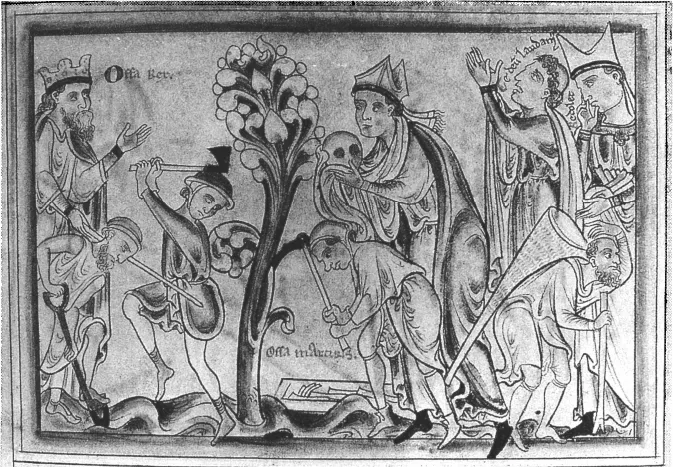
With his astonishing gift for creating vigorous, plausible new iconographies, Matthew provides a striking visual representation of what had clearly become firmly established as a mental image in the collective imagination of medieval western Europe.27 In the illustrated Vie de Seint Auban, the sequence on Alban’s inventio begins with King Offa’s dream, in which an angel directs him to the site; it then shows him and several bishops riding there, guided by visions of a celestial ray descending on the martyr’s grave. The dig is shown in a particularly vivid scene: Offa stands on the left, gesturing toward the ground and the diggers. Workmen, with realistically depicted tools and wicker crates, uncover a rectangular tomb containing something labeled “ossa martiris” (fig. 1). The public is represented by two clerics on the right, both with “speech bubble” phrases: one is praying “Te deum laudamus”; the other, with his index finger to his nose, says “Redolet.” The rhymed captions at this point become unusually expansive, covering more than the usual two couplets per picture:
Fig. 1. King Offa discovers the relics of St. Alban. From Matthew Parish Vie de Seint Auban, Trinity College Dublin Ms. 177, fol. 59 r. Reproduced by permission of The Board of Trinity College Dublin.
Crosent de besches e picois;
Asaartent boisuns e bois
Enportent zuches e racines;
Ostent blestes, ostent espines;
En hotes portent cailloz e tere.
Ne finent de chercher e quere.
Querent aval, querent amund.
Li reis i est ki les sumunt,
Tant k’est truvez li tresors
E les reliques du seint cors
Envolupez k’erent de paille
Ki ne pert ne culur ne taille.
They dig with spades and picks; they tear out shrubs and trees, carry away stumps and roots; they take off brambles and thorns; they carry pebbles and dirt in baskets. They do not cease to search. They search up and down—the King is there to supervise them—until the treasure is found, and the relics of the sacred body, which were wrapped in a pall that had lost neither color nor shape.28
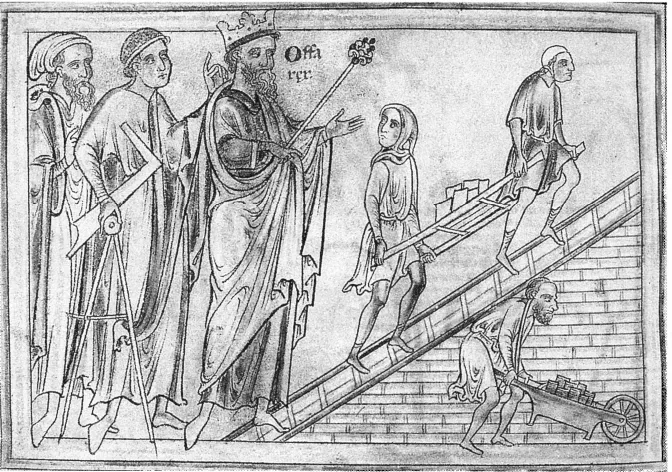
Figs. 2-3. King Offa oversees construction of St. Albans Abbey. From Matthew Paris’s Vie de Seint Auban, Trinity College Dublin Ms. 177, fols. 59 v and 60 r. Reproduced by permission of The Board of Trinity College Dublin.
This picture leads directly to a two-page representation of the building of the monastery (figs. 2 and 3). The connection, already strongly suggested by the general left-to-right orientation of the illustrations, is emphasized by one of Matthew’s usual continuity devices: a worker walking out of the inventio picture at the right.29 The remaining pictures show the appointment of the first abbot, the solemn elevatio of the relics, the institution of an annual procession to commemorate the inventio, and Offa’s endowment of the abbey.30 The sequence forms an invaluable visual record of what an inventio “looked like” in the minds of me...
Table of contents
Cover Page
Title Page
Copyright Page
Dedication
Contents
Acknowledgments
Introduction
[1] Inventiones
[2] Gaainable Tere: Foundations, Conquests, and Symbolic Appropriations of Space and Time
[3] Underground Treasures: The “Other Worlds” of William of Malmesbury, William of Newburgh, and Walter Map
[4] Quicksands: Gerald of Wales on Reading
Conclusion
Notes
Works Cited
Index
Trusted by 375,005 students
Access to over 1.5 million titles for a fair monthly price.
Study more efficiently using our study tools.
Frequently asked questions
Yes, you can cancel anytime from the Subscription tab in your account settings on the Perlego website. Your subscription will stay active until the end of your current billing period. Learn how to cancel your subscription
No, books cannot be downloaded as external files, such as PDFs, for use outside of Perlego. However, you can download books within the Perlego app for offline reading on mobile or tablet. Learn how to download books offline
Perlego offers two plans: Essential and Complete
Essential is ideal for learners and professionals who enjoy exploring a wide range of subjects. Access the Essential Library with 800,000+ trusted titles and best-sellers across business, personal growth, and the humanities. Includes unlimited reading time and Standard Read Aloud voice.
Complete: Perfect for advanced learners and researchers needing full, unrestricted access. Unlock 1.5M+ books across hundreds of subjects, including academic and specialized titles. The Complete Plan also includes advanced features like Premium Read Aloud and Research Assistant.
Both plans are available with monthly, semester, or annual billing cycles.
We are an online textbook subscription service, where you can get access to an entire online library for less than the price of a single book per month. With over 1.5 million books across 990+ topics, we’ve got you covered! Learn about our mission
Look out for the read-aloud symbol on your next book to see if you can listen to it. The read-aloud tool reads text aloud for you, highlighting the text as it is being read. You can pause it, speed it up and slow it down. Learn more about Read Aloud
Yes! You can use the Perlego app on both iOS and Android devices to read anytime, anywhere — even offline. Perfect for commutes or when you’re on the go. Please note we cannot support devices running on iOS 13 and Android 7 or earlier. Learn more about using the app
Yes, you can access Inventiones by Monika Otter in PDF and/or ePUB format, as well as other popular books in Literature & English Literary Criticism. We have over 1.5 million books available in our catalogue for you to explore.