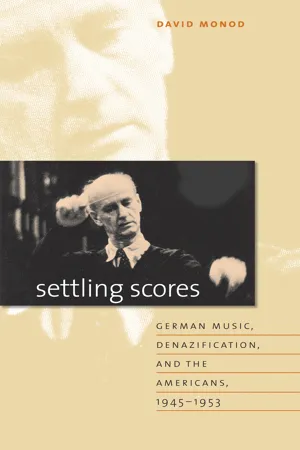
Classical music was central to German national identity in the early twentieth century. The preeminence of composers such as Bach and Beethoven and artists such as conductor Wilhelm Furtwängler and pianist Walter Gieseking was cited by the Nazis as justification for German expansionism and as evidence of Aryan superiority. In the minds of many Americans, further German aggression could be prevented only if the population’s faith in its moral and cultural superiority was shattered. In Settling Scores, David Monod examines the attempted “denazification” of the German music world by the Music Control Branch of the Information Control Division of Military Government.
The occupying American forces barred from the stage and concert hall all former Nazi Party members and even anyone deemed to display an “authoritarian personality.” They also imported European and American music. These actions, however, divided American officials and outraged German audiences and performers. Nonetheless, the long-term effects were greater than has been previously recognized, as German government officials regained local control and voluntarily limited their involvement in artistic life while promoting “new” (anti-Nazi) music.
- 344 pages
- English
- ePUB (mobile friendly)
- Available on iOS & Android
eBook - ePub
About this book
Information
1. Preparing for Music Control
For John Bitter it began in silence. A former intelligence officer attached to the 4th Armored Division, Bitter had come to Berlin three months after Germany’s surrender as a new addition to America’s Military Government. Disgorged from a C-37 at Tempelhoff airport with a jeep and three other soldiers, Bitter headed north, eager for a look at the remains of Hitler’s Berlin. Unable to proceed around military roadblocks or along rubble-congested streets, the GIs circled west of the administrative center and north of the Tiergarten park. Although it was growing dark, Bitter hoped to get a view of the city and climbed onto what was left of a wall. “I’ll never forget this,” he recalled, “because this was in Moabit, an old industrial part of Berlin. There was not a sound. I’ll tell you, for a musician to hear absolute silence is very odd. There is always some tone. You will hear the fan or the air conditioner or the wind or something and airplanes pass by. But here, not a sound. No lights. And it was like a moonscape.”1
A few days before, instead of going back to his job as conductor of the Miami Symphony Orchestra, Major Bitter had volunteered to join the American Military Government and remain in Germany. Telford Taylor, a friend of his from college days at Yale who was heading the team assembling material for the Nuremberg trials, had recommended him to one of his colleagues, General Robert Mc-Clure, the commander of the Psychological Warfare Division (PWD). On the lookout for men with fluency in German and expertise in specialized cultural fields, McClure approved his appointment.2 And so the kind, doughy-faced American arrived in Berlin as a member of one of the more peculiar elements in Germany’s postwar military administration: the music control branch of the Psychological Warfare Division.
Part of an omnibus field unit that included Theater and Film, the branch John Bitter joined was charged with the duty of coordinating the denazification of German musical life and reorienting it according to democratic principles. His job was to serve as a kind of sentinel watching over the birth of artistic freedom. As a music officer, Bitter was to ensure that no works endorsing fascist or militarist ideals were performed, that compositions suppressed in the Third Reich (such as Mendelssohn’s) were restored to the concert hall, that artists celebrated by the Nazis were blocked from further performances, that the influence of the state in the cultural sector was minimized, and that German audiences were taught that the music of other nations and cultures was as valid and worthy as their own. Music control aimed at creating a rupture in German cultural history by shattering the public’s sense of superiority in Germany’s musical achievements and by promoting performers and works that had been neglected or banned under Nazi rule.
In undertaking all of these tasks, music officers in the American occupation zone were participating in a massive undertaking whose goal was to obliterate the culture of Nazism and reorient German thinking. This was considered necessary because PWD planners believed they had to eliminate the forces that made Germany such a warlike and expansionist power. They considered the notion, popular at the time in Germany, that the Third Reich’s atrocities and the war were caused by a small group of Nazis much the same as the country’s effort in 1919 to deny its war guilt. “A repudiation of Nazism,” a SHAEF Joint Intelligence Report concluded in July 1945, “is one of the ways in which the average German can avoid [an] unpleasant feeling and the only fault they acknowledge is that they once trusted Hitler and add that they can hardly be blamed for failing to see how things would turn out.”3 Forcing the Germans to accept their collective responsibility for the crimes of Nazism was considered essential for the country to achieve a more peaceful future. “Our goal,” President Truman’s secretary informed the theologian Reinhold Niebuhr, is to “teach the Germans a lasting lesson by treating them as a defeated nation and pariah.” This, however, depended on the occupation forces’ ability to compel the defeated to accept that Nazism was simply the latest manifestation of their own innate aggression and chauvinism and that peace would only come to Europe once the Germans reformed their character.4 In order to achieve this, wartime planners prepared for the control of all aspects of German cultural expression: film, theater, museums, literature, radio, and newspapers. The idea was that if the Allies could supervise the news and entertainment media for long enough, prevent expressions of German patriotism and intolerance, and bombard the population with democratic and guilt-inducing messages, in time the country would be reformed.
WHY CLASSICAL MUSIC?
For most of the war, it had been the job of the U.S. Office of War Information (OWI), rather than the U.S. Army, to engage the enemy in cultural warfare, which it did by broadcasting messages from its London studios into the occupied countries. Here the idea of using the media to change German attitudes was first explored. As Virginia Pleasants, who worked for OWI’s American Broadcasting Station in Europe (ABSIE), remembered, “we scoured London for people with languages, because all kinds of expatriates [had] fled to England, and for GIs who spoke a foreign language. They would come and make short talks: morale building or information, something like that. . . . It was really propaganda, you know, because the announcer would say: ‘Here is somebody who speaks a dialect,’ but in reality he was a GI.”5
As part of its radio campaign, OWI sent music banned or disfavored by the Nazis and performances by American ensembles, both classical and popular, over the airwaves. Popular music—“the best of boogie-woogie and the baritone of Bing Crosby”—dominated OWI’s transmissions, composing almost 50 percent of its broadcast time, but classical music was also prominently featured. In fact, ABSIE had initiated its overseas transmission with a Stephen Foster tune played on the banjo followed by a Toscanini recording of Beethoven’s Seventh Symphony. These two dimensions—the popular and the serious—were each considered important to the war effort. In addition to attracting audiences with varied musical tastes and boosting morale among Europe’s subject people, they were intended to show the Germans that the United States was a vital and enviable musical superpower. The American composer Roy Harris, who headed OWI’s music program, emphasized that the agency had a two-pronged mission in Europe: first, “to show the interest, appreciation, understanding and activity in the performance of the music of the European nations as it is practised in this country. The second part concerns the development of a native music.”6 In effect, those in occupied Europe would gain hope and the Germans despair on learning that U.S. bands could not only play Brahms and Beethoven but also really jump and stomp.
OWI’s offices were once described as a “palace of culture, wisdom and swing,” and it seems fitting that the three categories were itemized separately. Although Harris was sympathetic to popular idioms, and the head of ABSIE’s music division, Marc Blitzstein, was a composer who explored the middle ground between popular and classical forms, the agency kept its musical offerings carefully segregated: culture and swing were presented as separate sound worlds, at different times of day, and in dissimilar formats. And while it was popular music that filled up the day and later evening, the prime-time broadcast hours were largely devoted to “the Music of the Great Masters.” The implicit rank ordering of OWI’s musical propaganda was echoed in the press, and it was always the popular idiom that the critics who doubted the value of OWI’s broadcasting ridiculed. “Occupied Europe dances while the American taxpayer pays the bills,” snarled one hostile press report in early 1945, while another mocked, “[A] German who can’t be cured by hot jazz or Harlem rhythm will bear watching. . . . It is the world’s tragic misfortune that the OWI music division didn’t start operating on Hitler and Himmler several years ago.” Interestingly enough, there was little or no press criticism of the broadcasting of classical music, a reflection of both the reluctance of the American intelligentsia to recognize the artistic value of the popular idiom and the inadequacies Americans still felt in presenting their homegrown culture to Europeans. Most Europeans, they felt, looked down on Americans as uncultured, a view substantiated by the country’s popular music. Many in the American establishment were vaguely embarrassed by OWI’s support for a music they found primitive. Even Roy Harris occasionally betrayed doubts, as when he told the press that he thought the most enthusiastic foreign audience for jazz broadcasts might be found among “many of the tribes of the Pacific.”7
Despite the symbols of equality Americans cherished, their music culture was deeply stratified. Classical music recordings and broadcasts had a sizable audience, which included large numbers of working-class immigrants, and conductors like Toscanini and Stokowski and soloists like Heifetz and Rubinstein were real celebrities. Indeed, as the popular columnist George Marek remembered, the audience for serious music in the United States had been growing in the interwar years: “[A]s more homes were equipped with radios, more people listened to symphonic broadcasts. As more people listened, more orchestras took to the air. Attendance at concerts leaped to a new spectacular high.” But while classical music did have a widening public, the fine arts establishment in the country remained centered in the East Coast and was presided over by such influential arbiters of taste as the newspaper critics Virgil Thomson and Olin Downes. In the late nineteenth century, concertgoing had become, for the affluent, an emblem of their status and a mark of cultivation. Their financial support maintained the country’s musical institutions. Well-to-do Americans often measured their sophistication in terms of their suffusion in European culture, and they believed (as did elite Germans) that classical music had an enlightening effect. Listening to serious music, it was suggested, made one a better, more cultured and more spiritually alive person.8 Views such as these had, by the mid-twentieth century, become part of classical music’s image, despite the efforts of many contemporary composers and musicians to challenge their rather hidebound associations. Consequently, although many people enjoyed classical music, it had a reputation for being high-brow, educational, and somewhat stuffy.
Prevailing attitudes to the classical repertoire helped shape responses to and the image of popular music in early twentieth-century America. Even though many well-to-do people enjoyed commercial music and jazz had a sizable audience among the young white-tie crowd, its associations were hardly refined. American race prejudices were central to popular music’s construction and the black origins of jazz made it and its offshoots seem unclean and base. If classical music was considered uplifting, popular music was connected in its public imagery with drink, drugs, sex, and miscegenation. Its defenders argued that it was all good fun and pure entertainment, but this too, with the commercialism it implied, tended to debase its coinage. In the 1930s, Tin Pan Alley had been legitimized somewhat by the crooners—such as the pipe-smoking, golf-playing Bing Crosby and the debonair Fred Astaire—and jazz had achieved a measure of respectability thanks to the efforts of Paul Whiteman, who led his orchestra (not band) with a baton, but popular music continued to suffer comparison with the status-enhancing classical sound. If the boundaries segmenting American culture were starting to become more fluid, and if a new midbrow terrain was emerging on the turf occupied by the popular classics, Broadway musicals and swing, traditional associations continued to dominate tastes. As a result, OWI had a much harder time convincing American critics that its boogie-woogie broadcasts were as important as its classical programming.
If OWI had difficulty establishing the propagandistic importance of popular music, it had even greater problems convincing the army that it should play any role at all in the upcoming campaign for Europe. OWI’s great limitation, as U.S. ground forces began engaging the enemy, was that as a civilian agency it had no connection to Eisenhower’s headquarters (SHAEF) and no mandate to operate in combat areas. OWI, together with the American secret service agency, OSS, had initially demanded and financed, in September 1942, a liaison unit, the Information and Censorship Section, that was attached to SHAEF. The new section’s job was to keep the two civilian administrations aware of the army’s needs and to help direct their propaganda efforts, press releases, scores of war correspondents, and secret service operations to military purposes. As the new unit would be coordinating both British and American propaganda efforts, the promotion of Robert McClure, former military attaché at the embassy in London, to the section’s command made a good deal of sense. As McClure explained, the job of the various leaflet writers, radio and press correspondents, and censors under his command was to disseminate propaganda “designed to undermine the enemy’s will to resist, demoralize his forces, and sustain the morale of our supporters.” McClure’s untidy unit was first employed in a combat situation in Morocco, but it was in Sicily where, he believed, it really proved its value by helping to break the morale of the Italian troops.9
In early 1944, with the prospect of an invasion of France nearing, Eisenhower approved the creation of a new division, with greater autonomy from the civilian agencies and with more military associations. The new Psychological Warfare Division was to assume responsibility for “all psychological warfare activities against the enemy and all consolidated propaganda activities in liberated countries.” Although the division, under McClure’s command, continued through the first half of 1945 to operate largely through civilian-controlled channels, distributing OWI pamphlets, transmitting over the American Broadcasting Station, and employing former OWI officials in its senior positions, it was slowly militarizing its ranks by recruiting soldiers with language and technical specializations. These activities geared up in the winter of 1944–45 when the decision was reached to make PWD, rather than OWI or another civilian agency, responsible for media control and censorship during the military occupation phase in Germany. As a result, by April 1945, the psychological warfare functions of OWI were gradually “dropped in the ashcan,” although its influence continued to be felt for some time to come.10
Headquartered in Paris, PWD began in February 1945 to train personnel to run Germany’s information and entertainment sectors. Initially, the new division would control the press, radio, and entertainment industries, but the full range of its responsibilities still had to be specified. In January, SHAEF drew up Military Government Law 191 which prohibited all film, theatrical, and musical entertainment in Germany that was not authorized by the military administration through the issuance of a license. Two months later, PWD composed its own plans for a three-phase psychological warfare offensive in Germany. According to initial planning, the army was going to occupy Germany for only a short time and had to be prepared to “pack up on 24 hours notice.” PWD therefore recognized the need to establish rapid controls over German media services to be followed by a lower-level surveillance phase that could be continued under State Department authority over the long haul. In phase one of the occupation, PWD would issue propaganda to demoralize enemy combat units and broadcast orders to civilians in occupied areas. It was also charged with assembling information regarding potential insurrections, encouraging anti-Nazi sentiment, and easing German fears regarding the occupation. In phase two, PWD was to get the production of newspapers under way, initiate radio transmission, and lay the groundwork for a licensing system. In phase three, Germans whom the division had vetted regarding their political allegiances would be allowed to assume responsibility for the various information services under PWD’s supervision.11 The entertainment industry was to receive precisely the same treatment as the radio and print media, although at this point no one had yet defined what “entertainment” was supposed to mean.
Several factors, however, were combining to narrow the scope of PWD’s understanding of entertainment. In the first place, PWD began seconding personnel with experience in arts administration from OWI, the most important of whom were drawn from America’s East Coast establishment. The first chief of the Radio Section was Davidson Taylor, the former head of classical-music broadcasting at CBS, and his deputy was Sam Rosenbaum, a wealthy Philadelphia lawyer and vice-president of the Philadelphia Symphony Orchestra. The first chief of the Entertainment Section was the eminent stage and film producer John Krimsky, another OWI official who before the war had produced, among other classic films, Three Faces of Eve and Emperor Jones, as well as the New York premier of the Three Penny Opera. The division’s London-based cultural expert, who participated in the discussions with the British over what aspects of German culture to control, was Warren Munsell, who prior to enlistment had been the producer for the New York Theater Guild and who,...
Table of contents
- Cover Page
- Settling Scores
- Copyright Page
- Dedication
- Contents
- Illustrations
- Acknowledgments
- Abbreviations
- Introduction
- 1. Preparing for Music Control
- 2. Facing the Music
- 3. Reforming Music Culture, 1945–1946
- 4. Learning to Keep Quiet
- 5. From Major to Minor
- 6. Paying Guests
- Conclusion
- Notes
- Bibliography
- Index
Trusted by 375,005 students
Access to over 1.5 million titles for a fair monthly price.
Study more efficiently using our study tools.
Frequently asked questions
Yes, you can cancel anytime from the Subscription tab in your account settings on the Perlego website. Your subscription will stay active until the end of your current billing period. Learn how to cancel your subscription
No, books cannot be downloaded as external files, such as PDFs, for use outside of Perlego. However, you can download books within the Perlego app for offline reading on mobile or tablet. Learn how to download books offline
Perlego offers two plans: Essential and Complete
- Essential is ideal for learners and professionals who enjoy exploring a wide range of subjects. Access the Essential Library with 800,000+ trusted titles and best-sellers across business, personal growth, and the humanities. Includes unlimited reading time and Standard Read Aloud voice.
- Complete: Perfect for advanced learners and researchers needing full, unrestricted access. Unlock 1.5M+ books across hundreds of subjects, including academic and specialized titles. The Complete Plan also includes advanced features like Premium Read Aloud and Research Assistant.
We are an online textbook subscription service, where you can get access to an entire online library for less than the price of a single book per month. With over 1.5 million books across 990+ topics, we’ve got you covered! Learn about our mission
Look out for the read-aloud symbol on your next book to see if you can listen to it. The read-aloud tool reads text aloud for you, highlighting the text as it is being read. You can pause it, speed it up and slow it down. Learn more about Read Aloud
Yes! You can use the Perlego app on both iOS and Android devices to read anytime, anywhere — even offline. Perfect for commutes or when you’re on the go.
Please note we cannot support devices running on iOS 13 and Android 7 or earlier. Learn more about using the app
Please note we cannot support devices running on iOS 13 and Android 7 or earlier. Learn more about using the app
Yes, you can access Settling Scores by David Monod in PDF and/or ePUB format, as well as other popular books in History & German History. We have over 1.5 million books available in our catalogue for you to explore.