This new revised and expanded edition of Reality Radio celebrates today’s best audio documentary work by bringing together some of the most influential and innovative practitioners from the United States, Canada, the United Kingdom, and Australia. With a new foreword and five new essays, this book takes stock of the transformations in radio documentary since the publication of the first edition: the ascendance of the podcast; greater cultural, racial, and topical variety; and the changing economics of radio itself. In twenty-four essays total, documentary artists tell — and demonstrate, through stories and transcripts — how they make radio the way they do, and why. Whether the contributors to the volume call themselves journalists, storytellers, or even audio artists — and although their essays are just as diverse in content and approach — all use sound to tell true stories, artfully.
Contributors include Jad Abumrad, Daniel Alarcón, Jay Allison, damali ayo, John Biewen, Emily Botein, Chris Brookes, Scott Carrier, Katie Davis, Sherre DeLys, Ira Glass, Alan Hall, Dave Isay, Natalie Kestecher, Starlee Kine, The Kitchen Sisters, Sarah Koenig and Julie Snyder, Maria Martin, Karen Michel, Joe Richman, Dmae Roberts, Stephen Smith, Alix Spiegel, Sandy Tolan, and Glynn Washington.
Jad Abumrad, Radiolab
Daniel Alarcón, Radio Ambulante
Jay Allison, The Moth Radio Hour, Transom.org
damali ayo, independent audio producer
John Biewen, audio program director at CDS, Scene on Radio
Emily Botein, vice president of On-Demand Content, WNYC
Chris Brookes, independent audio producer, Battery Radio
Scott Carrier, This American Life, Home of the Brave
Katie Davis, special projects coordinator at WAMU, Neighborhood Stories
Sherre DeLys, 360documentaries, ABC Radio National
Ira Glass, This American Life
Alan Hall, independent audio producer, Falling Tree Productions
Dave Isay, StoryCorps
Natalie Kestecher, Pocketdocs, ABC Radio National
Starlee Kine, Mystery Show
The Kitchen Sisters, The Hidden World of Girls, Hidden Kitchens
Sarah Koenig and Julie Snyder, Serial
Maria Martin, Latino USA, GraciasVida Center for Media
Karen Michel, independent audio producer
Joe Richman, Radio Diaries
Dmae Roberts, independent audio producer
Stephen Smith, APM Reports
Alix Spiegel, Invisibilia
Sandy Tolan, independent audio producer, Homelands Productions
Glynn Washington, Snap Judgment
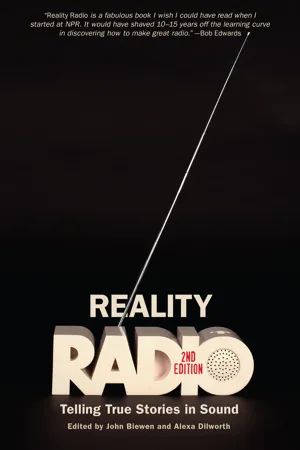
eBook - ePub
Reality Radio, Second Edition
Telling True Stories in Sound
- 272 pages
- English
- ePUB (mobile friendly)
- Available on iOS & Android
eBook - ePub
Reality Radio, Second Edition
Telling True Stories in Sound
Finding the Poetry
Voices have a poetry that is
Unlike
Just
Meaning
The way people speak
With pauses,
Stutters, stumbles, abrupt—
Eruptions and
. . . pauses . . .
And Undertones that underlie the words, raised and
Low volumes
High and Bass pitch
When people are excited or tired or perhaps
. . . lying or telling the truth . . .
This all makes a difference in the context
The meaning
Old/young/rural/urban/male/female/quiet/loud
All the variances and nuances give depth and texture to the words they speak.
The flow, the rhythms.
The way we over—
—lap in conversation and fill in each other’s sentences.
I love listening to people speak.
WHEN I STARTED PRODUCING radio in college, I had no idea I loved sound. I knew I loved writing my own words or being onstage and speaking incredible words written by classical playwrights. But sound? At the time I was a theater major and wanted to find a way to support my acting habit. So I changed my major to journalism and learned how to write for print. I volunteered at my local community radio station and learned the most important an surprising thing in my career.
I loved sound.
Recording sound.
Editing sound.
Interviewing people I’d never have the guts to talk to without a tape deck and mic. Putting together elaborate radio theater pieces by doing live mixes on turntables, cart machines, and reel-to-reels. And using the same techniques to create personal and sound-rich documentaries. At the heart of some wild productions were the sounds of words and of voices structured as in a Shakespearean play, with soliloquies and a variety of scenes with characters speaking their lines, sometimes in rhyme and oft-times in improvised free verse.
For the Peabody Award–winning Crossing East series on Asian American history, I had an opportunity to interview people of all ages and ethnic backgrounds.
In Hawaii, I interviewed a lot of older people about the language developed by plantation workers immigrating from Asia and Europe to Hawaii. The Hawaiians call it “pidgin” and delighted in describing it for me. But nothing could describe it better than the way they converse with each other.
In “Pidgin English” from the Crossing East series, Domingo and Espy, a Filipino couple in their seventies discuss what they had for breakfast. There is a rhythm to the words, it’s musical:
DOMINGO: This morning I had egg and bah-cone [bacon].
ESPY: Egg and bah-cone?
I had finafle [pineapple] juice.
And then I went stirring with the stirrer,
you know that look kind of like the whipping kind.
Yeah, I whip ’em.
DOMINGO: You whip ’em good.
ESPY: I whip ’em good. [They laugh.]
This poetic dialogue is priceless. I listen for gems like these when I’m interviewing and find a way to use them in my pieces—moments when a bland interview breaks out into poetry.
ESPY: Yeah, I whip em.
DOMINGO: You whip ‘em good.
You can hear the poetry in even something as potentially dry as a museum tour. I took a tour with Carolyn Micnihimer, the curator of a tiny turn-of-the-century Chinese herbalist’s shop turned museum in eastern Oregon. She was showing me a massive metal door.
Our front door, as you can see, was well-locked.
as well as a wooden bolt that went across to open it from the inside.
And the lock . . . [she bolts the lock] . . . also was lined with metal. . . .
And basically they did have fears of the outside,
Whether it was American or not.
We do have one bullethole in the door.
They say the Americans would shoot up Chinatown once in a while on Saturday night
and have not a malicious time
but a scaring time
for the Chinese.
“They did have fears of the outside. . . .” Who speaks like that anymore? I knew Micnihimer, the curator, was a gold mine because (1) she was in her eighties and had the wonderful textured voice of older people, (2) the way she spoke was reminiscent of a far-off time, (3) she almost rhymed at times. While editing and mixing this cut, I always joined in with the last three lines because they were so musical and quite thematic to the story about an herbalist living on the American frontier.
. . . not a malicious time
but a scaring time
for the Chinese.
Strange as it may sound, Shakespeare’s iambic pentameter is the closest rhythm to everyday English speech. People speak in poetic rhythm. You just have to listen for it and try to keep their form when you produce a piece.
One young woman I interviewed, Miracle Draven, talked so fast it made my head swim. But as soon as I heard her I knew she was a natural for radio. It didn’t hurt that she had a compelling story.
“Miracle on the Streets” is a documentary about a homeless girl who was kicked out of her family house for being gay. Miracle lived four years on the streets and became a crystal meth addict. She turned to dealing and prostitution to pay for her habit. She talked in run-on sentences, with repetitions and swift shifts of thought. To intensify the feeling I got from talking with Miracle, I overlapped some of her monologue, repeating only a few of her phrases, and underscored it with a hip-hop beat to heighten the poetry. (The asterisk indicates the phrase that overlaps here.)
You don’t eat when you’re on crystal . . .*
. . . Your appetite is suppressed.
That’s why you get so skinny . . .
. . . Cuz you’re really—you’re really—you’re really just not hungry . . .
You don’t even notice that you’re not hungry—you’re just not hungry . . .
. . . I think my number one thing that I always ate was Pepsi, always Pepsi . . .
. . . Star Crunch, which is a Little Debbie snack, costs 25 cents . . .
. . . Cuz I can’t spend my dealer’s money, so I have to spange my own money . . .
That was like all I ate.
That was like all I ate.
That was like all I ate . . .
With the musical beat underneath, this little speech became a song. There are beats and rhythms to how people “speak the speech, I pray you trippingly on the tongue . . .” (as Hamlet says). When you spend a lot of time editing recordings of people, you begin to hear the beats of their speech.
That was like all I ate.
That was like all I ate.
That was like all I ate . . .
I found that if I was holding a microphone, strangers would tell me the most intimate things—the most amazing stories. The best interviews are those that could easily be turned into a play or a film. When I asked Miracle what it was like to be a prostitute selling herself so she could buy drugs, what she told me could easily be turned into a soliloquy for the stage.
It’s not like you’re getting off. It’s not.
Dude, I was not even there.
You know, I’m thinking where am I going to go to find that dope?
Is this drug dealer home?
Ooh, wait, do I have that one drug dealer’s number?
It’s not like I was attracted to him or anything.
He didn’t have to be cute.
He didn’t have to be skinny or whatever, and be big and buff.
I wasn’t looking at that.
I’m only looking at your wallet,
and that’s a really horrible woman to turn into.
Dialogue can further intensify a scene. When Miracle met up with her friend, Teacup, a butch teen girl, they took me into a bathroom at the public library to show me how they prepared crystal meth in the stalls. They both were fighting the urge to sell drugs again.
MIRACLE: My biggest thing right now is I keep wanting to sell it to make more money. I don’t want to use ...
Table of contents
- Cover Page
- Title Page
- Copyright Page
- Dedication
- Contents
- Foreword
- Introduction
- Are We on the Air?
- That Jackie Kennedy Moment
- Talking to Strangers
- Variations in Tape Use and the Position of the Narrator: Alix Spiegel’s Practical Guide to Different Radio Techniques
- No Holes Were Drilled in the Heads of Animals in the Making of This Radio Show
- Harnessing Luck as an Industrial Product
- One Story, Week by Week
- Story Time at the Azteca Boxing Club
- Covering Home
- What Did She Just Say?
- Out There
- Cigarettes and Dance Steps
- Unreality Radio
- Finding the Beats
- Finding the Poetry
- Everyone around You Has a Story the World Needs to Hear
- Diaries and Detritus: One Perfectionist’s Search for Imperfection
- Living History
- The Voice and the Place
- Crossing Borders
- Adventurers in Sound
- Salt Is Flavor and Other Tips Learned While Cooking
- Afterword: Listen
- About the Contributors
- Editors’ Note: Hearing the Work
- Acknowledgments
Trusted by 375,005 students
Access to over 1.5 million titles for a fair monthly price.
Study more efficiently using our study tools.
Frequently asked questions
Yes, you can cancel anytime from the Subscription tab in your account settings on the Perlego website. Your subscription will stay active until the end of your current billing period. Learn how to cancel your subscription
No, books cannot be downloaded as external files, such as PDFs, for use outside of Perlego. However, you can download books within the Perlego app for offline reading on mobile or tablet. Learn how to download books offline
Perlego offers two plans: Essential and Complete
- Essential is ideal for learners and professionals who enjoy exploring a wide range of subjects. Access the Essential Library with 800,000+ trusted titles and best-sellers across business, personal growth, and the humanities. Includes unlimited reading time and Standard Read Aloud voice.
- Complete: Perfect for advanced learners and researchers needing full, unrestricted access. Unlock 1.5M+ books across hundreds of subjects, including academic and specialized titles. The Complete Plan also includes advanced features like Premium Read Aloud and Research Assistant.
We are an online textbook subscription service, where you can get access to an entire online library for less than the price of a single book per month. With over 1.5 million books across 990+ topics, we’ve got you covered! Learn about our mission
Look out for the read-aloud symbol on your next book to see if you can listen to it. The read-aloud tool reads text aloud for you, highlighting the text as it is being read. You can pause it, speed it up and slow it down. Learn more about Read Aloud
Yes! You can use the Perlego app on both iOS and Android devices to read anytime, anywhere — even offline. Perfect for commutes or when you’re on the go.
Please note we cannot support devices running on iOS 13 and Android 7 or earlier. Learn more about using the app
Please note we cannot support devices running on iOS 13 and Android 7 or earlier. Learn more about using the app
Yes, you can access Reality Radio, Second Edition by John Biewen, Alexa Dilworth, John Biewen,Alexa Dilworth in PDF and/or ePUB format, as well as other popular books in Languages & Linguistics & Communication Studies. We have over 1.5 million books available in our catalogue for you to explore.