There was a time when young people were the most passionate participants in American democracy. In the second half of the nineteenth century — as voter turnout reached unprecedented peaks — young people led the way, hollering, fighting, and flirting at massive midnight rallies. Parents trained their children to be “violent little partisans,” while politicians lobbied twenty-one-year-olds for their “virgin votes”—the first ballot cast upon reaching adulthood. In schoolhouses, saloons, and squares, young men and women proved that democracy is social and politics is personal, earning their adulthood by participating in public life.
Drawing on hundreds of diaries and letters of diverse young Americans — from barmaids to belles, sharecroppers to cowboys — this book explores how exuberant young people and scheming party bosses relied on each other from the 1840s to the turn of the twentieth century. It also explains why this era ended so dramatically and asks if aspects of that strange period might be useful today.
In a vivid evocation of this formative but forgotten world, Jon Grinspan recalls a time when struggling young citizens found identity and maturity in democracy.
eBook - ePub
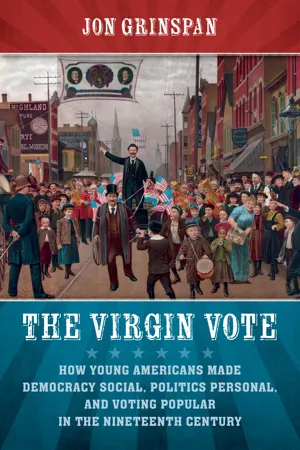
The Virgin Vote
How Young Americans Made Democracy Social, Politics Personal, and Voting Popular in the Nineteenth Century
- 264 pages
- English
- ePUB (mobile friendly)
- Available on iOS & Android
eBook - ePub
The Virgin Vote
How Young Americans Made Democracy Social, Politics Personal, and Voting Popular in the Nineteenth Century
About this book
Trusted by 375,005 students
Access to over 1.5 million titles for a fair monthly price.
Study more efficiently using our study tools.
Information
Chapter 1: Violent Little Partisans
It began at home. For Susan Bradford, home was a green-roofed, whitewashed country mansion at the center of the Pine Hill Plantation. There she lived with her father, mother, extended family, and 142 enslaved “servants.” Beyond the mansion and slave cabins stood 3,000 acres of the finest red land in Florida, planted with flower gardens, fields of cotton, and dense stands of pine.1
Susan first discovered the mystery as an eight-year-old in January 1855. Though the weather was unusually cold for Leon County, her father and several local leaders gathered outside for a hushed conference in a frosted rose garden.2 Always a curious little detective, brown-eyed, square-jawed Susan watched through a low window. She did not know that the men were all prominent southern Democrats, sharing conspiracy theories about abolitionist agitators. She knew only that “there is something wrong somewhere” and wished, more than anything, that an adult would explain “what they were talking about.”3
A few months later “something funny happened.” Susan watched as a visiting northerner gave her father a copy of Uncle Tom’s Cabin. She noted the way his face flushed when he recognized the cover. Over the next day he read it repeatedly. Father and daughter sat together in Pine Hill’s ornate library, Susan on the couch, scribbling in her diary, her father stiff in a chair, his sad brown eyes scanning Harriet Beecher Stowe’s abolitionist epic. When the guest approached and asked what he thought of the gift, the dignified Dr. Bradford, the master of Pine Hill, with his proud, mournful face and slicked gray hair, carefully placed the book in the snapping fireplace. Bradford looked his guest in the eye as the pages blackened and declared the coals “the best place for it.”4
Susan was puzzled. “I wanted to read that book myself,” she wrote in her diary that night, “but it must have been a bad book for Father, who loves books, to have treated it that way.”5
Even the woods seemed to contain adult secrets. Her nanny, an enslaved woman named Fannie, began to whisper terrifying rumors about an “Abolition crew” lurking nearby.6 Susan did not know what “abolition” meant but worried that someone planned to hurt her father. Another slave, an older man known as “Uncle Kinchen,” told her a confusing story about accompanying her grandpa on a trip north, where they observed a gathering of abolitionists. Whatever Fannie and Kinchen intended when they told Susan these rumors, they had the effect of terrifying the girl. She had nightmares that abolitionists—monstrous “devils” with horns and cloven feet—“were after me,” chasing Susan through the Florida pines.7
Soon she began to push her parents to explain the ominous references to “abolitionists” and “Republicans.” One evening she awoke from a nap on the parlor sofa to hear her mother and uncle anxiously discussing the North’s plans “to make trouble for us.” Susan listened for a while, pretending to sleep, but could not contain her nagging curiosity. She bolted up and blurted, “Oh, uncle Daniel, please tell me all about it!” Her mother sent her straight to bed.8 All she knew was that “there is trouble in the air but I cannot find out just what it is.”9
Susan filled her precocious diary with questions that intrigued most American children. Sons and daughters observed adult political passions long before they understood what they meant. From an early age they learned that their family supported a party, or sensed a rivalry with another movement, yet grasped the ideological differences between these organizations only when they had grown much older. Adults taught children to ape their politics, sing campaign songs, and jeer the rival party. It took years of such instruction before teens began to read the partisan press, and even longer before young men could legally vote. The American political nation did not emerge, fully formed, at age twenty-one. By the time they cast their first ballots, many virgin voters were veterans of at least a decade of popular democracy.
Politics seeped into children’s consciousness in a sloppy manner. Most experienced an education as haphazard as Susan Bradford’s. They overheard a debate at the dinner table or nodded through a confusing lecture from a towering adult, which piqued their interest but left little knowledge.10 Elders who warned curious children to stay out of worldly affairs only heightened the mystery, especially for determined kids like Susan. This untidy education taught many American children to view politics as an alluring hallmark of adulthood.
Adults knew a secret. Americans could never agree on how to formally introduce partisanship to their children, so they framed their politics as a slowly unfolding mystery.11 Children learned new clues at each stage of their passage into the public world. At home, kids eavesdropped on political debates and took note of their parents’ heroes and villains. In the semipublic realm of the classroom, children puzzled over the slogans chanted by older students and the biases of their teachers. By ten or twelve, boys and girls were allowed to join in rallies, parades, bonfires, and barbecues. Eventually some found their way into smoke-filled party headquarters, running errands for bosses. Along the way, boys and girls pieced together evidence about what politics actually meant.
I Know a Little Bit Now
“My earliest recollections are of endless political discussions,” Sally McCarty reminisced about her childhood in Leesburg, Virginia, in the 1840s. Like Susan Bradford, Sally grew up with political talk, but her folks let her in on the secret. The stridently Whig McCarty family indulged Sally, an only child with few playmates, letting her “sit up with my elders when I should have been in bed.”12
From that perch Sally absorbed the exploding political culture of the early 1840s. She claimed to be “tolerably conversant with the great questions of the day” by age seven, when she led a squad of little girls in a torchlight procession for William Henry Harrison. She learned to sew by watching ladies stitch Harrison banners, a new form of political expression for women in Virginia.13 And she felt, viscerally if superficially, the ups and downs of partisan commitment. Sally remembered refusing to dance “the hop” with a boy at a party one late summer evening in 1841, claiming she was upset because “Tyler had vetoed the Bank Bill,” whatever that was.14
Children like Sally did not know the difference between the organizations their parents loved and hated. They did not know that the Democrats were the oldest party in the country, formed in the 1820s as an alliance of aggrieved common men in the North, planters in the South, and frontiersmen in the West. They did not comprehend the party’s fundamental belief that class conflict shaped American politics or its fear that a big government would privilege wealthy merchants or meddle with slavery.15
Nor did they understand the motivations of the Whigs, organized to battle Democrats in the 1830s. Whigs rejected the Democrats’ belief in social conflict; they wanted an active federal government to help build infrastructure, stabilize the economy, and encourage harmony across class and region.16 These children did not understand the dynamics that led the northern Whig Party to give way to the Republicans in the 1850s, joined by marginalized Democrats and the antislavery fringe. This new movement wanted to assert the northern majority’s control over the country, halt the spread of slavery, and expand the federal government. Children born to parents who backed third parties—Antimasons, Free Soilers, Know Nothings, or Populists—had an even weaker grasp of their parents’ beliefs. No wonder so many Americans, young and old, were deeply confused about the platforms of their preferred party.17
Sally McCarty’s erratic education was typical. For most children, partisanship was overheard before it was taught and performed before it was understood. Sometimes kids decoded the information themselves, as in Susan Bradford’s case, while others had it thrust upon them. Elders led the way, though with so many early deaths and dislocations, this might be a stepfather, an aunt, or a talkative neighbor.18 Historians have long acknowledged the link between family background and party allegiance, but few have looked inside the home, at the political socialization of seven- or eleven-year-olds, to uncover the fitful yet abiding mechanisms that taught boys and girls to be Republicans or Democrats.19
Adults imbued children’s lives with partisanship from the very start. Infants were “born a Whig” or “drank in Democracy with their mother’s milk.”20 Some parents proclaimed their zeal by naming their sons for favored leaders. There were plenty of little George Washington ——s in the Early Republic, but this tradition peaked with the high tide of political enthusiasm and fell off suddenly around 1900. Starting in the 1830s, Andrew Jackson Smiths and Henry Clay Joneses proliferated in the census rolls. The popularity of such names often said more about a parent’s views than it did about the success of the namesake. There were, for instance, twenty-five times more little boys named Rutherford in 1880 than there had been in 1870.21 Children with such names carried the marker of partisanship from birth.
More children began their political education, like Sally and Susan, by eavesdropping. In a society with little separation by age, many boys and girls happened to be present when their elders talked politics. As “the main subject of conversation,” adults often discussed upcoming elections, especially when traveling with strangers, and few noticed their children listening in on the deck of a steamboat or while lodging at an inn.22
Once they observed adults’ intense interest, many kids wanted in on the fun. The writer and activist Lydia Maria Child recalled a bright little five-year-old girl who made it her mission to “to keep me booked up” on events in the 1856 election. Whenever the girl overheard political news she would dash over to Child’s house, holler something like “Miss Child! Pennylvany’s all right!” under her window, and then skip away again.23
Children of politically divided households often found themselves drawn into adults’ disagreements. One Georgia girl, sick of her family’s bickering, wished there was no such thing as politics, “for they are a never-ending source of warfare in the house.”24 Overheard debates filled children with misconceptions. Growing up in the late 1830s, Andrew Dickson White watched his Whig father quarrel fiercely with his maternal grandfather, an old-school Jeffersonian Democrat. The two stubborn men sent each other competing pamphlets, arguing ceaselessly over Martin Van Buren’s plan for an “Independent Sub-Treasury.”25 Like Sally McCarty, the eight-year-old White sided with his dad. He parroted his father, declaring that the Van Buren plan was “the most wicked outrage ever committed by a remorseless tyrant,” but later admitted that he had “not the remotest idea” what a Sub-Treasury was.26
This confused political education, all outrage and no instruction, led to a moment of genuine terror for poor Andrew. Early one April morning in 1841, his mother shook him awake. She told him, breathlessly, that President William Henry Harrison had suddenly died. The eight-year-old White panicked. His parents’ hero was dead, and he anxiously wondered, “What would become of us?” No one, it turned out, had told White that there was a vice president.27
Many children were left to puzzle out their parents’ politics, which could introduce real adult crises, as the elderly Alabama sharecropper Ned Cobb explained to interviewers in the mid-twentieth century. Ned’s dad, Hayes Cobb, had been born a slave but was emancipated at age fifteen. Ned recalled watching his father head off to vote with other black men throughout Reconstruction. So what if he sometimes sold his vote for a hunk of side meat or a sack of flour? “My daddy was a man that voted,” bragged his still-proud son nearly a century later.28 Then one day Hayes Cobb stopped voting. Instead, he spent Election Day hunting in the nearby swamp or hanging around their cabin. Ned “never did hear my daddy say nothing ’bout losin’ the vote. But I believe with all my heart he knowed what it meant...
Table of contents
- Cover Page
- Title Page
- Copyright Page
- Contents
- Introduction
- Chapter 1: Violent Little Partisans
- Chapter 2: The Generous Ambitions of Youth
- Chapter 3: My Virgin Vote
- Chapter 4: The Way for a Young Man to Rise
- Chapter 5: Every One Is Fifty
- Conclusion
- Afterword
- Appendix
- Notes
- Bibliography
- Acknowledgments
- Index
Frequently asked questions
Yes, you can cancel anytime from the Subscription tab in your account settings on the Perlego website. Your subscription will stay active until the end of your current billing period. Learn how to cancel your subscription
No, books cannot be downloaded as external files, such as PDFs, for use outside of Perlego. However, you can download books within the Perlego app for offline reading on mobile or tablet. Learn how to download books offline
Perlego offers two plans: Essential and Complete
- Essential is ideal for learners and professionals who enjoy exploring a wide range of subjects. Access the Essential Library with 800,000+ trusted titles and best-sellers across business, personal growth, and the humanities. Includes unlimited reading time and Standard Read Aloud voice.
- Complete: Perfect for advanced learners and researchers needing full, unrestricted access. Unlock 1.5M+ books across hundreds of subjects, including academic and specialized titles. The Complete Plan also includes advanced features like Premium Read Aloud and Research Assistant.
We are an online textbook subscription service, where you can get access to an entire online library for less than the price of a single book per month. With over 1.5 million books across 990+ topics, we’ve got you covered! Learn about our mission
Look out for the read-aloud symbol on your next book to see if you can listen to it. The read-aloud tool reads text aloud for you, highlighting the text as it is being read. You can pause it, speed it up and slow it down. Learn more about Read Aloud
Yes! You can use the Perlego app on both iOS and Android devices to read anytime, anywhere — even offline. Perfect for commutes or when you’re on the go.
Please note we cannot support devices running on iOS 13 and Android 7 or earlier. Learn more about using the app
Please note we cannot support devices running on iOS 13 and Android 7 or earlier. Learn more about using the app
Yes, you can access The Virgin Vote by Jon Grinspan in PDF and/or ePUB format, as well as other popular books in History & North American History. We have over 1.5 million books available in our catalogue for you to explore.