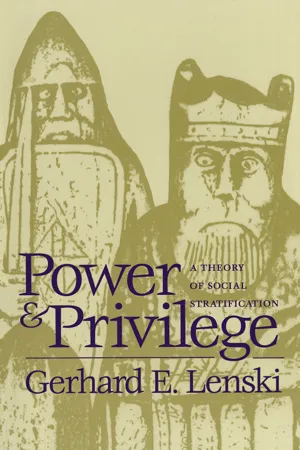
Power and Privilege seeks to answer the central question of the field of social stratification: Who gets what and why? Using a dialectical view of the development of thought in the discipline, Gerhard Lenski describes the outlines of an emerging synthesis of theories. He shows that perspectives as diverse and contradictory as those of Marx, Spencer, Sumner, Veblen, Mosca, Pareto, Sorokin, Parsons, and Dahrendorf are parts of an evolving and systematic body of theory.
- 525 pages
- English
- ePUB (mobile friendly)
- Available on iOS & Android
eBook - ePub
About this book
Information
1. The Problem: Who Gets What and Why?
“Curiouser and curiouser!” cried Alice.
Lewis Carroll
Lewis Carroll
Soon after President Kennedy’s election in the fall of 1960, Americans were again reminded of one of the curious features of their national life. When the President selected Robert S. McNamara for the post of Secretary of Defense, the press reported the substantial financial sacrifice the nominee would be forced to make. While still only a vice-president of the Ford Motor Company, McNamara received salary and other compensation in excess of $400,000 a year.1 With his promotion to the presidency of the company (just prior to his appointment as Secretary of Defense) he was certain to make substantially more. By contrast, as Secretary of Defense for the nation he received a salary of only $25,000, or roughly 5 per cent of what he would have received as president of the Ford Motor Company.
Few Americans seem to have been greatly surprised by these facts, and fewer still were shocked or disturbed. Like the natives of Lewis Carroll’s remarkable Wonderland, they saw nothing strange or incongruous in their surroundings.
Yet if one reflects on this matter, one cannot help being impressed by its curious quality. The same man with the same skills and talents moves to a post of far greater importance, and undoubtedly a more trying one, and finds his compensation reduced 95 per cent. In his new position, where he bears much of the burden of the defense of the nation, he receives a salary no greater than that of thousands of minor executives in industry.
If this were but an isolated instance, we might regard it as an interesting oddity, a curious exception to the rule, and think no more about it. But such is not the case. Even a superficial examination of American life reveals innumerable instances in which the rewards men receive bear little or no relation to the value of the services they render or the sacrifices they make in their performance. Many substantial fortunes have been built in a few short years by speculation in stocks and real estate, often with borrowed funds, but the public record reveals no instance in which a great fortune was ever established by a lifetime of skilled and conscientious labor in the foundries, shops, or mills of this country. Entertainers who reach the top in their field often receive several hundred thousand dollars a year. By contrast, the top pay for public school teachers, regardless of ability, is not greatly in excess of $10,000 a year. Playboys like John Jacob Astor III live lives of ease and indolence, while the vast majority of those who do the work which makes this way of life possible struggle to make ends meet.
What is the explanation of this situation which, like Wonderland, grows curiouser and curiouser the more we examine it? What principles govern the distribution of rewards in our society and in others? What determines the magnitude of the rewards each man receives?
These questions have long been argued and debated. In modern times they have become the heart and core of a special field of study within sociology known as “social stratification.” This label has been unfortunate for it encourages a seriously oversimplified view of modern social structure. Even worse, it fosters an excessive concern with questions of structure at the expense of more basic problems concerning the processes which generate these structures.
This field might better be identified as the study of the “distributive process.” Virtually all the major theorists in the field, regardless of their theoretical and ideological biases, have sought to answer one basic question: Who gets what and why?2 This is the question which underlies all the discussions of classes and strata and their structural relationships, though in some recent empirical research it seems to have been almost forgotten.
The chief aim of this book is to answer this basic question and the host of secondary questions to which it gives rise. Since this is not the first attempt to do this, we shall begin by reviewing the various theories already propounded to see what light they shed on the problem. In doing this, we shall attempt to see whether there is not some basic pattern to the development of thought in this field—a pattern which, once identified, can provide a foundation for our entire inquiry.
Early Pre-Christian Views
Where and when men first began to reflect on the nature of the distributive process and the causes of inequality is anybody’s guess. The fact of inequality is almost surely as old as the human species. No known society has ever had a completely egalitarian social system. From primitive Stone Age communities to complex industrial societies, inequality has always been present, though its forms and degree vary considerably.
In the simplest societies in the world today, the fact of inequality is taken for granted, as are other familiar features of existence. Undoubtedly this was true in prehistoric societies. The belief that conditions need not be as they are is characteristic of socially and technologically more advanced societies.
Some of the earliest records of thought on this subject are found in the writings of the early Hebrew prophets who lived approximately 800 years before Christ. In the writings of such men as Amos, Micah, and Isaiah we find repeated denunciations of the rich and powerful members of society. They were concerned not merely with the use of wealth and power, but, more significantly, with the means by which they had been acquired. A good example of this was Micah’s vigorous indictment of the leading citizens of his day:
Hear this, you heads of the house of Jacob
and rulers of the house of Israel,
who abhor justice
and pervert all equity,
who build Zion with blood
and Jerusalem with wrong . . .
Woe to those who devise wickedness
and work evil upon their beds!
When the morning dawns they perform it,
because it is in the power of their hand.
They covet fields and seize them;
and houses, and take them away;
they oppress a man and his house,
a man and his inheritance.
Therefore thus says the Lord:
Behold, against this family I am devising evil. . . .3
and rulers of the house of Israel,
who abhor justice
and pervert all equity,
who build Zion with blood
and Jerusalem with wrong . . .
Woe to those who devise wickedness
and work evil upon their beds!
When the morning dawns they perform it,
because it is in the power of their hand.
They covet fields and seize them;
and houses, and take them away;
they oppress a man and his house,
a man and his inheritance.
Therefore thus says the Lord:
Behold, against this family I am devising evil. . . .3
Elsewhere the prophet describes the rich men of Israel as “full of violence,” the princes and judges as asking for bribes, and the merchants as using a “bag of deceitful weights.” All these practices are described as contrary to the will of the Lord, and as perversions which will lead to the nation’s destruction.
In India, also, men gave thought to the basis of social inequality long before the Christian era. However, the dominant point of view was very different from that expressed by Micah, though here, too, the matter was viewed in a religious perspective. In the introduction to The Laws of Manu, compiled by Hindu priests about 200 B.C., we find an account of the creation of the world. In contrast to the Biblical account, it states that social inequalities were divinely ordained for the good of the world. In words ascribed to Manu, the great lawgiver:
For the sake of the prosperity of the worlds, he [the Lord, the divine Self-existent] caused the Brahmana, the Kshatriya, the Vaisya, the Sudra to proceed [in turn] from his mouth, his arms, his thighs, and his feet. . . . But in order to protect this universe, He, the most resplendent one, assigned separate [duties and] occupations to those who sprang from his mouth, arms, thighs, and feet.
To Brahmana he assigned teaching and studying [the Veda], sacrificing for their own benefit and for others, giving and accepting [of alms]. The Kshatriya he commanded to protect the people . . . The Vaisya to tend cattle . . . One occupation only the Lord prescribed to the Sudra, to serve meekly even these [other] three castes.4
In these strikingly divergent views of Micah and the priestly compilers of The Laws of Manu, we find the essential elements of two points of view concerning social inequality which have dominated men’s thinking from ancient times to the present. One is essentially supportive of the status quo, viewing the existing distribution of rewards as just, equitable, and frequently also inevitable. The other is highly critical, denouncing the distributive system as basically unjust and unnecessary.
In the pages which follow, I shall refer to the first of these viewpoints as the “conservative thesis” and the second as the “radical antithesis.” These terms seem fitting since historically the major controversies over social inequality have been essentially dialogues between proponents of these two schools of thought. One may question the wisdom of labeling the conservative position the thesis and the radical the antithesis, since this suggests that one predates the other. Actually, logic and what evidence there is suggest that neither viewpoint is significantly older than the other. Apparently both have developed side by side with each expression of either point of view stimulating the development of the other.
Over the centuries these two views of inequality have been stated again and again by scholars and laymen alike. Though the form of the argument changes somewhat, the essential elements remain, as social inequality is condemned as unjust, unwarranted, and unnecessary, and defended as just, equitable, and essential. Neither view has ever achieved a monopoly over the minds of men in any society. In ancient Israel it is clear that large numbers of the prophets’ contemporaries did not agree with them. A substantial proportion of the people continued to think of the monarchy as a divinely ordained institution, and probably had no difficulty in extending this view to other institutions which fostered inequality. In India the thesis of the orthodox Brahmin priests was under continuing attack for centuries from heretical religious movements such as Jainism and Buddhism, both of which contained distinct egalitarian tendencies.
The Greek philosophers of the classical period provide us with our first glimpses of the dialectic in action. In his famous work on politics, Aristotle deliberately sought to refute the radical proposals of men such as Plato and Phaleas of Chalcedon, both of whom advocated the communal ownership of property. Although Aristotle did not defend all aspects of the existing social order as ideal or even as just, he was a vigorous supporter of the basic institutions undergirding the system of social inequality. He defended not only the institution of private property, but also the institution of slavery. In speaking of the latter, Aristotle asserted:
It is clear that some men are by nature free, and others slaves, and that for these latter slavery is both expedient and right.5
While he did not deny that some men who should be free have been enslaved by force and violence, this had no bearing on the justice and propriety of the institution itself.
Phaleas and Plato, by contrast, did not hesitate to attack the basic institutional structure of society. Phaleas advocated the redistribution of land on an egalitarian basis. Plato’s proposals were even more radical, especially in The Republic. Here he advocated the communal ownership of all forms of property, and the establishment of a ruling class which would have even wives and children in common. This class would be selected on the basis of moral virtue, intellect, and love of knowledge. The central thesis of The Republic is summed up in one short passage:
Until philosophers are kings, or the kings and princes of this world have the spirit and power of philosophy, and political greatness and wisdom meet in one, and those commoner natures who pursue either to the exclusion of the other are compelled to stand aside, cities will never have rest from their evils. . . .6
Plato serves as a useful reminder that egalitarianism is not an essential feature of the radical antithesis. Some radicals, like Phaleas, have been egalitarians; perhaps the majority have been. Others, like Plato, have not objected to social inequality per se, but rather to the specific institutional bases on which the existing system of inequality rested. In Plato’s Republic, equality would extend only to material possessions and presumably also to opportunity for advancement (though on this latter point, Plato’s treatment tends to be self-contradictory).7 Honor and power would be reserved for the ruling class of guardians.8 Basically, Plato exemplifies the elitist position within the radical camp. Radical elitists, like egalitarians, are critical of the existing system of allocating rewards but, unlike the egalitarians, find nothing objectionable in social inequality per se. In general, this elitist branch of the radical tradition has attracted scholars and intellectuals; egalitarianism, by contrast, has had a greater appeal for the masses of common people, the workers, farmers, and peasants.
Christian Views from Paul to Winstanley
It is not our purpose here to trace each and every expression of thesis and antithesis from ancient times to the present. This would require an entire book in itself and would provide only a limited understanding of the problem of who gets what and why. Instead, our aim is to direct attention to a few of the more important expressions of these two points of view so as to provide the necessary background for the analysis which follows.
In its earliest phases, Christianity represented an interesting mixture of both radical and conservative elements, undoubtedly a reflection of the fact that social inequality per se was not of major concern to Jesus and his early followers. Nevertheless, their teachings and actions are by no means wholly irrelevant.
The goals which Jesus set before men, and his criticisms of the popular goals of his day, reflect a clear rejection of the latter. The communism of the early Church in Jerusalem clearly constituted an implicit criticism of the inequalities present in society. So, too, does the letter of James, thought by many to be a brother of Jesus and the first bishop of the Church in Jerusalem. In it he criticizes the early Christians for showing greater deference to the “man with gold rings and fine clothing” than to the poor man in shabby clothing.
But in the writings of St. Paul, who was destined to have such a profound influence on later Christian thought, a much more conservative spirit is evident. In at least four different places in his letters to the early churches he specifically enjoined slaves to obey their masters on the grounds that this is a legitimate expectation of their masters and presumably one sanctioned by God.9 St. Peter expressed the same thought in one of his letters. The frequency of these statements suggests that primitive Christianity tended to foster radical notions among many of the converts from the depressed classe...
Table of contents
- Cover Page
- Power and Privilege
- Copyright Page
- Dedication
- Preface to the Paperback Edition
- Preface
- Contents
- 1. The Problem: Who Gets What and Why?
- 2. Man and Society
- 3. The Dynamics of Distributive Systems
- 4. The Structure of Distributive Systems
- 5. Hunting and Gathering Societies
- 6. Simple Horticultural Societies
- 7. Advanced Horticultural Societies
- 8. Agrarian Societies: Part I
- 9. Agrarian Societies: Part II
- 10. Industrial Societies: Part I
- 11. Industrial Societies: Part II
- 12. Industrial Societies: Part III
- 13. Retrospect and Prospect
- Bibliography
- Author Index
- Subject Index
Trusted by 375,005 students
Access to over 1.5 million titles for a fair monthly price.
Study more efficiently using our study tools.
Frequently asked questions
Yes, you can cancel anytime from the Subscription tab in your account settings on the Perlego website. Your subscription will stay active until the end of your current billing period. Learn how to cancel your subscription
No, books cannot be downloaded as external files, such as PDFs, for use outside of Perlego. However, you can download books within the Perlego app for offline reading on mobile or tablet. Learn how to download books offline
Perlego offers two plans: Essential and Complete
- Essential is ideal for learners and professionals who enjoy exploring a wide range of subjects. Access the Essential Library with 800,000+ trusted titles and best-sellers across business, personal growth, and the humanities. Includes unlimited reading time and Standard Read Aloud voice.
- Complete: Perfect for advanced learners and researchers needing full, unrestricted access. Unlock 1.5M+ books across hundreds of subjects, including academic and specialized titles. The Complete Plan also includes advanced features like Premium Read Aloud and Research Assistant.
We are an online textbook subscription service, where you can get access to an entire online library for less than the price of a single book per month. With over 1.5 million books across 990+ topics, we’ve got you covered! Learn about our mission
Look out for the read-aloud symbol on your next book to see if you can listen to it. The read-aloud tool reads text aloud for you, highlighting the text as it is being read. You can pause it, speed it up and slow it down. Learn more about Read Aloud
Yes! You can use the Perlego app on both iOS and Android devices to read anytime, anywhere — even offline. Perfect for commutes or when you’re on the go.
Please note we cannot support devices running on iOS 13 and Android 7 or earlier. Learn more about using the app
Please note we cannot support devices running on iOS 13 and Android 7 or earlier. Learn more about using the app
Yes, you can access Power and Privilege by Gerhard E. Lenski in PDF and/or ePUB format, as well as other popular books in Social Sciences & Sociology. We have over 1.5 million books available in our catalogue for you to explore.