Most histories of the American South describe the conflict between evangelical religion and honor culture as one of the defining features of southern life before the Civil War. The story is usually told as a battle of clashing worldviews, but in this book, Robert Elder challenges this interpretation by illuminating just how deeply evangelicalism in Methodist, Baptist, and Presbyterian churches was interwoven with traditional southern culture, arguing that evangelicals owed much of their success to their ability to appeal to people steeped in southern honor culture. Previous accounts of the rise of evangelicalism in the South have told this tale as a tragedy in which evangelicals eventually adopted many of the central tenets of southern society in order to win souls and garner influence. But through an examination of evangelical language and practices, Elder shows that evangelicals always shared honor’s most basic assumptions.
Making use of original sources such as diaries, correspondence, periodicals, and church records, Elder recasts the relationship between evangelicalism and secular honor in the South, proving the two concepts are connected in much deeper ways than have ever been previously understood.
eBook - ePub
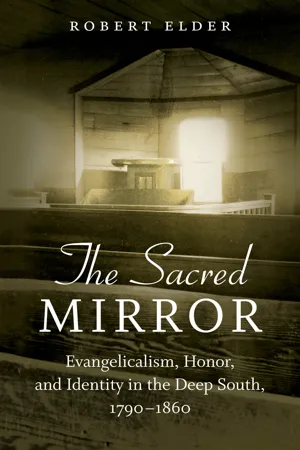
The Sacred Mirror
Evangelicalism, Honor, and Identity in the Deep South, 1790-1860
- 288 pages
- English
- ePUB (mobile friendly)
- Available on iOS & Android
eBook - ePub
About this book
Information
Topic
Theology & ReligionSubtopic
North American HistoryChapter One: True Honor Comes from God Alone
Evangelicalism and the Language of the Alternative Community
How can ye believe, which receive honour of one another, and seek not the honour that cometh from God only?
—JOHN 5:44, KJV
In an address to the undergraduates of South Carolina College in the 1840s, the Reverend James Henley Thornwell described the task that lay before him that day as college chaplain. “I shall feel that I have accomplished much if I have disarmed you of your prejudices against the evangelical scheme,” Thornwell proclaimed. “Never, never be ashamed of the Gospel,” he warned, “never be ashamed of a crucified Saviour and an indwelling spirit.” Arming his audience against the barbs of antagonists they were unlikely to encounter in South Carolina in the 1840s, Thornwell admonished, “Let not an atheists’ laugh or a skepticks jeer deprive you of the richest honour that God can confer on man,” he exclaimed, “—the honour of sharing with His own Son in the glory of His Heavenly Kingdom.”1
In this address, Thornwell employed a distinctive interpretation of the gospel that appealed to the two poles of social experience, honor and shame, between which his audience lived their lives. His address represents a late variant of an argument that can be traced through evangelical sermons and memoirs from the eighteenth century to the Civil War, an argument that appealed to southerners’ most basic assumptions about themselves and the sources of their identity. True honor, evangelicals argued, came from God and could only be properly judged by his people, who were to endure and even welcome the shame of the world as honor before God. Few historians have examined exactly how southern evangelicals actually thought, spoke, wrote, and argued about the ideas of honor and shame, and how they related these ideals to the sacred story of the gospel. Indeed, most considerations of the relationship between evangelical religion in the American South and the culture of honor that existed throughout the region have found them in mortal conflict, especially before the 1830s. Yet language and rhetoric are culturally shaped in the same way as the rest of human activity and have their own story to tell. Examining how evangelicals used honor and shame to convey their message reveals their assumptions about the sources and nature of human identity, assumptions that were rooted in the same traditional, communal forms of identity that nourished honor. Evangelicals called converts out of their old communities and identities into new communities and new identities that were self-consciously constructed around the individual experience of conversion, but they did this in part by employing the language and assumptions of a traditional honor culture, revealing the mediating nature of the evangelical movement as a bridge between the old and the new forms of identity in the Deep South.2
This chapter, focused primarily on South Carolina and Georgia, tells how a counter-cultural conception of honor and shame rooted in scripture shaped first evangelical and then southern identity in the half-century preceding the Civil War. During this period the evangelical message about honor and shame remained remarkably consistent, but the context in which it was preached and the way in which it was understood and appropriated changed dramatically. In the decades around the turn of the century the care-worn messengers of the gospel encouraged trembling sinners from the lower rungs of society to embrace the shame of the world as honor before God. But in the following decades significant events, including the nullification-era revivals in South Carolina and Georgia, the rise of radical abolitionism in the North and proslavery ideology in the South, and the sectional conflict of the 1850s, transformed the context and meaning of the old argument until finally a message that once appealed to the lowliest members of southern society was put to use helping white southerners resist the scorn of the nation and the shame of defeat.
LOOKING BACK ON THE history of the early Christian church, southern clergy in the mid-nineteenth century often highlighted the miracle of its success. “For the existence of Christianity,” wrote Baptist minister William Theophilus Brantly, “you cannot account upon any of the common principles of historical calculation.” Brantly, who began his career in Augusta, Georgia, and ended it as pastor of Charleston’s prominent First Baptist Church before his death in 1845, made the observation in a sermon titled “Christianity A Fact Requiring To Be Accounted For.” Certainly, he wrote, the religion’s early adherents had not been attracted to the messengers of the primitive gospel, who “made no pretensions to the refinements of speech, nor to the arts of eloquence.” Neither would a desire for worldly honor or office have impelled anyone to become a Christian in the first two centuries of Christian history. “They had no honours to offer to their adherents,” he wrote of the early apostles, “because all important offices were held either by Jews or Gentiles.” Furthermore, “they were subjected to such penalties as the confiscation of their goods and banishment.” Indeed, he explained, it was precisely the opposite of honor that frequently awaited the early Christian. “They understood, and made the disciples to understand, that reproach, contempt, poverty and death awaited them on account of their religious profession.” That early Christians endured the shame and contempt of the world and that Christianity had not only survived but thrived up to the present day was nothing short of a miracle, proof that only God’s hand could have sustained the progress of the gospel.3
Brantly might easily have been telling the story of the rise of the evangelical movement in his part of the South, at least as evangelicals themselves understood it from the vantage point of the mid-nineteenth century. The English evangelist George Whitefield came to South Carolina and Georgia during the First Great Awakening in the eighteenth century, but the paucity of churches and population limited the influence of the revivals mostly to the coastal cities. Nevertheless, Whitefield preached to huge congregations in Charleston at Josiah Smith’s Independent Meetinghouse in the 1740s and established his famous orphanage near Savannah. Even before this, Presbyterians had been present in the South Carolina lowcountry for most of the eighteenth century, and their churches could claim a small but significant number of the most influential members of the South Carolina elite. Midway Congregational Church in Liberty County, Georgia, founded by the descendants of English Puritans, dated to the 1750s. In the backcountry regions of South Carolina and Georgia in the 1760s, Anglican itinerant Charles Woodmason’s congregants complained that the area was “eaten up by Itinerant Teachers, Preachers, and impostors from New England and Pennsylvania-Baptists, New Lights, Presbyterians, Independants [sic], and an hundred other sects—so that one day you might hear this system of doctrine—next day another—next day another, retrograde to both.” The Baptists were particularly lively. One intrepid Baptist stole Woodmason’s gown and snuck into bed with a woman who gleefully spread the rumor that the “parson came to bed to her.” The Baptist congregation at Welsh Neck, in what would be Darlington County, was founded in 1738 and was well established by the Revolution. In 1769, the Separate Baptist leader Oliver Hart wrote from South Carolina to his friend Samuel Jones, relating the news of remarkable revivals among the Baptists in the “interior parts of this province.” By the end of the Revolutionary era the evangelical strain of Protestantism that swept the Atlantic world in the mid-eighteenth century had gained a foothold in the region.4
Nevertheless, states like South Carolina and Georgia lagged behind the upper South when it came to the spread of evangelical religion, and at the turn of the century the region remained a relative outpost, a situation that would not change until the 1830s. Before 1750 there were only five Baptist churches in the colony of South Carolina. In 1780, as the movement spread, there were still only thirty-five Baptist churches in South Carolina, and only five in Georgia. At the turn of the century when Methodist George Clark travelled to St. Mary’s, Georgia, on the state’s coast, there were people who claimed they had never heard a sermon or prayer before in their lives. Of the same period, William Grayson of Beaufort, South Carolina, recalled that “religion was very little regarded” in that region, and pious people “were the exceptions. The rule was the other way.”5
The turn-of-the-century revivals emanating from Cane Ridge, Kentucky, put the evangelical movement on more solid footing throughout the Deep South, though it was still restricted to certain segments of society. From the beginning the revivals were decidedly interdenominational. Presbyterians originated some of the earliest camp meetings in South Carolina in these years, but the Baptists and in particular the Methodists soon reaped a bountiful harvest from the religious fervor of the period. In South Carolina, the years of 1802 and 1803 are remarkable in local church records for the explosion of growth in members received by baptism. After years of single digit growth, Bush River Church recorded twenty-eight baptisms in 1802, and 121 in 1803. In 1802, Big Creek Baptist, situated in the South Carolina backcountry, recorded 124 baptisms. In summer of 1802, Methodist James Jenkins wrote to Francis Asbury from Camden, South Carolina, telling him that “hundreds” had been converted that year. “Hell is trembling,” wrote Jenkins, “and Satan’s kingdom falling. Through Georgia, South and North Carolina, the sacred flame and holy fire of God, amidst all the opposition, are extending far and wide.” Jenkins would go on to have a lengthy career as a Methodist preacher. Famed for his gruff manner and spiritual intensity, Jenkins witnessed firsthand the transformation of the Deep South into an evangelical society during his own lifetime. The revivals he described to Asbury would soon slow, and evangelical cultural dominance in the South would not be complete for another three decades or more, but at the turn of the century in South Carolina and Georgia, it must indeed have felt like the very foundations of hell were shaking.6
The kinds of people who came into the evangelical denominations in the years surrounding the turn of the century were generally from the lower strata of southern society, though not always the bottom. In general, Methodists were the poorest, while Baptists often occupied the yeomen rungs of the social ladder. According to the most reliable gauge of wealth in the South, slaveholding, census records reveal that of 661 possible Baptists in South Carolina in 1790, two-thirds owned no slaves and only twenty-one (or roughly three percent) owned more than twenty slaves (not surprisingly, Baptists owning more than twenty slaves were disproportionately from the lowcountry). In general, when it came to property, Baptists were “usually men of small means.” Describing the progress of Methodism in Georgia between 1785 and 1830, Methodist historian George Gilman Smith wrote, “Then the Methodists were humble, obscure, and poor; now [1830] the judge on his bench, the Congressman, and the Assemblyman were not ashamed to be known as Methodists.” Smith may have overstated the case for Methodism’s progress, but he captured the heart of the matter. Early evangelical clergy frequently used the adjective “poor” to designate themselves and their people, referring not necessarily to poverty but to their relative social position in southern society vis-à-vis the wealthy planters. James Jenkins, looking back on a long career from the vantage point of 1842, wrote, “I have always considered myself the poor man’s preacher,” and acknowledged defiantly that he had been of little use to the “rich and learned” of the world. The clergy in these early years were distinguished in the eyes of their descendants mainly for their pertinacity and physical vigor, and not for their education, wealth, or prominence in society. As George Gilman Smith noted, “The corps of preachers in Georgia was not at this time remarkable for mental power.”7
THE SOCIAL IMPLICATIONS of the evangelical message have long been recognized but not often described in great detail. Historian Stephanie McCurry described how evangelicalism gave the lower classes “a social style and self-image, a source of self-respect and self-assertion” to throw up against the pretensions and self-stylings of the planter elite. Another historian described evangelical converts as restless people with socially upward trajectories who found themselves hindered by the South’s traditional social hierarchies. Not the poorest, but far from wealthy, they were “humble enough to take a certain stubborn pride in the inadequacy of traditional social distinctions to define them.” Instead, they defined themselves through the experience of conversion, which gave them an alternative, and they claimed superior, social identity that did not map onto the traditional social landscape of the South. “They were trying,” Donald Mathews wrote, “to replace class distinctions based on wealth and status—they called it worldly honor—with nonclass distinctions based on ideological and moral purity.” Frederick Porcher, an Episcopalian who lived outside Charleston in the early nineteenth century, complained that as soon as his poorer relatives converted to Methodism they became unbearably condescending. Porcher probably spoke for the friends and relatives of many evangelical southerners, who perceived in the evangelical definition of saints and sinners a rhetorical attempt to claim superiority.8
Critical observers were able to understand the challenge evangelicalism posed partly because evangelicals used a language they understood. The honor culture of the Deep South was the social and rhetorical context in which evangelicals challenged and petitioned their society, the source of both the movement’s potential for social disruption and its appeal. It is clear that preachers in the evangelical movement during this period shared with their audiences the assumption that honor was desirable and shame was to be avoided. To argue otherwise would have been radical, indeed. Instead of rejecting honor and shame, evangelicals sought to redefine the concepts that shaped the traditional social relations of their friends and neighbors, filling old wineskins with new wine. Indeed, it was precisely the fact that evangelicals tried to redefine these concepts, rather than simply rejecting them, that caused much of the friction between evangelicals and their antagonists. What the evangelical message offered was a novel reformulation of traditional definitions of honor and shame that drew on the language and authority of scripture to elevate those the world disdained. It was a message that sought to reorient its hearers within a new way of seeing the social world they inhabited, placing God not only as the ultimate judge of mankind’s eternal fate, but also the only true source of honor. Evangelicals argued that God, not man, was the ultimate source and only true judge of both honor and shame. When the world mocked what God required, which in the evangelical view happened quite often, evangelicals encouraged each other to view the scorn of the world as honor before God. Methodists, Baptists, and Presbyterians employed this distinctive approach to honor throughout the first half of the nineteenth century. The broad outlines of the message can be sketched by drawing on materials from nearly every decade before 1860, although as we will see the context and uses of the message changed dramatically during this period.
Evangelicals drew their reinterpretation of honor from the Bible.9 When William Brantly described the early Christian community and its members’ alienation from the societal norms of honor, he drew not from the cultural lingua franca of the South but from descriptions contained in scripture itself. One needs only to open the diary of a Methodist minister to get a sense of the close relationship between what evangelical clergy read and what they preached. Their surviving diaries are riddled with lists of biblical texts from which they crafted their sermons. In some cases this is nearly all they recorded.10 The biblical text they read assumed the vital importance of both honor and shame. It was probably from the book of Hebrews that William Brantly took his description of the confiscation of goods suffered by the early Christians, as well as the reproach and contempt they faced from the wider community. According to one biblical scholar the chief concern of the author of the book of Hebrews was to reinforce alternate definitions of honor and shame in an effort to maintain the strength of the Christian community in the face of outside pressure to conform. The author of Hebrews offered early Christians an alternative vision of honor intended to sustain them under the weight of worldly shame, drawing on the idea first offered by Aristotle that disgrace endured for a noble end was not shameful, but was instead highly honorable once that end was revealed or accomplished. The primary example of this idea for the New Testament authors was Christ himself, who, though his crucifixion marked him as a disgraced criminal in the eyes of Greco–Roman society, was now, Christians believed, seated at the right hand of God. Christ’s example in “despising the shame” of the cross became the model for Christian life in a world that scorned both him and them.11
This biblical approach to honor indelibly shaped the evangelical message during the movement’s early years and echoed through the ensuing decades. Evangelical preachers found the message a ready-made weapon against the condescension of their social superiors and an antidote against the shame that many in their audiences feared would accompany conversion. Consider the sermon that Methodist George Dougherty preached in Camden, South Carolina, at the turn of the century in the midst of the revivals that secured the foundation of the evangelical movement in the region. Dougherty, as Methodist historian F. A. Mood described him, was a “man of much affliction.” Tall and thin, Dougherty’s face was terribly scarred by small-pox, which had also taken one of his eyes.12 The sermon’s title was “The Rock of Fear,” and in it Dougherty attempted to overcome the main obstacle that he saw preventing people from joining the church, which was the derision that attached to the Methodists in those years. Dougherty assured his audience that in spite of the reproach attaching to the Methodists in many quarters it was not the Methodists who would finally be shamed. “O! say you, I am afraid my acquaintances will laugh at me,” Dougherty exclaimed, “how can I endure to look them in the face? Brothers, sisters, and cousins will laugh at me, and call me a Methodist, an enthusiast. But O, my friends, you will not be ashamed by and by.”
Dougherty emphasized the difficulties facing those who converted, his language echoing the ...
Table of contents
- Cover Page
- Title Page
- Copyright Page
- Dedication
- Contents
- Acknowledgments
- Introduction
- Chapter One: True Honor Comes from God Alone
- Chapter Two: In the Publick Manner
- Chapter Three: Dual Citizens and a Twice Sacred Circle
- Chapter Four: Social Death and Everlasting Life
- Chapter Five: A Voice at Its Full Thunder
- Chapter Six: An Everlasting Name
- Epilogue
- Notes
- Bibliography
- Index
Trusted by 375,005 students
Access to over 1.5 million titles for a fair monthly price.
Study more efficiently using our study tools.
Frequently asked questions
Yes, you can cancel anytime from the Subscription tab in your account settings on the Perlego website. Your subscription will stay active until the end of your current billing period. Learn how to cancel your subscription
No, books cannot be downloaded as external files, such as PDFs, for use outside of Perlego. However, you can download books within the Perlego app for offline reading on mobile or tablet. Learn how to download books offline
Perlego offers two plans: Essential and Complete
- Essential is ideal for learners and professionals who enjoy exploring a wide range of subjects. Access the Essential Library with 800,000+ trusted titles and best-sellers across business, personal growth, and the humanities. Includes unlimited reading time and Standard Read Aloud voice.
- Complete: Perfect for advanced learners and researchers needing full, unrestricted access. Unlock 1.5M+ books across hundreds of subjects, including academic and specialized titles. The Complete Plan also includes advanced features like Premium Read Aloud and Research Assistant.
We are an online textbook subscription service, where you can get access to an entire online library for less than the price of a single book per month. With over 1.5 million books across 990+ topics, we’ve got you covered! Learn about our mission
Look out for the read-aloud symbol on your next book to see if you can listen to it. The read-aloud tool reads text aloud for you, highlighting the text as it is being read. You can pause it, speed it up and slow it down. Learn more about Read Aloud
Yes! You can use the Perlego app on both iOS and Android devices to read anytime, anywhere — even offline. Perfect for commutes or when you’re on the go.
Please note we cannot support devices running on iOS 13 and Android 7 or earlier. Learn more about using the app
Please note we cannot support devices running on iOS 13 and Android 7 or earlier. Learn more about using the app
Yes, you can access The Sacred Mirror by Robert Elder in PDF and/or ePUB format, as well as other popular books in Theology & Religion & North American History. We have over 1.5 million books available in our catalogue for you to explore.