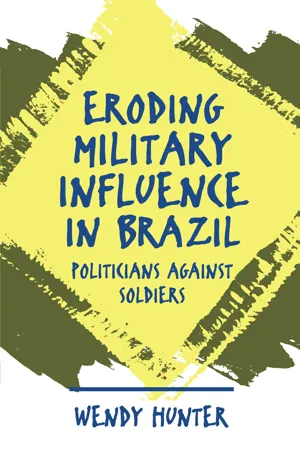
Wendy Hunter explores civil-military relations in Brazil following the transition to civilian leadership in 1985. She documents a marked, and surprising, decline in the political power of the armed forces, even as they have remained involved in national policy making. To account for the success of civilian politicians, Hunter invokes rational-choice theory in arguing that politicians will contest even powerful forces in order to gain widespread electoral support.
Many observers expected Brazil’s fledgling democracy to remain under the firm direction of the military, which had tightly controlled the transition from authoritarian to civilian rule. Hunter carefully refutes this conventional wisdom by demonstrating the ability of even a weak democratic regime to expand its autonomy relative to a once-powerful military, thanks to the electoral incentives that motivate civilian politicians. Based on interviews with key participants and on extensive archival research, Hunter’s analysis of developments in Brazil suggests a more optimistic view of the future of civilian democratic rule in Latin America.
- 260 pages
- English
- ePUB (mobile friendly)
- Available on iOS & Android
eBook - ePub
About this book
Information
1: The Reduction of Military Influence in Postauthoritarian Brazil: Analytic Themes
What impact does democratic government have on the military’s ability to exercise decisive influence over issues of broad social and political significance? Are electoral politicians under democracy likely to preserve or diminish the military’s sphere of involvement? What resources can and will the armed forces deploy to defend and advance their claims?
This chapter discusses competing theoretical approaches that claim to provide answers to these questions. The first section presents and probes the central analytic issue of the book: whether and for how long the “pacted” or negotiated nature of the transition to democracy in Brazil inhibited democracy’s consolidation. Did the military governments’ firm guidance of the transition, which allowed the armed forces to maintain ample institutional powers and play an influential political role in the initial phase of the new regime, create a legacy of extensive military influence? Or did the rules and norms of democracy eventually lead elected civilians to rein in the political activities of the military? The framework I present and endorse in this section suggests that the competitive dynamic of democracy unleashes irresistible incentives for civilian politicians to contest a military prone to political interference and endowed with ample institutional prerogatives, and that the popular support certified by electoral victory enhances their capacity to do so.1
The second section examines and analyzes the effect of two conditioning factors—civilian political institutions and broader power alignments—in shaping the strategies of democratically elected political actors to extend their power and influence over the military. I argue that the weak institutionalization of Brazil’s political system and multiple constraints on the use of military force for domestic political purposes in the current era reinforce the pressures created by democratic competition to reduce military influence.
While recognizing that the definition of democracy is a subject of intense debate,2 I conceptualize democracy as a system of governance in which an inclusive adult population is free to engage in individual and collective forms of political action and in which rulers are selected through open, competitive, peaceful, and regularly scheduled elections. This is similar to what Robert Dahl calls “polyarchy.”3 Such a minimalist, formal-procedural definition of democracy is necessary because I seek to investigate the impact that democratic procedures have on a substantive issue (the influence of the military in politics). My study would be condemned to uncovering a tautology if it included in the definition of democracy the absence of interference by unelected officials, such as military officers.
CIVIL-MILITARY RELATIONS IN POSTAUTHORITARIAN BRAZIL: CONTINUITY VERSUS CHANGE?
“Confining Conditions” Inhibit Civilian Sovereignty
Many analysts, including Alfred Stepan, Frances Hagopian, Guillermo O’Donnell, and Terry Karl, posited that Brazilian democracy would suffer from a serious “birth defect.”4 They claimed that the negotiated nature of the transition to civilian rule would provide the military, along with other important actors from the authoritarian period, with long-lasting political clout.5 More specifically, they contended that institutional privileges the armed forces retained in the transition process would give them a strong and indefinite foundation of political leverage. The military would be able to exercise undue influence in nonmilitary spheres as well as resist civilian direction over defense issues. The concern of these authors was not that the armed forces would launch a frontal assault on democracy by waging a coup d’état, but that they would impede democratic consolidation by continual tutelage, causing democracy to die a “slow death.”6 In line with the view that “patterns of politics established in periods of transition have a very real and strong potential to become semipermanent features of the political landscape,” Hagopian contends, “[t]he advent of civilian rule in Brazil did not erode military authority, though it may have disguised it.”7 O’Donnell saw Brazil as vulnerable to the development of a democradura, a civilian government controlled by military and authoritarian elements.8 The considerable political interference of the army in the first three years of the civilian regime seemed to provide empirical verification for this theoretical expectation.
Tenets of “historical institutionalism” informed the development of this rather pessimistic view.9 The influence of branching tree models, such as Krasner’s model of “punctuated equilibrium,” is particularly observable.10 These models claim that stable institutional patterns structure political life. By creating vested interests that promote their own persistence, institutions gain considerable autonomy and strength to withstand shifts in the broader political and socioeconomic environment. Even a challenge drastic enough to upset established institutional patterns is conditioned in its impact by the institutional setting in which it occurs. Historical institutionalists therefore view political development as a path-dependent process: following one path channels further development down the same path and precludes other options.
According to this view, significant political change only takes place at “critical junctures” or “turning points,” when institutional patterns are challenged by strong socioeconomic or political pressures. Such moments present rare opportunities for political actors to reshape the political landscape by founding new institutions. Periods of regime transition—when the rules of the game are in flux—constitute such moments. If change is to occur, quick action must be taken before the transition period comes to a close and patterns and practices inherited from the previous regime have a chance to congeal. After these windows of opportunity close, stability prevails and profound political change, which would reshape the institutional framework, is unlikely. If left unchallenged during the regime change, previous institutional patterns are believed to be reaffirmed and given a strong foundation to persist. A historical institutionalist perspective would predict that the armed forces would be able to preserve their power and set limits to popular sovereignty in the new democracy if they and other conservative elites managed to retain strong institutional prerogatives throughout a transition from authoritarian rule.
Electoral Competition Leads Civilians to Contest the Military
In contrast to the view described above, my research on postauthoritarian Brazil suggests that countries that return to civilian rule through elite-led negotiations need not be constrained indefinitely by the balance of forces that prevailed in the transition and immediate posttransition period. Civil-military relations in postauthoritarian Brazil have displayed much greater dynamism than a historical-institutionalist framework can account for. The firm hand the armed forces exercised over the transition and the institutional prerogatives they retained did strengthen their political clout in the immediate aftermath of the transition. The army’s interference in civilian decision making was considerable and often met with success in this initial period.11 But as the authoritarian past receded further into the distance, the advantage that military elites could reap from factors stemming from the transition began to erode. Within roughly three years, elected officials began to take gradual yet significant steps to check the military’s political interference. Politicians first confronted the military over issues that directly affected their popularity and electoral standing. Later, their actions included efforts to diminish the military’s institutional basis for political involvement, for example, by forming civilian-led organs to replace the former National Security Council (Conselho de Segurança Nacional or CSN) and the National Information Service (Serviço Nacional de Informações or SNI). At the same time, while some of the military’s institutional prerogatives remained in existence, leading officers appeared increasingly unable to use them to wield actual political influence.
How do I explain this unanticipated result? I argue that electoral competition creates incentives for politicians to reduce the interference of a politically powerful and active military, and that electoral victory enhances their capacity to do so. This claim rests on two premises: that politicians are first and foremost interested in their own political survival, and that the broad institutional context in which they operate structures their behavior. These premises suggest that politicians will contest the military when military actions conflict with politicians’ opportunity to gain widespread electoral appeal. Thus, in contrast to the view that political arrangements that are founded or reaffirmed during regime transitions will remain entrenched even as the political landscape around them changes, I contend that broad political and institutional shifts—in this case, the unfolding of the rules and norms of democracy—can disrupt patterns and practices put in place under a different set of circumstances. Rather than creating a static framework, democracy unleashes a competitive dynamic conducive to change.
This analysis is inspired by the literature on rational choice, which focuses on actors and their intentions and explains political action with reference to rational interest calculation. Strategic interaction among individuals maximizing their self-interest is seen as the foundation of politics. In the rational choice perspective, institutions result from this kind of interaction among individuals; they are created by actors pursuing their own preferences in instrumental ways. Once established, institutions set parameters for individual actors and their interest calculations, but they are always open to further modification.12
These are the explicit premises of arguments that authors such as Barry Ames and Barbara Geddes advance to explain politics and institutional change in Latin America.13 These ideas are also reflected in Douglas Chalmers’s concept of the “politicized state,”14 which differs fundamentally from Krasner’s model of “punctuated equilibrium.” Whereas Krasner stresses the stickiness of institutions and confines the possibility of change to rare but major moments of reorientation, such as regime transitions, Chalmers emphasizes the ever-present fluidity of Latin American politics, marked by frequent incremental shifts in the balance of power among self-interested actors and the institutional arrangements they establish.
Both historical institutionalism and rational choice focus on the relationship between actors and institutions but differ in their views concerning the malleability of institutions and the direction of the causal relationship between actors and institutions. Historical institutionalism sees institutional arrangements as resistant to change, except during rare crises, and focuses on the constraints that institutions impose on actors. By contrast, rational choice sees institutions as more mutable and underscores the capacity of actors to shape institutions and modify them once they are created. Rational choice theorists recognize that actors are conditioned by their institutional setting, which establishes a strategic context for decision making, but hasten to emphasize that this framework itself is the product of interaction among self-interested individuals.
Insofar as my empirical findings show that self-interested actors began rather quickly to reshape institutional arrangements and to alter the balance of political power in their favor, my study bears out the guiding principles of rational choice and diverges from those of historical institutionalism. The rules of democracy in Brazil have fostered political competition and thus induced and enabled politicians to undermine the terms of the conservative pact made during the transition from authoritarianism. In particular, politicians have begun to remove important constraints on popular sovereignty by contesting the institutional prerogatives of the military and reducing their political influence.
Political Incentives
What, more specifically, are the factors that induce and enable civilian politicians to undermine military tutelage over the new democracy? Why do many efforts by politicians to enhance their electoral chances conflict with positions the armed forces hold? And how do politicians gain the force to advance their preferences even against opposition from the armed forces?
Democratization gives rise to two types of incentives for electoral politicians: particularistic and programmatic. Particularistic incentives concern the use of resources to build and maintain politicians’ personal support networks. Programmatic incentives involve the credit given to politicians for advances in public policy (e.g., health, education, welfare, and economic reform). Both types of incentives are operative in Brazil, as in most democracies. And in different ways both generate strong and specific pressures against the persistence of military involvement in politics.
First, democratization in Brazil has reinforced particularistic incentives associated with political clientelism, often at the armed forces’ expense. Heightened electoral competition since the early 1980s has motivated politicians to search ever more energetically for economic assets to distribute as political pork barrel, thereby improving their chances of reelection.15 The dream of clientelist politicians is to build roads, schools, hospitals, sanitation systems, and other public works projects in their electoral districts. These benefits are targeted toward specific, regionally delimited groups of people. The extent to which legislators support local pork barrel projects, and the prevalence of logrolling in congressional voting patterns, strongly suggest that many Brazilians still vote largely with considerations of patronage in mind, or at least that politicians think they do.
Beyond seeking to distribute particularistic patronage, politicians also pursue “categorical patronage.” Such benefits are targeted to specific industries and/or categories of people. In principle, benefits are defined in general terms, but the beneficiaries unfailingly “happen” to be concentrated regionally. The rather narrow and regionally concentrated nature of the given categories qualifies these benefits as patronage and not as an integral part of programmatic strategies. The purpose of providing categorical patronage is for politicians to win regionally based electoral support, not to advance universalist goals. Examples of categorical patronage include subsidies for Brazil’s sugar alcohol program and coffee sector, and social security provisions for specific types of workers and pensioners, especially those who are concentrated in the country’s most developed regions.
The rampant pursuit of patronage resources by politicians not only clashes with the long-standing positivist impulse within the military to “rationalize” the public bureaucracy.16 It also leads them to enter into direct competition with military elites over state resources. Politicians are tempted to shift budget shares away from the military to civilian ministries better suited for pork barrel. Similarly, where military officers hold key posts in large state enterprises—strategic positions from which to build political allies by distributing jobs and other benefits—patronage-seeking politicians will seek to replace them. The competition for patronage resources unleashed by democratic competition thus generates strong pressures against the continued entrenchment of the military in the political and economic fabric of the country.
Second, in addition to unleashing particularistic incentives associated with political clientelism, democratization reinforces programmatic incentives that frequently work against the armed forces. In Brazil, winning elections often depends on gaining the votes of the country’s impoverished yet increasingly mobilized majority. Besides seeking to rise from their own poverty, some of Brazil’s poor have visions, albeit often vaguely defined, of a more egalitarian society. Politicians of diverse ideological leanings suggest increasingly in their conduct that they feel pressured to respond to this pool of voters in a symbolic, if not effective, way. This is especially true of politicians who need to appeal to urban electorates; they would quickly be turned out if they merely defended the interests of the privileged. Politicians tend to portray themselves as sympathetic with the plight of the country’s poor, despite the deeply conservative tendencies of Brazilian politics. They do so in rhetorical ways; for example, the successor of the government part...
Table of contents
- Cover Page
- Eroding Military Influence in Brazil
- Copyright Page
- Contents
- Acknowledgments
- Acronyms and Abbreviations
- Introduction
- 1: The Reduction of Military Influence in Postauthoritarian Brazil: Analytic Themes
- 2: Military Strength at the Inception of Civilian Rule
- 3: Military Prerogatives and Institutional Structures under the New Democracy
- 4: Labor Rights in Brazil’s New Democracy: Politicians Rein in the Military
- 5: Budgetary Politics: Soldiers and Politicians Compete
- 6: Civil-Military Conflict over the Amazon
- Conclusion
- Notes
- Bibliography
- Index
Trusted by 375,005 students
Access to over 1.5 million titles for a fair monthly price.
Study more efficiently using our study tools.
Frequently asked questions
Yes, you can cancel anytime from the Subscription tab in your account settings on the Perlego website. Your subscription will stay active until the end of your current billing period. Learn how to cancel your subscription
No, books cannot be downloaded as external files, such as PDFs, for use outside of Perlego. However, you can download books within the Perlego app for offline reading on mobile or tablet. Learn how to download books offline
Perlego offers two plans: Essential and Complete
- Essential is ideal for learners and professionals who enjoy exploring a wide range of subjects. Access the Essential Library with 800,000+ trusted titles and best-sellers across business, personal growth, and the humanities. Includes unlimited reading time and Standard Read Aloud voice.
- Complete: Perfect for advanced learners and researchers needing full, unrestricted access. Unlock 1.5M+ books across hundreds of subjects, including academic and specialized titles. The Complete Plan also includes advanced features like Premium Read Aloud and Research Assistant.
We are an online textbook subscription service, where you can get access to an entire online library for less than the price of a single book per month. With over 1.5 million books across 990+ topics, we’ve got you covered! Learn about our mission
Look out for the read-aloud symbol on your next book to see if you can listen to it. The read-aloud tool reads text aloud for you, highlighting the text as it is being read. You can pause it, speed it up and slow it down. Learn more about Read Aloud
Yes! You can use the Perlego app on both iOS and Android devices to read anytime, anywhere — even offline. Perfect for commutes or when you’re on the go.
Please note we cannot support devices running on iOS 13 and Android 7 or earlier. Learn more about using the app
Please note we cannot support devices running on iOS 13 and Android 7 or earlier. Learn more about using the app
Yes, you can access Eroding Military Influence in Brazil by Wendy Hunter in PDF and/or ePUB format, as well as other popular books in Politics & International Relations & Latin American & Caribbean History. We have over 1.5 million books available in our catalogue for you to explore.