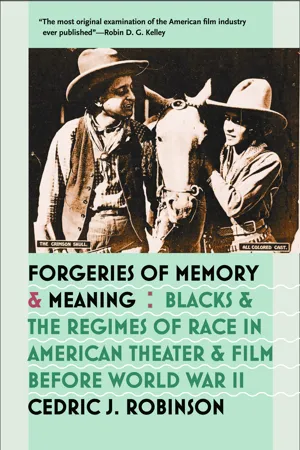
Cedric J. Robinson offers a new understanding of race in America through his analysis of theater and film of the early twentieth century. He argues that economic, political, and cultural forces present in the eras of silent film and the early “talkies” firmly entrenched limited representations of African Americans.
Robinson grounds his study in contexts that illuminate the parallel growth of racial beliefs and capitalism, beginning with Shakespearean England and the development of international trade. He demonstrates how the needs of American commerce determined the construction of successive racial regimes that were publicized in the theater and in motion pictures, particularly through plantation and jungle films. In addition to providing new depth and complexity to the history of black representation, Robinson examines black resistance to these practices. Whereas D. W. Griffith appropriated black minstrelsy and romanticized a national myth of origins, Robinson argues that Oscar Micheaux transcended uplift films to create explicitly political critiques of the American national myth. Robinson’s analysis marks a new way of approaching the intellectual, political, and media racism present in the beginnings of American narrative cinema.
eBook - ePub
Forgeries of Memory and Meaning
Blacks and the Regimes of Race in American Theater and Film before World War II
- 456 pages
- English
- ePUB (mobile friendly)
- Available on iOS & Android
eBook - ePub
Forgeries of Memory and Meaning
Blacks and the Regimes of Race in American Theater and Film before World War II
About this book
Information
1 The Inventions of the Negro
Doubtless because of the skeletons and bones of strange animals . . . that came to the Smithsonian from the early trans-continental surveys the institution came to be regarded as haunted. This was especially true in the case with the colored people, whose superstitious natures made them so fearful of the innocent building that they could not be induced to pass the door after sundown.
—Dr. Marcus Benjamin, “Memories of the Smithsonian,” May 1917
Counterfeits of History
A pall of sadness becomes almost a constant presence for anyone who wishes to revisit the corrupt association between American science and race in the century—the nineteenth—which ended with the appearance of moving pictures. In a better world, a world so different from the one this science helped to create, one might avert one’s eyes. But good manners are a luxury which these scientists forfeited, willfully and frequently. They gave little quarter to those whom they regarded as their inferiors, dismissed and hounded those critics whom they could not summarily dispatch, and thoroughly enjoyed their social standing and each other. Some sense of to what I am referring is present in the epigraph above, a presumably casual and ultimately unimportant observation really unrelated to the greatness of the Smithsonian. And yet here it is, certainly an unintentionally disturbing, presumably amusing, and insignificant comedic racial gesture smuggled into Marcus Benjamin’s reverential but still cozy remembrance of the “great and good comrades” who brought the Smithsonian into being and sustained its realization.
To be sure, Benjamin could be confident of his scientific audience’s shared propensity to be entertained and amused by the superstitions of colored people. He was the editor of the Smithsonian Institution’s publications, and just two years earlier he had been elected president of the Washington, D.C., chapter of Sigma Xi, the Scientific Research Society. Another evidence of Benjamin’s confidence is a bit of racial overdetermination. “It is said,” he wrote as he sailed into his second anecdote, that a Black man (Benjamin, of course, used the then more courteous “colored man”), upon learning that he was to be employed at the Smithsonian, “became so frightened that he ran away and could not be found for two weeks.”1 He seems untroubled by the paradox that his tale is folkloric yet addressed to a scientific establishment. His demeanor, however, becomes less strange when we more closely inspect the agents who occupied the “innocent building.”
Benjamin’s “memories” are crowded by the names of the eminent men (all men) who came through the doors of the Smithsonian and frequently stayed on. Of course, he attends the successive administrative heads (the secretary) of the institution up to his own present: Joseph Henry, Spencer F. Baird, Samuel P. Langley, and Charles Walcott. But he reserves a special prominence for two of the myriad of scientists (from chemistry, astronomy, mathematics, geology, paleontology, ornithology, mineralogy, conchology, anthropology, and so on) he recollects: “About the middle of the last century there were two great masters who in this country exerted a tremendous influence upon young men, leading them to the study of natural science. These were Agassiz and Baird.”2 The former was Louis Agassiz, the Swiss-born Harvard zoologist whose championing of polygeny and eugenics had considerably assisted the braiding of these hair-brained notions into scientific doctrine.
In 1981, Stephen Jay Gould exhumed Agassiz from the protective cover draped over him by his widow and later historians of science who had published selectively expurgated versions of his correspondence. In a letter to his mother in December 1846, Agassiz excitedly described his reaction to the Black servants at his Philadelphia hotel:
In seeing their black faces with their thick lips and grimacing teeth, the wool on their head, their bent knees, their elongated hands, their large curved nails, and especially the livid color of the palms of their hands, I could not take my eyes off their face in order to tell them to stay far away. And when they advanced that hideous hand towards my plate in order to serve me, I wished I were able to depart in order to eat a piece of bread elsewhere, rather than dine with such service. What unhappiness for the white race—to have tied their existence so closely with that of negroes in certain countries!3
We can only surmise how the senior Mrs. Agassiz responded to this outburst of eroticized images, but in 1895, some twenty years after Louis’s death, his widow and her collaborators saw fit to excise these passages from Louis Agassiz: His Life and Correspondence. Authenticity was clearly not the rationale for such a cut-and-paste approach to Agassiz’s writings, for Louis himself persisted in his racism even when it contradicted the dictums of naturalism. For one instance, notwithstanding the existence of half a million mulattos by the time of the 1860 census, Agassiz persisted in the notion that his own repugnance of Blacks was natural (since he “just ‘knew’ they were barely higher than apes”), shared widely, and enforceable.4 He supposed, he wrote to one of the members of Lincoln’s Inquiry Commission in 1863, that the threat of miscegenation in the postwar period would be contained, since Blacks could only survive in the isolation of the Southern lowlands.5 Nevertheless, he seems to have genuinely believed that it was his disinterested inquiry, and not his personal dispositions, which led him to the conclusion that too much learning would swell the Negro brain, bursting the skull wall.6
It was thus that race science was staged between performances of burlesque and horror.
The dominant natural scientists in America in the nineteenth and early twentieth centuries had been impaled on Negro slavery and its social and cultural debris. But rather than experiencing anguish at their acute artificiality, they seemed to exist in a perpetual state of conceit. Thinking themselves the heirs to a venerable legacy of philosophy (love of knowledge) extending back to the ancient Greeks, they almost reflexively appropriated Plato and Aristotle, two of the earlier period’s most persuasive defenders of slavery. They were mistaken. To be sure, the race science of the modern African slave era was in truth an American/Atlantic/Western branch of prior racial dogma. But Plato and Aristotle had been inferiorizing very different subjects, such as Scythians, Persians, Thracians, Celts, and so on, who had been contributors to Western civilization. The paradox was lost on the naturalists and anthropologists of the nineteenth century. And so while they parroted the arguments of the ancients as if they had directly telegraphed the methods and protocols of race science, the modernists invented entirely new subjects: indigenous peoples of Africa, the New World, and the Orient.
Race presents all the appearance of stability. History, however, compromises this fixity. Race is mercurial—deadly and slick. And since race is presumably natural, the intrusion of convention shatters race’s relationship to the natural world. This is true for the contemptible Black, at one and the same time the most natural of beings and the most intensively manufactured subject. And most relevant to our interest, the imaginings of Blacks in early American films are the reconstitutions of Black which culminated in the spectacle performed within the Smithsonian and exported into the public arena. By the time the moving picture camera arrived on the scene, the Negro was in full costume. But before then, that costume would undergo extraordinary changes in the seventeenth century and then again at the end of the nineteenth century.
A large proportion of, perhaps even most, Western scholars have a great deal of difficulty in assigning the emergence of racial discourses before the advent of the Atlantic or African slave trade. They reason that race is a concomitant to slavery, and as Peter Erickson succinctly puts it, “The systematic racism associated with this structural development cannot be said to exist in the historical stages that preceded, and lead up to, this moment.”7 It would be kinder, perhaps, to leave Erickson and his co-dogmatists to this conceit, but it would not alter actual history. Simply put, the Atlantic slave trade was not the first slave system, nor the first slave system engaged in by Europeans, nor the first slave system to affect Europeans or their ancestors, and not the only slave system to produce a racialist culture.8 Europeans enslaved Europeans just as Asians enslaved Asians, Africans enslaved Africans, and Native Americans enslaved Native Americans. And as Orlando Patterson has noted, the designators of inferiorization extend back into what Westerners like to think of as their antiquity. Just as earlier, Greeks had displayed contempt for non-Greeks, by the second century B.C., H. Hill writes, “no Greek could help being distressed by the almost universal contempt shown, at least in public utterances, toward his nation.”9 In the European instance, the frequency with which one nation was victimized at least until the end of the Middle Ages is preserved in most West European languages by the use of the term “Slav” (slave, esclavo, esclave, etc.) to designate the condition of human property.
There is scarcely a people in Europe who have not at some time furnished victims to the slave trade. But few furnished them so consistently, for so many centuries, as the Slavic peoples from the Dinaric Alps. Indeed, the word “slave” in most modern European languages is derived from the ethnic term “sclavus” meaning Slav. Furthermore, in Arabic speaking lands, the word “Slav” provides the root for a term meaning eunuch and in Catalan for one meaning “castrated goat.” In Castilian, moreover, a word for chain is derived from “Slav.”10
The fact that the phenotypes of the enslaved and the slavers differed insignificantly did not erode the force of the racism which victimized Koreans, Poles, the Irish, and others who experienced the misfortune of long-term slavery or domination. This is confirmed when Theodore Allen writes on English despotism in Ireland: “Irish history presents a case of racial oppression without reference to alleged skin color or, as the jargon goes, ‘phenotype.’”11 Only once one evacuates those hundreds of slave systems and the millennia of recorded history which documents them is it remotely possible to consign race consciousness to modernity (that is, the era initiated by the West’s encounter with the “New World”).
Thus Erickson (and many, many others) trip over several historical fallacies. They stumble when they assume that the Atlantic slave trade was a singular historical event; they falter when they presume that race must incur phenotypic differences as obvious as those between the whitest Europeans and the blackest Africans; and they falter when they seek to periodize the study of race to modernity. Finally, they succumb to the most naïve of beliefs when they insist that Africans and Europeans encountered each other at some determinable date deposed by the Atlantic trade. As Kim Hall observes in her criticism of Kwame Anthony Appiah’s embrace of this credo, “His notions of Elizabethan England are a clear articulation of a largely unstated bias against the study of ‘pre-slavery’ Europe by scholars centrally concerned with race: that studies of race and blackness should primarily be concerned with the construction of black subjectivity (the corollary being that the early modern period cannot be the subject of black studies because there were no blacks to study).”12
Hall is right: there is something amiss, something fishy about the putative boundary erected by the notion of a “pre-slavery Europe.” But she, too, misses the point when she sutures “race and blackness.” They can only be fixed in that way by a sociological imagination which not only miscomprehends Elizabethan England but, as well, much of the history of the cultures and peoples of the world which preceded it. But Elizabethan England will serve sufficiently here as a point ...
Table of contents
- Cover Page
- Forgeries of Memory and Meaning
- Copyright Page
- Dedication
- Contents
- Illustrations
- Preface
- Acknowledgments
- 1 The Inventions of the Negro
- 2 In the Year 1915
- 3 Blackface Minstrelsy and Black Resistance
- 4 Resistance and Imitation in Early Black Cinema
- 5 The Racial Regimes of the “Golden Age”
- Bibliography
- Index
Trusted by 375,005 students
Access to over 1.5 million titles for a fair monthly price.
Study more efficiently using our study tools.
Frequently asked questions
Yes, you can cancel anytime from the Subscription tab in your account settings on the Perlego website. Your subscription will stay active until the end of your current billing period. Learn how to cancel your subscription
No, books cannot be downloaded as external files, such as PDFs, for use outside of Perlego. However, you can download books within the Perlego app for offline reading on mobile or tablet. Learn how to download books offline
Perlego offers two plans: Essential and Complete
- Essential is ideal for learners and professionals who enjoy exploring a wide range of subjects. Access the Essential Library with 800,000+ trusted titles and best-sellers across business, personal growth, and the humanities. Includes unlimited reading time and Standard Read Aloud voice.
- Complete: Perfect for advanced learners and researchers needing full, unrestricted access. Unlock 1.5M+ books across hundreds of subjects, including academic and specialized titles. The Complete Plan also includes advanced features like Premium Read Aloud and Research Assistant.
We are an online textbook subscription service, where you can get access to an entire online library for less than the price of a single book per month. With over 1.5 million books across 990+ topics, we’ve got you covered! Learn about our mission
Look out for the read-aloud symbol on your next book to see if you can listen to it. The read-aloud tool reads text aloud for you, highlighting the text as it is being read. You can pause it, speed it up and slow it down. Learn more about Read Aloud
Yes! You can use the Perlego app on both iOS and Android devices to read anytime, anywhere — even offline. Perfect for commutes or when you’re on the go.
Please note we cannot support devices running on iOS 13 and Android 7 or earlier. Learn more about using the app
Please note we cannot support devices running on iOS 13 and Android 7 or earlier. Learn more about using the app
Yes, you can access Forgeries of Memory and Meaning by Cedric J. Robinson in PDF and/or ePUB format, as well as other popular books in Social Sciences & Film History & Criticism. We have over 1.5 million books available in our catalogue for you to explore.