The rise of black radicalism in the 1960s was a result of both the successes and the failures of the civil rights movement. The movement’s victories were inspirational, but its failures to bring about structural political and economic change pushed many to look elsewhere for new strategies. During this era of intellectual ferment, the writers, editors, and activists behind the monthly magazine Liberator (1960–71) were essential contributors to the debate. In the first full-length history of the organization that produced the magazine, Christopher M. Tinson locates the Liberator as a touchstone of U.S.-based black radical thought and organizing in the 1960s. Combining radical journalism with on-the-ground activism, the magazine was dedicated to the dissemination of a range of cultural criticism aimed at spurring political activism, and became the publishing home to many notable radical intellectual-activists of the period, such as Larry Neal, Ossie Davis, Ruby Dee, Harold Cruse, and Askia Touré.
By mapping the history and intellectual trajectory of the Liberator and its thinkers, Tinson traces black intellectual history beyond black power and black nationalism into an internationalism that would shape radical thought for decades to come.
eBook - ePub
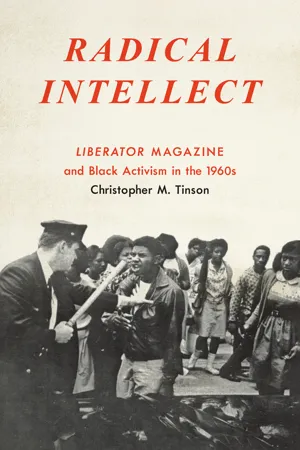
Radical Intellect
Liberator Magazine and Black Activism in the 1960s
- 346 pages
- English
- ePUB (mobile friendly)
- Available on iOS & Android
eBook - ePub
About this book
Information
1
Voices of Black Protest
Voices of Black Protest
Contours of Anticolonialism and Black Liberation
Africa has become the magic word and the new hope.
—John Henrik Clarke, “The New Afro-American Nationalism” (1961)
Anticolonialism, decolonialization, independence, anti-imperialism, self-governance, and self-determination were watchwords of a black new world order in the 1960s. John Henrik Clarke’s observance bespoke considerable energies devoted to the cause of African liberation given by black bodies scattered around the globe, and most especially those asserting themselves throughout cities large and small in the United States. To embrace, digest, and implement the visions embedded in these concepts would not only require analytical sophistication and political agility. These concepts also necessitated a clear plan for the reordering of massive populations of human activity, modes of resource extraction and exchange, commerce, infrastructure, decision-making authority, and long-range vision. Nearly every black activist or intellectual navigating and making sense of Cold War fractures was required to hold forth on any combination of these issues. If not simply to understand this changing world for themselves, such activists were expected to galvanize an increasingly anxious black public on the verge of long-awaited political and social possibilities. Liberator seized the black political imagination as if receiving a call from on high. It would be the space where these issues were argued about and clarified with force. Moreover, it would be “the voice of the black protest movement,” as it declared across its masthead by 1962. By the mid-1960s, even mainstream journalists such as Mike Wallace would call it “the sounding board for the angriest black writers in the black community.”1 Liberator injected itself into the confluence of several strands of transnational debate and local organizing, seeking to give voice to a range of political demands. From the standpoint of its editors, it would be the periodical that announced the death of colonialism to the world. It would be the magazine that proudly reflected Du Bois’s vision of a “rising tide of color,” shaking up the world with black and brown bodies poised to rewrite the history of world leadership. While energized to seize the moment, the activist-writers that made Liberator a go-to voice in black movement activities in the north were up against a countervision led by a U.S. government hell-bent on keeping Africa free of Soviet influence. More directly, Liberator writers and readers alike encountered the chagrin of white liberal American intellectuals and expressly anticommunist commentators, who not only questioned African Americans’ allegiance to Africa, but also bristled at the idea that some black people in the United States would prioritize African affiliation over American citizenship.
In 1959, the journalist turned lecturer from the Massachusetts Institute of Technology and American Committee on Africa (ACOA) executive member, Harold R. Isaacs, speaking to an assembly of Africanists at the second annual meeting of the American Society of African Culture (AMSAC), queried: “Can we say that in acquiring a new image of Africa now, the Negro American is really engaged in acquiring nothing less than a new image of himself?”2 The new image of Africa of which Isaacs spoke was the burgeoning shift in African American consciousness toward Africa as it shed the skin of direct colonial rule. Africans on the continent and black people in the United States were paving a united road toward a new day, the thinking went. As numerous writers have pointed out, the attitude of diasporan Africans toward Africa has undergone a number of historical shifts, ebbs, and flows since the mid-1890s. Consciousness of Africa has been the source of both hope and consternation.3 These African-centered global imaginings would be given new life in the 1960s. For his part, Isaacs would be part of a swelling American anticommunist, liberal interest in African independence, and African American political identification with Africa. And as the Year of Africa continued to attract the world’s attention, AMSAC and ACOA would find an eager adversary in the Liberation Committee for Africa (LCA) and its organ, Liberator.
______
Of all the African connections that piqued LCA political curiosity and catapulted it into existence, the independence of Ghana, Kwame Nkrumah’s charismatic brand of pan-Africanism and his political fortunes, and the Congo Crisis, resulting in Patrice Lumumba’s assassination, loomed largest. All the Liberator’s coverage of Africa pivoted from these two pan-African pressure points. James Meriwether effectively demonstrates African Americans’ attraction to African independence as he highlights several key moments in African history that galvanized entire hemispheres of black activism in the first half of the twentieth century.4 The LCA was one of the formations that owed its existence to histories of black struggle, having grown out of earlier traditions of activism. Yet the late 1950s and early 1960s marked a new epoch in African and African American struggles.
The sixteen African nations that gained independence from colonial rule in 1960, in name if not in effect, nonetheless signaled a sea change to African Americans that was nearly as profound as it was to Africans themselves. This explosion of political independence was subsequently dubbed the Year of Africa, oddly enough by Adlai Stevenson himself according to some accounts. By 1961, the total number of nominally independent nations numbered twenty-eight. The expedience of this movement carried with it numerous complicated and contentious issues, which surfaced as a hindrance to national stability. Largely owing to Cold War alignments, newly independent nations required support from international allies to sustain their autonomy and to guarantee that basic goods and services could be distributed to their citizenry. As new nations, they were not self-sufficient enough to determine how such relationships to the outside world would generate a stable degree of economic productivity. As such, these nations were torn between the influence of the United States and that of the Soviet Union. Others, inspired by the 1955 Bandung Conference, were determining whether a course of nonalignment was tenable.
At the local level, African nation-building initiatives confronted the question of what type of political system would be incorporated, what economic system would be put in place, and how regional differences would be resolved to the success of the national unity. Important, too, would be issues concerning the changes in social and cultural customs as a result of national imperatives toward progress, which resulted in clashes between tradition and modernity.5 So described, Nkrumah’s attempts underscore the multitudinous internal and external facets of nation building in this period, which sought to build a broad sense of cohesion in order to advance the cause of continent-wide unity. He, for one, believed that Ghana’s independence mattered slightly unless it was connected to the independence of other nations, as only then could continental unity be achieved.6
The Liberator’s emergence out of the global anticolonial and domestic antidiscrimination politics that flourished in the late 1950s and 1960s meant its task was in many ways already outlined—utilize the skills and tools of activist journalism to push for African liberation.7 This necessarily included a vibrant and vocal distrust and dissatisfaction with western society, especially its governing institutions. The core staff of the periodical saw themselves as part of the critical vanguard of U.S.-based activists charged with interpreting and analyzing the impact of African liberation on domestic struggles in the United States and vice versa. The Liberator staffers, especially its editor in chief, the bombastic and disgruntled Dan Watts, sought to develop close ties with African diplomats, students, artists, and workers and use these connections as leverage for African American representation at the United Nations, among other goals. Watts was a once-promising New York City architect, who had been hired by one of the most prominent architectural firms of the day, Skidmore, Owings and Merrill. After his demand for promotion to partner failed, he found himself increasingly disenchanted with the profession and the racial glass ceiling of corporate America. Prior to leaving, however, Watts formed a group called the Committee for the Advancement of the Negro in Architecture (CANA), where he would meet Pete Beveridge, who also had an interest in architecture, an awareness that would later serve as safety net. It is interesting that another organization carried a similar acronym and is perhaps better known, the Committee for the Negro in the Arts (CNA), which broke down numerous racial and gender barriers in the hiring practices of the entertainment industry. It is uncertain if these groups had any direct relationship, yet it is likely that Watts was inspired or encouraged by the arts committee to form an organizing unit for his profession. Gathering himself after the crashed hopes of a life in architecture, Watts threw himself headlong into local and international struggles for justice.
In June 1960 the newly established LCA issued a press release that announced the basis of its formation and provided its Statement of Aims, effectively announcing its arrival on the scene. Its opening statement connected the struggles of African people to black people in the United States, plainly stating, “Freedom and equality for Americans of African descent is inextricably linked with the freedom of Africans in their home lands.”8 It went on to pinpoint four aims that reflected their belief in the inextricable bond between African and African American struggles. Its stated aims were:
To work for and support the immediate liberation of all colonial peoples
To provide a public forum for African freedom fighters
To provide concrete aid to African freedom fighters
To re-establish awareness of the common cultural heritage of Afro-Americans with their African brothers9
These broadly conceived aims did not provide a blueprint of how these goals would be accomplished, nor did they reveal a particular ideological perspective or leaning. That would have to be worked out through engagement with the issues. One example of how the LCA hoped to support African independence occurred toward the end of 1961, when the organization solicited financial contributions to send to families in war-torn Northern Rhodesia, yet it would be the flashpoints of Congo and Ghanaian independence that LCA allied itself with.10 The Congo Crisis brought the LCA out of the shadows and well into the center of debates concerning African independence. These aims reflect the LCA’s attempt to provide a vital platform where people could exchange ideas, and where the politics of African and African American liberation could be explored and brought into lived reality. Moreover, these points of emphasis express an active pan-African consciousness that highlights the significance of the African liberation and its relevance to black struggle in the United States. Moreover it envisions a diasporic project based on reciprocal political support and a common vision of tangible empowerment.
At its inception, the LCA sought support from both the black community and white activists and writers who viewed themselves as allies. Under the title, “What Africa Means to Americans,” the LCA placed a full-page ad in The Nation, where it stated that its membership “includes Americans of all races,” and expanded on its stated aims. Though it was primarily concerned with the global black community, in its early goings it explicitly welcomed solidarities that cut across racial and class lines. Over the next year, the LCA sought to “make permanent that unity of purpose and effort” displayed at the UN protest supporting slain Congolese leader Patrice Lumumba in February 1961, adding that its intention was to “give Africans a voice here in the United States.” Last, recognizing its function as a disseminator of information, it sought “to inform all Americans of Africa’s proud heritage, long obscured by racist myths.”11 Indicated in this ad were the political, cultural, and epistemological registers that would occupy this small, fluid grouping throughout its ten-year existence.
In an organized act of defiance, a week following Lumumba’s murder, Black Nationalist organizations and individuals based in Harlem, joined with several other New York–based Black Nationalist groups at a meeting of the UN Security Council on February 15, 1961. A riot broke out, according to the New York Times, when, during the speech of UN Security Council Ambassador Adlai Stevenson, guards arrested a woman who stood up to protest his speech. According to Dan Watts, as reported in the Times article, the demonstration was intended to be a peaceful one. But when Stevenson announced his support for UN secretary general Dag Hammarskjöld, the person many knew to be responsible for the protection of Lumumba, a woman stood up in protest and “guards rushed for her.”12
According to Richard Gibson, “It was [Robert F.] Williams who inspired that much publicized and highly effective demonstration in the United Nations Assembly after the American-inspired murder of Patrice Lumumba.” Mae Mallory, a New York City activist and close associate of Williams, influenced the protest from the beginning. Gibson’s neighbors, Max Roach and Abbey Lincoln, also participated. Williams was away on a speaking engagement and Gibson had to report at CBS News, and thereby missed the demonstration.13 Perhaps, in this instance, playing coy, Watts indicated to the press that the demonstration was not intended to be more than a display of civil disobedience. However, On Guard for Freedom leader Calvin Hicks offered his take on the disruption that offered different details. As he recalled, the demonstration was intended to be disruptive. During Stevenson’s speech, a visiting Cuban student in solidarity with the Lumumba protesters stood up and threw an object in Stevenson’s direction. As guards hurried toward the student, chaos bro...
Table of contents
- Cover
- Title Page
- Copyright
- Dedication
- Contents
- List of Illustrations
- Acknowledgments
- Prologue: Inscribing Liberation: Contexts and Conditions of Black Radicalism
- 1: Voices of Black Protest: Contours of Anticolonialism and Black Liberation
- 2: Spokespersons and Advocates: The Contested Intellectual Life of African Independence
- 3: Radical Commitments: The Promise of Black Women’s Activism
- 4: Rebellion or Revolution: The Challenge of Black Radicalism
- 5: New Breeds, Old Dreams: Liberator and Black Radical Aesthetics
- Epilogue: Refusing to Go Quietly
- Notes
- Bibliography
- Index
Trusted by 375,005 students
Access to over 1.5 million titles for a fair monthly price.
Study more efficiently using our study tools.
Frequently asked questions
Yes, you can cancel anytime from the Subscription tab in your account settings on the Perlego website. Your subscription will stay active until the end of your current billing period. Learn how to cancel your subscription
No, books cannot be downloaded as external files, such as PDFs, for use outside of Perlego. However, you can download books within the Perlego app for offline reading on mobile or tablet. Learn how to download books offline
Perlego offers two plans: Essential and Complete
- Essential is ideal for learners and professionals who enjoy exploring a wide range of subjects. Access the Essential Library with 800,000+ trusted titles and best-sellers across business, personal growth, and the humanities. Includes unlimited reading time and Standard Read Aloud voice.
- Complete: Perfect for advanced learners and researchers needing full, unrestricted access. Unlock 1.5M+ books across hundreds of subjects, including academic and specialized titles. The Complete Plan also includes advanced features like Premium Read Aloud and Research Assistant.
We are an online textbook subscription service, where you can get access to an entire online library for less than the price of a single book per month. With over 1.5 million books across 990+ topics, we’ve got you covered! Learn about our mission
Look out for the read-aloud symbol on your next book to see if you can listen to it. The read-aloud tool reads text aloud for you, highlighting the text as it is being read. You can pause it, speed it up and slow it down. Learn more about Read Aloud
Yes! You can use the Perlego app on both iOS and Android devices to read anytime, anywhere — even offline. Perfect for commutes or when you’re on the go.
Please note we cannot support devices running on iOS 13 and Android 7 or earlier. Learn more about using the app
Please note we cannot support devices running on iOS 13 and Android 7 or earlier. Learn more about using the app
Yes, you can access Radical Intellect by Christopher M. Tinson in PDF and/or ePUB format, as well as other popular books in Social Sciences & North American History. We have over 1.5 million books available in our catalogue for you to explore.