The first major modern edition of the wartime correspondence of General William T. Sherman, this volume features more than 400 letters written between the election of Abraham Lincoln in 1860 and the day Sherman bade farewell to his troops in 1865. Together, they trace Sherman’s rise from obscurity to become one of the Union’s most famous and effective warriors.
Arranged chronologically and grouped into chapters that correspond to significant phases in Sherman’s life, the letters — many of which have never before been published — reveal Sherman’s thoughts on politics, military operations, slavery and emancipation, the South, and daily life in the Union army, as well as his reactions to such important figures as General Ulysses S. Grant and President Lincoln.
Lively, frank, opinionated, discerning, and occasionally extremely wrong-headed, these letters mirror the colorful personality and complex mentality of the man who wrote them. They offer the reader an invaluable glimpse of the Civil War as Sherman saw it.
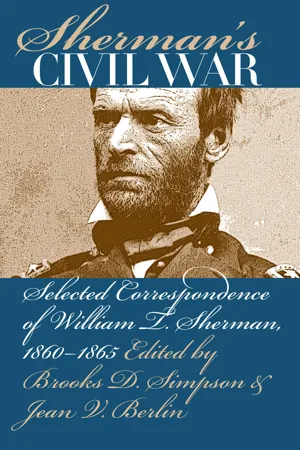
eBook - ePub
Sherman's Civil War
Selected Correspondence of William T. Sherman, 1860-1865
- 976 pages
- English
- ePUB (mobile friendly)
- Available on iOS & Android
eBook - ePub
Sherman's Civil War
Selected Correspondence of William T. Sherman, 1860-1865
About this book
Information
Chapter 1: November 3, 1860–February 25, 1861
For William T. Sherman, the breakup of the United States in the secession crisis of 1860–61 could not have come at a worse time. After years of struggling in various civilian pursuits following his resignation from the United States Army in 1853, he had finally found success as the superintendent of the Louisiana State Seminary and Military Academy in Alexandria. Since his arrival in Louisiana in the fall of 1859, he had done much to put the military academy on a sound footing, supervising construction, purchasing books, and overseeing the education and training of a growing student body. Not even the promise of a position as a banker in faraway London, tempting as it was, could pull him away from his new post; rather, he had been looking forward to the day when he could bring the rest of his family to Alexandria. He had spent far too much time away from his wife, Ellen, and his children, who had been residing in Lancaster, Ohio, with Ellen’s father (and Sherman’s foster father), Thomas Ewing Sr. Now, however, all was jeopardized by national events. “It does seem that the whole world conspires against us,” Sherman sadly remarked.1
It had not always been this way. Born February 8, 1820, in Lancaster, the sixth child of Charles and Mary Sherman, Tecumseh Sherman was nine years old when his father died. Thomas Ewing, a prominent lawyer and politician who lived up the street from the Shermans, took in the boy; unhappy with the youth’s name—it seemed somehow unfitting to be named after an Indian warrior—the Ewings made sure that he was baptized “William.” Two years later, Ewing won election to the United States Senate; the clout that came with this position proved helpful in securing an appointment at the United States Military Academy at West Point for the boy known to his friends as Cump. Sherman entered the academy in 1836; upon his graduation in 1840, he ranked sixth in his class and would have ranked even higher but for his indifference to the demerit system. He accepted a commission as a second lieutenant of artillery and over the next six years saw service in Florida during the Second Seminole War followed by tours of duty in Alabama and South Carolina. Transferred to California at the beginning of the Mexican-American War, Sherman failed to see action in the conflict but gained a small slice of immortality as the officer who confirmed the discovery of gold in 1848. On May 1, 1850, he married Ellen Ewing, Thomas Ewing’s daughter, in a Washington ceremony attended by many of the nation’s most prominent political leaders, who no doubt welcomed the respite from the ongoing debate over sectional issues that culminated in a grand compromise agreement later that year.2
The next decade proved a trying one. Ellen did not care for army life and soon decided to return to Lancaster, taking the couple’s daughter, Maria (affectionately known as Minnie), with her; soon they were joined by a second girl, Mary Elizabeth (called Lizzie). Sherman cared little for the arrangement, but it soon became evident that he would have to choose between his career and his family and in 1853 he resigned his commission. His first step as a civilian took him back to California, where he engaged in banking. Determined to make it on his own, he resisted his father-in-law’s efforts to bring him—or, more accurately, Ellen—back to Ohio; he also welcomed the arrival of his first son, William, in 1854. Financial chaos, the appearance of vigilante violence, and Ellen’s desire to return to Lancaster, however, led him to welcome the opportunity to relocate to New York in 1857, only to find himself the victim of the financial panic that spread over the land that fall. Crestfallen, he accepted his father-in-law’s offer to manage a coal and saltworks, then took a turn as a lawyer in Kansas while trying to find other ways to make money, secure his independence, and reunite his family (now grown to four children with another boy, Thomas) under his own roof. “I am doomed to be a vagabond,” he remarked. “I look upon myself as a dead cock in the pit, not worthy of further notice.”3 It was at this point that the offer of the superintendency promised a solution to his problems.
It was not as if Sherman was unaware of the storm clouds of secession. He had sat in the galleries as Congress debated the terms of the Compromise of 1850 and at one point secured admission to the floor to hear Daniel Webster’s farewell address to the Senate. While in California, he had provided pointed commentary on events in Kansas, where proslavery and antislavery forces clashed. That his brother John was making a mark as a member of the new Republican party as a congressman only added to his interest. Cump shared none of his brother’s antipathy toward slavery; he despised secessionist fire-eaters and abolitionists alike, even though Ellen’s brother Thomas Ewing Jr. practiced antislavery politics. No sooner had he arrived in Louisiana than he found himself an object of suspicious curiosity, for John Sherman had just endorsed Hinton Rowan Helper’s tract against slavery, The Impending Crisis of the South. Southern congressmen seized on this gaffe to deny Sherman the speakership of the House of Representatives. Cump stuck by his brother but only after reassuring anyone who would listen that John had never read the book.
Sherman had no problem with slavery. “I would not if I could abolish or modify slavery,” he told Tom Ewing Jr. “I don’t know that I would materially change the actual relation of master and slave. Negroes in the great numbers that exist here must of necessity be slaves”—a remark remarkable for its ignorance of the free black population in New Orleans. Blacks, he argued, would not work except under coercion; they could never claim equality with whites. “All the congresses on earth can’t make the negro anything else than he is,” he declared. “He must be subject to the white man, or he must amalgamate or be destroyed.” He suggested that slave owners might enhance the acceptability of the peculiar institution by adopting reforms to preserve slave families and promote the education of slaves. He even contemplated the purchase of a few slaves as servants for his new home.4
But for secession Sherman harbored only hostility. He assailed those Southern politicians who constantly raised the threat of disunion, claiming that they had exaggerated the extent of support for secession in the North. He pledged to resign his post and leave Louisiana should that state leave the Union. In the presidential contest of i860 he expressed his preference for the candidacy of the Constitutional Unionist John Bell, although in the end he did not vote.
The triumph of Republican nominee Abraham Lincoln, Sherman observed, made secession inevitable, for many Southern whites believed that the new president espoused abolitionist principles. The prospect of disunion, war, and chaos depressed him. Despite the “General Anarchy” that would ensue, a “mad foolish crowd” was determined to destroy the nation. Although Sherman was determined to leave the state should Louisiana secede, he did not know what the future held for him. “I see every chance of long, confused and disorganized Civil war, and I feel no desire to take a hand therein,” he remarked. Indeed, he was not sure whether it would be wise to resist secession: only if the states bordering the Mississippi River joined the disunion movement was there a sufficient reason for a war.5
Passion and ignorance ruled the day. To one of his instructors at the academy, David F. Boyd, Sherman railed against the insanity of secession. “You, you the people of the South, believe there can be such a thing as peaceable secession. You don’t know what you are doing. . . . The country will be drenched in blood. . . . Oh, it is all folly, a crime against civilization.” War would be costly, especially to the South. “The North can make a steam-engine, locomotive or railway car; hardly a yard of cloth or shoes can you make. You are rushing into war with one of the most powerful, ingeniously mechanical and determined people on earth—right at your doors. You are bound to fail. Only in your spirit and determination are you prepared for war. In all else you are totally unprepared, with a bad cause to start with. … If your people would but stop and think, they must see that in the end you will surely fail “6
But the time for sober reflection had passed. “When People believe a delusion they believe it harder than a real fact,” Sherman told Minnie. “Men have ceased to reason, and war seems to be courted by those who understand not its costs, and demoralizing results,” he observed as Louisiana prepared to secede. “Civilians are far more willing to start a war than Military men and so it appears now.” Yet it was also obvious to him that if the politicians had helped bring on the crisis, they would not be able to manage it. “My notion is that this war will ruin all Politicians & that military Leaders will direct the events,” he predicted. With that in mind, he left Louisiana on February 24. When next he returned, he would be wearing the uniform of a major general in the United States Army.7
1. WTS to EES, December 23, 1860.
2. The best full biographies of Sherman are John F. Marszalek, Sherman: A Soldier’s Passion for Order (New York, 1993), and Lloyd Lewis, Sherman: Fighting Prophet (1932; reprint, Lincoln, Neb., 1993). Michael Fellman’s Citizen Sherman (New York, 1995) provides an incisive and provocative analysis of Sherman’s personality, mentality, and character.
3. Marszalek, Sherman, 119.
4. Lewis, Sherman, 119, 120, 129.
5. WTS to EES, November 3, 23, 1860, January 8, 1861; WTS to JS, December 9, 1860.
6. Lewis, Sherman, 138.
7. WTS to Minnie Sherman, December 15, 1860; WTS to George M. Graham, January 16, 1861; WTS to JS, January 18, 1861.
TO ELLEN EWING SHERMAN
Louisiana State Seminary of Learning
and Military Academy.
Alexandria, Novr. 3, 1860
and Military Academy.
Alexandria, Novr. 3, 1860
Dearest Ellen,
This is Saturday evening, and I am seated at the office table where the Academic Board has been all week examining Cadets[.] We have admitted in all some eighty and rejected about a dozen, for want of the elementary knowledge required for admission.1 Tonight Saturday we close the business and on Monday Recitations begin. Still Many more will straggle in, and I expect we will settle down to about a hundred and twenty, less than we had reason to expect, but quite enough for comfort.
Joe2 got here on Monday last and is here, helping receive, unpack and distribute stores, and he helps blow the calls—a Bugler I picked up in New Orleans, a kind of circus man. I hardly know what to do with Joe and he will be on my hands till something turns up. I had him make a list of the contents of some boxes, but his spelling is so bad that I cannot get him to help me in writing—I will take two of the Cadets for that purpose but what with treasurers accounts and the voluminous Correspondence I fear I will not be able to take reasonable exercise.
Poor Clay has fallen away much and I have him fed on oats at about a dollar a bushel, & hay $60 a ton but he dont appear to appreciate it—I have not had a chance to ride him this week, but made Joe take him to exercise this afternoon. Tomorrow Sunday also I must write all the day and Same next week, but then I hope to take some relief. Our House has now the 2nd coat of plaster all save the lower hall and as the scaffolding is removed it looks very well. The house will be good in every respect, and I hope to drive the Plasterer away in ten days—the Carpenter can finish up in ten more days and the painting ought not to take more than a month, so that by Christmas it will be done. A fence has to be built—I intend if affairs move along slowly—to furnish it in part, and occupy it by January—At present we have our old mess which smacks of the same old pork Grease—The Country is very poor and nothing can be bought here but stewed beef & pork—vegetables are out of the question save Potatoes at about $5 the barrel. Professors Vallas3 & St. Ange4 still are ugly, but I dont expect much trouble—only as the Board have divided my authority I will take less interest in details. People here now talk as though Disunion was a fixed thing—men of property say that as this constant feeling of danger of abolitionism exists they would rather try a Southern Confederacy—Louisiana would not secede but should South Carolina secede, I fear other Southern states will follow, and soon General Anarchy will prevail—I say but little, try & mind my own business, and await the issue of Events.
Sunday—here I was interrupted and occupied till bedtime and postponed balance to this Sunday—The day is beautiful—I have taken a long stroll embracing the new Houses which more & more please me on each visit—I think them admirably planned, and adapted to the circumstances & climate. Joe has gone to church and so have the Professors and many of the Cadets. Bye the way—Dr. Clark5 our Surgeon a young gentleman (engaged to Miss Boyce6 en confidence) has asked me to convey to you the assurances of his distinguished respect & consideration, and his wish that you Shd. hurry down—he says on his way south he fell in with Wash Young,7 and by a mere accident they found we were mutual acquaintances—Wash of course spoke well of me, but of you he deal in panegyric especially on the Subject of Eucre,8 and Dr. Clark says of all things Eucre is his delight—he is very young ...
Table of contents
- Cover Page
- Sherman’s Civil War
- Copyright Page
- Dedication
- Contents
- Maps and Illustrations
- Introduction
- Acknowledgments
- Editorial Method
- Symbols and Abbreviations
- Chapter 1: November 3, 1860–February 25, 1861
- Chapter 2: March 9, 1861–July 14, 1861
- Chapter 3: July 15, 1861–December 12, 1861
- Chapter 4: December 18, 1861–May 26, 1862
- Chapter 5: May 31, 1862–August 25, 1862
- Chapter 6: August 26, 1862–January 25, 1863
- Chapter 7: January 25, 1863–March 16, 1863
- Chapter 8: April 3, 1863–July 4, 1863
- Chapter 9: July 5, 1863–December 30, 1863
- Chapter 10: January 6, 1864–May 4, 1864
- Chapter 11: May 20, 1864–September 4, 1864
- Chapter 12: September 7, 1864–November 12, 1864
- Chapter 13: December 13, 1864–February 24, 1865
- Chapter 14: March 12, 1865–April 9, 1865
- Chapter 15: April 12, 1865–May 30, 1865
- Chronological List of Letters
- List of Letters by Recipient
- Index
Trusted by 375,005 students
Access to over 1.5 million titles for a fair monthly price.
Study more efficiently using our study tools.
Frequently asked questions
Yes, you can cancel anytime from the Subscription tab in your account settings on the Perlego website. Your subscription will stay active until the end of your current billing period. Learn how to cancel your subscription
No, books cannot be downloaded as external files, such as PDFs, for use outside of Perlego. However, you can download books within the Perlego app for offline reading on mobile or tablet. Learn how to download books offline
Perlego offers two plans: Essential and Complete
- Essential is ideal for learners and professionals who enjoy exploring a wide range of subjects. Access the Essential Library with 800,000+ trusted titles and best-sellers across business, personal growth, and the humanities. Includes unlimited reading time and Standard Read Aloud voice.
- Complete: Perfect for advanced learners and researchers needing full, unrestricted access. Unlock 1.5M+ books across hundreds of subjects, including academic and specialized titles. The Complete Plan also includes advanced features like Premium Read Aloud and Research Assistant.
We are an online textbook subscription service, where you can get access to an entire online library for less than the price of a single book per month. With over 1.5 million books across 990+ topics, we’ve got you covered! Learn about our mission
Look out for the read-aloud symbol on your next book to see if you can listen to it. The read-aloud tool reads text aloud for you, highlighting the text as it is being read. You can pause it, speed it up and slow it down. Learn more about Read Aloud
Yes! You can use the Perlego app on both iOS and Android devices to read anytime, anywhere — even offline. Perfect for commutes or when you’re on the go.
Please note we cannot support devices running on iOS 13 and Android 7 or earlier. Learn more about using the app
Please note we cannot support devices running on iOS 13 and Android 7 or earlier. Learn more about using the app
Yes, you can access Sherman's Civil War by Brooks D. Simpson, Jean V. Berlin, Brooks D. Simpson,Jean V. Berlin in PDF and/or ePUB format, as well as other popular books in History & Military Biographies. We have over 1.5 million books available in our catalogue for you to explore.