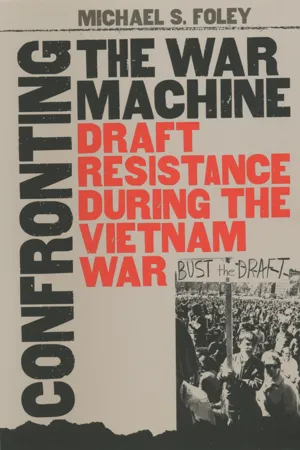
Shedding light on a misunderstood form of opposition to the Vietnam War, Michael Foley tells the story of draft resistance, the cutting edge of the antiwar movement at the height of the war’s escalation. Unlike so-called draft dodgers, who left the country or manipulated deferments, draft resisters openly defied draft laws by burning or turning in their draft cards. Like civil rights activists before them, draft resisters invited prosecution and imprisonment.
Focusing on Boston, one of the movement’s most prominent centers, Foley reveals the crucial role of draft resisters in shifting antiwar sentiment from the margins of society to the center of American politics. Their actions inspired other draft-age men opposed to the war — especially college students — to reconsider their place of privilege in a draft system that offered them protections and sent disproportionate numbers of working-class and minority men to Vietnam. This recognition sparked the change of tactics from legal protest to mass civil disobedience, drawing the Johnson administration into a confrontation with activists who were largely suburban, liberal, young, and middle class — the core of Johnson’s Democratic constituency.
Examining the day-to-day struggle of antiwar organizing carried out by ordinary Americans at the local level, Foley argues for a more complex view of citizenship and patriotism during a time of war.
- 456 pages
- English
- ePUB (mobile friendly)
- Available on iOS & Android
eBook - ePub
About this book
Information
Topic
GeschichteSubtopic
Nordamerikanische GeschichteNotes
ABBREVIATIONS
AJP | Alex Jack Papers, personal collection |
ASCA | Arlington Street Church Archives, Arlington Street Church, Boston, Mass. |
BDRG | Boston Draft Resistance Group |
BSP | Benjamin M. Spock Papers, Bird Library, Syracuse University, Syracuse, N.Y. |
BTP | Barrie Thorne Papers, Michigan State University, East Lansing, Mich. |
CFDCR | Case Files, U.S. District Court Records, National Archives, Waltham, Mass. |
CFP | Charles S. Fisher Papers, personal collection (now at Swarthmore) |
CNVA | Committee for Non-Violent Action |
HMP | Howard Marston Jr. Papers, personal collection |
JBP | The Reverend Jack Bishop Papers, personal collection |
JOP | James Oestereich Papers, personal collection |
LBJL | Lyndon B. Johnson Presidential Library, Austin, Tex. |
MFP | Michael Ferber Papers, personal collection (now at Swarthmore) |
MZP | Michael Zigmond Papers, personal collection |
NER | New England Resistance |
NPM | Richard Nixon Presidential Materials, National Archives, College Park, Md. |
NYT | New York Times |
RCP | Robert Chalfen Papers, personal collection |
RHP | Richard Hughes Papers, personal collection |
RSP | Robert Shapiro Papers, personal collection |
SCPC | Swarthmore College Peace Collection, Swarthmore, Pa. |
SSS | Selective Service System |
WHCF | White House Central Files |
WHSF | White House Special Files |
INTRODUCTION
1. Although Sandi Cooper covers European pacifists before the Great War, her use of “patriotic pacifism” is germane to the subjects of this study. See Cooper, Patriotic Pacifism.
2. See, for example, Powers, Vietnam; Zaroulis and Sullivan, Who Spoke Up?; Small, Johnson, Nixon, and the Doves; DeBenedetti, American Ordeal; Wells, War Within; Jeffreys-Jones, Peace Now! With the exception of Wells, each of these historians weaves brief discussions of draft resistance with discussions of the rest of the antiwar movement. Wells (War Within, 191–95, 268–70) gives the most attention to draft resistance, but even he understates its impact. Although he credits draft resistance with affecting the rest of the antiwar movement and American policy in Vietnam, he provides comparatively few details about the lives and motivations of rank-and-file draft resisters and, instead, relies on a few interviews with former Resistance leaders. For a broader trajectory of the peace movement since the 1930s, see Wittner, Rebels against War. And for a national overview written by an active leader in the antiwar movement, see Halstead, Out Now!
Of course, as syntheses, these studies cannot capture every subset or geographical difference present in the antiwar movement. This book, therefore, will join Heineman, Campus Wars; Swerdlow, Women Strike for Peace; Moser, New Winter Soldiers; and Hunt, Turning, in answering Christian Appy's call for more complexity and nuance at the local level of the antiwar movement. See Appy, “Give Peace Activism a Chance,” 142.
3. Gitlin, Sixties, 291–92; Terry Anderson, Movement and the Sixties. Rossinow, Politics of Authenticity, gives only the briefest mention of draft resistance within a larger discussion on New Left masculine identity; Isserman and Kazin, America Divided, give two paragraphs to draft resistance; Burner, Making Peace with the 60s, treats draft resistance in one paragraph; Farrell, Spirit of the Sixties, captures the influence of religiosity in social movements of that decade—an important point—but discusses draft resistance in only a handful of paragraphs; Morgan, 60s Experience, treats it in a few paragraphs; Burns, Social Movements of the 1960s gives a little more attention to the Resistance than most but mischaracterizes it as “probably the most suffused [of New Left organizations] with countercultural values and lifestyle.” The book cover's dominant image is also a man burning a draft card; Miller, Democracy Is in the Streets, focuses primarily on Students for a Democratic Society and draft resistance is all but ignored; Matusow, Unraveling of America, like Terry Anderson, addresses draft resistance in only a couple of pages; Blum, Years of Discord, dates draft resistance earlier than it actually occurred and makes it seem more like an SDS effort than it was; Farber, Age of Great Dreams, gives a brief, incorrect representation of draft resistance (“A group called the Resistance urged young men to burn their draft cards in public. Thousands did.”); Terry Anderson, Sixties, ignores draft resistance altogether.
4. Caute, in Year of the Barricades, 127–35, provides a breezy summary of draft resistance in 1968 and directs almost all of his attention to the Spock trial rather than to the tactic of resistance. See also Fraser, ed. 1968; Witcover, Year the Dream Died.
5. See, for example, Collier and Horowitz, Destructive Generation, and Garfinkle, Telltale Hearts.
6. An unscientific sampling of fourteen current college textbooks reveals the emphasis on the more controversial burning of draft cards and draft dodging. Only James Henretta et al., America: A Concise History (Boston: Bedford Books, 1999), actually name the Resistance and its omega symbol. Even so, they emphasize draft card burnings and make it seem as though the Resistance supported draft dodgers: “Several thousand young men ignored their induction notices risking prosecution for draft evasion. Others left the country, most for Canada or Sweden. The Resistance, started at Berkeley and Stanford and widely recognized by its omega symbol, supported these draft resisters.” Other textbooks either ignore or barely mention draft resistance. For example, George Brown Tindall and David E. Shi, America: A Narrative History, 4th ed. (New York: Norton, 1996), 2:1441, mentions draft resistance but lumps it together in a paragraph mostly about draft dodging; James West Davidson et al., Nation of Nations: A Narrative History of the American Public, 3rd ed. (Boston: McGraw-Hill, 1998), 2:1105, empha...
Table of contents
- Cover Page
- Title Page
- Copyright Page
- Dedication
- Contents
- Preface
- Acknowledgments
- Introduction. Draft Resistance in American Memory
- I. Toward a Movement
- II. Confrontations and Misconceptions
- III. Peaks, Valleys, and the Changing Horizon
- Epilogue
- Appendix A: Tables
- Appendix B: Statement on Methodology
- Appendix C: Letter to Survey Recipients and Questionnaire
- Notes
- Bibliography
- Index
Trusted by 375,005 students
Access to over 1.5 million titles for a fair monthly price.
Study more efficiently using our study tools.
Frequently asked questions
Yes, you can cancel anytime from the Subscription tab in your account settings on the Perlego website. Your subscription will stay active until the end of your current billing period. Learn how to cancel your subscription
No, books cannot be downloaded as external files, such as PDFs, for use outside of Perlego. However, you can download books within the Perlego app for offline reading on mobile or tablet. Learn how to download books offline
Perlego offers two plans: Essential and Complete
- Essential is ideal for learners and professionals who enjoy exploring a wide range of subjects. Access the Essential Library with 800,000+ trusted titles and best-sellers across business, personal growth, and the humanities. Includes unlimited reading time and Standard Read Aloud voice.
- Complete: Perfect for advanced learners and researchers needing full, unrestricted access. Unlock 1.5M+ books across hundreds of subjects, including academic and specialized titles. The Complete Plan also includes advanced features like Premium Read Aloud and Research Assistant.
We are an online textbook subscription service, where you can get access to an entire online library for less than the price of a single book per month. With over 1.5 million books across 990+ topics, we’ve got you covered! Learn about our mission
Look out for the read-aloud symbol on your next book to see if you can listen to it. The read-aloud tool reads text aloud for you, highlighting the text as it is being read. You can pause it, speed it up and slow it down. Learn more about Read Aloud
Yes! You can use the Perlego app on both iOS and Android devices to read anytime, anywhere — even offline. Perfect for commutes or when you’re on the go.
Please note we cannot support devices running on iOS 13 and Android 7 or earlier. Learn more about using the app
Please note we cannot support devices running on iOS 13 and Android 7 or earlier. Learn more about using the app
Yes, you can access Confronting the War Machine by Michael S. Foley in PDF and/or ePUB format, as well as other popular books in Geschichte & Nordamerikanische Geschichte. We have over 1.5 million books available in our catalogue for you to explore.