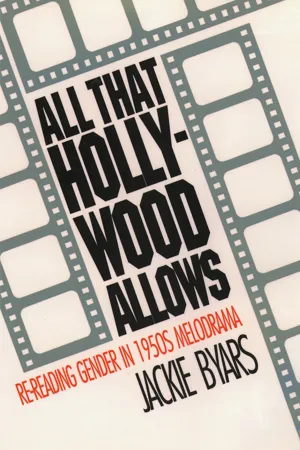
All That Hollywood Allows explores the representation of gender in popular Hollywood melodramas of the 1950s, the last decade in which film enjoyed a pivotal cultural position. Both a work of feminist film criticism and theory and an analysis of popular culture, this provocative book examines from a cultural studies perspective the top-grossing film melodramas of that decade, including A Streetcar Named Desire, From Here to Eternity, East of Eden, Imitation of Life, and Picnic.
Stereotypically viewed as a complacent and idyllic time, the 1950s were actually a period of dislocation and great social change as Americans struggled to regain their equilibrium in the wake of World War II. Jackie Byars argues that mass-media texts of the period, especially films, provide evidence of society’s consuming preoccupation with the domestic sphere — the nuclear family and its values. The melodramas included in her study appeared in theaters just as women were leaving their homes for the workplace. Some films challenged and some reinforced previously sacrosanct gender roles. Byars shows how Hollywood melodramas participated in, interpreted, and extended societal debates concerning family structure, sexual divisions of labor, and gender roles.
Byars’s readings of these films assess a variety of critical methodologies and approaches to textual analysis, some central to feminist film studies and some that previously have been bypassed by scholars in the field. She specifically questions the validity of readings grounded solely on the premises of psychoanalysis, arguing that the male norm inherent in the psychoanalytic viewpoint may well prevent us from hearing, let alone understanding, the female voices that make their way into the most patriarchal of films. Byars thus critiques earlier approaches to the study of women’s films and offers fresh readings, emphasizing from several important perspectives the suppressed female voice.
- 336 pages
- English
- ePUB (mobile friendly)
- Available on iOS & Android
eBook - ePub
About this book
Information
Subtopic
Film History & Criticism1
Cultural Studies
An Alternative for Feminist Film Studies
Feminism and Film in the United States
Criticism and theory are processual, characterized by struggle, internal and external. During the late 1960s and early 1970s, as feminists challenged the confines of women’s social, political, and economic roles, feminist critics and theorists examined the roles and representations of women in the production, distribution, and consumption of cultural texts; they questioned the process that constructs and reconstructs “Woman,” aiming to intervene in that process. Feminist film critics in the United States, by revealing the inadequacies of women’s roles and images in Hollywood films, challenged the assumption that entertainment texts are either insignificant or neutral; these critics claimed that the films had had detrimental effects on real women and argued for more positive representations of women. Their criticism was characterized by a sociological orientation. The pioneering journal Women and Film (published from 1972 to 1975) was established to provide an outlet for their work, and special issues on women and film were published by Velvet Light Trap, Take One, and Film Library Quarterly. The high point of this early era of feminist film criticism came in 1973, when both Molly Haskell and Marjorie Rosen published books that surveyed Hollywood’s stereotyping and misrepresentation of women and women’s experiences.1
During this period, American feminist filmmaking closely paralleled American feminist film criticism, with filmmakers’ primary concern being the documentation of the “real” lives of “real” women. Feminist documentaries filled women’s film festivals in New York, Toronto, Washington, and Chicago. In 1971 alone, Growing Up Female, Janie’s Janie, Three Lives, and The Woman’s Film were released in the United States, products of the first generation of feminist documentarians in the United States.2 By the mid to late 1970s, however, the arena of American feminist film studies and filmmaking became internally conflicted; documentarians and critics alike faced charges of theoretical naivete, and sociological feminist film criticism was rapidly displaced from the mainstream of feminist film criticism and theory in the United States by an approach based in semiotics and psychoanalysis, a displacement that had already occurred within French film theory and within the British feminist film theory directly influenced by French theory.
Christian Metz, a French linguist and film theorist, had already produced an important body of work on semiotics and film “language” when his students began asking about fellow Parisian Lacan’s new readings of Freud’s theories of psychoanalysis.3 Metz became increasingly interested in psychoanalysis and, attracted to Lacan’s ideas, incorporated many of them into his descriptions of narrative form, film language, and reception. Lacan’s emphasis on the importance of language in the process of identity development (for Lacan, it was central) appealed to those whose work involved language—particularly those in the areas of literary and film studies. Increasingly—if problematically (see chapter 4)—Lacan’s theories became central to much film theory, including—surprisingly—feminist film theory.4 During the 1970s, film theorists editing and publishing in the influential British film journal Screen (among them, feminists such as Laura Mulvey) combined their interest in semiotic analysis and psychoanalysis with a rejection of orthodox Marxist notions of ideology, concluding—unlike their counterparts at the Centre for Contemporary Cultural Studies in Birmingham—that significatory processes are virtually autonomous from other arenas (i.e., the economic) and that it is through the forms of signification that values, ideas, and, therefore, practices are instilled. The overwhelming emphasis on semiotics and psychoanalysis led to the assumption that it is only through significatory processes that human “subjects” are formed and social change occurs, an assumption that continues to plague feminist film theory.
Up to this time, most feminists had been highly skeptical of psychoanalysis, both because it presents the male as the norm and the female as abnormal and because one of its primary practical uses had been to keep women in “their place.” Women with “abnormal” behaviors were often sent to psychiatrists—and sometimes to institutions—where psychoanalytic methods were used to modify their behavior so that they could passively fit into the patriarchal scheme of things. But during the mid-1970s, the British feminists Juliet Mitchell, with Psychoanalysis and Feminism, and Laura Mulvey, with “Visual Pleasure and Narrative Cinema,” argued that psychoanalysis—by allowing for an understanding of women’s oppression—had a powerful political potential for feminism. The feminist turn to psychoanalysis was a shocking move, but Mitchell’s theorizing quickly spread among English-speaking feminists, and Mulvey’s article was published in Screen and acknowledged by both British and American feminists as a landmark in the shifting arena of feminist film theory.
The feminist concern for meaning and interpretation remained constant, but the critical and theoretical focus shifted away from the content of films and toward their formal patterns. Drawing on the highly formalist “semio-psychoanalysis” or “cine-psychoanalysis,” film critics explicated the way “realist” filmic techniques (particular kinds of camerawork, editing, etc.) give the impression of transparency, the impression that the medium simply records and shows the world “as it is,” while the techniques actually function to naturalize dominant ideologies through a manipulation of film language. Semiotics provided the tools for textual analysis that allowed critics to examine the processes by which films encourage certain interpretations; with these tools, feminist critics revealed that the “language” of “dominant cinema” contributes to women’s oppression. Because sociologically oriented criticism paid no attention to this aspect of film, it was dismissed as hopelessly naive and it rapidly became passe in film studies—the baby, as it were, thrown out with the bathwater.
By the mid-1970s, American feminists had begun studying film theory in Paris with Metz, with the literary and film analyst Raymond Bellour, and with their colleagues, whose work had already penetrated the male mainstream of film theory in both Great Britain and the United States; by the late 1970s, feminist film theory was an arena no longer clearly divided by the Atlantic.5 Metz’s theoretical work and Bellour’s psychoanalytically based textual analyses proved particularly useful for feminists; Bellour’s explanation of film form included descriptions of the way Hollywood films positioned female characters for the spectator.6 In 1976, some of the feminists who had studied in Paris, former members of the editorial board of Women and Film, established the American feminist film journal Camera Obscura, through which they expressed an explicit concern with structuralism, semiotics, and psychoanalysis.7 Early issues of Camera Obscura included translations of the French theorists and critics with whom these feminists had studied, bringing semio-psychoanalysis—inflected by the editors’ own feminism—into the heart of American feminist film studies, where it has remained. The feminist analysis of women’s oppression now extended to—but was often limited to—the forms and processes of meaning-making.8 Hollywood films—characterized as the products of the “dominant” or “classical” realist cinema—were shown to victimize both female characters and female viewers, and many feminist critics and filmmakers turned to the experimental avant-garde for hopes of a liberatory “counter-cinema.”
By the late 1970s, this theoretical self-consciousness had become evident in British feminist filmmaking. Laura Mulvey and Peter Wollen made highly abstract experimental films (Riddles of the Sphinx, 1976, and Amy!, 1980), as did Sally Potter (Thriller, 1979). And while the cinema vérité documentary form continued to dominate American feminist filmmaking, some filmmakers began experimenting. Michelle Citron’s Daughter-Rite (1978) seemed to be a documentary but turned out to be a fiction. And the highly theoretical and abstract Sigmund Freud’s Dora (1979, by Andrew Tyndall, Anthony McCall, Claire Pajaczkowska, and Jane Weinstock) built directly on and from British and French avant-garde filmmaking.9 In the early 1980s, several books reviewed and consolidated the gains made in feminist film studies; they included Annette Kuhn’s Women’s Pictures: Feminism and the Cinema (1982), E. Ann Kaplan’s Women and Film: Both Sides of the Camera (1983), and Re-vision (1984), the “state-of-the-art” anthology edited by Mary Ann Doane, Patricia Mellencamp, and Linda Williams. Feminist film studies had come a very long way in its brief history, but as in other areas within feminist studies, there remained important unanswered questions.
In the mid to late 1980s, most of the questions central to feminist film theory and even to feminist film criticism concerned textual consumption: the nature of the “spectating subject” and her or his relationship to the filmic text. Most feminist film theorists and critics take a stand on this issue, implicitiy or explicitly, and their textual analyses often provide the space for expressing competing positions, the sites for struggle.10 The roots of the various disagreements surrounding the concept are found in the differences between sociology and psychology and in the distinct notions of spectatorship the two fields have generated. Indeed, the roots of most disagreements in film studies can be found in the seemingly inherent distinctions between the study of social groups (sociology) and the study of the formation and forms of the individual psyche (psychology); moving beyond many theoretical impasses involves moving beyond the notion that these fields—and the theories in which they are based—are incommensurable. The duality of the “social” and the “psychic” may be tired, but its presence lingers, influentially. The constant presence of this duality inhibits the development of what I call a “materialist psychoanalysis” but can also serve as the springboard for its development.
Briefly: “the subject” began its life in film theory as a notoriously ambiguous psychoanalytic concept used to describe the ongoing product-process of discursive practices. The argument follows: the subject and the Unconscious are constructed through the (unconscious) process of acquiring language, which entails a series of repressions. The Unconscious, then, is structured “like” language, although sometimes people forget that the language analogy is just that—an analogy. Cinema too is structured “like” language, and the analogic relationship is even more likely to be forgotten here. Then, a further analogy: because language, cinematic language, the language of the Unconscious, and basically “reality” have now become virtually conflated, the subject is seen to be “appropriately” positioned in ideology through manipulations of “cinematic language.”11 As a result, the subject is considered a discursive phenomenon, and subjects are believed to be formed in and changed through—and only through—discourse. But this discursive subject is distinguished from the “historical” or “social” subject—the “real” human being who lives and acts in the world, the seemingly unified, individual human watching a film. Two of the articles included in Re-vision are, in fact, concerned with this issue: the nature of the “spectating subject” and her or his relationship to the filmic text. Teresa de Lauretis’s contribution to Re-vision (also included in a collection of her essays, Alice Doesn’t, published the same year) examines the potential of Michel Foucault’s “discourse analysis” (referenced in two other articles in the anthology) for explaining a particular reader—in this case, herself. Explaining real readers, she argued, should be the task of feminist critical practice, which she felt no longer needed the demonstration of “the functioning of ‘woman’ as the support of masculine vision, the restoration of Oedipus’ sight, or the odd term in the relations of power.”12 She was, of course, correct, so far as use of the theories and methods for demonstrating such phenomena are concerned. We do not really need yet another explication of the victimization of “woman” by that pernicious male gaze. We do, however, need to question the adequacy of the theoretical framework that insists it has answered certain questions for all texts and all times and places.
De Lauretis attempted, with her writing, to engage in a discursive struggle to “challenge theory on its own terms.” In Alice Doesn’t, she took responsibility for her own voice, confronting the “masters” of semiotics, psychoanalysis, and narrative theory as she struggled to “produce the conditions of visibility for a different social subject”—woman.13 In the essay included in both books, de Lauretis used Foucaultian concepts and categories to explain her reading of Nicholas Roeg’s film Bad Timing, finding that the value of Foucault’s thinking lies, first, in the insistence on abandoning the notion that a single discursive practice—like the cinema—can be understood in isolation and, then, in the assurance that possibilities for resistance exist everywhere. She saw, however, a danger in the tendency toward totalizing “discourse.”
Christine Gledhill expressed even greater reservations about “discourse theory” in her contribution to Re-vision. She reworked a previously published exploration of the theoretical underpinnings of feminist film studies, which, she noted, appropriated tools developed within patriarchy for an analysis of patriarchy itself. Reviewing feminist positions in the debates over realism, ideology, psychoanalysis, and cultural practice, Gledhill concluded with an outline of current problems and suggestions for directions in addressing them. Observing that the neo-Marxist, semiotic, and post-structuralist theories of Althusser, Barthes, and Lacan had been assumed rather than explained (and, certainly, never questioned), Gledhill argued that the theoretical framework erected by feminist film critics restricts “the kinds of questions it asks of cinema and the range of film practices it makes available for feminist development.”14 The struggle for social change is, after all, basic to feminism, and we cannot afford to limit our strategies unnecessarily.
Feminists have a greater motivation than many other theorists to link the theoretical with the practical, and as a result, this distinction between discursive subject and social-historical subject has proved especially problematic. The split raises numerous questions, and responses come from such different theoretical bases that they may almost be considered not different varieties of the same species but different species altogether—apples and oranges, so to speak. Primarily, what is the relation between the “social” spectator and the spectator positioned by the text? Additionally, what is the relation between the spectator and film form? How does identification work? How do the unconscious desires of the spectator influence interpretation? How much control can a spectator exert over her or his interpretation? How can we account for the existence of varying defensible feminist readings of a text? And, especially important for feminists, is spectatorship gendered?15
The first clear position on the question of gendered spectatorship was constructed in response to the question “Is the gaze [the construction of the characters’ and spectators’ look or point of view] male?” The earliest, most rigid answer was “Yes, but though the spectator may or may not be male, she or he is constructed by the text as masculine.” E. Ann Kaplan presented this position—a bit more sophisticated than the claim that the gaze is “male”—in Women and Film (1983). Based on Lacanian psychoanalysis, this response assumes a rather direct parallel between spectating and voyeurism and depends on the assumption that voyeurism is inherently masculine. But even this cinematic voyeurism is not considered truly an activity; the spectator passively submits to the text’s manipulations. The text controls its own reading.
Laura Mulvey, in “Afterthoughts on ‘Visual Pleasure and Narrative Cinema’ Inspired by Duel in the Sun” (1981), argued for a second position. She argued that spectatorship is indeed gendered but that pleasure in film viewing is inaccessible to the “feminine” portions of the psyche; the female spectator calls up a long-repressed masculinity to engage in the transsexual identification that can allow her pleasure in film viewing. This response is based on Freud’s description of female development, a description that initially assumed the masculine as base but eventually came to include bisexuality in that base, still excluding certain experiences (voyeurism among them) from the “feminine.” The response—more sophisticated than an essentialist argument in its use offeminine and masculine as terms not determined by biology—still assumes a passive (male or female) spectator, whose interpretation is controlled by the text itself.
A third position on gendered spectatorship argues that the text presents multiple and contradictory spectating positions and that the female spectator juggles these, identifying with none but rather with contradiction itself. One permutation of this explains the female reader as traumatized by pre-Oedipal separation anxiety (separation from the mother) and as constantly schizophrenic, constantly reading with a knowledge of her involvement in and separation from the text; she sees herself both identifying with the protagonist and knowing more than the protagonist. This response allows the spectator more agency in the construction of her reading and requires that she recognize the text’s preferred reading, as well as alternatives to that reading. In “‘Something Else Besides a Mother’: Stella Dallas and the Maternal Melodrama” (1984), Linda Williams took this position, and in Loving with a Vengeance (1982), Tania Modleski described readers of Harlequin romances as schizophrenic, simultaneously aware of their identification with the heroine and aware of the superior knowledge provided them by the text and by their knowledge of the rigid formula that governs it. Still, however, according to this response, the alternatives are encompassed by the text; still the text controls its own reading.
A fourth position allows for female spectatorship but assumes that “woman” (an abstract category representative of, but not synonymous with, actual living women) and “feminine sexuality” are so thoroughly colonized by patriarchy that female spectatorship is, therefore, not a viable liberatory subject positioning. In 1985, E. Ann Kaplan—influenced by Julia Kristeva—argued this position in Cinema Journal’s “Dialogue” section and later in “Feminist Film Criticism: Current Issues and Problems,” a review article for Studies in the Literary Imagination. This response assumes that subjects are constructed through language but that “woman is in all cases positioned in a signifying chain based on her representing lack, absence.” The response indicates that resistance is possible because the discourses in which language takes form do have gaps that permit “new articulations” through which “new subjects” may be formed.16 It is unclear, however, just how a lack can fill a gap.
Finally, my own position on gendered spectatorship denies the “radical innocence” of women and points to the ongoing participation and complicity of women in meaning-making pro...
Table of contents
- Cover Page
- Title Page
- Copyright Page
- Dedication
- Contents
- Acknowledgments
- Introduction: Saying What Can't Be Said, Reading What Must Be Read: Feminist Criticism, Melodrama, and Film Studies
- Chapter One: Cultural Studies: An Alternative for Feminist Film Studies
- Chapter Two: Re-reading Sociological Criticism: Roles, Stereotypes, and Popular Film Melodramas of the Early 1950s
- Chapter Three: Re-reading Narrative Structure and Gender: The “Social Problem” Film in the 1950s
- Chapter Four: Re-reading Psychoanalysis for Feminist Film Studies: The “Family Romance” and “the Gaze” in Female-Oriented Film Melodramas of the 1950s
- Chapter Five: Race, Class, and Gender: Film Melodramas of the Late 1950s
- Epilogue: Reflections
- Notes
- Bibliography
- Filmography
- Index
Trusted by 375,005 students
Access to over 1.5 million titles for a fair monthly price.
Study more efficiently using our study tools.
Frequently asked questions
Yes, you can cancel anytime from the Subscription tab in your account settings on the Perlego website. Your subscription will stay active until the end of your current billing period. Learn how to cancel your subscription
No, books cannot be downloaded as external files, such as PDFs, for use outside of Perlego. However, you can download books within the Perlego app for offline reading on mobile or tablet. Learn how to download books offline
Perlego offers two plans: Essential and Complete
- Essential is ideal for learners and professionals who enjoy exploring a wide range of subjects. Access the Essential Library with 800,000+ trusted titles and best-sellers across business, personal growth, and the humanities. Includes unlimited reading time and Standard Read Aloud voice.
- Complete: Perfect for advanced learners and researchers needing full, unrestricted access. Unlock 1.5M+ books across hundreds of subjects, including academic and specialized titles. The Complete Plan also includes advanced features like Premium Read Aloud and Research Assistant.
We are an online textbook subscription service, where you can get access to an entire online library for less than the price of a single book per month. With over 1.5 million books across 990+ topics, we’ve got you covered! Learn about our mission
Look out for the read-aloud symbol on your next book to see if you can listen to it. The read-aloud tool reads text aloud for you, highlighting the text as it is being read. You can pause it, speed it up and slow it down. Learn more about Read Aloud
Yes! You can use the Perlego app on both iOS and Android devices to read anytime, anywhere — even offline. Perfect for commutes or when you’re on the go.
Please note we cannot support devices running on iOS 13 and Android 7 or earlier. Learn more about using the app
Please note we cannot support devices running on iOS 13 and Android 7 or earlier. Learn more about using the app
Yes, you can access All That Hollywood Allows by Jackie Byars in PDF and/or ePUB format, as well as other popular books in Media & Performing Arts & Film History & Criticism. We have over 1.5 million books available in our catalogue for you to explore.