In the segregated South of the early twentieth century, unwritten rules guided every aspect of individual behavior, from how blacks and whites stood, sat, ate, drank, walked, and talked to whether they made eye contact with one another. Jennifer Ritterhouse asks how children learned this racial “etiquette,” which was sustained by coercion and the threat of violence. More broadly, she asks how individuals developed racial self-consciousness.
Parental instruction was an important factor — both white parents' reinforcement of a white supremacist worldview and black parents' oppositional lessons in respectability and race pride. Children also learned much from their interactions across race lines. The fact that black youths were often eager to stand up for themselves, despite the risks, suggests that the emotional underpinnings of the civil rights movement were in place long before the historical moment when change became possible. Meanwhile, a younger generation of whites continued to enforce traditional patterns of domination and deference in private, while also creating an increasingly elaborate system of segregation in public settings. Exploring relationships between public and private and between segregation, racial etiquette, and racial violence, Growing Up Jim Crow sheds new light on tradition and change in the South and the meanings of segregation within southern culture.
eBook - ePub
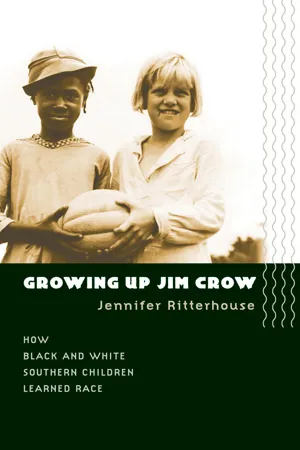
Growing Up Jim Crow
How Black and White Southern Children Learned Race
- 320 pages
- English
- ePUB (mobile friendly)
- Available on iOS & Android
eBook - ePub
About this book
Information
1 The Etiquette of Race Relations
On a mid-September evening in 1898, Mrs. J. F. Taylor and Mrs. H. E. Mosley of Winston-Salem, North Carolina, went for a ride on their bicycles. Nearing a tobacco factory, they encountered a crowd of African American workers spilling onto the sidewalk at the end of their shift. “Mrs. Taylor was in front and determined that she would ride ahead anyway, so she brushed past the negroes.” the Winston Free Press reported. One black woman “then got right in the middle of the path and Mrs. Mosley had to dismount from her wheel and roll it around the impudent negro wench, and all the impudent wenches laughed loudly and clapped their hands.” the Free Press continued, adding that “such exasperating occurrences would not happen but for the fact that the negro party is in power in North Carolina.” Blacks’ success in gaining several dozen mostly lower-level political offices in the 1896 elections had supposedly emboldened “bad negroes to display their evil, impudent and mean natures.” If white North Carolina newspapers were to be believed, blacks were becoming bolder all across the state that September, just a few weeks before the next statewide election. Newspapers reported all sorts of minor racial incidents, many of which involved white women out for a stroll or a breath of fresh air who were jostled, poked, swatted with umbrellas, and jeered by working-class black women they met on the street.
“What is going on here.” historian Glenda Gilmore asks. She suggests three possibilities. First, the stories might have been totally or partially made-up—“urban legends ... intended to arouse white male voters” and make sure that the Democrats, with their rhetoric of white supremacy and plans for disfranchisement, regained control after the state’s brief experiment with a biracial Republican-Populist “fusion” government. Second, white women might have been inspired by prevailing political bombast to report commonplace, but usually private, complaints. Third, these sidewalk tussles “may represent a departure from normal interaction; the stories may be at least partially true, and the laughter, poking, and physical isolation of white women by black women may constitute political actions using ‘weapons of the weak.’”1 This third possibility compels Gilmore and readers of her Gender and Jim Crow to examine these encounters as examples of working-class black women asserting their right to a public presence at a time when whites were moving to eliminate black male voters from the political arena. Bolstered by past successes, they challenged whites’ expectations for deference in order to dramatize their opposition to any political arrangement that would privilege leisured white women while denying black women and men visibility and voice in southern society.
Especially since the publication of political scientist James C. Scott’s Weapons of the Weak and Domination and the Arts of Resistance, historians such as Gilmore have paid considerably more attention to street-level wrangles between blacks and whites in the post-Civil War South than ever before. Although observers of the southern past had long been attuned to everyday forms of resistance practiced by slaves and, to a lesser extent, working-class African Americans, Scott and other theorists have encouraged a wide-ranging reexamination of such practices by recognizing that they were not merely individual expressions of frustration or recalcitrance but quintessentially political acts. In perhaps the clearest formulation of the argument, Scott describes the “public performance” demanded of workers, tenants, sharecroppers, serfs, and all others who are “subject to elaborate and systematic forms of social subordination.” “With rare, but significant exceptions.” he writes, “the public performance of the subordinate will, out of prudence, fear, and the desire to curry favor, be shaped to appeal to the expectations of the powerful.” Behind this “public transcript.” however, lies a “hidden transcript” crafted by subordinates themselves. Just as much a social performance as the performance of deference, this hidden transcript includes not only “back talk.” often expressed in folklore, songs, and jokes, as well as behind-the-scenes conversation, but also a range of dissident practices such as theft, foot-dragging, and sabotage. Such talk and behavior is not simply about individuals blowing off steam, Scott argues. Instead, taken together, the hidden transcripts of an oppressed group comprise an “infrapolitics” that is essential to the development of organized political protest. The reiteration and elaboration of discontent among subordinates lays the foundation for more overt political acts.2
For historians interested in the political views and agency of men and women who left few written records, Scott’s description of the hidden transcript has opened a wide range of speech and behavior to analysis. Thus, Gil-more can read between the lines of racist newspaper reports and understand working-class black women’s verbal and physical battle for precedence on the sidewalk in the context of an electoral battle for control of the North Carolina statehouse. Similarly, Robin D. G. Kelley has applied Scott’s concept of “infrapolitics” to his study of working-class black life in the mid-twentieth century to show “how seemingly innocuous, individualistic acts of survival and opposition shaped southern urban politics, workplace struggles, and the social order generally. ”3 Meanwhile, interest in slave resistance burgeoned to such an extent in the 1990s that at least one scholar felt it necessary to remind a rising generation of African American and labor historians that “their preferred historical agents ... got crushed in the nineteenth century, crushed by overwhelming material, institutional, and ideological power that no subaltern formation anywhere in the world could even begin to match. ”4
Such criticisms duly noted, analyses of black southerners’ hidden transcripts have added a great deal to our understanding of southern history both before and after emancipation. Yet there is still much to learn by subjecting the public transcript of southern race relations to the same degree of scrutiny. Scott and other like-minded scholars have given us a model for examining not only the “weapons of the weak” but also the workings of culture and—once we acknowledge that children participated in both public and hidden transcripts—how culture is perpetuated from one generation to the next. Building on Scott’s framework, we can write the history of late-nineteenth-and early-twentieth-century southern race relations as the story of how white southerners fought, with only partial success and against fierce opposition on the part of blacks, to undo the social, political, and economic changes wrought by the Civil War and Reconstruction and to shape a public transcript more to their liking. To do so required not only the subjugation of free black labor and the expulsion of blacks from electoral politics but also the reassertion of a code of domination and deference rooted in slavery—in short, racial etiquette.
This chapter traces the evolution of racial etiquette from slavery through emancipation and its aftermath and well into the twentieth century. I ask what the social code scripting interactions between blacks and whites was and what compelled blacks, in particular, to follow it. What were the relationships between etiquette and racial violence and etiquette and segregation? How does recognizing that racial etiquette shaped social relations both in private and in public (complicating black and white southerners’ experience of segregation as a new, essentially public, and largely urban and small-town arrangement of racial power relations) allow us, by looking at racial etiquette, to understand the gendered nature of domination more clearly? While Chapter 2 highlights white women’s roles in teaching racial etiquette to their children, in this chapter we see both white women and white men participating in everyday social dramas designed to keep blacks “in their place.”
The Role of Racial Etiquette
The fact is that the sidewalk bumptiousness that was so prominent among the weapons of the weak was also among the many and various weapons of the powerful. As historian Jane Dailey writes of 1880s Virginia, whites’ “urge for domination” often revealed itself “in small, routine, and seemingly insignificant ways, such as a calculated bump with a shoulder or an imperious demand for an ‘explanation’ when jostled on the street.” Black and white southerners spoke the same language (although with definite class inflections within each racial group) when it came to what was and was not respectful behavior, and whites routinely withheld from blacks all forms of civility that might imply that they were equals. At the same time, whites demanded that blacks display not only civil but often servile behavior, to be manifested in a wide array of verbal and physical cues. The code could be complex and varied, but it outlined a fundamental pattern of white supremacy that both blacks and whites understood. As Dailey notes, it was “the convergence of black and white opinion on markers of status and face in the postwar urban South that turned public behavior into a zero-sum game where one person’s gain was another’s clear loss. ”5 Whenever blacks rejected the command performance of deference—whenever whites lost the zero-sum game of racial etiquette—violence could and often did result. Because small and seemingly insignificant behaviors were not their only weapons, whites were almost always prepared to take the zero-sum game of domination and subordination to the next level.
If racial etiquette was important because breaches of etiquette resulted in violence, it was even more important because etiquette was not seriously breached most of the time. Violence was prevalent, and the possibility of violence was always in the back of black and white southerners’ minds. But it was not always in the forefront of their consciousness, even if it was a lot closer to the forefront of consciousness for blacks, who had to fear for their safety, than for whites. From one moment to the next, racial etiquette scripted the daily performance of power relations that Scott defines as the public transcript. By acting, at least outwardly, within the limits of the code, blacks avoided verbal or physical assault and whites maintained a sense of dominance that was also rooted in material and institutional power. On a day-to-day level—and especially in the eyes of black and white children who could not so easily see or comprehend the laws and labor arrangements on which white power also rested—etiquette as practiced was the defining idiom of southern race relations. Indeed, the enactment of racial etiquette was how the race line was most often drawn.
As historian J. William Harris observes, despite white southerners’ tendency to think of “races” as distinct and biologically determined, “it was not the presence of two races in the South that created a boundary between them, but the presence of a boundary that created two races. ”6 The Civil War and its aftermath shook the legal and economic foundations of the boundary that had been built up over the generations of blacks’ enslavement. With freedom, blacks gained not only new opportunities for economic and educational advancement but also a new legal and political identity. Congressional Reconstruction, and specifically the Fourteenth Amendment to the U.S. Constitution, ratified in 1868, brought citizenship, due process, and “the equal protection of the laws”—at least on paper. The ratification of the Fifteenth Amendment in 1870 strengthened voting rights for black men, and they would continue to exercise these rights, despite whites’ violent opposition, for the rest of the nineteenth century. Only after southern Democrats implemented poll taxes and literacy and understanding tests in the 1890s and early 1900s was the black vote effectively eliminated.7
White southerners reasserted their economic dominance more quickly, especially after the federal government abandoned early promises of “forty acres and a mule” and left penniless ex-slaves and their offspring to work out their destiny as sharecroppers, laborers, and—increasingly as the nineteenth century wore into the twentieth—as migrants to southern and northern cities. This migration began within the South as soon as slavery ended, and booming “New South” cities such as Atlanta and Nashville saw sharp increases not only in the numbers but also in the percentages of blacks in their rapidly growing populations throughout the late nineteenth century.8 Yet 90 percent of black Americans still lived in the South in 1917, and 75 percent of black southerners still lived in rural areas.9 With mobilization for war providing jobs and the flow of European immigrants cut off, World War I opened a floodgate. Nearly half a million blacks left the South during the war years, a number roughly equivalent to the total number of black out-migrants in the previous four decades. Another 800,000 black southerners moved north in the 1920s, followed by almost 400,000 in the 1930s. Long known as the Great Migration, this population shift planted the seeds for tremendous changes in the nation as a whole by the late twentieth century. The immediacy of such changes, however, should not be overstated, especially not for the South, where, despite three decades of departures, nearly 80 percent of all African Americans still lived in 1940. That black southerners continued to face economic and political oppression, as well as the humiliations of racial etiquette and other hardships, is evident in the fact that another 1.5 million left the South in the 1940s, as opportunities opened up with World War II, and an equal number left in the 1950s, the decade that saw the southern civil rights movement take flight.10
Nevertheless, for all the hardships they faced, black men and women had grounds for considerable optimism as they looked ahead from 1865, and white southerners recovering from the Civil War’s devastation had reason to feel that, if white supremacy was to be maintained—an absolute necessity, to their way of thinking—then they must act and act fast. “As racial subordination was reimposed in the long process of ‘redeeming’ the South, racial boundaries had to be drawn in new ways.” writes Harris. “A taboo on sexual contact between black men and white women became central to that boundary.... Racial subordination also was continually recreated in the routine actions of the everyday world.” where “racial etiquette and violence served to mark a new color line. ”11
In fact, what a look at racial etiquette before and after emancipation shows is that white southerners acted to redraw the color line in culture long before they were able to “redeem” the South in the areas of law and politics, which were more open to federal oversight. That whites acted as they did was only natural, given not only the force of custom but also their deeply held beliefs that blacks were inferior and mu...
Table of contents
- Cover Page
- Growing Up Jim Crow
- Copyright Page
- Dedication
- Contents
- Illustrations
- Acknowledgments
- Introduction
- 1 The Etiquette of Race Relations
- 2 Carefully Taught
- 3 I Knew Then Who I Was
- 4 Playing and Fighting
- 5 Adolescence
- Conclusion
- Notes
- Bibliography
- Index
Trusted by 375,005 students
Access to over 1.5 million titles for a fair monthly price.
Study more efficiently using our study tools.
Frequently asked questions
Yes, you can cancel anytime from the Subscription tab in your account settings on the Perlego website. Your subscription will stay active until the end of your current billing period. Learn how to cancel your subscription
No, books cannot be downloaded as external files, such as PDFs, for use outside of Perlego. However, you can download books within the Perlego app for offline reading on mobile or tablet. Learn how to download books offline
Perlego offers two plans: Essential and Complete
- Essential is ideal for learners and professionals who enjoy exploring a wide range of subjects. Access the Essential Library with 800,000+ trusted titles and best-sellers across business, personal growth, and the humanities. Includes unlimited reading time and Standard Read Aloud voice.
- Complete: Perfect for advanced learners and researchers needing full, unrestricted access. Unlock 1.5M+ books across hundreds of subjects, including academic and specialized titles. The Complete Plan also includes advanced features like Premium Read Aloud and Research Assistant.
We are an online textbook subscription service, where you can get access to an entire online library for less than the price of a single book per month. With over 1.5 million books across 990+ topics, we’ve got you covered! Learn about our mission
Look out for the read-aloud symbol on your next book to see if you can listen to it. The read-aloud tool reads text aloud for you, highlighting the text as it is being read. You can pause it, speed it up and slow it down. Learn more about Read Aloud
Yes! You can use the Perlego app on both iOS and Android devices to read anytime, anywhere — even offline. Perfect for commutes or when you’re on the go.
Please note we cannot support devices running on iOS 13 and Android 7 or earlier. Learn more about using the app
Please note we cannot support devices running on iOS 13 and Android 7 or earlier. Learn more about using the app
Yes, you can access Growing Up Jim Crow by Jennifer Ritterhouse in PDF and/or ePUB format, as well as other popular books in Social Sciences & North American History. We have over 1.5 million books available in our catalogue for you to explore.