Many early-nineteenth-century slaveholders considered themselves “masters” not only over slaves, but also over the institutions of marriage and family. According to many historians, the privilege of mastery was reserved for white males. But as many as one in ten slaveholders — sometimes more — was a widow, and as Kirsten E. Wood demonstrates, slaveholding widows between the American Revolution and the Civil War developed their own version of mastery.
Because their husbands' wills and dower law often gave women authority over entire households, widowhood expanded both their domestic mandate and their public profile. They wielded direct power not only over slaves and children but also over white men — particularly sons, overseers, and debtors. After the Revolution, southern white men frequently regarded powerful widows as direct threats to their manhood and thus to the social order. By the antebellum decades, however, these women found support among male slaveholders who resisted the popular claim that all white men were by nature equal, regardless of wealth. Slaveholding widows enjoyed material, legal, and cultural resources to which most other southerners could only aspire. The ways in which they did — and did not — translate those resources into social, political, and economic power shed new light on the evolution of slaveholding society.
eBook - ePub
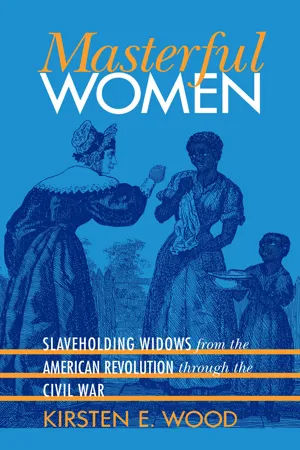
Masterful Women
Slaveholding Widows from the American Revolution through the Civil War
- 304 pages
- English
- ePUB (mobile friendly)
- Available on iOS & Android
eBook - ePub
Masterful Women
Slaveholding Widows from the American Revolution through the Civil War
About this book
Information
Topic
Scienze socialiSubtopic
Storia nordamericanaChapter 1: Broken Reeds
In the early nineteenth-century Southeast, published and private texts advised that man’s genius was to rule and woman’s to yield. In her popular 1828 advice book, Virginia Cary praised women for their greater facility at “submission.” A decade later, moral philosopher Jasper Adams admonished women that they must “give way” if ever they disagreed with their husbands.1 Although pliancy was sometimes considered a strength of the sex, it also suggested weakness. In 1812, Virginian Charles Cocke believed that widowhood had desolated a “tender” and “meek” kinswoman, who was now “like the broken reed, bending before the strong blast of adversity.” In Aesop’s fable, a possible source for Cocke’s metaphor, a reed wins a contest of strength with a tree because the reed bends before the wind, while the tree is uprooted. In the context of widowhood, the image harkened back to the discourse of feminine strength and resilience. Cocke may have had the Bible rather than Aesop in mind, however: the broken reed collapses under pressure, and Cocke described his widowed cousin as reduced “to the very dust.”2
Such images of womanly weakness obscure slaveholding men’s faith in and reliance on both wives and widows. Colonial historians have long known that southern widows’ share in and authority over their husbands’ estates declined over time. Less appreciated, however, is the fact that slaveholding widows’ resources and duties remained substantial despite that decline. In their laws and wills, slaveholding men continued to give widows access to and authority over property. During marriage, they also relied on wives to act as seconds-in-command, giving women experience with managing property in the process. In the largely rural communities of the Southeast, wives’ obligation to fill their husbands’ shoes changed relatively little from the mid-eighteenth through the mid-nineteenth centuries. These two continuities—between marriage and widowhood, and between the late colonial and early national periods—help explain both how widows incurred the obligations of household mastery and how they managed to fulfill them.
THE ROOTS OF nineteenth-century southern widowhood stretched back to English precedents which accompanied the colonists.3 English common law deemed widows legally independent individuals. Consequently, widows were judged competent to settle their husbands’ estates and were granted the first claim to administer intestate estates. Every widow was also legally responsible for managing her own property. That property usually took the form of dower, or a life estate in one-third of her husband’s lands. A widow could claim dower whether her husband died intestate or wrote a will. If the will allotted her less than dower, she could contest the legacy and be awarded her thirds. In real terms, the meaning of a dower share varied considerably. Among rural landowners, dower typically included all or part of a house plus farm land. Widows could use or sell whatever crops were produced from their dower land, but they could not sell or bequeath the land itself, and they had to protect its value. This meant, for example, that they could not raze timber stands and had to maintain fences and outbuildings.4
All of the southern colonies followed England in acknowledging widows’ dower thirds, legal personhood, and claim to administer intestate estates. They differed, however, in the shares of personal property they assigned to widows, a category that included furniture, tools, livestock, foodstuffs, and bedding. Virginia and North Carolina required that widowed mothers divide the personalty equally with their children, while the widows of childless men received one-third of their husbands’ personal property. In Georgia, widowed mothers also received a child’s share, but childless widows took one half. South Carolina decreed that widows should take one-third whether or not their husbands had children.5 The tendency to treat widows somewhat less generously in the Upper South also shaped the distribution of slaves. Under Virginia’s intestacy law, widows received slaves only for life, on the premise that slaves should descend on the same terms as land. In North Carolina, widows also took slaves for life only, unless their husbands had no descendants. In South Carolina and Georgia, however, widows received absolute title to their slaves. This included the right to sell or devise them, and it made widows the owners of female slaves’ future offspring. Upper South widows were thus at a comparative disadvantage in their share of their husbands’ estates, although the day-to-day demands of slave management and agriculture loomed as large for widows who held slaves for life as for those who owned slaves outright.6
In the southern colonies, the statutes that undergirded widowhood changed little from the seventeenth century to the Revolutionary era, but their application shifted.7 The best known case concerns the Chesapeake. Through the first several decades of settlement, husbands in Virginia and Maryland favored widows over other heirs: nearly three-fourths of those who wrote wills bequeathed their widows more than their statutory thirds. A considerable proportion gave widows their entire estates for life or even outright,8 and the vast majority made their widows sole or joint executors.9 Over time, however, both widows’ legacies and their access to executorship declined markedly. By the Revolutionary era, far fewer husbands bequeathed their wives more than dower law required, and increasing numbers excluded widows from executing their estates. Before mid-century, nearly two-thirds of Amelia County, Virginia, husbands named their widows as executors—either sole or joint—but thirty years later, that proportion had slipped to 43 percent. In South Carolina, the proportion of widows named as sole executors declined by 50 percent during the eighteenth century.10
Yet while widows’ access to property and authority contracted, the responsibilities of widowed householders remained as substantial as ever. They had to order and pay for slaves’ provisions, keep an eye on field work, collect and pay debts, and sell whatever crops they raised. For slaveholders, this often entailed trans-Atlantic commerce. After Gawin Corbin died in 1760, his widow Hannah managed Peckatone plantation in Westmoreland County, Virginia, for many years. Corbin sold her tobacco through several London concerns, and she conducted an extensive business correspondence with these Londoners and fellow Virginians. Her contemporary Martha Custis ran a tobacco plantation between her first husband’s death and her remarriage in 1759. Custis had help from her husband’s former manager, but she personally negotiated terms with her London factors, sternly directing them in their duty “to get me a good price.”11 Mid-eighteenth century widows were less likely to receive managerial authority over non-agricultural businesses, but those who did were also involved in complex commercial and legal transactions. When Elizabeth Timothy’s husband died in 1738, she supported herself and her children by running the family print shop in Charleston. Timothy printed broadsides, pamphlets, and blank legal forms, published the South Carolina Gazette, and served as the official printer to the colony. In the mid-1740s, she diversified into books and stationery. According to the Timothys’ business partner, Benjamin Franklin, Elizabeth Timothy was an exemplary business woman, while her husband had been “ignorant in Matters of Account.” Franklin recalled that Elizabeth sent him accounts “with the greatest Regularity & Exactitude every Quarter.” She even managed “to purchase of me the Printing-house and establish her Son in it.” By the time she died, this enterprising widow owned at least six slaves, a house, and a small parcel of land, as well as books, silverware, and furniture.12
Critical in the managerial successes of slaveholding widows like Hannah Corbin and Elizabeth Timothy was their previous experience with productive and commercial endeavors. Timothy apparently learned accounting as a girl in the Netherlands, where formal education in such matters was not uncommon. Benjamin Franklin’s admiration for Elizabeth Timothy prompted him to recommend that parents include accounting in their daughters’ education, since that was “likely to be of more Use” to young women “than either Music or Dancing.”13 Genteel American families almost universally ignored this sound advice. Most slaveholding women learned about business in a more fragmentary fashion, by acting as agents for friends, relatives, and husbands. Slaveholding women routinely shopped for each other, for example, and they could also make agreements to buy or sell goods on their husbands’ behalf. If her husband was away, a wife could make a contract that would be legally binding upon him as long as it involved routine business and unless he contested her actions on his return: she could buy essential supplies, but she could not sell off the back forty.14 Wives also substituted for their husbands in supervisory capacities, overseeing slaves and other workers. Some wives spent only the occasional day as “deputy husbands,” but others managed for weeks or even months, in their husbands’ absence.15
Slaveholding wives’ ability to act as deputies hinged on the day-to-day mingling of domestic and business concerns within their households. According to the increasingly popular texts that instructed wealthy colonists in gentility—some of which Elizabeth Timothy herself may have published—the home should be a haven of elegance and leisure, not a site of labor and commerce. In reality, however, both productive and commercial activities occurred in slaveholders’ living spaces. Bed chambers and parlors were sites of business, not just testaments to wealth and good taste. Consequently, wives had the opportunity to witness transactions and decision-making. This passive education gave them at least some preparation for acting as their husbands’ deputies, which in turn provided women with some understanding of what might await them in widowhood.16
Also important to late colonial widows’ householding were their connections to well-placed and well-disposed men. Elizabeth Timothy’s success depended in part on conserving her ties to her husband’s business partner, Franklin, an enormous asset to anyone in the printing or bookselling trade. Planter widows similarly adopted their husbands’ commercial networks, selling tobacco to the same factors in London and relying on the same agents for more local business. Kinsmen made perhaps the most useful connections, particularly if they were themselves wealthy or politically prominent. A letter that Martha Custis’s cousin Mary Campbell wrote to the governor of Virginia provides a particularly clear example of how well-placed widows sought to manipulate their ties to even more powerful men. During Lord Dunmore’s brief tenure in the governor’s palace (1771–75), Mary Campbell asked him to halt an execution on her property, ordered by the General Court to settle her second husband’s debts. In her petition, Campbell appealed not only to justice, but also to her wealth and connections. As she reminded Dunmore, she possessed “a fortune that set me on a level with the foremost in the colony.” Equally significant, “both Birth & Marriage” connected her “to some of the best familys in Virginia.” Dunmore probably knew that she was a Dandridge by birth, and he would surely have remembered that her first husband had been John Spotswood, son of Governor Alexander Spotswood. As for her children—Alexander, John, Anne, and Mary Spotswood—their “names alone, methinks[,] should endear them to Virginia.” Campbell’s money and connections did not entirely exempt her from the law, but they loaned considerable force to her request for special treatment after the fact.17
The eighteenth century undoubtedly witnessed a pronounced contraction in widows’ access to property and managerial authority in their husbands’ wills, and the last quarter of the century did not reverse this decline. However, slaveholding widows continued to manage land, slaves, and often entire households up to the outbreak of the Revolution. The war years dramatically increased the number of female householders and the breadth of their responsibilities. Independence and revolution also altered longstanding patterns of thought and behavior, prompting at least some women to claim the rights of liberty and representation.
SLAVEHOLDING WIDOWS participated directly and indirectly in the Revolutionary struggle. Some became fierce partisans, many lost kinsmen to the war, and others fled violence or became its victims themselves. All encountered some economic disruption, from boycotting imported goods to losing property to American or British military forces. These challenging circumstances bested some women, but others developed new confidence, especially in their dealings with public authority. More generally, the war years confirmed that declining legacies and decreased access to estate management in the late colonial period had not caused a definitive female retirement from householding.
Some widows articulated political commitments well before independence. In the summer of 1767, Hannah Corbin participated in a response to the Stamp Act crisis, contributing £5 to a subscription honoring Lord Camden for his opposition to the Act. The funds were destined to commission a portrait of Camden to hang in the Westmoreland County courthouse, so that “all future Judges may be induced … to recollect those virtues the possession of which procures Lord Camden the love of his Country.” Because the Camden portrait was never painted, this political gesture was short-lived, but the subscription identified which Westmoreland notables—male and female—supported the American cause. It also suggests the thicket of relations that united them. In addition to Hannah Corbin, the contributors included four of Corbin’s brothers, her future sister-in-law Elizabeth Steptoe, and Elizabeth’s sister, Anne Washington.18
By 1774, both the imperial crisis and women’s interest in it had heightened considerably. In that year, a group of wealthy women from Edenton, North Carolina, made a joint public statement of their politics. To illustrate their support for patriot leaders in the colony, they jointly pledged “to do everything as far as lies in our power, to testify our sincere adherence” to the new boycott of British goods. The Edenton declaration involved an equally elite and interconnected group as the Camden subscription: among the signatories were Penelope Dawson and Jean Blair, close kin to a former and a future governor, as well as several of their kinswomen and close friends. This statement exposed its authors to public scorn in England, provoking a satirical cartoon and at least one letter likening the Edenton ladies to Amazons. North Carolinians, by contrast, received the Edenton ladies’ act far more favorably.19 More typical than the Edenton statement were the political sentiments that appeared in personal letters, especially after the fighting began. In the spring of 1778, North Carolina widow Elizabeth Steele reminded her brother-in-law in Pennsylvania “to pass no opportunity of giving us the news.” She also thanked him for sending her “the Crisis No. 5.” As she observed, this publication served “to brace our minds, long relaxed by the Inaction of the armies thro the winter season.”20 When the fighting later shifted to the South, Steele provided regular reports of battles and armies and begged for “northern intelligence” in return, reminding him that “you know I am a great politician.”21
Some widows found that the war spilled over from newspaper reports and battlefields into their neighborhoods and households.22 In May 1779, a rumor that “the British troops will certain be here by Wednesday night” set the women of Edenton, North Carolina, to frantically packing “every thing yesterday even to the Pictures and looking glasses.” That rumor proved unfounded, but two years later the town was less lucky. In mid-April 1781, “a certain account” of an English advance p...
Table of contents
- Cover Page
- Masterful Women: Slaveholding Widows from the American Revolution through the Civil War
- Copyright Page
- Dedication
- Contents
- Acknowledgments
- Introduction
- Chapter 1: Broken Reeds
- Chapter 2: The Management of Negroes
- Chapter 3: The Strongest Ties That Bind Poor Mortals
- Chapter 4: A Very Public Road
- Chapter 5: The Leading Men and Women
- Chapter 6: Worried in Body and Vexed in Heart
- Chapter 7: What Will Become of Us!
- Epilogue
- Notes
- Bibliography
- Index
Trusted by 375,005 students
Access to over 1.5 million titles for a fair monthly price.
Study more efficiently using our study tools.
Frequently asked questions
Yes, you can cancel anytime from the Subscription tab in your account settings on the Perlego website. Your subscription will stay active until the end of your current billing period. Learn how to cancel your subscription
No, books cannot be downloaded as external files, such as PDFs, for use outside of Perlego. However, you can download books within the Perlego app for offline reading on mobile or tablet. Learn how to download books offline
Perlego offers two plans: Essential and Complete
- Essential is ideal for learners and professionals who enjoy exploring a wide range of subjects. Access the Essential Library with 800,000+ trusted titles and best-sellers across business, personal growth, and the humanities. Includes unlimited reading time and Standard Read Aloud voice.
- Complete: Perfect for advanced learners and researchers needing full, unrestricted access. Unlock 1.5M+ books across hundreds of subjects, including academic and specialized titles. The Complete Plan also includes advanced features like Premium Read Aloud and Research Assistant.
We are an online textbook subscription service, where you can get access to an entire online library for less than the price of a single book per month. With over 1.5 million books across 990+ topics, we’ve got you covered! Learn about our mission
Look out for the read-aloud symbol on your next book to see if you can listen to it. The read-aloud tool reads text aloud for you, highlighting the text as it is being read. You can pause it, speed it up and slow it down. Learn more about Read Aloud
Yes! You can use the Perlego app on both iOS and Android devices to read anytime, anywhere — even offline. Perfect for commutes or when you’re on the go.
Please note we cannot support devices running on iOS 13 and Android 7 or earlier. Learn more about using the app
Please note we cannot support devices running on iOS 13 and Android 7 or earlier. Learn more about using the app
Yes, you can access Masterful Women by Kirsten E. Wood in PDF and/or ePUB format, as well as other popular books in Scienze sociali & Storia nordamericana. We have over 1.5 million books available in our catalogue for you to explore.