In this outstanding book Susan Strehle argues that a new fiction has developed from the influence of modern physics. She calls this new fiction actualism, and within that framework she offers a critical analysis of major novels by Thomas Pynchon, Robert Coover, William Gaddis, John Barth, Margaret Atwood, and Donald Barthelme.
According to Strehle, the actualists balance attention to questions of art with an engaged meditation on the external, actual world. While these actualist novels diverge markedly from realistic practice, Strehle claims that they do so in order to reflect more acutely what we now understand as real. Reality is no longer “realistic”; in the new physical or quantum universe, reality is discontinuous, energetic, relative, statistical, subjectively seen, and uncertainly known — all terms taken from new physics.
Actualist fiction is characterized by incompletions, indeterminacy, and “open” endings unsatisfying to the readerly wish for fulfilled promises and completed patterns. Gravity’s Rainbow, for example, ends not with a period but with a dash. Strehle argues that such innovations in narrative reflect on twentieth–century history, politics, science, and discourse.
- 293 pages
- English
- ePUB (mobile friendly)
- Available on iOS & Android
eBook - ePub
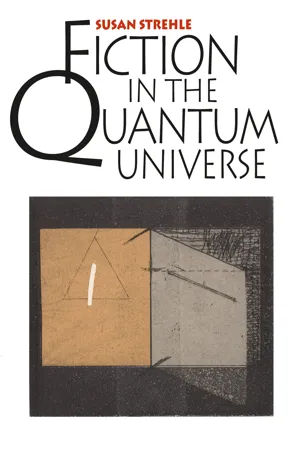
Fiction in the Quantum Universe
About this book
Information
ONE
ACTUALISM
FICTION IN THE QUANTUM UNIVERSE
According to conventional aesthetics, fiction aims either at the realistic representation of life or at the antirealistic exploration of artistic processes. It selectively focuses either on the human reality that is its subject or on the linguistic and formal rendering that constitutes its art. Fictional choices work this way because, for traditional theorists, perception itself functions in either-or fashion; visual and literary readings must choose a single plane of orientation. Authors therefore direct readers to observe either the garden outside the window or the glass through which the garden appears, in the metaphor proposed by Ortega y Gasset.
We have here a very simple optical problem. To see a thing we must adjust our visual apparatus in a certain way.... Looking at the garden we adjust our eyes in such a way that the ray of vision travels through the pane. . . . But we can also deliberately disregard the garden and, withdrawing the ray of vision, detain it at the window. We then lose sight of the garden. . . . Hence to see the garden and to see the windowpane are two incompatible operations which exclude one another because they require different adjustments. Similarly a work of art vanishes from sight for a beholder who seeks in it nothing but the moving fate of [the characters]. . . . The portrayed person and his portrait are two entirely different things; we are interested in either one or the other.1
Following this binary logic, Ortega y Gasset sees nineteenth-century realistic fiction as pandering to the masses, by reducing the “strictly aesthetic elements to a minimum” and encouraging readers to “revel in the human reality with which the work deals.” Modernism, by contrast, attempts a “purification of art” through the “progressive elimination of the human, all too human, elements.”
We might begin by objecting in principle: surely this is too simple a model of perception. Surely vision can accommodate awareness of both garden and pane; surely reading encompasses interests in both portrayed life and the means of portrayal. Readers have always brought some awareness of aesthetic elements to the reading of fiction, and authors have devoted their own attention to artistic processes even (or perhaps especially) when they sought to make their art invisible. Since poststructuralist and deconstructive theory have sharpened the focus on textual and intertextual issues, postmodern readers can hardly see the most avowedly realistic fiction as a clear transparency through which to study human reality. Its textuality remains always an element of the text before us. At the same time, most fiction neither manages nor even attempts to eliminate the human element, the lived reality expressed in story. Where there is plot and character, even in the most self-consciously aesthetic of modernist and postmodernist texts, there is inevitably also some degree of worldliness to the text. The constricting binary logic of realism and antirealism has, however, reduced fiction’s rich double interest in both art and life to a single dimension for many readers and critics.
The legacy of these assumptions becomes especially restrictive—even blinding, I would argue—for critics of postmodern fiction. While some writers appeal to realist assumptions about the world and the text (I think of Bellow, Fowles, Heller, Kesey, Oates, Morrison, Roth, Mailer, and Updike), others clearly and even explicitly refuse the realistic tradition in narrative, together with its vision of reality. Writers like Atwood, Barth, Pynchon, Gaddis, Coover, and Barthelme—as well as Hawkes, Didion, Coetzee, Kundera, Eco, Calvino, Puig, and Nabokov, for example—cannot be described as realistic. They are, therefore, approached as antirealists. Limited to these two exclusive alternatives, critics who have appropriately identified the divergence from realism in postmodern fiction can only place it in the opposite camp, which flies most prominently the banner of metafiction. It has been called other things as well: irrealism, counterrealism, surfiction, disruptive fiction, and parafiction.
Logically, then, criticism has emphasized the antireferential nature of postmodern fiction. It has no relation to the external world, whose “reality” it sees as questionable; instead, it self-reflexively confronts its own status as language, performance, mental construct, city of words. According to this interpretation, postmodern fiction becomes a stained-glass window through which nothing is visible. “Clearly, then, the parafictionist seeks to vaporize our common universe . . . and replace it with another within whose verbal boundaries art would become but one more way to experience the fiction of life.” For another critic, “If the world is absurd, if what passes for reality is distressingly unreal, why spend time representing it?” For another, surfiction “exposes the fictionality of reality.”2 Critics approach single authors with these assumptions—various essays place most of the writers I discuss in this book as metafictionists; equally, since Robert Scholes’s definitive essay “Metafiction” (1970), critics bring the metafictive paradigm to bear on groups of contemporary novelists.
Its exclusive self-reflexivity has become, in fact, the most common starting point for critical discussion of contemporary fiction, both by critics who condemn its narcissism and by others who approve its artful stratagems. Even “neutral” reporters on the state of affairs in contemporary letters can by now assume its metafictiveness, so that a broadly introductory survey like Robert Kiernan’s American Writing since 1945 labels the texts I discuss here metafiction, which is the most “interesting fiction in the postwar period.. .. Stressing the composed aspect of fiction, it tends to put in the foreground both language and authorship in an attempt not simply to undercut the illusions of realism but to discover new modes of narrative gamesmanship. Essentially, it is a body of fiction about the making of fictions.”3 Since surveys like Kiernan’s function in part to voice widely accepted premises, Kiernan’s easy assimilation of metafictive assumptions illuminates the pervasive assent to arguments made with thoroughness and rigor by Scholes, McCaffery, Klinkowitz, Alter, Waugh, Christensen, Hutcheon, Imhof, and dozens more.
Metafiction does, of course, exist. It is practiced consciously and adeptly by Gilbert Sorrentino, Ronald Sukenick, and Raymond Federman. Some of William Gass’s texts are explicitly metafictional; William Burroughs’s theoretical emphasis on the arbitrariness of narrative ordering makes him describable as a metafictionist. Steve Katz, B. S. Johnson, Ishmael Reed, Russell Banks, and others write fiction of which critics like Jerome Klinkowitz can justly and satisfactorily say that it “does not represent reality.... it creates a whole life of its own.”4 John Barth’s story “Autobiography” demonstrates the pure form of the metafictive impulse to foreground language, particularly through wordplay, and to explore theories of fiction-making. Philosophical, linguistic, theoretical in its interests and in its approach, and self-conscious to its core, metafiction is the educated offspring of modernist parents.
But what are we to make of the wealth of historically accurate detail in texts like Coover’s Public Burning or Pynchon’s Gravity’s Rainbow or Barth’s LETTERS? How are we to read the prominent commentary on Western culture, urban political economy, sexual and racial issues, and socially constituted forms of power and their abuse in texts like Gaddis’s J R, Atwood’s Cat’s Eye, and Barthelme’s Paradise? Far from excluding or “vaporizing” external reality, these texts, while patently not realistic, nonetheless seem impelled to explore, celebrate, criticize, and engage the outer world. These novels differ from the intentionally aesthetic narratives of metafiction.
The authors’ statements about their fiction differ, too, from the positions taken by thoroughgoing metafictionists. Ronald Sukenick, for example, writes that “reality doesn’t exist, time doesn’t exist, personality doesn’t exist”; and, “As artifice the work of art is a conscious tautology in which there is always an implicit (and sometimes explicit) reference to its own nature as artifact—self-reflexive, not self-reflective. It is not an imitation but a new thing in its own right, an invention.”5 To see the difference in emphasis, we can turn to Pynchon’s introduction to his collection of early stories, Slow Learner. Pynchon finds his early work flawed, in part by its false assumption that “one’s personal life had nothing to do with fiction, when the truth, as everyone knows, is nearly the direct opposite.” The fiction he admires most engages both art and life and makes its artistry “luminous” by expressing human reality. “In fact the fiction . . . that moved and pleased me then as now was precisely that which had been made luminous, undeniably authentic by having been found and taken up, always at a cost, from deeper, more shared levels of the life we all really live.”6 The authors I discuss in this book have all made similar statements suggesting not only that reality does exist but that art’s goal is to engage it.
These writers—Pynchon, Atwood, Barth, Coover, Gaddis, and Barthelme, as well as many others—cannot be described as metafictionists, however broadly one stretches the term, any more than they can be placed as neorealists.7 In contrast to the theoreticians of self-reflexivity, they want fiction to comment on a lived reality through the pane of art. In contrast to the neorealists, they believe art cannot efface itself or become pure transparency, unconscious of its status as created language. They affirm both art (self-consciously aware of its processes and of aesthetic traditions) and the real world (specifically, the postmodern world, with a detailed awareness of its nature and history). Their fiction admits both the garden and the glass.
In the realm of aesthetic theory, the longstanding duality separating art and reality, or the perceiver and the world, has been exploded by modern discoveries about the nature of perception. Thus the argument I’m making about the effort among contemporary novelists to find a position blending some transformed assumptions from realism and antirealism, to create an art about both reality and artistic process, appears in persuasive theoretical terms in Raymond Williams’s The Long Revolution.
The new facts about perception make it impossible for us to assume that there is any reality experienced by man into which man’s own observations and interpretations do not enter. Thus the assumptions of naive realism—seeing the things as they really are, quite apart from our reactions to them—become impossible. Yet equally, the facts of perception in no way lead us to a late form of idealism; they do not require us to suppose that there is no kind of reality outside the human mind; they point rather to the insistence that all human experience is an interpretation of the non-human reality. But this, again, is not the duality of subject and object—the assumption on which almost all theories of art are based. We have to think, rather, of human experience as both objective and subjective, in one inseparable process.8
Following Williams’s logic, we can understand the group of writers I’ve identified as radically original: they form a challenging new fiction that is based on the awareness of interpretation as an interactive process. While the neorealists attempt, often in subtle and sophisticated ways, to see things as they really are, and while the metafictionists or neomodernists bring theoretical intelligence to the late idealism that spins reality out of the mind, these other writers engage the double but undivided nature of art as the human interpretation of a nonhuman reality. Their version of postmodernism does not emerge, as some critics suggest, as a late echo or higher amplification of literary modernism. Rather, their fiction creates its own different aesthetic stance through a process John Barth terms “the synthesis or transcension of these antitheses, which may be summed up as the premodernist and modernist modes of writing. My ideal postmodernist author neither merely repudiates nor merely imitates either his twentieth-century modernist parents or his nineteenth-century premodernist grandparents.”9 Breaking out of the false and restrictive duality between realism and antirealism, these postmodern authors manage an original fusion that transforms both strands of their literary heritage.
Because the language of realism and antirealism carries with it outmoded assumptions about reality and art, we need a new term or aesthetic category for these writers and their texts. As Alan Wilde points out in his important book Middle Grounds, “For want of an adequate designation,” this “tertium quid of current literature” can only “languish in the outback of current criticism.” Wilde proposes to call the “referential but nonmimetic literature” we both admire “midfiction.” “Rejecting metafiction’s pronounced tilt toward the reflexive . . . and rejecting as well realism’s belief in the possibility of simple mimesis, midfiction is intended to suggest neither compromise nor mediation, and still less an inevitable or necessary moderation in its perceptions of the world and in the strategies that variously render them. What it does instead is to stake out a variety of middle grounds on which it tests the assumptions of other fictional forms and, more importantly, defines its own in opposition to them.”10 While I agree with many of Wilde’s assumptions and much of his assessment of contemporary fiction, I would fault his term for suggesting a static resting place, a ground midway between the poles of the binary dualism we both find so damaging. Intended to suggest broad latitude, range, and what Wilde elegantly terms “the close interanimation of consciousness and world, of perception and creation,” “midfiction” connotes too clearly the mean, or average, between extremes, where Wilde himself understands their transcension in a different mode of seeing and writing.
I propose, instead, to call the new mode of fiction actualism. I believe it emerges from a widespread change in the way reality is understood by the culture at large, and I see this shift localized usefully in the new physics. To anticipate a discussion I will complete after the necessary background in physical science, I derive the term “actualism” from a distinction Werner Heisenberg makes between the actual and the real.11 At the subatomic level, he says, reality is not real, but it is active, dynamic, “actual.” Actualistic fiction expresses, then, a literary version of the reality constituted by fundamentally new physical theories in the first half of the twentieth century. Departing from the stable material reality underpinning Newtonian science and realistic fiction, actualism abandons and even subverts the narrative conventions of realism. It does so, however, not to replace reality with the purified aesthetics of self-reflexivity, but rather, self-consciously and theoretically, to renew art’s readiness for its perennial project: the human interpretation of a nonhuman reality.
Actualism and the New Physics
Actualism develops in postmodern fiction because reality has changed. It has changed for thinkers in every field, and the shift has been described and theorized variously in different disciplines. Physics, the science devoted to studying nonliving reality, provides an especially pronounced measure of the change in worldview. While the general importance of the new physics may be known by most of the educated public, the extent to which relativity theory, quantum theory, and wave mechanics revolutionized previous concepts of reality deserves emphasis. In The Philosophical Impact of Contemporary Physics, Milič Čapek defines in strong language the “astonishment” generated by the way modern concepts transform classical physics. “There is hardly any similarity between the ‘matter’ of modern physics and the traditional material substance of the classical period, and this is true in varying degrees of other concepts as well.... It is true that the effect of [relativity, quantum theory, and wave mechanics] on the imagination of physicists, philosophers, and even laymen was truly shattering; the contrast between the new theories and the appealing clarity of classical concepts was sharp and shocking.”12 Similar assessments, with a frequent invocation of the term “revolution,” appear throughout studies of the new physics—one of them, revealingly, titled Dismantling the Universe.13
A skeptic might object here that, however radical the redefinition of reality in new physics, its impact on literature can hardly be immediate or direct—novelists surely don’t read physics journals, nor could they follow the mathematical or theoretical subtleties if they did. Granted: of the novelists I discuss in this book, only Pynchon has a sound education, undergraduate at that, in physics. But changes in physical theories inspire changes in a culture’s general attitudes, and art both responds to and shapes these assumptions. Physics and fiction inhabit the same planet, however divergent their discourses about it may be. Canadian fiction writer Alice Munro describes the way private individuals come to share the most progressive notions afloat in their culture: “It’s as if tendencies that seem most deeply rooted in our minds, most private and singular, have come in as spores on the prevailing wind, looking for any likely place to land, any welcome.”14 Writers ...
Table of contents
- Cover Page
- Title Page
- Copyright Page
- Dedication
- Contents
- Preface
- Chapter One ACTUALISM Fiction in the Quantum Universe
- Chapter Two THOMAS PYNCHON Gravity's Rainbow and the Fiction of Quantum Continuity
- Chapter Three ROBERT COOVER The Public Burning and the Accidents of History
- Chapter Four WILLIAM GADDIS J R and the Matter of Energy
- Chapter Five JOHN BARTH LETTERS and the Relative Frame
- Chapter Six MARGARET ATWOOD Cat's Eye and the Subjective Author
- Chapter Seven DONALD BARTHELME Paradise and the Uncertain Principles of Actualism
- Chapter Eight BEYOND THE BORDERS Actualism in the Quantum Universe
- Notes
- Bibliography
- Index
Trusted by 375,005 students
Access to over 1.5 million titles for a fair monthly price.
Study more efficiently using our study tools.
Frequently asked questions
Yes, you can cancel anytime from the Subscription tab in your account settings on the Perlego website. Your subscription will stay active until the end of your current billing period. Learn how to cancel your subscription
No, books cannot be downloaded as external files, such as PDFs, for use outside of Perlego. However, you can download books within the Perlego app for offline reading on mobile or tablet. Learn how to download books offline
Perlego offers two plans: Essential and Complete
- Essential is ideal for learners and professionals who enjoy exploring a wide range of subjects. Access the Essential Library with 800,000+ trusted titles and best-sellers across business, personal growth, and the humanities. Includes unlimited reading time and Standard Read Aloud voice.
- Complete: Perfect for advanced learners and researchers needing full, unrestricted access. Unlock 1.5M+ books across hundreds of subjects, including academic and specialized titles. The Complete Plan also includes advanced features like Premium Read Aloud and Research Assistant.
We are an online textbook subscription service, where you can get access to an entire online library for less than the price of a single book per month. With over 1.5 million books across 990+ topics, we’ve got you covered! Learn about our mission
Look out for the read-aloud symbol on your next book to see if you can listen to it. The read-aloud tool reads text aloud for you, highlighting the text as it is being read. You can pause it, speed it up and slow it down. Learn more about Read Aloud
Yes! You can use the Perlego app on both iOS and Android devices to read anytime, anywhere — even offline. Perfect for commutes or when you’re on the go.
Please note we cannot support devices running on iOS 13 and Android 7 or earlier. Learn more about using the app
Please note we cannot support devices running on iOS 13 and Android 7 or earlier. Learn more about using the app
Yes, you can access Fiction in the Quantum Universe by Susan Strehle in PDF and/or ePUB format, as well as other popular books in Literature & Literary Criticism Theory. We have over 1.5 million books available in our catalogue for you to explore.