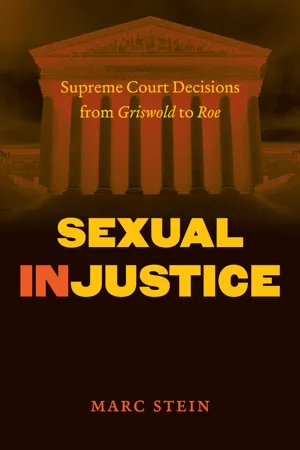
Focusing on six major Supreme Court cases during the 1960s and 1970s, Marc Stein examines the generally liberal rulings on birth control, abortion, interracial marriage, and obscenity in Griswold, Eisenstadt, Roe, Loving, and Fanny Hill alongside a profoundly conservative ruling on homosexuality in Boutilier. In the same era in which the Court recognized special marital, reproductive, and heterosexual rights and privileges, it also upheld an immigration statute that classified homosexuals as “psychopathic personalities.” Stein shows how a diverse set of influential journalists, judges, and scholars translated the Court’s language about marital and reproductive rights into bold statements about sexual freedom and equality.
- 384 pages
- English
- ePUB (mobile friendly)
- Available on iOS & Android
eBook - ePub
About this book
Information
Topic
DerechoSubtopic
Derecho públicoPart 1 : Decisions and Doctrines
1 : Liberalization's Limits from Griswold to Roe
Before 1965, U.S. federal, state, and local laws policed and produced sex in countless ways. Bans on oral and anal sex prohibited particular uses of specific body parts, promoting others in the process. Restrictions on adultery, bestiality, cohabitation, fornication, homosexuality, and incest distinguished between unacceptable and acceptable partners, as did statutes dealing with those deemed incapable of consent. Laws that regulated interracial marriage, marriage involving minors, marriage between members of the same family, plural marriage, and same-sex marriage identified some liaisons as less legitimate than others. Statutes criminalizing rape and assault constructed boundaries between involuntary and voluntary sex. Laws related to prostitution and other forms of sex work constituted some purposes of sex as less valid than others. Restrictions on sex in the military, prisons, and public space created institutional and geographic parameters for illegal and legal intimacies. Abortion, birth control, and sterilization statutes influenced the potentially reproductive consequences of sex, as did laws concerning illegitimacy, inheritance, and parenting. Sex was also policed and produced through laws on disorderly conduct, indecency, nudity, obscenity, sexual psychopathy, and sexually transmitted diseases. Meanwhile, in policy areas such as education, employment, health, housing, immigration, taxation, and welfare, legislation that seemingly had nothing to do with sex encouraged and discouraged specific forms of sexual expression.1
The overwhelming majority of these laws remained constitutional in 1973 after the Supreme Court's rulings in Griswold, Fanny Hill, Loving, Eisenstadt, and Roe. The Court had struck down state laws forbidding the use of contraceptives by married couples, prohibiting interracial couples from marrying, criminalizing the distribution of birth control materials to the unmarried, and imposing strict restrictions on abortions. The Court had also limited the application of obscenity laws by protecting materials with “redeeming social value.” These were major achievements, but the Court had not overturned a vast array of laws related to sex, leaving them presumptively constitutional. Most of the justices had suggested in cases concerning other matters that laws against nonmarital sex were constitutional.
This chapter examines the rulings in Griswold, Fanny Hill, Loving, Eisenstadt, Roe, and related cases, arguing that the Court in this period developed a doctrine of heteronormative supremacy. Recognizing special rights and privileges for adult, heterosexual, marital, monogamous, private, and procreative forms of sexual expression, the Court permitted denials of equal rights and privileges for other forms. Some have accused the Court of inconsistency in these rulings, asking, for instance, how the justices could recognize a right of sexual privacy while affirming the constitutionality of laws against nonmarital sex. Others have argued that no matter what the Court said, the decisions are best understood as affirming sexual freedom and equality. This chapter, in contrast, argues that the Court in the late 1960s and early 1970s never recognized rights of sexual privacy, freedom, or equality. More generally, chapter 1 identifies the consistent heteronormative principles articulated in these rulings and the ways in which these decisions were implicated in the ongoing formation of gender, class, and race hierarchies.
Searching for doctrinal consistency across these five rulings is difficult. To begin with, the Court's makeup changed: of the nine justices who decided Griswold in 1965, only four were on the Court when Roe was decided in 1973. Moreover, the justices changed their minds and their reasoning over time, and some treated previous rulings in which they had dissented as legitimate precedents for later rulings. In addition, the lead opinions in these five cases were credited to four different authors and in all five at least one justice agreed with the decision but not the reasoning of the lead opinion.
Nevertheless, the justices attempted, except in unusual circumstances, to make their decisions appear consistent, and this was their intention in the cases considered here. For example, although the rulings in Griswold, Eisenstadt, and Roe differed in important respects, the Court depicted them as consistent. Moreover, if we focus on the votes in these five cases, eight of the fifteen justices who served in this period—Blackmun, Brennan, Douglas, Fortas, Goldberg, Marshall, Powell, and Warren—consistently supported the Court's judgments in the cases in which they participated. After dissenting in Griswold, Stewart joined the liberalizing justices in the remaining cases. Rehnquist dissented in Roe, but he and Powell joined the Court too late to participate in the earlier decisions. The remaining five justices voted with the majorities in some but not all of the cases, primarily because of differing definitions of obscenity and conflicting views on whether privacy was protected by the Constitution. In short, it is possible to find elements of a collectively authored doctrine supported by a majority of the justices in these decisions. Key passages in the rulings from Griswold to Roe make it clear that the Court rejected sexual libertarianism and egalitarianism. Different passages may have suggested otherwise, but the presence of conservative and limiting language, available for use in later contexts, meant that sexual freedom and equality had not been secured.
Griswold (1965)
Griswold is often regarded as the foundational decision recognizing a constitutional right of sexual privacy, but the Court's ruling did not mention sexual privacy. What the Court affirmed was a right of marital privacy, and a majority of the justices made comments suggesting that laws against nonmarital sex were constitutional. In other words, Griswold was a pro-marriage ruling, and given the nature of marriage and sex law in 1965, the decision strengthened the supremacy of heteronormative sexual expression. As for procreation, although it may seem counterintuitive to argue that a ruling that increased legal access to contraception favored reproductive forms of sex, Griswold did just that by extending special protection to one type of sex, the type that was potentially reproductive.2
Writing for a majority of five (two other justices concurred with the decision but not the reasoning), Douglas offered a narrative of conflict between Estelle Griswold and C. Lee Buxton on the one hand and the state of Connecticut on the other. Griswold was described as the executive director of the state's Planned Parenthood League. Buxton was presented as a licensed physician, a Yale professor, and the medical director of the League's center in New Haven. According to Douglas, Griswold and Buxton were arrested for giving “information, instruction, and medical advice to married persons as to the means of preventing conception.” The statutes cited criminalized “any person who uses any drug, medicinal article or instrument for the purpose of preventing conception” and “any person who assists, abets, counsels, causes, hires or commands another to commit any offense.” Griswold and Buxton were found guilty of the latter, but the Court concluded that they also had “standing to raise the constitutional rights of the married people with whom they had a professional relationship.”3
The Court's conclusion was that the statute violated the constitutional privacy rights of married couples.4 Acknowledging that the Constitution nowhere explicitly mentions privacy, Douglas argued that “penumbras” and “emanations” originating in various constitutional provisions effectively established privacy rights. These provisions included the First Amendment's references to rights of speech and assembly; the Third Amendment's prohibition on the peacetime quartering of soldiers without homeowner consent; the Fourth Amendment's invocation of the rights of the people to be “secure in their persons, houses, papers, and effects, against unreasonable searches and seizures”; the Fifth Amendment's restriction on forced self-incrimination; and the Ninth Amendment's declaration that rights not mentioned in the Constitution are “retained by the people.” According to Douglas, the Court had recognized a “right to privacy” in previous rulings, including an 1886 decision that rejected “all governmental invasions ‘of the sanctity of a man's home and the privacies of life.’”5
How far did the right of privacy extend? In Griswold, Douglas made it clear that he was writing specifically about privacy within marriage. Having referred to the “married persons” and “married couples” served by Griswold and Buxton, the rights of “married people,” and the operation of the law on the “intimate relation of husband and wife,” Douglas concluded with dramatic rhetorical flourish: “Would we allow the police to search the sacred precincts of marital bedrooms for telltale signs of the use of contraceptives? The very idea is repulsive to the notions of privacy surrounding the marriage relationship.” He continued, “We deal with a right of privacy older than the Bill of Rights—older than our political parties, older than our school system. Marriage is a coming together for better or for worse, hopefully enduring, and intimate to the degree of being sacred. It is an association that promotes a way of life, not causes; a harmony in living, not political faiths; a bilateral loyalty, not commercial or social projects. Yet it is an association for as noble a purpose as any involved in our prior decisions.” In this formulation, marriage was a pre-constitutional institution and the bedroom was the married couple's privileged space. Protecting that space was the concept of privacy, which Douglas located at the boundaries of marriage, “surrounding” it. Outside of these boundaries were politics, commerce, and society. Inside was a sacred, intimate, and harmonious relationship.6
Goldberg's concurring opinion, joined by Warren and Brennan, also endorsed “the right of privacy in marriage,” but emphasized the Ninth Amendment and the Fourteenth Amendment, according to which states may not “deprive any person of life, liberty, or property, without due process of law.” After citing one precedent that affirmed the right “‘to marry, establish a home and bring up children,’” another that recognized “‘the liberty of parents and guardians to direct the upbringing and education of children,’” and a third that referred to “‘the private realm of family life which the state cannot enter,’” Goldberg endorsed Harlan's dissent in an earlier case, Poe (1961), which had declared, “Of this whole ‘private realm of family life’ it is difficult to imagine what is more private or more intimate than a husband and wife's marital relations.” Goldberg concluded, “Although the Constitution does not speak in so many words of the right of privacy in marriage, I cannot believe that it offers these fundamental rights no protection. The fact that no particular provision of the Constitution explicitly forbids the State from disrupting the traditional relation of the family—a relation as old and as fundamental as our entire civilization—surely does not show that the Government was meant to have the power to do so.”7
Deciding that the Constitution protected marital privacy did not fully determine the outcome of Griswold, as the Court generally argued that federal and state laws could violate fundamental rights if there were legitimate, compelling, and substantial state interests at stake and if the laws were narrowly tailored and necessary to serve those interests. This was the Court's “strict scrutiny” test, which it also used if a law relied on suspect classifications such as race. Douglas did not mention the interests claimed by the state, but cited the Court's general rule that “a ‘governmental purpose to control or prevent activities constitutionally subject to state regulation may not be achieved by means which sweep unnecessarily broadly and thereby invade the area of protected freedoms.’” The implication was that the law was not narrowly tailored to serve legitimate state interests, presumably because it affected the married and unmarried alike.8
Goldberg's concurrence addressed the asserted state interests more directly and in so doing took a significant step beyond the majority opinion. Douglas emphasized the right of privacy in marriage but did not discuss specific types of laws, other than the type exemplified by Connecticut's anticontraception law, that would or would not violate this right. Goldberg did, identifying two hypothetical laws that would not be constitutional and several existing laws that were. The hypothetical laws declared that “all husbands and wives must be sterilized after two children have been born to them” or, more generally, a law mandating “compulsory birth control.” Goldberg was challenging the dissenters for suggesting that states could do anything not specifically prohibited by the Constitution, a position he described as permitting “totalitarian limitation of family size.” Even in these imaginary scenarios, Goldberg indicated that such laws might be constitutional if there was a “compelling subordinating state interest.” Goldberg also named specific types of existing sex laws that were constitutional. In the course of emphasizing that Connecticut's statute interfered with marital rights, Goldberg noted that “the discouraging of extra-marital relations” was “a legitimate subject of state concern,” that state “regulation of sexual promiscuity or misconduct” was “proper,” and that the constitutionality of laws prohibiting “adultery and fornication” was “beyond doubt.” Making his position clear, Goldberg included another excerpt from Harlan's dissent in Poe, which declared, “Adultery, homosexuality and the like are sexual intimacies which the State forbids…but the intimacy of husband and wife is necessarily an essential and accepted feature of the institution of marriage, an institution which the State not only must allow, but which always and in every age it has fostered and protected. It is one thing when the State exerts its power either to forbid extra-marital sexuality…or to say who may marry, but it is quite another when, having acknowledged a marriage and the intimacies inherent in it, it undertakes to regulate by means of the criminal law the details of that intimacy.” Endorsing Harlan's historically inaccurate claim about the universal state promotion of marriage and his tacit acceptance of laws against interracial marriage, Goldberg's formulation implied that marriage was a fragile institution in need of state support and offered constitutional means by which the state could protect and promote marriage by prohibiting nonmarital sex.9
Harlan and White, both of whom concurred with the Griswold decision but not the reasoning used by Douglas, also made it clear that the relevant rights were marital and highlighted the constitutionality of laws banning sex outside of marriage. Harlan filed a concurring opinion that reaffirmed his dissent in Poe. White criticized the law “as applied to married couples.” Noting that “the statute is said to serve the State's policy against all forms of promiscuous or illicit sexual relationships, be they premarital or extramarital, concededly a permissible and legitimate legislative goal,” White wrote that he failed to see “how the ban on the use of contraceptives by married couples in any way reinforces the State's ban on illicit sexual relationships.” White did not invoke “privacy,” preferring to emphasize the related concept of “liberty,” but he too argued that Connecticut's law violated the rights of married people, and he too suggested that other types of sex laws were constitutional.10
Griswold did not recognize a broadly libertarian right to sexual privacy but a narrower right held by married couples only. It may be tempting to dismiss as “dicta” the Court's comments about laws against nonmarital sex, but these passages help clarify what the Court meant when it referred to marital privacy. According to the ruling, rights of privacy do not establish a literal sphere (i.e., the bedroom, home, or private property) in which consenting adults may do as they please. Instead, these rights create a quasi-literal and quasi-figurative sphere in which married people have certain privileges that unmarried people do not have. Although seven justices voted to strike down Connecticut's law, an equal number suggested that laws against nonmarital sex were constitutional, and neither of the other two (Douglas and Clark) disagreed.11
Theoretically, Griswold affirmed that all married U.S. citizens had special privacy rights, but in various ways the decision reflected and contributed to the country's ongoing formation of class, race, and gender hierarchies. One of the first issues addressed in the majority opinion was whether Griswold and Buxton had standing to address the rights of the married women served by the clinic. To establish their standing, Douglas invoked several precedents, including Barrows (1953), which held that “a white defendant, party to a racially restrictive covenant …, was allowed to raise the issue that enforcement of the covenant violated the rights of prospective Negro purchasers.” Just as a white property owner had standing to raise questions about the rights of prospective black buyers, health care professionals had standing to raise questions about the rights of their clients. In this sense, just as prospective black buyers did not speak for themselves in Barrows, married women served by Planned Parenthood did not speak for themselves in Griswold...
Table of contents
- Cover Page
- Sexual Injustice
- Copyright Page
- Contents
- Preface
- Introduction
- Part 1 : Decisions and Doctrines
- Part 2 : Activists and Advocates
- Part 3 : Readings and Readers
- Epilogue
- Notes
- Acknowledgments
- Index
Trusted by 375,005 students
Access to over 1.5 million titles for a fair monthly price.
Study more efficiently using our study tools.
Frequently asked questions
Yes, you can cancel anytime from the Subscription tab in your account settings on the Perlego website. Your subscription will stay active until the end of your current billing period. Learn how to cancel your subscription
No, books cannot be downloaded as external files, such as PDFs, for use outside of Perlego. However, you can download books within the Perlego app for offline reading on mobile or tablet. Learn how to download books offline
Perlego offers two plans: Essential and Complete
- Essential is ideal for learners and professionals who enjoy exploring a wide range of subjects. Access the Essential Library with 800,000+ trusted titles and best-sellers across business, personal growth, and the humanities. Includes unlimited reading time and Standard Read Aloud voice.
- Complete: Perfect for advanced learners and researchers needing full, unrestricted access. Unlock 1.5M+ books across hundreds of subjects, including academic and specialized titles. The Complete Plan also includes advanced features like Premium Read Aloud and Research Assistant.
We are an online textbook subscription service, where you can get access to an entire online library for less than the price of a single book per month. With over 1.5 million books across 990+ topics, we’ve got you covered! Learn about our mission
Look out for the read-aloud symbol on your next book to see if you can listen to it. The read-aloud tool reads text aloud for you, highlighting the text as it is being read. You can pause it, speed it up and slow it down. Learn more about Read Aloud
Yes! You can use the Perlego app on both iOS and Android devices to read anytime, anywhere — even offline. Perfect for commutes or when you’re on the go.
Please note we cannot support devices running on iOS 13 and Android 7 or earlier. Learn more about using the app
Please note we cannot support devices running on iOS 13 and Android 7 or earlier. Learn more about using the app
Yes, you can access Sexual Injustice by Marc Stein in PDF and/or ePUB format, as well as other popular books in Derecho & Derecho público. We have over 1.5 million books available in our catalogue for you to explore.