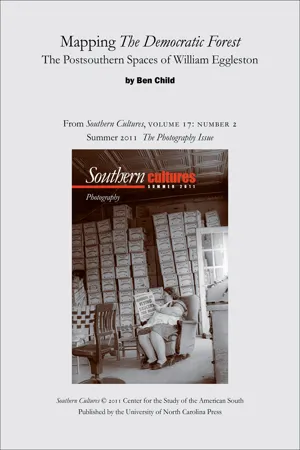
eBook - ePub
Mapping The Democratic Forest: The Postsouthern Spaces of William Eggleston
An article from Southern Cultures 17:2, The Photography Issue
- English
- ePUB (mobile friendly)
- Available on iOS & Android
eBook - ePub
Mapping The Democratic Forest: The Postsouthern Spaces of William Eggleston
An article from Southern Cultures 17:2, The Photography Issue
About this book
Eggleston, the iconoclastic and colorful groundbreaker, imbues the mundane with vibrancy.This article appears in the Summer 2011 issue of Southern Cultures:The Photography Issue. "When the color photographs of William Eggleston first appeared at the Museum of Modern Art in 1976, the boldness of Eggleston's palette and his disregard for the conventions of black-and-white photography were shocking; nearly all the major critics were scornful, and Ansel Adams wrote a scathing letter of protest."
Information
Subtopic
Art GeneralIndex
HistoryESSAY
Mapping The Democratic Forest
The Postsouthern Spaces of William Eggleston
“I’m taking pictures of life today.”
—William Eggleston
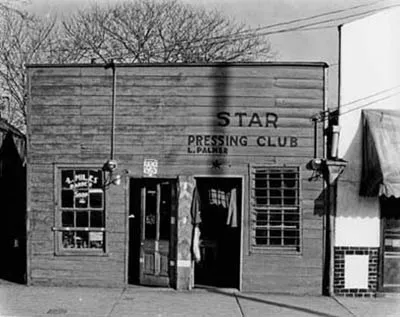
One influence William Eggleston’s photography acknowledges is Walker Evans’s, an artist whose work also searches out the everyday corners of his cultural milieu. Evans’s approach is marked by a “leveling of discriminations, between the beautiful and the ugly, the important and trivial.” Vicksburg, Mississippi, 1936, by Walker Evans, courtesy of the Collections of the Library of Congress.
When the color photographs of William Eggleston first appeared at the Museum of Modern Art in 1976, they had no clear antecedents. The boldness of Eggleston’s palette and his disregard for the conventions of black-and-white photography were shocking; nearly all the major critics were scornful, and Ansel Adams wrote a scathing letter of protest to curator John Szarkowski, baldly calling Eggleston a “put on.” Using a dye-transfer printing method primarily associated with advertising, Eggleston’s images draw out the deep, frequently striking tonal potentials of natural colors. But within the tradition of photography, as critic Peter Schjeldahl succinctly notes in his essay on Eggleston, “color befuddles”—and Eggleston’s colors certainly did. One influence Eggleston’s photography acknowledges, however, is Walker Evans, an artist whose work also searches out the everyday corners of his cultural milieu. Evans’s approach is marked by an expansive, Whitmanesque vision that Susan Sontag describes as a “leveling of discriminations, between the beautiful and the ugly, the important and trivial.” And yet, in On Photography, Sontag finds little use for Evans’s ambitions. Photography, she holds, is no longer required to be “literate, authoritative, transcendent,” as Evans hoped it might be, and his photos could never achieve the transcendence they aspire to in the contemporary world, where the most effective photographs feature a turn toward surrealism. This is because, Sontag explains, in matters of political action the documentary function of realist photography threatens to lull viewers into a state of voyeuristic observation, from which only the surreal can startle them into movement.1
With their penetrating ability to reveal something like the surreal in the most familiar of scenes and objects, Eggleston’s photographs seem to simultaneously embrace and to reject Sontag’s conclusion, and the images that compose Eggleston’s 1989 book The Democratic Forest are perhaps the best model for this principle. Unlike William Eggleston’s Guide (1976), human figures are rarely the focus of these photographs, and when humans are present, they appear as fixtures in or fragments of the larger landscape. It is spaces and places that bear the primary burden of compositional meaning in The Democratic Forest, as Eudora Welty’s incisive introduction affirms: “All the photographs have place as their subject.” This is not, however, a simple narrative about the comforts of home. It is about uncovering the disconcerting realities of the commonplace, as Welty further asserts: “What is there, however strange, can be accepted without question; familiarity will be what overwhelms us.”
Although the images are a clear product of their place and time, we are invited by that familiarity to read them more broadly, as reflections and predictions of the future of southern spaces at the end of the twentieth century. With that in mind, we recognize that these images offer a compelling visual manifestation of the “postsouthern” theorized by literary scholars such as Lewis Simpson, Michael Kreyling, and Martyn Bone. A term first coined and examined by Simpson in response to the work of Walker Percy—an artist who, like Eggleston, explores the emerging subdivisions and social orders of the New South—the postsouthern approach seeks to deconstruct ideas about the exclusivity of southern spaces and identities, a key characteristic of The Democratic Forest.
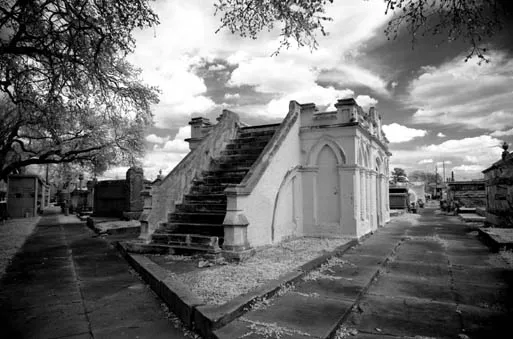
Photography, according to Susan Sontag, is no longer required to be “literate, authoritative, transcendent,” as Walker Evans hoped it might be, and...
Table of contents
- Cover Page
- Title Page
- Copyright Page
- ESSAY Mapping The Democratic Forest
Trusted by 375,005 students
Access to over 1.5 million titles for a fair monthly price.
Study more efficiently using our study tools.
Frequently asked questions
Yes, you can cancel anytime from the Subscription tab in your account settings on the Perlego website. Your subscription will stay active until the end of your current billing period. Learn how to cancel your subscription
No, books cannot be downloaded as external files, such as PDFs, for use outside of Perlego. However, you can download books within the Perlego app for offline reading on mobile or tablet. Learn how to download books offline
Perlego offers two plans: Essential and Complete
- Essential is ideal for learners and professionals who enjoy exploring a wide range of subjects. Access the Essential Library with 800,000+ trusted titles and best-sellers across business, personal growth, and the humanities. Includes unlimited reading time and Standard Read Aloud voice.
- Complete: Perfect for advanced learners and researchers needing full, unrestricted access. Unlock 1.5M+ books across hundreds of subjects, including academic and specialized titles. The Complete Plan also includes advanced features like Premium Read Aloud and Research Assistant.
We are an online textbook subscription service, where you can get access to an entire online library for less than the price of a single book per month. With over 1.5 million books across 990+ topics, we’ve got you covered! Learn about our mission
Look out for the read-aloud symbol on your next book to see if you can listen to it. The read-aloud tool reads text aloud for you, highlighting the text as it is being read. You can pause it, speed it up and slow it down. Learn more about Read Aloud
Yes! You can use the Perlego app on both iOS and Android devices to read anytime, anywhere — even offline. Perfect for commutes or when you’re on the go.
Please note we cannot support devices running on iOS 13 and Android 7 or earlier. Learn more about using the app
Please note we cannot support devices running on iOS 13 and Android 7 or earlier. Learn more about using the app
Yes, you can access Mapping The Democratic Forest: The Postsouthern Spaces of William Eggleston by Ben Child in PDF and/or ePUB format, as well as other popular books in History & Art General. We have over 1.5 million books available in our catalogue for you to explore.