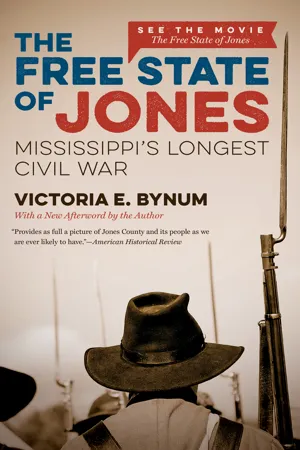
Between late 1863 and mid-1864, an armed band of Confederate deserters battled Confederate cavalry in the Piney Woods region of Jones County, Mississippi. Calling themselves the Knight Company after their captain, Newton Knight, they set up headquarters in the swamps of the Leaf River, where they declared their loyalty to the U.S. government.
The story of the Jones County rebellion is well known among Mississippians, and debate over whether the county actually seceded from the state during the war has smoldered for more than a century. Adding further controversy to the legend is the story of Newt Knight’s interracial romance with his wartime accomplice, Rachel, a slave. From their relationship there developed a mixed-race community that endured long after the Civil War had ended, and the ambiguous racial identity of their descendants confounded the rules of segregated Mississippi well into the twentieth century.
Victoria Bynum traces the origins and legacy of the Jones County uprising from the American Revolution to the modern civil rights movement. In bridging the gap between the legendary and the real Free State of Jones, she shows how the legend — what was told, what was embellished, and what was left out — reveals a great deal about the South’s transition from slavery to segregation; the racial, gender, and class politics of the period; and the contingent nature of history and memory.
In a new afterword, Bynum updates readers on recent scholarship, current issues of race and Southern heritage, and the coming movie that make this Civil War story essential reading.
The Free State of Jones film, starring Matthew McConaughey, Gugu Mbatha-Raw, and Keri Russell, will be released in May 2016.
- 352 pages
- English
- ePUB (mobile friendly)
- Available on iOS & Android
eBook - ePub
About this book
Trusted by 375,005 students
Access to over 1.5 million titles for a fair monthly price.
Study more efficiently using our study tools.
Part One: The Origins of Mississippi’s Piney Woods People
Chapter One: Jones County’s Carolina Connection
Class and Race in Revolutionary America
We can’t boast of our ancestors because, when we get started talking about our families, out jumps the ghost of a pirate or a cousin of color.—Sam Dabney, from James Street’s Tap Roots, 1943
[The Knights were of ] the old aristocracy, bringing in slaves and finery from an older civilization.—Ethel Knight, Echo of the Black Horn, 1951
Although South Carolina was the birthplace of most Jones County settlers, most of the parents of these settlers, especially those born before 1820, came from North Carolina. Swept by the forces of evangelical revivalism, the Regulator Movement, and the American Revolution, they participated in various “uncivil” wars, creating antiauthoritarian traditions among their descendants that later would support desertion of the Confederacy as well as secession from the Union. Thus the divisions that ripped apart families and neighborhoods in Civil War Jones County would be nothing new for the Welborns, Knights, Collinses, Sumralls, Bynums, Valentines, and Welches, who shared with one another a rich heritage of dissent and conflict.1
While it would be a mistake to attribute Southern dissenters’ political views and behavior to their ancestors’ experiences, that heritage did influence descendants’ future economic, geographic, and marital choices, which in turn influenced their Civil War behavior. So important, in fact, is the historical background of participants in the Free State of Jones that it, too, became contested terrain between novelist James Street and local historian Ethel Knight.
Street’s allusions to pirates and cousins of color in Tap Roots were part of his effort to link the origins of anti-Confederate sentiment in Piney Woods Mississippi to the ancestry of its participants. Interwoven within his tale of action and romance were the Revolution, the War of 1812, the settling of the frontier, and the historical evolution of relations of class and race from the perspective of his fictional characters. As an author of history as well as fiction, Street wanted readers to understand that the past weighed mightily on the Civil War generation.
To understand Street’s effort to connect the Free State of Jones to the Revolutionary era, however, one must read his earlier novel, Oh, Promised Land, published in 1940. The popularity of Tap Roots, reflected in Universal Studio’s release in 1948 of a movie by the same name, overshadowed his earlier novel in which he discussed not only race relations but also the class origins and political backgrounds of Piney Woods settlers. Using the Dabneys as a fictional composite of Jones County’s early Anglo settlers, Street placed them in frontier Georgia as former Tories, Indian fighters, and plain folk who eventually came to hate the institution of slavery.2
If Street had gone back one more generation, he likely would have added Revolutionary era Regulators and radical Baptist exhorters from North and South Carolina to his cast of characters. Between 1750 and 1815 in the Carolinas, plain folk participated in religious schisms, civil disorders, and battles with Indians over possession of lands. Political and economic conflict rocked both colonies, driving people from one frontier to another until finally they headed to the Southwest. Baptist Separates, Regulators, Tories, and especially, land-hungry farmers fled from North Carolina into Tennessee and Georgia, but particularly over the border into South Carolina’s districts of Camden, Orangeburgh, and Ninety Six. In 1766 tensions over taxes and lands culminated in North Carolina when farmers organized the Regulator Movement to overturn corrupt local governments dominated by elite planters, merchants, and lawyers. Regulators struggled to maintain their status as independent producers who enjoyed a “competency” based on both self-sufficiency and commercial exchange.3
Among these families were many ancestors of Jones County settlers who later shared a historical predisposition to view the Civil War as a “rich man’s war and a poor man’s fight.” Still, traditions of civil disaffection among the Southern yeomanry did not in and of themselves cause later generations to oppose the Confederacy. Indeed, in Jones County as elsewhere, many white Southerners believed that rebellion against the Union was the ultimate act of principled civil disobedience against greedy tyrants. The local context in which a family encountered Confederate authority greatly influenced whether that family would be anti- or pro-Confederate, and branches of the same families frequently adopted opposite stances.4
Ethel Knight, raised to revere the American Revolution and slavery, as well as the supremacy of the white race, could not abide such a history for her ancestors. She assured her readers that although many early white migrants to Jones County were “without lands or money,” or “simply adventurers and vagabonds,” the founding families, including the Knights, were part of “the old aristocracy, bringing in slaves and finery from an older civilization.” Historical records, however, do not bear out such aristocratic claims. As Street recognized, the ancestors of Jones County families were mostly plain folk who migrated to Mississippi Territory in search of elusive prosperity.5
In 1951, however, Street’s images of racially mixed ancestors disturbed Ethel Knight more than his class-conscious characters and drove her to write Echo of the Black Horn. Street’s creation of the Tap Roots character Kyd Fermat Dabney, a Cajun orphan adopted by Hoab and Shellie Dabney who secretly possessed “Moorish blood,” seemed particularly to disturb Ethel. Although Kyd was not by birth a Dabney, Street’s description of her as an orphan suggested that she might be modeled after Mason Rainey Knight, Newt Knight’s mother and Ethel’s direct ancestor.6
The mysterious tales about Mason Knight, who was reputed to have been the “ward” of Jackie Knight before she married his son Albert, were tailor-made for Street’s novel of adventure and scandal, and he may indeed have built on legends about her to create Kyd. In 1935 Tom Knight described his grandmother as an orphan whose surname was actually Griffin, not Rainey. He further explained that she was raised by Jackie and Keziah Knight alongside their own children. Around the same time, Martha Wheeler, a former Knight family slave, told Works Projects Administration (WPA) writer Addie West that “she had always been told” that Mason Rainey had “attached herself” to the Knights in Asheville, North Carolina, after her own people died of the flux. Strikingly similar to Wheeler’s story was Street’s description of how a yellow-fever epidemic killed the parents of Kyd Fermat, causing her to turn to the Dabneys for sustenance.7
Kyd Dabney’s resemblance to Mason Rainey disturbed some Knights because of her mixed-blood ancestry. “Those black eyes of Kyd’s,” mused Kyd’s adoptive father, Sam Dabney, “ay they glow like bits of polished ebony in a tiny spoon of milk. And those full lips. And her happy nature. She’s too unrestrained to be all white.” Ethel Knight thus widened the distance between Street’s fictional Kyd and her great-great-grandmother by expanding on Tom Knight’s and Martha Wheeler’s tales. She insisted that Mason Rainey’s true name was Rebecca Griffith and that she and her brother were orphaned by their wealthy parents’ death from the “bloody flux” during their move west. Shortly thereafter, she claimed, a group of Masons rescued the orphaned children and found a new home for the girl among the Knights. Ethel claimed that the Masons showed up on the Knights’ doorstep on a rainy night—hence, the Knights renamed her Mason Rainey.8
To further counter any suggestion that Mason, like Kyd Dabney, might have had “black blood,” Ethel described her as a “strange and beautiful” “Spanish-type lady.” Since it was important to Ethel in 1951 that Mason’s body contain not a drop of African blood, she explained her apparent lack of ivory skin and aquiline features by endowing her with an exotic (but European) ancestry. Because of Tap Roots and Davis Knight’s trial, the racial identity of all Jones County Knights was openly in question at that time, and Ethel placed the blame for that squarely on the shoulders of James Street and Newt Knight.9
Although Ethel Knight’s racial attitudes conformed to those exhibited by many white Southerners of her generation, these sentiments had evolved over a period of three centuries. By the 1840s, claims of Indian, Iberian, or Mediterranean ancestry defended one’s whiteness against race-based laws and social harassment. But before the nineteenth century—and especially before slavery became firmly entrenched in the Carolina and Georgia back-countries—racial identity was more fluid, even negotiable in some cases. Nothing better exemplified its uncertain meaning in the era of the American Revolution than the prominent role played by Gideon Gibson, a light-skinned slaveholder of partially African ancestry, in South Carolina’s Regulator Movement. As enforcement of race laws hardened, mixed people, including many of Gideon Gibson’s descendants, migrated west in search of whiteness as well as fresh lands.10
During North America’s colonial period, the yeoman ancestors of Jones County settlers lived in a patriarchal world bounded by lines of gender, class, and increasingly, race. The decision by colonial planters—the overwhelming majority of whom were white men—to abandon bound labor in favor of chattel slavery hastened their disproportionate control over land and wealth. In this world of expanding agricultural commerce and slavery, ordinary men understood that attaining economic success and individual honor depended on their ability to gain and cultivate land through the violent dispossession of Indians and ownership of African slaves.11
The rise of white men in the expansive colonial economy in turn gave rise to a racialized class structure. Even though slaveowners comprised only a minority of North Carolina’s white population, their replacement of white servants with black slaves nonetheless sent the message to ordinary white men and women that servitude was uncomfortably close to slavery. As whiteness became the essential basis for freedom, white women became the crucial vessels of racial purity; black men, its despoilers. The policing of white women’s and black men’s sexual behavior revealed most strikingly the need for discrete categories of race in a society under-girded by the labor of enslaved Africans. Black women were designated as bearers of racially “polluted” offspring—whether fathered by black or white men—while notions of racial and sexual purity converged in the “chaste” white woman. Legally and socially, white women who crossed the color line entered a racialized realm of whoredom. As whites increasingly associated unbridled carnality, lust, and “nasty” sexual impulses with Africans, the term “wench” became almost synonymous with a female slave. At the same time, blame for the mixing of the races was placed squarely on the shoulders of white women, the designated repositories of chastity and racial purity, for their lewd “polluting” of white bloodlines.12
Male honor also became wedded to whiteness in this structure. A white man’s success as patriarch depended not only on his owning land and mastering a household but on conquering “savage” Indians or owning “barbarian” Africans. Nevertheless, the bifurcation of racial identity into discrete categories of black and white was a long and ultimately illusory process. People of mixed racial ancestry were legally restrained and socially ostracized, but they could not be erased. Whether labeled Mulattoes, Mustees, Melungeons, Creoles, Cajuns, or the like, the mixing of peoples in early America was a visible fact.13
Despite increasingly close connections between racial and class identity in Revolutionary America, lower and middling white men continued to resent powerful white men, and an interracial subculture continued to flourish underground. Even slaveholders clandestinely participated in activities that regularly occurred among slaves and free blacks, often in wooded areas outside mainstream society. Sexual relationships, illicit trade, feasts, and religious celebrations flourished in what Rhys Isaac has termed an “alternative territorial system.” Although whites moved in and out of this world, they asserted the prerogatives of whiteness when it served their interests to do so.14
In a world that increasingly linked white male honor to the ownership of African Americans, white men who openly shared their hearths and homes with blacks beyond the use of their labor were considered dishonorable. So embedded became the construction of whiteness as a marker of both racial and class supremacy that, one hundred years later, few whites questioned that Newton Knight and his children’s interracial relationships were the result of degraded, “unnatural” impulses.15 Interracial mixing had not abated; it had merely moved underground. Had Newt and his children treated their proscribed relationships as shameful liaisons to be kept secret, they would have posed little threat to society. Instead, Newt welcomed Rachel Knight and her children into the fold of his own family, thereby severing masculine honor from the prerogatives (and responsibilities) of whiteness, an act more shocking to his neighbors than his rebellion against the Confederacy.16
To help drive home her contention that Newt was an aberrant, deviant member of an otherwise distinguished family, Ethel Knight emphasized that his grandfather Jackie Knight was the son of a Revolutionary soldier and one of Jones County’s largest slaveholders. While it is true that Jackie Knight owned twenty-two slaves by 1850, he did not begin adult life as a large slaveholder, nor could Ethel prove that he, her great-great-grandfather, was the son of a Revolutionary patriot soldier. And like most of his Piney Woods cohorts, Jackie Knight was descended from North Carolinians who grew up amid profound political, economic, and religious struggles that ...
Table of contents
- Cover Page
- The Free State of Jones: Mississippi’s Longest Civil War
- Copyright Page
- Dedication
- Contents
- Illustrations, Maps, and Tables
- Acknowledgments
- Timeline: The Free State of Jones
- Preface
- Introduction. Sacred Wars: Race and the Ongoing Battle over the Free State of Jones
- Part One: The Origins of Mississippi’s Piney Woods People
- Part Two: Civil War, Reconstruction, and the Struggle for Power
- Bibliography
- Index
Frequently asked questions
Yes, you can cancel anytime from the Subscription tab in your account settings on the Perlego website. Your subscription will stay active until the end of your current billing period. Learn how to cancel your subscription
No, books cannot be downloaded as external files, such as PDFs, for use outside of Perlego. However, you can download books within the Perlego app for offline reading on mobile or tablet. Learn how to download books offline
Perlego offers two plans: Essential and Complete
- Essential is ideal for learners and professionals who enjoy exploring a wide range of subjects. Access the Essential Library with 800,000+ trusted titles and best-sellers across business, personal growth, and the humanities. Includes unlimited reading time and Standard Read Aloud voice.
- Complete: Perfect for advanced learners and researchers needing full, unrestricted access. Unlock 1.5M+ books across hundreds of subjects, including academic and specialized titles. The Complete Plan also includes advanced features like Premium Read Aloud and Research Assistant.
We are an online textbook subscription service, where you can get access to an entire online library for less than the price of a single book per month. With over 1.5 million books across 990+ topics, we’ve got you covered! Learn about our mission
Look out for the read-aloud symbol on your next book to see if you can listen to it. The read-aloud tool reads text aloud for you, highlighting the text as it is being read. You can pause it, speed it up and slow it down. Learn more about Read Aloud
Yes! You can use the Perlego app on both iOS and Android devices to read anytime, anywhere — even offline. Perfect for commutes or when you’re on the go.
Please note we cannot support devices running on iOS 13 and Android 7 or earlier. Learn more about using the app
Please note we cannot support devices running on iOS 13 and Android 7 or earlier. Learn more about using the app
Yes, you can access The Free State of Jones, Movie Edition by Victoria E. Bynum in PDF and/or ePUB format, as well as other popular books in History & American Civil War History. We have over 1.5 million books available in our catalogue for you to explore.