The Clinton administration’s failed health care reform was not the first attempt to establish government-sponsored medical coverage in the United States. From 1915 to 1920, Progressive reformers led a spirited but ultimately unsuccessful crusade for compulsory health insurance in New York State. Beatrix Hoffman argues that this first health insurance campaign was a crucial moment in the creation of the American welfare state and health care system. Its defeat, she says, gave rise to an uneven and inegalitarian system of medical coverage and helped shape the limits of American social policy for the rest of the century.
Hoffman examines each of the major combatants in the battle over compulsory health insurance. While physicians, employers, the insurance industry, and conservative politicians forged a uniquely powerful coalition in opposition to health insurance proposals, she shows, reformers' potential allies within women’s organizations and the labor movement were bitterly divided. Against the backdrop of World War I and the Red Scare, opponents of reform denounced government-sponsored health insurance as “un-American” and, in the process, helped fashion a political culture that resists proposals for universal health care and a comprehensive welfare state even today.
eBook - ePub
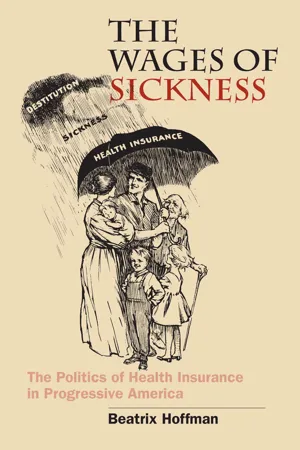
The Wages of Sickness
The Politics of Health Insurance in Progressive America
- 280 pages
- English
- ePUB (mobile friendly)
- Available on iOS & Android
eBook - ePub
About this book
Trusted by 375,005 students
Access to over 1.5 million titles for a fair monthly price.
Study more efficiently using our study tools.
Information
Topic
MedicineSubtopic
North American History1 Patchwork Protection
THE SPECTER OF SICKNESS AND POVERTY
Ever since arriving in New York from Germany in 1882, Emil Bollhausen had followed his trade as a cabinetmaker. The skills he learned from his father in Berlin led to steady employment in New York City’s furniture industry. Bollhausen married and had a son; with his wife’s work as a janitress, the small family earned enough to survive. But in 1915, at the age of fifty-four, Bollhausen was doing fine handwork for an antiques dealer when he was stricken with pleurisy, pneumonia, and heart trouble. When he stopped work to enter the hospital, most of the family’s income stopped as well. His son was tubercular and unable to work, and the family was forced to turn to the Charity Organization Society for help. A charity report described the Bollhausen family’s rapid decline: “[H]ospital treatment, then a few day’s work, illness again, no money to pay the doctor, the use of patent medicines suggested by neighbors, the hospital again with some improvement followed by four weeks in the country ... work again too hard for him, another illness, dispensary treatment ... eight months of sickness and treatment and still unable to undertake regular work.”1
The story of the Bollhausen family was just one of hundreds of cases cited in a 1917 study of illness among New York City wage earners. The report, sponsored by the Russell Sage Foundation, surveyed 690 families on relief and found that sickness was a major factor leading to charity dependence for 452 of them.2 These findings corroborated the experience of John Kingsbury, director of one of the largest New York City charities. In 1918 Kingsbury declared that the connection between ill health and economic dependence was “so direct and obvious to anyone who is in [charity] work that I have repeatedly said that good relief work tends more and more to be health work.”3
The reformers who drafted the New York health insurance proposal drew on evidence like the Russell Sage study to argue that the poverty and insecurity endemic among American workers were, to a great extent, the result of ill health. Since few employers offered sick pay, even a short illness could mean a devastating loss of income for a worker’s family. In 1916, the U.S. Public Health Service estimated that each of the country’s thirty million workers missed an average of nine days of work a year because of sickness, costing them over eight million dollars in lost wages.4 Few workers could amass enough savings to tide themselves over in an emergency. One result of this was “the common custom of ‘passing the hat’ around the shop for the benefit of some sick worker”; one working woman told reformers that a collection was taken “practically every week, in her factory” in aid of fellow workers whose income had been cut off in time of illness.5

“‘The Three Fears.’ The Greatest of These Will Be Banished by Universal Health Insurance” (American Labor Legislation Review [1919]; photograph courtesy of The University Library, University of Illinois at Chicago).
Forty-two states passed workmen’s compensation laws between 1911 and 1920, so at least some wage earners could receive compensation for injuries received on the job.6 Disease and sickness, however, even if directly caused by working conditions, were not covered by workmen’s compensation. And many of the illnesses common among workers were indeed related to their jobs. Miners, stonecutters, and textile workers suffered from high rates of respiratory illness, especially tuberculosis.7 A doctor in New York City, asked in 1916 about the most frequent ailments among the working populations he treated, said that hemorrhoids and chronic constipation were common among factory operatives, and that fur workers, cap makers, bakers, and hairdressers tended to suffer from tuberculosis, bronchitis, and asthma. The most prevalent illness he found among all workers was duodenal ulcer. Reformers attributed many such medical conditions not only to specific workplace hazards but also to the long hours that left workers exhausted and unable to fight disease.8
The stress and exhaustion of work could also lead to health problems after hours. Laborers had no time or desire to exercise or seek fresh air. A doctor who studied ailing clinic patients in New York City “found many men who had begun work when only nine or ten years old. They had no experience in recreation as we understand it.” Often relaxation was found only in drink, and alcoholism ravaged bodies as well as families and communities.9 Poor nutrition, overcrowding, inadequate sanitation, and lack of preventative health services and education added to the medical problems of the poorest city dwellers. Crowded tenement housing was a notorious breeding ground for tuberculosis and other respiratory ailments. Residents of Columbus Hill, an impoverished “colored” neighborhood in New York City, suffered from high incidences of nutritional disorders like rickets, as well as syphilis and bronchitis.10
Infant and maternal mortality, a significant threat for all classes, was devastating among populations with a large number of working mothers. African American women, especially, found themselves forced by economic necessity to work as long as possible during pregnancy and then to return to work quickly after childbirth, a practice that researchers said contributed to the shockingly high infant mortality rate in poor black neighborhoods.11
Wage workers feared illness doubly because it was inevitably accompanied by a loss of income. A bout with influenza or pneumonia led to both physical suffering and serious financial difficulties. Whether for skilled male workers earning twenty dollars a week or for women pieceworkers making only five, stopping work meant stopping wages. And lost income made it difficult to pay not only for life’s basic necessities but for doctor bills as well. Lack of medical care commonly led to the vicious cycle of worsening health and continuing inability to return to work. It was this cycle that compulsory health insurance intended to break.
While reformers worked to find an overarching solution to these problems, a minority of American workers used a variety of methods that promised to protect them from sickness and economic insecurity. Progressive America had a patchwork of protection, ranging from free dispensaries, to immigrant fraternal societies, to private insurance policies. The existence of this “system” served both sides in the health insurance battle. Opponents of compulsory health insurance argued that private protective institutions adequately supported sick workers. They also believed that voluntary protection was a virtue in itself, and far preferable to the government interference that compulsory health insurance would require. But defenders of compulsory health insurance insisted that the patchwork system was a dismal failure at meeting the economic and medical needs of the populace. All types of existing protection, from voluntary insurance to factory health clinics, had significant restrictions and drawbacks for their users. Most important, the majority of Americans had no access at all to these limited benefits.
MUTUAL AID AND SELF-HELP: FRATERNAL SOCIETIES
Fraternal societies—voluntary groups organized by religion, ethnicity, or similar affiliation —were the most common providers of insurance and relief before the New Deal. According to historian David Beito, “literally thousands” of these societies, also known as lodges, “dotted the American landscape” between 1900 and 1930. Low-income workers were far more likely to receive benefits from a fraternal order than from other charity or welfare institutions.12 At the time of the health insurance battle, about 30 percent of workers obtained some coverage by fraternal methods in the large industrial states of California, Illinois, Ohio, and Pennsylvania. The number of workers covered in New York was probably smaller.13
In addition to providing benefits, native white fraternal societies such as the Freemasons and Odd Fellows were known for their elaborate secret rituals and their valorization of “brotherhood” and masculinity.14 The very concept of fraternalism was based in exclusion. However, this type of exclusion could be practiced not just by prosperous white males but also by middle-class blacks, Jewish immigrants, and women workers. African Americans and women forbidden to join the large mainstream fraternals formed their own, separate branches, while smaller societies proliferated among ethnic and working-class groups in the nation’s cities. For example, there were large, all-black branches of the Knights of Pythias and the Order of Odd Fellows. These black fraternals, Beito points out, “owed [their] origin[s] to the exclusionary racial restrictions of the parallel white organization.”15
Fraternalism, as the name implies, was primarily a male endeavor. Of the 690 charity applicants interviewed by Russell Sage researchers in 1917, 124 men and only 3 women belonged to some type of benefit society.16 Those fraternal organizations that admitted women members at all, according to the Russell Sage study, “allowed only those who were wives and widows of members to join ... [and] these women were not even admitted on the same basis as men. The women for the most part were eligible only for the death and burial benefits.”17 In addition to upholding their purpose as havens of masculine solidarity, fraternals were wary of signing up women members because of their higher sickness rates.
Even those few societies that paid sickness benefits to women refused to cover conditions identified as “female problems,” including pregnancy and childbirth. When David Jacobs applied to join the Jewish Progress Mutual Aid Society, which normally provided benefits to the wives of its members, he was required to sign a special agreement: the society admitted Jacobs to membership but “as a single man, merely deriving benefits for myself. This agreement is made, due to my wife being in a pregnant condition.... I will not hold the PMAS responsible for any benefits occurring under the laws of the Society for my wife Rose Jacobs.”18
As with African Americans, this discrimination led women to start their own lodges. Most were branches of existing male orders. The Women’s Benefit Association of the Maccabees, an affiliate of the Knights of the Maccabee, had over 231,000 members in 1920. The women Maccabees were one of the few fraternal societies that offered maternity benefits.19 The all-white Independent Order of Odd Fellows had women’s branches that were known as Rebekah Lodges; the Sojourna Household of Ruth was an all-female adjunct to the black Grand United Order of Odd Fellows. (It should be pointed out, however, that many African American fraternals included members of both sexes.20)
Despite their diversity, most fraternal and mutual aid societies had a great deal in common that made them a useful source of protection for some Americans but entirely inaccessible to others. All fraternals, including the black and women’s associations, had stringent requirements for membership. For example, most societies had age limits and charged higher rates to older members since they were more likely to use sickness or death benefits. The most common rule was that no one over forty-five years of age was eligible for membership in a fraternal.21
Voluntary societies offering benefits required a medical examination for membership in order to exclude those in poor health.22 Those who passed the examination were then required to pay an initiation fee of one or two dollars, followed by monthly dues payments. Fraternal dues averaged ten dollars a year, with some societies charging as little as two dollars and some as much as twenty-two annually.23 In return, members received a modest cash benefit when they could not work because of illness. In New York City, payments to beneficiaries of fraternal sickness funds averaged five dollars a week. Brief illnesses were not covered; most societies would pay benefits only for sickness lasting at least one week. And there were maximum as well as minimum limits placed on benefits. A typical example is the Sojourna Household in New York City, which in 1914 made payments of four dollars a week for the first six weeks of a member’s illness, dropping to two dollars for the next six weeks and nothing thereafter.24 These restrictions meant that most fraternal insurance did not cover long-term disability.
While benefits tended to be meager, the fraternal missi...
Table of contents
- Cover Page
- The Wages of Sickness
- Copyright Page
- Contents
- Illustrations
- Preface
- Acknowledgments
- Abbreviations
- Introduction
- 1 Patchwork Protection
- 2 Crafting a Solution to the Sickness Problem
- 3 A Dose of Prussianism
- 4 The Worst Insult to the Greatest Profession
- 5 Moneyed Interests
- 6 The House of Labor Divided
- 7 Insuring Maternity
- 8 The Politics of Defeat
- Epilogue
- Notes
- Bibliography
- Index
- Series
Frequently asked questions
Yes, you can cancel anytime from the Subscription tab in your account settings on the Perlego website. Your subscription will stay active until the end of your current billing period. Learn how to cancel your subscription
No, books cannot be downloaded as external files, such as PDFs, for use outside of Perlego. However, you can download books within the Perlego app for offline reading on mobile or tablet. Learn how to download books offline
Perlego offers two plans: Essential and Complete
- Essential is ideal for learners and professionals who enjoy exploring a wide range of subjects. Access the Essential Library with 800,000+ trusted titles and best-sellers across business, personal growth, and the humanities. Includes unlimited reading time and Standard Read Aloud voice.
- Complete: Perfect for advanced learners and researchers needing full, unrestricted access. Unlock 1.5M+ books across hundreds of subjects, including academic and specialized titles. The Complete Plan also includes advanced features like Premium Read Aloud and Research Assistant.
We are an online textbook subscription service, where you can get access to an entire online library for less than the price of a single book per month. With over 1.5 million books across 990+ topics, we’ve got you covered! Learn about our mission
Look out for the read-aloud symbol on your next book to see if you can listen to it. The read-aloud tool reads text aloud for you, highlighting the text as it is being read. You can pause it, speed it up and slow it down. Learn more about Read Aloud
Yes! You can use the Perlego app on both iOS and Android devices to read anytime, anywhere — even offline. Perfect for commutes or when you’re on the go.
Please note we cannot support devices running on iOS 13 and Android 7 or earlier. Learn more about using the app
Please note we cannot support devices running on iOS 13 and Android 7 or earlier. Learn more about using the app
Yes, you can access The Wages of Sickness by Beatrix Hoffman in PDF and/or ePUB format, as well as other popular books in Medicine & North American History. We have over 1.5 million books available in our catalogue for you to explore.